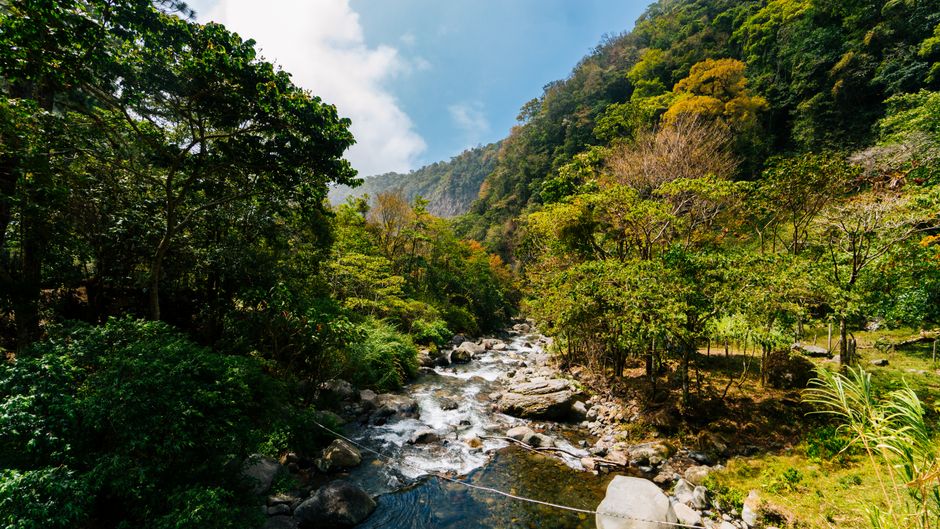
Boquete is a green mountain valley in Panama’s western province of Chiriquí, at the foot of Volcán Barú, the country’s highest peak. With temperatures of about 12 to 30 °C (53 to 86 °F), according to Panama’s tourism authority (ATP), it is one of the coolest places in Panama, and its volcanic soils, altitude and misty microclimate grow some of the most prized coffee in the world, including the famous Geisha variety. Visitors come to tour coffee farms, hike cloud-forest trails to waterfalls and lookouts, search for the resplendent quetzal, climb Barú at night to watch the sunrise over two oceans, raft the Chiriquí Viejo River and soak in hot springs. The town itself, Bajo Boquete, is small, walkable and friendly, with hotels, cafés, breweries and tour operators along the Caldera River, and a large community of foreign retirees.
Right now in Boquete
- Tue 18–23°C 64–74°F 17 mm Heavy rain
- Wed 18–25°C 64–77°F 17 mm Heavy rain
- Thu 18–25°C 64–76°F 21 mm Heavy rain
Weather: MET Norway (CC BY 4.0)
Top tours in Boquete
See all tours for Boquete →
From local operators, with prices and reviews; you check availability and book on Viator, our partner. We may earn a commission at no extra cost to you. How we earn money
Boquete at a glance
- Best for: coffee tours, hiking and volcano climbs, birdwatching, waterfalls, rafting and a cool mountain break from the coast.
- How long: three days for a coffee tour, a waterfall trail and a birding walk; four or five to add Volcán Barú and rafting.
- Best time: December to April, the dry season, which is windy with drizzle; late February to April is best for quetzals, according to the ATP.
- Getting there: fly from Panama City to David and drive about 50 minutes, or take a bus to David (about six hours) and a local bus or taxi.
- Before you go: entry rules, money and safety basics are in our Panama travel guide.
Boquete’s areas: where things are
According to the ATP, Bajo Boquete, the district capital, sits in the middle of the valley, crossed by the Caldera River, with hotels, cabins and hostels, tour operators, restaurants and breweries. To the north, Los Naranjos is the coffee-farm area, with forests that lead into Barú Volcano National Park and La Amistad International Park. To the east, Jaramillo has viewpoints, small farms and farm-to-table restaurants. Roads climb to about 2,000 m (6,560 ft) at the top of the valley, where it is noticeably colder.
Top things to see and do in Boquete
Coffee farm tours
According to the ATP, Boquete’s coffee grows at 1,000 to 2,100 m (3,280 to 6,900 ft) in fertile volcanic soil with a stable microclimate. Its most famous variety is Geisha, whose thin leaves and roots make it hard to grow in volume, and which sells for record prices at auction. Boquete has the widest choice of farm tours in the country, from the region’s oldest estate to small family farms focused on sustainability and bird-friendly growing, and the ATP’s “Coffee Circuit” groups them for planning. From December to March you arrive in the harvest, with red cherries on the plants and pickers at work; at other times, tours focus on roasting, grinding and tasting. Book a tour with a tasting (cupping) to compare varieties.
Volcán Barú
Panama’s highest point, at 3,474 m (11,398 ft), according to the ATP, is a volcano with seven craters inside Barú Volcano National Park, which protects more than 141 km² (54 sq miles) and over 400 species, from rainforest to cloud and dwarf forest and high-altitude grassland. On a clear morning you can see both the Pacific and the Caribbean from the summit. There are two routes:
- The Boquete route: a rough road that climbs from the edge of Boquete to the summit; it is the less steep option, and the summit can be reached in as little as six hours on foot, according to the ATP. Many hikers start around midnight to reach the top for sunrise. Specially modified 4×4 vehicles also run tours up this road.
- The Los Llanos route: from the town of Volcán on the western side, rated difficult and taking up to about eight hours, through savanna, moist forest and moss forest to the rocky summit.
It is cold at the top, near freezing before dawn, and the air is thin. The national park is managed by Panama’s Ministry of Environment, which charges an entry fee at the ranger stations. Go with a guide: according to the UK government, trails in the Chiriquí hills may be poorly marked, mobile coverage is unreliable, and tourists have gone missing and died hiking without one.
Trails and waterfalls
According to the ATP, Boquete’s trails suit every level:
- Los Quetzales Trail: through primary cloud forest between Boquete and the Cerro Punta side of Barú, the best-known place to look for quetzals and three-wattled bellbirds.
- Pipeline Trail (Camino del Pipeline): a jungle walk beside a river in Los Naranjos to an impressive waterfall, also known for birds.
- Las Tres Cascadas: a trail past three waterfalls, which you can walk or partly drive to.
- El Pianista and La Piedra de Lino: climbs from the valley floor into the clouds, gentle and steep respectively.
- Culebra, Piedra de la India Vieja and Piedra del Musgo: trails for orchids, rock viewpoints and changing landscapes from farmland to forest.
- Jä Gwätä ñöi waterfall: a 10- to 15-minute walk for families, to a lagoon with an 8 m (26 ft) cliff jump.
Some trails cross private land and charge a small fee; carry cash and start early, before the afternoon clouds. See our hiking guide.
Birdwatching
According to the ATP, the protected areas around Boquete are home to more than 300 bird species. The resplendent quetzal is easiest to see from late February to April, its breeding season, and September to November brings huge numbers of migrants from North America. Highland specialties include the collared whitestart, sulphur-winged parakeet, volcano junco and volcano hummingbird on Barú’s slopes, and the three-wattled bellbird on the Quetzal Trail. Hire a local birding guide for the best results.
Other things to do in Boquete
- Rafting and kayaking: rapids of all levels on the Chiriquí Viejo River, according to the ATP, and gentler trips on other rivers; the season and the classes depend on water levels.
- Climbing and rappelling: the basalt columns of Los Ladrillos are a natural climbing wall.
- Hot springs: the natural thermal pools at Caldera, about an hour away, by a river.
- Hanging bridges and zip lines: canopy tours in the forests above town.
- Food and markets: farm-to-table restaurants in Jaramillo, local breweries, and the Sunday market, plus Boquete’s Flower and Coffee Fair in January.
Food and drink in Boquete
Boquete is the best place in Panama to drink coffee, and its food scene is unusually varied for a mountain town. Start with the coffee itself: Boquete’s highland farms are famous for Geisha, a floral, tea-like variety that has sold for record prices at specialty auctions, and cafés in Bajo Boquete serve it by the cup, as pour-over or espresso, next to more affordable local blends. Many farms sell roasted beans after their tours, and a few cafés offer tasting flights so you can compare varieties and processing methods.
For local food, fondas near the main square serve Panamanian plates of rice, beans, stewed chicken or beef, fried plantain and sancocho, the national chicken soup with culantro and yam, ideal on a cool evening. Breakfast might be hojaldras (fried dough) or tortillas de maíz with fresh cheese. Chiriquí is Panama’s market garden, so vegetables, strawberries and fresh fruit are excellent, especially from the valley’s farm stands and the Sunday market. A large community of foreign residents has added bakeries, craft breweries, wine bars and Italian, Thai, Peruvian and German restaurants. Most kitchens close by 9 p.m., and nightlife is mostly a pint at a brewery or live music at weekends.
Day trips and next stops
- Tierras Altas (Volcán and Cerro Punta): farm towns and flower fields on the western side of Barú, about two hours away by car, according to the ATP, with the trailhead of the Quetzal Trail and access to La Amistad International Park.
- The Gulf of Chiriquí: Pacific islands, snorkeling and whale watching from about July to October, around two hours away via David.
- David: Chiriquí’s busy, hot capital, about 50 minutes down the mountain, with the airport, the bus terminal, big supermarkets, banks and malls; most travelers pass through rather than stay.
- Playa Las Lajas: a long, wide Pacific beach of gray sand with gentle waves, about an hour and a half east of David, popular with Panamanian families at weekends; it is a good warm contrast to the cool highlands.
- Bocas del Toro: about three and a half hours by road to the port of Almirante, then a water taxi; see our Bocas del Toro travel guide.
Nearby destinations
- Bocas del Toro65 km
- Puerto Viejo de Talamanca104 km
- Manuel Antonio National Park198 km
- Tortuguero National Park217 km
- San José222 km
Getting there and getting around
According to the ATP, the fastest way from Panama City is to fly to David, the capital of Chiriquí, from Tocumen or Albrook airport, then drive or take a taxi for about 50 minutes to Boquete; Air Panama flies from Albrook. By road, take the Pan-American Highway to David, about six hours, and then about an hour more to Boquete; buses from the Gran Terminal de Albrook reach David in about six hours, where you change to a local bus to Boquete, which runs frequently from the David terminal. Shuttles link Boquete with Bocas del Toro and with Costa Rica via the Paso Canoas border, about an hour from David.
In Boquete, the center is walkable, and taxis are cheap; local minibuses run up the valley roads to Los Naranjos and Jaramillo. Most tours include pick-up. A rental car helps for Tierras Altas and the Pacific coast, but drive carefully on narrow, winding mountain roads and avoid night driving.
When to go and how long to stay
Panama’s Institute of Meteorology and Hydrology (IMHPA) notes that Chiriquí’s mountains, the highest in the country, have their own microclimates. Panama’s dry season normally runs from December 16 to May 15, and in Boquete it coincides with northeast trade winds that blow from December to April, bringing sunny days, strong gusts and a fine, misty drizzle (“bajareque”) that creates frequent rainbows over the valley. The rainy season, from mid-May to mid-December, brings afternoon storms; October is usually the wettest month in Panama. For 2026, the IMHPA forecasts near- or above-normal rain in the Chiriquí highlands in October and November, while most of the country is drier than normal.
| Months | What it’s like | Good for |
|---|---|---|
| December–February | Dry, windy and sunny with misty drizzle; cool nights | Coffee harvest, hiking, Barú summit views; Flower and Coffee Fair in January |
| March–April | The driest, calmest weeks | Quetzals (late February to April), Barú, birding |
| May–August | Rainy afternoons, green valleys | Waterfalls, rafting, lower prices |
| September–November | The wettest months; muddy trails | Bird migration (September to November), coffee tastings |
The ATP gives Boquete’s temperatures as about 12 to 30 °C (53 to 86 °F). There is no official climate normal for Boquete in the WMO dataset we use, so the month descriptions are general.
Boquete month by month
| Month | Weather | Crowds and prices | Why go |
|---|---|---|---|
| January | Dry, windy and sunny; misty drizzle and rainbows | Busy during the Flower and Coffee Fair | Coffee harvest, the fair, Barú summit views |
| February | Dry and windy; cool nights | High season; Carnival brings domestic visitors | Coffee harvest, hiking; quetzals from late February |
| March | The driest, calmest weeks | High season | Quetzals, Barú, birding |
| April | Dry, warming up; first showers late in the month | Busy in Holy Week | Quetzals, clear hikes |
| May | Rainy season begins in mid-month | Quieter; lower rates | Green valley, waterfalls |
| June | Afternoon storms | Quiet | Waterfalls, rafting |
| July | Rainy afternoons, sunny mornings | Moderate | Rafting, hikes in the morning |
| August | Rainy afternoons | Moderate | Rivers in good flow |
| September | Wet; muddy trails | Quiet | Bird migration begins |
| October | One of the wettest months | Very quiet | Coffee tastings, migrant birds |
| November | Very wet, easing late in the month | Quiet; national holidays bring Panamanian visitors | Bird migration; harvest starts on lower farms |
| December | Dry season returns mid-month; windy | Busy at Christmas | Coffee harvest, holidays |
3 days in Boquete
Day one, a coffee farm tour with a tasting and an evening in town. Day two, an early birding walk on the Pipeline Trail and a waterfall hike in the afternoon. Day three, rafting on the Chiriquí Viejo or the Caldera hot springs.
4 to 5 days
Add the Volcán Barú night hike or 4×4 tour for sunrise, with a rest day after, and the Quetzal Trail or a day in Tierras Altas, before continuing to Bocas del Toro or the Gulf of Chiriquí.
Where to stay in Boquete and the hotel taxes
- Bajo Boquete: hostels, guesthouses and small hotels within walking distance of restaurants and tour pick-ups.
- Los Naranjos and Palo Alto: lodges and cabins on coffee farms and by the forest, quieter and cooler, good for birders.
- Jaramillo and Alto Boquete: boutique inns with valley views and farm-to-table dining.
Panama taxes lodging at 10% ITBMS, compared with the standard 7%, according to the tax authority (DGI). Check whether quotes include it. Few rooms have air conditioning, which isn’t needed; ask about heating or extra blankets in the dry season.
What a day in Boquete costs
Panama uses the US dollar alongside its balboa (B/.), fixed at par, so these prices apply in either. Boquete is a little cheaper than Panama City, though its restaurants aimed at foreign residents charge city prices. These are our estimates for 2026, not official prices.
| Item | Price (US$ = B/.) |
|---|---|
| Lunch at a fonda | US$5–9 |
| Cup of Geisha coffee at a café | US$6–15 |
| Regular coffee | US$2–3.50 |
| Local bus, David to Boquete | US$2–3 |
| Taxi within the valley | US$3–8 |
| Coffee farm tour | US$35–60 |
| Guided Barú summit hike or 4×4 trip | US$100–200 per person |
| Hostel dorm bed | US$15–25 |
| Mid-range double room | US$70–140 |
| Craft beer | US$4–7 |
Budget travelers can get by on about US$45 to US$60 a day with a dorm bed, fondas and self-guided hikes; a mid-range trip with a farm lodge, a coffee tour and dinners out is closer to US$150 to US$200 per person.
Practical tips for Boquete
- Money: ATMs and banks are in Bajo Boquete and David; trail fees and small farms take cash.
- Hike with a guide on Barú and remote trails, start early, tell your hotel where you are going, and carry water, layers and a light.
- Altitude and cold: Barú’s summit is near 3,500 m; go slowly and bring warm clothes for the pre-dawn hours.
- Rivers: water levels rise quickly after rain; use licensed rafting companies and don’t swim in fast rivers.
- Emergencies: call 911; for an ambulance, 103. David has the nearest large hospitals.
What to pack for Boquete
Bring layers: a fleece or light down jacket, a hat and gloves for Barú, a waterproof jacket for the drizzle and storms, long pants and hiking shoes with grip for muddy trails, and quick-dry clothes. Add binoculars, a headlamp for the night climb, insect repellent, sunscreen for the strong mountain sun, a swimsuit for waterfalls and hot springs, and a reusable bottle. Plugs are the US type.
Boquete travel FAQ
How do I get from Panama City to Boquete?
Fly to David and drive about 50 minutes, or take a bus from the Albrook terminal to David, about six hours, and a local bus to Boquete.
How long does it take to hike Volcán Barú?
From Boquete, as little as six hours up, according to the ATP; the harder Los Llanos route from Volcán takes up to about eight. Many hikers start at midnight for sunrise; go with a guide.
How high is Volcán Barú?
3,474 m (11,398 ft), the highest point in Panama, according to the ATP. On a clear day you can see both oceans from the top.
When is coffee harvest season in Boquete?
December to March, according to the ATP. Farm tours run all year, focusing on roasting and tasting outside the harvest.
When is the best time to see quetzals in Boquete?
From late February to April, during their breeding season, according to the ATP. The Quetzal Trail and the Pipeline Trail are the best places.
How cold does Boquete get?
The ATP gives about 12 to 30 °C (53 to 86 °F). Nights are cool, and Barú’s summit can be near freezing before dawn.
What is the hotel tax in Boquete?
Panama taxes lodging at 10% ITBMS, according to the tax authority; check whether quoted rates include it.
What is Geisha coffee, and where can I try it?
Geisha is a coffee variety with a delicate, floral taste that has made Boquete famous at specialty auctions. Cafés in Bajo Boquete serve it by the cup, and several farms offer tastings on their tours.
Do I need a car in Boquete?
No. The town is walkable, taxis are cheap, minibuses run up the valley, and most tours include pick-up. A car helps for Tierras Altas, the Pacific beaches and the Gulf of Chiriquí.
How much does a day in Boquete cost?
By our estimates, about US$45 to US$60 a day on a budget and US$150 to US$200 mid-range. A guided Barú summit trip costs more, roughly US$100 to US$200 per person.
Sources and last review
Researched and last reviewed on 4 October 2026. Temperatures, the town’s areas, coffee altitudes, Geisha, the harvest season and the Coffee Circuit, Volcán Barú’s height, craters, park size, species and routes, trails and waterfalls, bird species and seasons, rafting, climbing, the Caldera hot springs, Tierras Altas, and travel times by air, road and bus: Panama’s tourism authority (ATP); flights from Albrook: Air Panama; microclimates, seasons and the 2026 forecasts: the Institute of Meteorology and Hydrology (IMHPA); the lodging tax: the tax authority (DGI); hiking safety and emergency numbers: the UK government’s Panama pages. The national park fee, the bajareque, the Flower and Coffee Fair, the Sunday market, the expat community, Caldera’s travel time, Paso Canoas, the Gulf of Chiriquí and local transport come from secondary sources or general knowledge and are flagged for checking. Prices and conditions change, so check before you go. For entry rules and money, see our Panama travel guide. The food notes, Geisha coffee, David, Playa Las Lajas, the month-by-month table and the daily costs come from general knowledge or our own estimates and are flagged for checking.
Plan your trip
Partner links: TravelerCenter may earn a commission if you book, at no extra cost to you.
🇪🇸 Useful Spanish phrases for Boquete
All 38 Spanish phrases: restaurant, hotel, emergencies, romance (printable) →