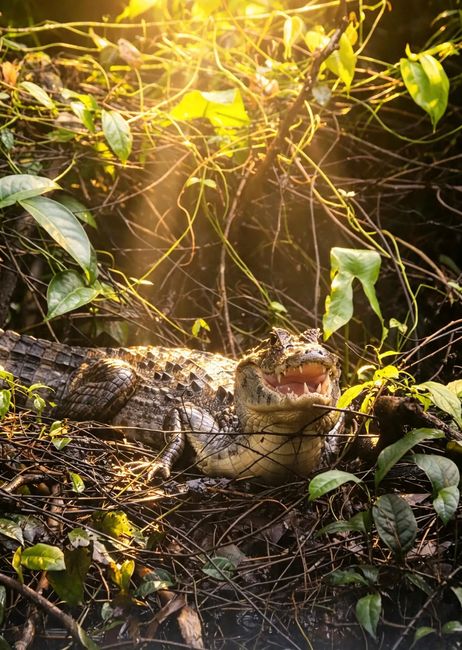
Tortuguero National Park, on the remote north Caribbean coast of Costa Rica, is a world of water: a long, wild beach backed by lagoons, rivers and narrow canals winding through flooded rainforest, with no roads in or out. It exists because of sea turtles. According to SINAC, which manages it, it protects the most important green turtle nesting beach in the Western Hemisphere, and leatherback, hawksbill and loggerhead turtles nest here too. On summer nights you can watch a green turtle dig her nest and lay her eggs with a certified guide, and by day you glide through the canals by canoe or boat, looking for caimans, monkeys, sloths, river turtles, kingfishers and the great green macaw. The village of Barra del Tortuguero, where most visitors stay, has no cars, only bicycles and boats, and an Afro-Caribbean culture that dates back to the turtle hunters and loggers of the early 20th century.
Right now in Tortuguero National Park (Tortuguero)
- Wed23–30°C73–86°F12 mm rain
- Thu23–30°C73–85°F3 mm rain
- Fri24–30°C75–86°F1 mm rain
Top tours in Tortuguero National Park
See all tours for Tortuguero National Park →
From local operators, with prices and reviews; you check availability and book on Viator, our partner. We may earn a commission at no extra cost to you. How we earn money
Tortuguero at a glance
- Best months: July to October for green turtle nesting, which SINAC says runs from June to October; March, April and October are the least rainy months.
- Time needed: two nights for a canal tour, the beach trail and a night turtle tour; three to relax and add Cerro Tortuguero or a kayak trip.
- Getting there: by road to the La Pavona dock and then a boat of about an hour, by private boat from Caño Blanco or Moín, or by small plane to the Tortuguero airstrip (TTQ).
- Fee (as of October 2026): US$16.95 for foreign adults and US$5.65 for children, VAT included; tickets through SINAC’s online system.
- Before you go: entry rules, money and the park ticket system are in our Costa Rica travel guide.
Fees, hours and tickets (as of October 2026)
The park has two main visitor sectors: Cuatro Esquinas, at the south end of Barra del Tortuguero village, with the ranger station, the beach trail and the start of the canal trails; and Jalova, at the southern end of the park. A separate trail climbs Cerro Tortuguero at the north end. According to SINAC:
| Area | Foreign visitors (VAT included) | Hours |
|---|---|---|
| Cuatro Esquinas and Jalova sectors (land and water trails) | Adults US$16.95; children US$5.65 | Daily 6 a.m.–noon and 1 p.m.–4 p.m. |
| Cerro Tortuguero trail | US$2.26 (adults and children) | 8 a.m.–3:30 p.m.; may close with notice after storms |
Tickets are bought through SINAC’s online booking system (serviciosenlinea.sinac.go.cr), which lists the Tortuguero canal sector and Cerro Tortuguero, and payment is by debit or credit card (American Express, Mastercard, Visa, Discover, JCB and Diners Club). Ticket sales run from 6 a.m. to 3:30 p.m. Most lodges and guides include or arrange park tickets for their tours. Residents and Costa Ricans pay ₡1,130 for adults and ₡565 for children at the main sectors.
Turtle watching: the official program and the rules
To protect nesting turtles, access to the beach is restricted between 6 p.m. and 6 a.m. from March 1 to October 31, according to SINAC. The only way to see turtles nesting at night is the park’s turtle observation program, run with a local organization. Specially trained turtle spotters (rastreadores) patrol the beach and are the only people who look for turtles as they come out of the sea; visitors wait with their certified guide at waiting points behind the beach, learning about the turtles, until a turtle is laying eggs and can be watched without disturbing her. This avoids crowds walking the sand and scaring turtles back into the water.
- Season: SINAC gives the turtle nesting season as June to October, and asks visitors to check that the season has opened, as nature varies from year to year. Green turtles are the main nesters; leatherbacks come earlier in the year.
- Booking: book a night tour with a certified guide in the village or through your lodge, ideally on the day you arrive; groups and numbers are limited.
- On the beach: no flashlights, phones or camera screens and no flash photography; wear dark clothes and closed shoes; keep quiet and follow the guide and spotter.
- Nests and hatchlings: never touch turtles, eggs or hatchlings, and don’t walk on nests by day; the Jaguar trail behind the beach shows tracks and nests without disturbing them.
Tortuguero’s role in turtle science began in the 1950s, when the University of Florida zoologist Archie Carr started studying green turtles here and founded the Caribbean Conservation Corporation, according to SINAC; the group is now called the Sea Turtle Conservancy. The park was declared on September 24, 1970, and has been enlarged three times to about 76,937 hectares (297 sq miles), of which 50,284 hectares are sea.
Top things to see in Tortuguero
The canals by canoe, kayak or boat
The park’s “water trails” are its highlight. According to SINAC:
- Caño Chiquero and Caño Mora (2.3 km / 1.4 miles): narrow, overgrown channels open only to canoes, kayaks and electric motors; quiet and excellent for wildlife.
- Río Tortuguero (4.3 km / 2.7 miles): the gateway to the canals, by motorboat, with waterbirds, frogs and reptiles.
- Caño Harold (3.5 km / 2.2 miles): a wide, calm canal good for spotting caimans and turtles.
- Caño Palma (5.1 km / 3.2 miles): a narrow canal with dense vegetation and many waterbirds, reached from Laguna Penitencia near Cerro Tortuguero.
Go at dawn with a guide, when animals are most active. A paddle canoe tour is quieter and gets you into the smallest channels. See our boat trips guide.
The Jaguar trail
This linear land trail runs 2.5 km (1.6 miles) parallel to the beach from the Cuatro Esquinas station, with marked beach entrances every 100 m numbered 37 to 60. In nesting season you see turtle tracks and nests, and in the forest, hawks, monkeys, curassows, dragonflies and butterflies, according to SINAC. Rubber boots are recommended, and the lodges and shops in the village rent them.
Cerro Tortuguero
Near the village of San Francisco, north of Barra del Tortuguero, this small volcanic cone, 119 m (390 ft) high and about 1.8 million years old, is the highest point in the area. A steep, often muddy trail climbs to a viewpoint over the country’s largest wetland, the lagoon, swamps, palm forest and the Caribbean, according to SINAC. Look for poison dart frogs, trogons, spider and white-faced monkeys on the way.
Wildlife
SINAC has recorded 442 bird species, 138 mammals, 118 reptiles and 58 amphibians in the park. Highlights include the endangered great green macaw, which nests and feeds here, caimans sunning on logs, black river turtles stacked on branches, northern jacanas and anhingas along the canals, the strawberry poison dart frog, and spider and white-faced monkeys. The park also protects the West Indian manatee, one of Costa Rica’s rarest mammals, and one of the country’s largest populations of jaguars, which are studied here and occasionally seen on the beach.
Other things to do in Tortuguero
- Barra del Tortuguero village: walk or cycle the sandy paths, eat Caribbean rice and beans in coconut milk at local sodas, and visit the turtle conservation visitor center at the north end of the village.
- Kayaking: rent a kayak and explore the main canal and lagoon on your own (stay out of the restricted narrow channels without a guide and a park ticket).
- Night walks and birdwatching: guided walks for frogs and snakes, and dawn birding with local guides; see our hiking guide.
Food and drink in Tortuguero
Tortuguero’s food is Caribbean home cooking, served in a handful of sodas and small restaurants along the sandy main path of Barra del Tortuguero. Expect rice and beans cooked in coconut milk with Caribbean-style chicken or fish, rondón seafood stew, fried plantains, coconut bread and patí turnovers from village bakeries, with fresh fruit drinks and coconut water. Turtle meat and eggs are protected and must never be bought or eaten.
Package lodges across the river include buffet meals, usually breakfast, lunch and dinner, so check before you plan to eat in the village; many guests still cross for one meal to support local businesses. Everything arrives by boat, so the choice is small and prices are higher than on the mainland, and some places close early or on quiet days. Nightlife is a few beers at a riverside bar, then early to bed for the dawn canoe tour.
Getting there
There are no roads to Tortuguero. According to SINAC, there are three ways in by land and water, plus small planes:
| Route | How it works |
|---|---|
| La Pavona (the most common and fastest) | Road from Guápiles to Cariari, then to the La Pavona dock, and a boat to the village. Public and private boats run continuously; a 4×4 is preferable, and you leave the car in the dock’s parking lot. |
| Caño Blanco | Road from Siquirres to the Caño Blanco dock, then private boat only, booked in advance with a boat operator. |
| Puerto Moín | Private boat from Moín, near Puerto Limón, along the coastal canals. |
| By air | Small planes to the Tortuguero airstrip (TTQ), such as SANSA from San José, on their own schedules. |
Most visitors buy a package from San José (or from La Fortuna or Puerto Viejo) that includes a shuttle to the dock, the boat, lodging, meals and tours; independent travelers can take public buses from San José via Cariari to La Pavona and the public boat. The boat ride from La Pavona takes about an hour, through rivers and canals with wildlife on the way. The UK government notes past accidents with small boats in the Tortuguero area, so use established boat operators.
Around Tortuguero
- Barra del Colorado: the wildlife refuge to the north, famous for tarpon fishing.
- Puerto Viejo de Talamanca and Cahuita: the South Caribbean’s beaches and reefs; see our Puerto Viejo travel guide.
- La Fortuna and Sarapiquí: inland rainforest, rafting and Arenal; see our La Fortuna travel guide.
Nearby destinations
- San José84 km
- Puerto Viejo de Talamanca118 km
- La Fortuna126 km
- Manuel Antonio National Park136 km
- Monteverde144 km
- Bocas del Toro183 km
- Boquete217 km
- Tamarindo252 km
When to go and how long to stay
Tortuguero is one of the wettest places in Costa Rica. According to SINAC, average rainfall reaches about 6,000 mm (236 in) a year; the wettest months are July and December, the least rainy March, April and October, and the average temperature ranges from 25 to 30 °C (77 to 86 °F). Heat, humidity and rain are constant companions, so come prepared. For comparison, the official station at Puerto Limón, further south on the same coast, averages highs of 31–33 °C (87–91 °F), lows of 19–22 °C (65–71 °F) and about 3,790 mm (149 in) of rain a year, with September and October the driest months (WMO 1991–2020 normals).
| Month | Weather | Turtles and wildlife | Crowds and prices |
|---|---|---|---|
| January | Wet, with northern cold fronts | Canal wildlife; few turtles | Quiet after New Year |
| February | Wet, with cold-front rain easing late in the month | Canal wildlife; migrant birds | Quiet; good lodge deals |
| March | Among the least rainy months | Leatherbacks begin nesting; good canal trips | Moderate; the beach closes at night from March 1 |
| April | Among the least rainy months | Leatherbacks nesting; good canal trips | Busy in Holy Week |
| May | Rains increase | Last leatherbacks; birds nesting | Quiet |
| June | Rainy | Green turtle season opens | Moderate |
| July | One of the two wettest months | Peak green turtle nesting | Busy; book turtle tours and lodges ahead |
| August | Wet, with drier spells | Peak nesting; hatchlings from about August | Busy |
| September | Drier spells | Nesting and hatchlings | Moderate |
| October | One of the least rainy months | End of the nesting season; hatchlings | Moderate; the beach reopens at night from November 1 |
| November | Very wet | Quiet; birds and canal wildlife | Quiet |
| December | The wettest month | Quiet; birds and canal wildlife | Busier at Christmas |
Two days in Tortuguero
Arrive by boat around midday, walk the village and the Jaguar trail in the afternoon, and join a turtle tour at night in season. The next morning, take a dawn canoe tour of Caño Chiquero and Caño Mora, then relax before the boat out on day three, or leave in the afternoon.
Three days
Add the climb up Cerro Tortuguero and a kayak trip on the lagoon, a second canal tour by boat to Caño Harold, and a night walk for frogs.
Where to stay in Tortuguero
- Barra del Tortuguero village: cabinas, guesthouses and small hotels, walking distance from the park station and the beach; book tours with local guides directly.
- Lodges along the canals: package lodges across the river from the village, with transport, meals and guided tours included; they ferry guests to the village and park.
Taxes: Costa Rican lodging carries 13% value-added tax, and restaurant bills include a 10% service charge, according to the tourism board (ICT). Packages are usually quoted in US dollars; check whether tax, park fees and the turtle tour are included.
Which to choose? Staying in the village is cheaper, lets you book tours directly with local guides, eat in sodas and walk to the park station and beach, but rooms are simple, with fans more often than air conditioning. A canal lodge package takes the planning out of a short stay and adds pools, gardens and wildlife on the grounds, but you depend on the lodge’s boat schedule to reach the village. Either way, two nights is the sweet spot.
What a trip to Tortuguero costs
Because everything comes in by boat, Tortuguero costs more than its simple feel suggests. Lodges, packages and tours quote in US dollars; sodas, the public boat and buses charge in colones. These are our estimates for 2026, not official prices, converted at about ₡460 to US$1, close to the Central Bank’s reference rate in early October 2026. Park fees are SINAC’s official prices.
| Item | Colones (₡) | About (US$) |
|---|---|---|
| Park entry, Cuatro Esquinas or Jalova, foreign adult (SINAC) | about ₡7,800 | US$16.95 |
| Cerro Tortuguero trail (SINAC) | about ₡1,000 | US$2.26 |
| Public boat, La Pavona to the village (one way) | ₡2,000–3,500 | US$4–8 |
| Night turtle tour with a certified guide (excluding park fee) | ₡12,000–18,000 | US$26–40 |
| Dawn canoe tour of the canals (excluding park fee) | ₡12,000–18,000 | US$26–40 |
| Rice and beans at a village soda | ₡4,500–7,000 | US$10–15 |
| Rubber boot rental | ₡1,000–2,000 | US$2–4 |
| Village cabina, double | ₡18,000–37,000 | US$40–80 |
| Two-night lodge package from San José, per person | ₡140,000–275,000 | US$300–600 |
Independent travelers using buses and the public boat, a village cabina and local guides can manage on about US$70 to US$100 (₡32,000–46,000) a day; a lodge package with transfers, meals and tours usually works out at US$150 to US$300 (₡69,000–138,000) per person per day.
Practical tips for Tortuguero
- Bring cash: the village has few card machines and its ATM can run out; bring colones and dollars from the mainland.
- Don’t swim: SINAC advises against swimming in the sea or the lagoons, because of dangerous currents, boats and animals.
- Park rules: no alcohol, drugs, sound systems, sports, fires, weapons, fishing or pets in the park; stay on trails and take your trash out.
- Look after your things: keep valuables in your room’s safe, and take care of your belongings on boats and in the village.
- Emergencies: call 911; medical services in the village are basic.
What to pack for Tortuguero
SINAC recommends cool clothing, a hat or cap, insect repellent and sunscreen, and rubber boots. Add a good rain jacket, quick-dry clothes, dark clothing and closed shoes for the turtle tour, a dry bag for boat rides, binoculars, a red-light headlamp for walking in the village (not on the beach), and a light bag: boats and small planes have limited room. Plugs are the US type.
Tortuguero travel FAQ
How much is Tortuguero National Park?
US$16.95 for foreign adults and US$5.65 for children, VAT included, for the main sectors; the Cerro Tortuguero trail is US$2.26, according to SINAC as of October 2026.
When is turtle season in Tortuguero?
SINAC gives the nesting season as June to October, mainly green turtles. Check that the season has opened before you book, as it varies by year.
Can I watch turtles nesting without a guide?
No. The beach is closed from 6 p.m. to 6 a.m. between March 1 and October 31, and night visits are allowed only through the official program with a certified guide and turtle spotters.
How do I get to Tortuguero?
By road via Guápiles and Cariari to the La Pavona dock and then a boat of about an hour, by private boat from Caño Blanco or Moín, or by small plane to the Tortuguero airstrip.
What are Tortuguero National Park’s hours?
Daily from 6 a.m. to noon and 1 p.m. to 4 p.m. for the main sectors, and 8 a.m. to 3:30 p.m. for the Cerro Tortuguero trail.
How many days do I need in Tortuguero?
Two nights is ideal: enough for a canal tour at dawn, the beach trail and a turtle tour in season.
Can you swim at Tortuguero beach?
It isn’t recommended: SINAC warns of dangerous currents in the sea, and of boats and animals in the lagoons.
Should I stay in the village or at a lodge?
Stay in Barra del Tortuguero village for lower prices, local guides and sodas within walking distance of the park; choose a canal lodge package for transfers, meals and tours arranged for you. Both work well for two nights.
Can I visit Tortuguero without a tour package?
Yes. Take a bus from San José to Cariari and on to the La Pavona dock, then the public boat to the village, and book park tickets, guides and the turtle tour yourself. It is cheaper, but plan around the boat times.
Is there an ATM in Tortuguero?
The village has very few card machines and its ATM can run out of cash, so bring enough colones and dollars from the mainland for tours, meals and tips.
Plan your trip
Partner links: TravelerCenter may earn a commission if you book, at no extra cost to you.
🇪🇸 Useful Spanish phrases for Tortuguero National Park
All 38 Spanish phrases: restaurant, hotel, emergencies, romance (printable) →
Sources · last reviewed 4 October 2026
Researched and last reviewed on 4 October 2026. Fees, hours, payment, ticket sales, the turtle observation program and season, beach restrictions, water and land trails, Cerro Tortuguero, species counts, park history and size, climate, access routes, park rules and packing advice: SINAC (the park’s pages and online booking system); comparison climate: the WMO 1991–2020 normals for Puerto Limón (archived by NOAA NCEI); boat safety: the UK government’s Costa Rica pages; SANSA’s Tortuguero route: SANSA; VAT and service charge: the Costa Rica Tourism Board (ICT). The boat time from La Pavona, leatherback and hatchling timing, beach-tour etiquette, the visitor center, Barra del Colorado and cash availability come from secondary sources or general knowledge and are flagged for checking. Rules and prices change, so check SINAC before you go. For entry rules and money, see our Costa Rica travel guide. The food notes, the comparison of village and lodges, the month-by-month details beyond SINAC’s seasons and the trip costs come from general knowledge or our own estimates and are flagged for checking; colón amounts are converted at about ₡460 to US$1, close to the Central Bank’s reference rate in early October 2026.
Data: Weather: MET Norway (CC BY 4.0) · Sea temperature: NOAA CoastWatch · Rates: ECB · Costs: World Bank ICP and price levels · Wikidata (CC0)