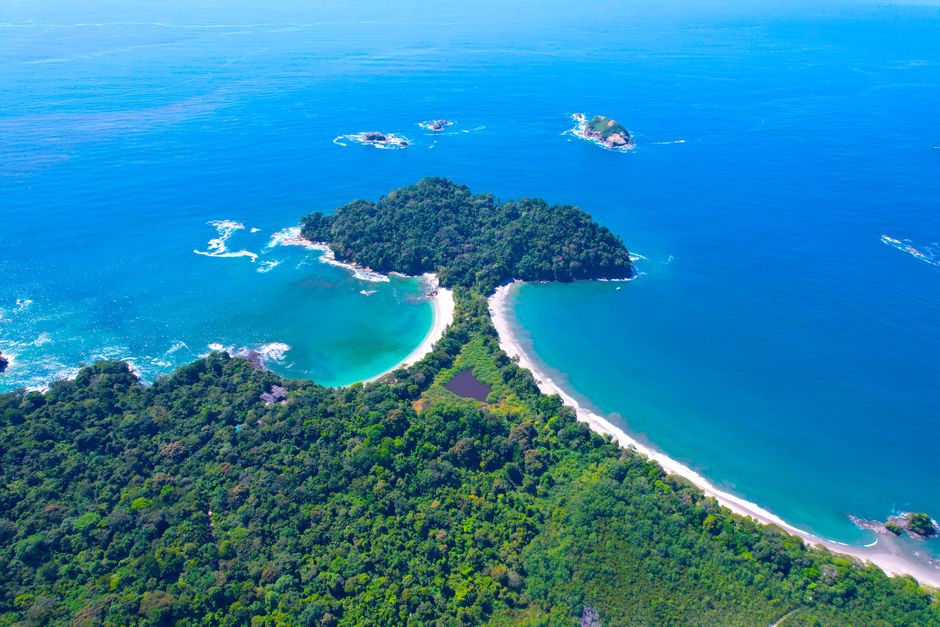
Manuel Antonio National Park is where the rainforest meets the Pacific: a small, hilly headland on Costa Rica’s central coast with white-sand coves, rocky points, mangroves and a lagoon, wrapped in tropical forest full of animals that are easy to see. Sloths hang above the trails, white-faced capuchins raid unattended bags, squirrel monkeys, the park’s emblem, move through the trees in noisy troops, and the beaches inside the park are among the most beautiful in the country. According to SINAC, which manages it, it is the protected area that receives the most visitors in Costa Rica. It is also strictly managed: tickets are sold only online for a time slot, the park is closed every Tuesday, food is restricted, and the gates close in the afternoon. Plan around those rules and a visit is unforgettable. The park sits 157 km (98 miles) south of San José, near the town of Quepos.
Right now in Manuel Antonio National Park (Manuel Antonio)
- Wed25–30°C77–85°F4 mm rain
- Thu25–29°C76–85°F6 mm rain
- Fri26–30°C79–86°F1 mm rain
Top tours in Manuel Antonio National Park
See all tours for Manuel Antonio National Park →
From local operators, with prices and reviews; you check availability and book on Viator, our partner. We may earn a commission at no extra cost to you. How we earn money
Manuel Antonio at a glance
- Best months: December to April, the dry season on the Pacific. September and October are the wettest and quietest months; go early in the day.
- Time needed: a morning or a full day in the park; two or three nights in the area to add a catamaran, mangrove or waterfall trip.
- Open: Wednesday to Monday, 7 a.m. to 3 p.m. Closed every Tuesday.
- Fee (as of October 2026): US$18.08 for foreign adults and US$5.65 for children aged 2 to 12, VAT included; tickets online only.
- Getting there: about three hours by road from San José or a short SANSA flight to Quepos (XQP).
- Before you go: entry rules, money and how SINAC’s ticket system works are in our Costa Rica travel guide.
Tickets, hours and fees (as of October 2026)
According to SINAC, Manuel Antonio is open to visitors from Wednesday to Monday, 7 a.m. to 3 p.m., and closed on Tuesdays. Entry tickets are sold only on SINAC’s online booking site (serviciosenlinea.sinac.go.cr), not at the gate: create an account, choose the date and entry time, enter each visitor’s name and passport number, and pay by card. Arrive within your time slot with the passports you booked with.
| Visitor | Price (VAT included) |
|---|---|
| Non-resident adult (over 12) | US$18.08 |
| Non-resident child (2 to 12) | US$5.65 |
| Non-resident child under 2 | Free |
| Resident adult (over 12) | ₡1,808 |
| Resident child (6 to 12) | ₡565 |
- Limits: for security reasons, SINAC allows one purchase per user per day for Manuel Antonio, with up to six tickets; travel agencies can buy up to ten per purchase.
- No refunds: tickets can’t be refunded if you can’t go or the weather is bad, and they can’t be transferred to another person. If the park closes for an emergency, write to SINAC’s booking office to change the date.
- Book early: slots sell out in high season, on weekends and holidays. Many tours include tickets.
- Free day: August 24, National Parks Day, is free for everyone, and very crowded.
Park rules: food, bags and what to leave behind
Manuel Antonio’s rules protect its animals, which have learned to steal food. According to SINAC, you can’t bring food or drinks of any kind into the park beyond the conditions and exceptions set by the park administration (in practice, water in a reusable bottle), and food is not allowed on the beaches or trails. A concession inside sells food and crafts from 7:30 a.m. to 3:30 p.m., and you may eat only in its designated area. Also banned:
- Feeding or touching wild animals.
- Pets of any kind.
- Alcohol, smoking and drugs.
- Beach umbrellas, balls, tents and hammocks.
- Fishing, hunting, fires, weapons and collecting shells or plants.
The park has toilets, changing rooms and showers (no soap or shampoo), lockers from 7 a.m. to 4 p.m., and drinking fountains along the main trail and beach paths to refill your bottle. Keep your bag closed and with you: capuchins and raccoons open zips. Don’t sit under or touch the manzanillo trees on the beach, whose sap and fruit are toxic, as SINAC warns.
Guides and tours
A guide with a spotting scope makes a huge difference: they find sloths, snakes, frogs and birds you would walk past, and many take photos through the scope with your phone. Inside the park, the official guiding concession is run by the association of certified tour guides of Quepos (Manuel Antonio Official Tour Guides), according to SINAC. Guided walks are offered Wednesday to Monday from 7 a.m. to 2 p.m., and in the high season (November to April) there are also late-afternoon tours at 3:30 p.m. on Saturdays, Sundays and Mondays and night tours at 5:30 p.m. on Wednesdays, Thursdays and Fridays. Only use guides who carry an ICT certification card; unofficial guides wait outside the gate.
Top things to see in Manuel Antonio National Park
Playa Manuel Antonio
The park’s most famous beach, a curve of pale sand between forested points, is calm enough for swimming and, according to SINAC, very popular for snorkeling along its edges, where you can see marine life and some coral. At its southern end, near Punta Catedral, look at low tide for La Trampa, a circle of stones that, according to local history, was a trap Indigenous people used to catch turtles and fish.
Punta Catedral
This headland was once an island, joined to the coast by a sandbar (a tombolo). A loop trail climbs through the forest past five viewpoints over the Pacific and the offshore islands, some of them home to seabirds.
Playa Espadilla Sur and Playa Gemelas
Espadilla Sur is a wide beach at low tide, quieter than Manuel Antonio but with stronger waves in some seasons. Playa Gemelas (the “twin beaches”) is split in two by a rock formation and keeps changing shape with the currents, according to SINAC.
The Waterfall and Punta Serrucho trails
Inland trails lead to La Catarata, a small waterfall that flows only in the rainy season, and up to the Punta Serrucho viewpoint, a jagged rocky point on a geological fault, at about 160 m (525 ft), the park’s highest area. They are steeper and quieter than the beach paths, with views of the coast. Wear closed shoes, not sandals.
The mangrove and the wildlife
A mangrove of about 18 hectares (44 acres) lines the trails behind Manuel Antonio and Espadilla Sur beaches, with red and other mangrove species. SINAC has recorded about 352 bird species and 109 mammal species in the park, including the Central American squirrel monkey (mono tití), white-faced capuchins, mantled howler monkeys, two- and three-toed sloths, raccoons, coatis and the fiery-billed aracari. The main trail from the entrance, called the Sloth Trail (Sendero Perezoso), is wide and flat and the best place to spot sloths.
Other things to do around Manuel Antonio
- Playa Espadilla (outside the park): the long public beach in Manuel Antonio village, open every day including Tuesdays, with surf lessons, chairs and restaurants. Watch for rip currents. See our beaches guide.
- Catamaran and boat trips: sailing and snorkeling trips along the coast, with dolphins and, from about July to October and December to March, humpback whales offshore. See our boat trips guide.
- Mangrove kayaking: paddle or take a boat through the Damas Island mangroves north of Quepos.
- Sportfishing: Quepos’s marina is a base for sailfish and marlin charters.
- Zip lines, rafting and waterfalls: canopy tours in the hills, rafting on the Savegre and Naranjo rivers, and the Nauyaca waterfalls further south.
Food and drink around Manuel Antonio
You can’t picnic in the park, so plan meals around your visit: a big breakfast before a 7 a.m. entry, and lunch after you leave or at the concession’s dining area inside. In Quepos, sodas near the market and bus station serve the cheapest casados, fish of the day and arroz con mariscos (seafood rice), and the marina has waterfront restaurants. Sportfishing boats bring in mahi-mahi and tuna, which turn up grilled, in ceviche and in fish tacos all along the coast.
The hill road between Quepos and the park is where most visitors eat in the evening, with restaurants on terraces facing the sunset, from seafood and Costa Rican plates to Italian, Asian and vegan menus; several are famous more for the view than the food, so book a table at sunset in high season. Near Playa Espadilla, beach shacks sell fresh coconuts, fruit and simple lunches. Nightlife is modest: a few bars and live music on the hill and in Quepos, quieter on weeknights in the rainy season. Menu prices usually include the 10% service charge and 13% VAT.
Getting there
The park’s main entrance is about 7 km (4 miles) from the town of Quepos, at the end of the road through Manuel Antonio village. According to SINAC, the park has no parking, and in high season the single road between Quepos and Manuel Antonio is very busy, so walk, take the local bus or a taxi, or use paid private lots in the village.
| From | Route | Time |
|---|---|---|
| San José | 157 km (98 miles), mostly by the Route 27 highway and the coastal Route 34 via Jacó | About 3 hours by car or shuttle; longer by public bus to Quepos |
| San José by air | SANSA to Quepos airport (XQP), then taxi | Flight under an hour |
| La Fortuna or Monteverde | Tourist shuttle via the Central Valley or the coast | About 4–5 hours |
| Liberia airport and Guanacaste | Coastal highway south via Puntarenas | About 4 hours |
Shared tourist shuttles with hotel pick-up are the easiest way without a car. On the way from San José, Carara National Park, whose tickets are also sold online by SINAC, is a good stop for scarlet macaws, and many drivers pause at the Tárcoles River bridge to see the crocodiles below. Driving tips are in our Costa Rica guide; don’t leave anything in a parked car.
Around Manuel Antonio
- Quepos: the working town, with the marina, banks, supermarkets, the bus station and cheaper hotels and sodas.
- The Manuel Antonio road: the hilly road between Quepos and the park, lined with hotels, restaurants and sunset viewpoints over the ocean.
- Dominical and Uvita: surf towns about an hour south, with Marino Ballena National Park’s whale-tail sandbar.
- Jacó: a busy surf and nightlife town about an hour north, close to Carara.
Nearby destinations
- San José62 km
- Monteverde127 km
- La Fortuna134 km
- Tortuguero National Park136 km
- Puerto Viejo de Talamanca155 km
- Boquete198 km
- Bocas del Toro207 km
- Tamarindo209 km
When to go and how long to stay
According to Costa Rica’s National Meteorological Institute (IMN), the Central Pacific region has a tropical climate with a short, moderate dry season and a long, very heavy rainy season. The valleys behind the coast average about 3,500 mm (138 in) of rain a year, on about 166 days, with average highs of 31.0 °C (88 °F) and lows of 22.7 °C (73 °F) all year (1961–1990 averages). About 52% of the rain falls from May to August and 44% in a second rainy period from September to November; the short mid-year lull (“veranillo”) that other Pacific areas get is barely noticeable here.
| Season | What it’s like | Good for |
|---|---|---|
| Dry season (Dec–Apr) | Sunny, hot and humid; the busiest months | Beaches, snorkeling, late-afternoon and night tours (November to April) |
| Early rainy season (May–Aug) | Sunny mornings, afternoon storms; school holidays in July | Lower prices, lush forest, whale season begins |
| Wettest months (Sep–Oct) | Heavy rain most days; SINAC notes the fewest visitors | Quiet trails if you go early; some businesses close |
| November | Rains easing | Shoulder season before the holidays |
SINAC itself suggests visiting early in the day in September and October and bringing suitable clothes for rain. Wildlife is most active in the first hours after opening, at any time of year.
Manuel Antonio month by month
| Month | Weather | Crowds and prices | Why go |
|---|---|---|---|
| January | Dry, sunny and hot | High season; book park slots early | Beaches, snorkeling, late-afternoon tours |
| February | Dry and sunny | High season | Clear water, humpbacks offshore |
| March | Dry and hot | High season | Beaches, catamarans |
| April | Hot; first showers late in the month | Very busy in Holy Week | Beaches, wildlife at opening time |
| May | Rainy season starts; afternoon storms | Quieter; lower rates | Green forest, morning visits |
| June | Sunny mornings, rainy afternoons | Moderate | Wildlife, surf lessons |
| July | Wet afternoons; little mid-year break here | Busy with school holidays | Humpback season begins |
| August | Wet; heavy afternoon rain | Moderate; free entry on August 24 (very crowded) | Whales offshore |
| September | One of the wettest months | Very quiet | Quiet trails if you go early |
| October | The wettest month; some businesses close | Very quiet | Low prices, whales early in the month |
| November | Rains easing | Shoulder season | Night and afternoon tours resume |
| December | Dry season returns | Busy and pricier at Christmas | Beaches, holidays; book ahead |
Manuel Antonio in one day
Book the 7 a.m. slot and a guide for the first two hours on the Sloth Trail and mangrove boardwalks. Then walk the Punta Catedral loop, swim and snorkel at Playa Manuel Antonio, and take the Punta Serrucho trail if you have energy left. Leave by 3 p.m., and watch the sunset from Playa Espadilla or a hillside bar.
Two or three days
Add a catamaran or mangrove trip, surf lessons at Playa Espadilla, or a day south to the Nauyaca waterfalls or Uvita. Plan the park for any day except Tuesday, and use Tuesday for a boat trip.
Where to stay near Manuel Antonio
- Manuel Antonio village: hotels and hostels within walking distance of the park entrance and Playa Espadilla.
- The hill road: boutique hotels and resorts with ocean views and wildlife in the gardens; you’ll need the bus, taxis or a car.
- Quepos: the cheapest rooms, near the marina and bus station, a short bus ride from the park.
Taxes: Costa Rican hotel rooms carry 13% value-added tax, and restaurant bills include a 10% service charge, according to the tourism board (ICT). Many hotels quote in US dollars before tax, so check the total.
What a day around Manuel Antonio costs
The park itself is good value, but the area’s hotels and tours are among the priciest in Costa Rica. Hotels, tours and the park quote in US dollars; sodas, buses and taxis charge in colones. These are our estimates for 2026, not official prices, converted at about ₡460 to US$1, close to the Central Bank’s reference rate in early October 2026. The park fee is SINAC’s official price.
| Item | Colones (₡) | About (US$) |
|---|---|---|
| Park entry, foreign adult (SINAC) | about ₡8,300 | US$18.08 |
| Certified guide in the park (per person, shared group) | ₡14,000–23,000 | US$30–50 |
| Local bus, Quepos to the park entrance | ₡400–600 | under US$1.50 |
| Taxi, hill hotels to the park | ₡3,000–6,000 | US$7–13 |
| Casado at a soda in Quepos | ₡4,000–6,000 | US$9–13 |
| Dinner with a sunset view on the hill | ₡14,000–28,000 | US$30–60 |
| Hostel dorm bed | ₡8,000–14,000 | US$17–30 |
| Mid-range double room | ₡46,000–92,000 | US$100–200 |
| Catamaran snorkel cruise | ₡37,000–55,000 | US$80–120 |
A budget day with a hostel, sodas, the bus and the park without a guide costs about US$50 to US$70 (₡23,000–32,000); with a guide, a view hotel and a boat trip, plan on US$250 to US$350 (₡115,000–161,000) per person.
Practical tips for Manuel Antonio
- Never on a Tuesday: the park is closed every Tuesday, so plan your visit for another day.
- Book online in advance and screenshot your tickets; mobile signal can be patchy.
- Pack light: no food, no umbrellas, no balls; bring water in a reusable bottle, swimwear and a towel.
- Protect your things: monkeys and raccoons steal from open bags on the beach, and thieves target cars and beach bags outside the park.
- Swim carefully: Playa Manuel Antonio is usually calm, but Espadilla and Espadilla Sur can have rip currents; swim where others swim and never alone.
- Rangers: park staff wear SINAC uniforms and work only inside the park; ask them for information. Emergencies: call 911.
What to pack for Manuel Antonio
Bring swimwear, a quick-dry towel, reef-safe sunscreen, a hat, insect repellent, a refillable water bottle, closed shoes for the inland trails, a small dry bag for your phone and passport, and binoculars. A snorkel mask is useful at Playa Manuel Antonio. In the rainy season, add a light rain jacket. Plugs are the US type.
Manuel Antonio travel FAQ
How much is the Manuel Antonio entrance fee in 2026?
US$18.08 for foreign adults and US$5.65 for children aged 2 to 12, VAT included, according to SINAC. Children under 2 are free.
Is Manuel Antonio National Park closed on Tuesdays?
Yes. It is open Wednesday to Monday from 7 a.m. to 3 p.m. and closed every Tuesday.
Can I buy Manuel Antonio tickets at the gate?
No. Tickets are sold only online on SINAC’s booking site, for a set date and time, with up to six tickets per purchase and one purchase per account per day.
Can I bring food into Manuel Antonio?
No. Food and drinks are not allowed beyond the park’s exceptions, and eating is permitted only at the concession’s dining area. Bring water in a reusable bottle; there are refill fountains.
Do I need a guide in Manuel Antonio?
No, but a certified guide with a scope finds far more wildlife. The official guide concession works inside the park from 7 a.m. to 2 p.m., with afternoon and night tours from November to April.
Is there parking at Manuel Antonio National Park?
No. The park has no parking of its own; use the bus from Quepos, a taxi or a paid private lot in the village.
When is the best time to visit Manuel Antonio?
December to April for dry, sunny days. In any season, go at opening time, when animals are most active and the trails are quieter.
How do I get from San José to Manuel Antonio?
It is 157 km, about three hours by shuttle or car via the coastal highway, longer by public bus to Quepos, or a short SANSA flight to Quepos airport.
What should I do in Manuel Antonio on a Tuesday?
Spend it outside the park: swim or take a surf lesson at the public Playa Espadilla, book a catamaran or mangrove trip, or drive south to the Nauyaca waterfalls or Uvita. The park is closed every Tuesday.
How much does a day in Manuel Antonio cost?
By our estimates, about US$50 to US$70 a day on a budget with a hostel, sodas and the park without a guide, and US$250 to US$350 per person with a guide, a view hotel and a boat trip. The park fee is US$18.08 for foreign adults.
Plan your trip
Partner links: TravelerCenter may earn a commission if you book, at no extra cost to you.
🇪🇸 Useful Spanish phrases for Manuel Antonio National Park
All 38 Spanish phrases: restaurant, hotel, emergencies, romance (printable) →
Sources · last reviewed 4 October 2026
Researched and last reviewed on 4 October 2026. Hours, the Tuesday closure, fees, online-only tickets, purchase limits, refunds and the free day, park rules and services, the guiding concession and its schedule, the beaches, trails, mangrove, species counts, the manzanillo warning, the lack of parking, the distance from San José and visiting in September and October: SINAC (the park’s page, its online booking system and its frequently asked questions); climate: the National Meteorological Institute’s (IMN) regional study of the Central Pacific; SANSA’s Quepos route: SANSA; Carara’s online tickets: SINAC; VAT and service charge: the Costa Rica Tourism Board (ICT). Travel times, whale seasons, nearby towns, rip currents at Espadilla and the trail names beyond SINAC’s list come from secondary sources or general knowledge and are flagged for checking, as do the food notes and the month-by-month table. The daily costs are our own estimates, with colón amounts converted at about ₡460 to US$1, close to the Central Bank’s reference rate in early October 2026. Rules and prices change, so check SINAC before you go. For entry rules and money, see our Costa Rica travel guide.
Data: Weather: MET Norway (CC BY 4.0) · Sea temperature: NOAA CoastWatch · Rates: ECB · Costs: World Bank ICP and price levels · Wikidata (CC0)