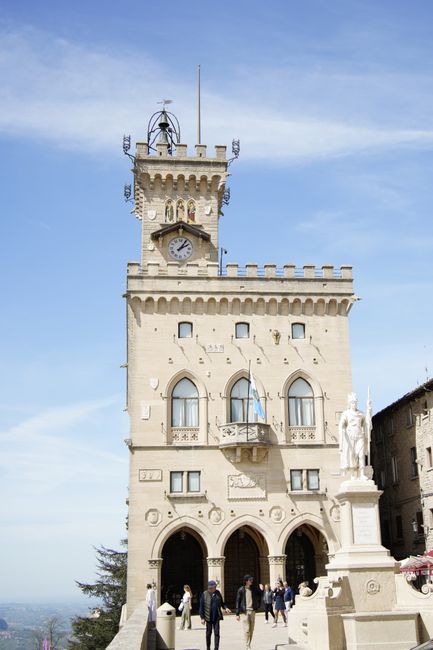
San Marino is a tiny independent republic in the hills of central Italy, about 10 km from the Adriatic coast at Rimini. By tradition it was founded in AD 301, which makes it the world’s oldest surviving republic, and it has kept its independence ever since, with two heads of state who change every six months. Its capital, the City of San Marino, clings to the ridge of Monte Titano at around 750 m: a walled medieval town of stone lanes, government palaces and three towers on the cliff edge, with views across Romagna to the sea on one side and the Apennines on the other. The historic centre and Monte Titano are a UNESCO World Heritage Site. Most people come for a day from Rimini by bus or car; stay a night and you’ll have the lanes and the sunset almost to yourself. There is no border control, San Marino uses the euro, and Italian is spoken everywhere. This guide covers both the country and the practical visit, from the towers, cable car and museum pass to parking, the bus from Rimini and the €5 passport stamp, checked against official sources as of October 2026.
Right now in San Marino
- Wed 12–21°C 54–70°F 1 mm Partly cloudy
- Thu 15–21°C 58–70°F 4 mm Light rain
- Fri 12–15°C 54–60°F 7 mm Heavy showers
Weather: MET Norway (CC BY 4.0)
Multi-day tours of San Marino
Multi-day tours from local operators. You check dates and book on Viator, our partner; we may earn a commission at no extra cost to you. How we earn money
San Marino at a glance: overview and geography
The Republic of San Marino covers 61.19 km², according to its tourism board, and is surrounded entirely by Italy: the region of Emilia-Romagna (province of Rimini) to the north-east and the Marche (province of Pesaro e Urbino) to the south-west, with a border of almost 40 km. The land is hilly. Monte Titano, a limestone ridge with a sheer cliff on its eastern face, rises to 755 m and dominates the country; the lowest point, at Falciano, is only 55 m above sea level. The resident population was 34,172 on 31 December 2025. San Marino is divided into nine municipalities called castelli: Città di San Marino (the capital), Borgo Maggiore, Serravalle, Domagnano, Fiorentino, Faetano, Montegiardino, Acquaviva and Chiesanuova.
According to tradition, a stonemason called Marinus, a Christian from the Dalmatian island of Rab who had come to work in Rimini, took refuge on Monte Titano and founded a small community there on 3 September 301. The community grew into a self-governing commune in the Middle Ages, protected by its towers and walls, its isolation and careful diplomacy with powerful neighbours such as the Montefeltro of Urbino. It was occupied only briefly: by Cesare Borgia in 1503, and in 1739–40 by Cardinal Alberoni, the papal legate, whose occupation ended on 5 February 1740, the feast of St Agatha, still a national holiday. Napoleon respected its independence, and when Italy was unified in the 19th century San Marino stayed out, confirmed by treaties with the new kingdom. During the Second World War it declared itself neutral and sheltered many thousands of refugees, but was bombed in June 1944.
San Marino’s institutions are unusually old. Its Statutes date from the 1600s, and every six months the Great and General Council elects two Captains Regent who serve together as heads of state; they take office on 1 April and 1 October in a ceremony that has barely changed in centuries. San Marino is not a member of the European Union, but it has a customs union and close agreements with the EU, uses the euro and mints its own euro coins. The “Historic Centre of San Marino and Mount Titano” joined the UNESCO World Heritage List in July 2008.
Time zone: San Marino runs on Central European Time (UTC+1, UTC+2 in summer), the same as Italy. The language is Italian; many people in tourism also speak English or German.
The areas and towns
- Città di San Marino: the walled capital on the crest of Monte Titano, with the three towers, Piazza della Libertà, the Palazzo Pubblico, the Basilica of San Marino, museums and most hotels and restaurants in the historic centre. Car-free in the inner lanes.
- Borgo Maggiore: the old market town at the foot of the cliff, linked to the capital by the cable car. A weekly market has been held here for centuries.
- Serravalle and Dogana: the largest town and the border area on the road from Rimini, with the San Marino Stadium, shopping centres and the San Marino Outlet Experience.
- The southern castelli: Fiorentino, Montegiardino, Faetano and Chiesanuova, quiet hill villages with farms, viewpoints and walking trails.
- Domagnano and Acquaviva: villages on the slopes around Monte Titano, with farmland, woods and walking paths.
Where to go: the City of San Marino and beyond
Almost everyone heads first for the capital on Monte Titano. It is compact: you can walk from the main gate, Porta San Francesco, to the furthest tower in about 30 minutes, though it is all up and down, with many steps. The best plan is to arrive in the morning, see the towers and piazza before the coach groups, eat a long lunch with a view and stay for sunset.
The Three Towers: Guaita, Cesta and Montale
The towers on the three peaks of Monte Titano appear on San Marino’s flag and coat of arms. A path along the ridge, the Passo delle Streghe (Witches’ Pass), links them, with the cliff dropping away on one side.
- Prima Torre (Guaita): the oldest and largest, begun in the 11th century, with two rings of walls, a 16th-century bell tower and the Torre della Penna, a 15th-century watchtower you can climb for views to the Adriatic, the Montefeltro castles and Monte Carpegna. It was used as a prison until the 1970s.
- Seconda Torre (Cesta or Fratta): on the highest summit at 755 m. Documented in 1253 and restored in the 1920s, it houses the Museum of Ancient Arms, with around 700 pieces from medieval armour to 19th-century rifles.
- Terza Torre (Montale): the smallest, from the 14th century. It is not open inside, but the walk to it through the woods is quiet and lovely.
Piazza della Libertà and the Palazzo Pubblico
The main square has the white marble Statue of Liberty (1876) and the Palazzo Pubblico, the town hall and seat of government, built in 1884–1894 in medieval style by Francesco Azzurri and restored by Gae Aulenti in 1996. Inside are the Council Hall and the Captains Regent’s rooms. The Palazzo Pubblico is closed to visitors for restoration from 2 April to 31 October 2026, according to the State Museums; check whether it has reopened before you go. In summer the Fortress Guard, in green and red uniforms with plumed helmets, performs the Changing of the Guard in front of the palace.
The Basilica of San Marino and the churches
The neoclassical Basilica of San Marino, built in the 1830s on the site of an earlier church, keeps the relics of the founder. The little church of San Pietro next door has two niches cut in the rock said to be the beds of Marinus and his companion Leo; as of October 2026 it was open free until 17 October. Near Porta San Francesco, the church and convent of San Francesco house the Pinacoteca, a collection of sacred art.
Museums
The State Museum (Museo di Stato) in Palazzo Pergami Belluzzi covers archaeology, art and coins, including the Gothic jewellery of the Domagnano Treasure. The National Gallery shows modern and contemporary art, and the Museum of Stamps and Money tells the story of San Marino’s famous stamps and coins. Several private museums (torture instruments, curiosities, wax figures and more) line the streets of the old town; they are a matter of taste and are not covered by the state pass.
Borgo Maggiore and the cable car
The cable car (funivia) drops about 200 m from the edge of the old town to Borgo Maggiore in under two minutes, with views over the plain to the coast. Borgo Maggiore has a pleasant arcaded square, cafés and the Thursday market, and is a cheaper place to park.
Beyond the capital: the castelli and nearby Italy
Outside the capital, San Marino is quiet hill country with walking and cycling routes. Just over the border in Italy, the Valmarecchia and Montefeltro hills are full of castles and hill towns: the fortress of San Leo on its rock, Verucchio, Gradara and the Renaissance city of Urbino. Rimini, 25 km away, has long beaches and Roman monuments. Further afield, San Marino is an easy add-on to a tour of northern and central Italy; see our Italy guide, and Florence, Tuscany, Venice and Verona, all reachable by train via Bologna.
A walking route through the old town
This loop takes two to three hours with visits, longer with lunch. Start at Porta San Francesco, the main gate at the bottom of the old town, close to the bus stops and car parks. Just inside is the church and convent of San Francesco with the Pinacoteca. Climb the main street, lined with shops, to Piazza Garibaldi, where the tourist office will stamp your passport, and continue up to Piazza della Libertà for the Palazzo Pubblico and the balustrade with views over the Apennines. From there, lanes lead up past the Basilica of San Marino and San Pietro to the gate of the Guaita. After the first tower, follow the cliff-top Passo delle Streghe to the Cesta and its arms museum, then take the woodland path to the Montale. Walk back along the ridge road, or drop down through the old town to the upper cable car station and ride down to Borgo Maggiore for a coffee in its square. The State Museum, near Piazza della Libertà, fits in at any point.
San Marino with children
Children usually love San Marino: towers and battlements to climb, the cable car, the arms museum, crossbow displays and the guard in uniform. Under-18s go free in the state museums, and children under 120 cm ride the cable car for free. Keep a close eye on small children along the cliff walls and on the steep, polished steps. Some private museums in the old town, such as the torture museum, are not suitable for young children. For a break from history, the San Marino Adventures adventure park on Monte Titano offers rope courses in the woods in the warmer months; holders of the TuttoSanMarino Card get a discount.
Best time to visit San Marino
San Marino is worth visiting all year, but the best months are May, June, September and October, when it is warm enough to sit outside and walk the ridge but not as crowded or hot as in midsummer. July and August bring the most day-trippers from the Rimini beaches, longer opening hours and evening events. In winter the old town is quiet and can be cold, windy and occasionally snowy, but the Christmas markets bring it to life.
The capital is high up, so it is several degrees cooler than the coast. Approximate averages for the City of San Marino suggest highs of about 9–10 °C in January, 21 °C in May, 28 °C in July and August and 19 °C in October, with lows of about 4 °C in January and 21 °C in July. Rain is spread through the year, wettest from September to November. Fog and low cloud sometimes hide the views, especially in autumn and winter, so keep an eye on the forecast or the official webcams.
Festivals and events
- 5 February: feast of St Agatha and the anniversary of liberation from Cardinal Alberoni’s occupation.
- 1 April and 1 October: investiture of the Captains Regent, with a colourful procession in uniform.
- Summer: the Changing of the Guard at the Palazzo Pubblico, and the Medieval Days (Giornate Medioevali), usually in late July, with costumes, crossbows and markets. Dates for 2027 had not been published in October 2026.
- 3 September: feast of St Marinus and the founding of the Republic, with Mass, a historical procession and the traditional crossbow tournament.
- 8–11 October 2026: Rallylegend, a celebration of historic rally cars based at the stadium in Serravalle.
- 28 November 2026 to 6 January 2027: the Christmas of Wonders in the old town, with lights and markets, free, 10:30–19:00, on weekends from 28 November, then 5–8, 12–13 and 19–20 December, and every day from 24 December to 6 January.
Public holidays
1 and 6 January, 5 February, 25 March (the Arengo and the Feast of the Militias), Easter Monday, 1 April and 1 October (investiture), 1 May, Corpus Christi, 28 July (fall of Fascism), 15 August, 3 September, 1 and 2 November, 8, 25 and 26 December. Museums and shops may change their hours on these days.
How long to stay: sample plans
One day from Rimini
Take an early Bonelli bus from Rimini station (55 minutes). Walk up to the Guaita and along the Passo delle Streghe to the Cesta and its arms museum, then down to Piazza della Libertà. Lunch on a terrace, then the State Museum or the Basilica, get your passport stamped at the tourist office, ride the cable car down to Borgo Maggiore and back, and catch an afternoon bus to Rimini.
Two days: stay overnight
Day one as above, but stay for sunset over the Montefeltro hills and dinner in the old town after the day visitors leave. On day two, walk to the Montale tower and along the trails around Monte Titano, visit Borgo Maggiore’s market (on Thursdays), or drive to San Leo and Verucchio in the Valmarecchia.
San Marino in a longer Italy trip
San Marino fits easily into a week on the Adriatic coast or a route between Bologna, Ravenna, Urbino and Florence. Two nights here plus Rimini’s beaches and Urbino make a relaxed long weekend.
Entry, money, fees and costs
Entry and borders (last reviewed October 2026)
There are no border formalities between Italy and San Marino; you pass a sign and you’re in. San Marino is not in the EU or the Schengen area, but its border with Italy is open, and the tourism board says the Republic is open to anyone allowed to enter Italy. In practice you need whatever you need to enter Italy and the Schengen area. Citizens of EU and EEA countries and Switzerland need a passport or national ID card. Visitors from many other countries, including the United States, Canada, the UK and Australia, can stay without a visa for up to 90 days in any 180-day period in the Schengen area; time in San Marino is effectively spent inside that open border area. Others need a Schengen visa valid for Italy.
- Entry/Exit System (EES): the EU’s digital border system has been fully running at all Schengen external borders since 10 April 2026. If you are not an EU citizen and you arrive from outside Schengen, for example at Bologna or Rimini airport on a flight from the UK, your passport details, a photo and fingerprints are recorded at that first border instead of a stamp; children under 12 are not fingerprinted. Registration is free and lasts three years. There is no EES check at the San Marino border.
- ETIAS: the EU’s planned online travel authorisation (fee €20) is not in operation as of October 2026. No start date has been published and press reports point to 2027. Ignore websites selling “ETIAS applications” until the EU confirms a date.
- Passports: for non-EU visitors, your passport should have been issued less than 10 years before you arrive in Schengen and be valid for at least 3 months after the day you plan to leave.
- Passport stamp: there is no entry stamp, but you can get a souvenir San Marino tourist visa stamped in your passport at the Tourist Information Office, Piazza Garibaldi 5, for €5. The office is open Monday to Friday 9:00–18:00 and at weekends 9:00–13:00 and 13:30–18:00.
The euro, coins and stamps
San Marino uses the euro and has minted its own euro coins at the Italian mint since 2002, with San Marino designs on the national side. They are legal tender across the euro area but rarely seen in change. Collectors also buy San Marino’s silver and gold coins and its stamps, which have been prized by philatelists since the 19th century; the Philately and Numismatics Office is in Piazza Garibaldi, by the tourist office. Cards are widely accepted, but keep some cash for small cafés and markets. Tipping is as in Italy: not expected, but rounding up or leaving a few euros for good service is appreciated.
Museum pass, cable car and parking prices (October 2026)
| What | Price | Notes |
|---|---|---|
| State museums pass | €11, reduced €8 | Covers both open towers, State Museum, Pinacoteca San Francesco, National Gallery, Museum of Stamps and Money (and the Palazzo Pubblico when open) |
| “Last Hours” ticket | €5 | On site only, all state venues from 16:00 to closing |
| Cable car | €4 one way, €7 return | Reduced €3/€5; day pass €10; free under 120 cm |
| Passport souvenir stamp | €5 | Tourist office, Piazza Garibaldi 5 |
| Bus Rimini–San Marino | €7 one way | Bonelli Bus / Benedettini shuttle, 55 minutes |
| Parking (cars) | €1.50 first hour, €3 for 2 hours, €4.50 for 3–5 hours, €8 full day | Payable 8:00–20:00 from October to March, 8:00–24:00 from April to September |
The state museums are free for under-18s and on some national days (5 February, 7 July, 3 September, 27 September and European Heritage Days); the reduced rate is for students and over-65s. As of October 2026 they are open 9:00–16:50 (ticket office until 16:30) from 27 September to the end of the year, and longer in spring and summer; they close on 1 January, 25 December and the afternoon of 2 November. If you stay at least a night in San Marino, ask your hotel for the free TuttoSanMarino Card: the museum pass for €8, cable car fares at €3 one way or €5 return, and discounts at private museums, shops and restaurants.
Typical travel costs
San Marino is priced like a popular Italian hill town: lunch with a view costs more than in Rimini, but hotels outside summer are reasonable. As a planning guide per person per day in October 2026: budget about €70–110 with a B&B or hostel, a piadina lunch, the museum pass and the bus; mid-range about €140–220 with a 3- or 4-star hotel shared by two in the old town, restaurant meals and the cable car; high-end €300 and up. We found no separate tourist tax listed on the official tourism pages as of October 2026; ask your hotel. These figures are our estimates.
Getting there and getting around
By air
San Marino has no airport. The nearest is Rimini’s Federico Fellini airport, 27 km away, with mostly seasonal flights; Bologna airport, 132 km away, has far more connections. Ancona is 115 km away. From Bologna airport, the Shuttle Italy Airport coach runs to Rimini; or take the train from Bologna Centrale to Rimini, about an hour on the fastest trains.
By train and bus from Rimini
There is no railway into San Marino. Take the train to Rimini, then the shuttle bus run jointly by Bonelli Bus and Fratelli Benedettini, every day all year. As of October 2026:
- Route: Rimini railway station (stop on the station square), Arco d’Augusto, Cerasolo, Dogana (San Marino Outlet and border), Serravalle, Domagnano, Borgo Maggiore and San Marino (Murata and the Ex Stazione car park P2 Bus). It takes about 55 minutes from Rimini station to the old town.
- Fare: €7 one way between Rimini and the City of San Marino; children under 100 cm travel free without a seat. Buy online (recommended, as seats are not guaranteed on full buses), at authorised sellers such as Visit Rimini, or on board if there is room.
- Timetable 15 September to 7 November 2026: from Rimini station at 08:00, 09:25, 10:40, 11:45, 14:25, 15:40, 17:00 and 19:00; from San Marino at 08:10, 09:15, 10:30, 12:00, 14:15, 15:30, 17:00 and 19:00. Check the new timetable from 8 November.
By car
From the A14 motorway (Bologna–Ancona), leave at Rimini Sud and follow the SS72 dual carriageway to San Marino, about 25 minutes, or leave at Rimini Nord and take the SP258 Marecchiese road. Italian traffic rules apply. The old town is closed to most traffic; park in one of the numbered car parks around it:
- P1–P8: smaller car parks in or next to the old town; P3 is a short walk away.
- P9: a big multi-storey car park (959 spaces) with panoramic lifts up to the old town, or about 300 steps if you prefer. Payable 24 hours.
- P10 and P11: P10 takes campervans near P9’s lifts; P11 is in Borgo Maggiore, by the cable car station.
- P12: overflow car park on very busy days, with a shuttle to the old town for €5 per person including parking.
Hotel guests in the old town pay €6 per night for parking in affiliated car parks; give your hotel your number plate.
Getting around
The old town is best on foot, with steep lanes and steps; wear proper shoes. The cable car links Borgo Maggiore (Piazzale Campo della Fiera, car park P11) with the edge of the old town every 15 minutes, continuously when busy. Hours as of October 2026: 7:45–19:00 from 1 October to 31 March, 7:45–19:45 in spring and in September, and 7:45–00:45 from 1 July to 6 September. It is closed for testing from 21 to 23 October 2026. In summer (until mid-September in 2026) a road “train” shuttle links the car parks with the old town for €3 single or €5 return, and Smuvi, a flexible shared transport-on-demand service, helps you get around the rest of the country. Taxis are based at the central taxi station.
Walking, cycling and the outdoors
San Marino is small but hilly, and the best way to see it is on foot. The ridge walk between the three towers is short but spectacular, and paths circle Monte Titano through oak and chestnut woods, past old quarries and viewpoints. The Cammino del Santo Marino is a pilgrimage route that follows the saint’s legendary journey from Rimini to Monte Titano. A traditional climb leads from Borgo Maggiore up to the old town on steep paths and steps if you’d rather not take the cable car. The tourism board publishes nature trails and cycling routes; road cyclists come for the long climb from the coast, and mountain bikers for the trails in the castelli. See our guides to hiking and cycling, and for the coast, beaches.
Safety, health and connectivity
Safety
San Marino is very safe, with little crime. The main hazards are physical: steep, slippery stone lanes and steps, especially when wet; cliff edges along the tower paths (stay behind the walls and railings); and traffic on the winding road up the mountain. Watch your bags on crowded summer buses. From a mobile phone, the European emergency number 112 works on Italian networks; tell the operator you are in San Marino.
Health and accessibility
San Marino has its own state hospital, the Ospedale di Stato, below the capital. EU visitors should carry their European Health Insurance Card and everyone should have travel insurance. The old town is hard for wheelchair users because of its slopes and steps, but the cable car and the P9 lifts are accessible, and the tourism board publishes accessible routes and the PiùperteCard scheme for visitors with special needs.
Connectivity and power
Landlines use the San Marino code +378; mobile networks are largely Italian. Because San Marino is outside the EU, check your roaming plan: many EU plans treat it like Italy, but some charge extra. Sockets are Italian types F and L, 230 V; bring a travel adapter if you come from outside Europe.
Food, wine and culture
Food in San Marino is the cooking of Romagna and the Montefeltro hills. Try piadina flatbread filled with cheese and ham, fresh pasta such as tagliatelle and strozzapreti with meat sauce, cappelletti in broth in winter, grilled meats, truffles and mushrooms in autumn, and local cheeses. San Marino’s sweets are the Torta Tre Monti, a layered wafer and hazelnut chocolate cake named after the three towers, and bustrengo, a rustic cake of bread, dried fruit and honey. Local wines include Sangiovese, Biancale and the sparkling Moscato, made by the national wine cooperative. Restaurants with terraces on the cliff edge charge for the view; for value, look for places a few lanes back or in Borgo Maggiore.
Culture here is civic pride and ceremony: the Captains Regent, the uniformed corps of the Fortress Guard and the Crossbowmen, the feast of St Marinus and the stamps and coins that carry the Republic’s image around the world. People are proud of being Sammarinese, not Italian, even though they share the language and much of the way of life.
Things to do in San Marino
- Walk the Passo delle Streghe between the Guaita, the Cesta and the Montale towers.
- Climb the Guaita and the Torre della Penna for the view to the Adriatic.
- See the Museum of Ancient Arms in the Cesta.
- Watch the Changing of the Guard in Piazza della Libertà in summer, or the investiture of the Captains Regent on 1 April or 1 October.
- Get the €5 passport stamp at the tourist office.
- Ride the cable car to Borgo Maggiore.
- Visit the State Museum and the Museum of Stamps and Money.
- Stay for sunset over the Montefeltro hills.
- Taste Torta Tre Monti and a glass of Sangiovese.
- Make day trips to San Leo, Verucchio, Urbino and the Rimini coast. See our city sightseeing guide for more ideas.
Where to stay in San Marino
- The old town (Città di San Marino): the most atmospheric choice, with small hotels and B&Bs inside the walls and views from many rooms. Quiet after the day-trippers leave. Bring light luggage: you may have to walk from the car park or bus stop.
- Borgo Maggiore: cheaper, with easy parking and the cable car up to the old town.
- Serravalle, Domagnano and the castelli: modern hotels, agriturismi and holiday flats, best with a car.
- Rimini: many visitors stay by the sea and come up for the day; buses run every day.
Staying at least one night gets you the TuttoSanMarino Card and discounted parking.
Practical tips
- Come early or stay late: coach groups crowd the old town from late morning to mid-afternoon.
- Wear good shoes: the lanes are steep and the stone is slippery when wet.
- Check the weather and webcams: on foggy days you may see nothing from the towers.
- Book the bus online in summer and on holidays; seats are not guaranteed.
- Buy the museum pass rather than single tickets if you plan to see more than two sites.
- Check closures: the Palazzo Pubblico is closed until 31 October 2026 and the cable car on 21–23 October 2026.
What to pack
Comfortable walking shoes with good grip, a warm layer even in summer evenings (it is windy up on Monte Titano), a rain jacket from autumn to spring, sunglasses and sun protection in summer, and your passport if you want the souvenir stamp.
San Marino travel FAQ
Is San Marino a country?
Yes. It is an independent republic of about 61 km² surrounded by Italy, founded according to tradition in AD 301, which makes it the oldest surviving republic in the world.
Do I need a passport to enter San Marino?
There are no border checks. You need whatever documents you need to enter Italy and the Schengen area, and you should carry your passport or ID card.
Can I get a San Marino stamp in my passport?
Yes. The Tourist Information Office in Piazza Garibaldi 5 stamps a souvenir tourist visa in your passport for €5.
Is San Marino in the EU or Schengen?
No, but its border with Italy is open and there is no EES check. It has a customs union with the EU and uses the euro.
What currency does San Marino use?
The euro. San Marino also mints its own euro coins and collector coins and issues its own stamps.
How do I get from Rimini to San Marino?
Take the Bonelli Bus / Benedettini shuttle from Rimini railway station: about 55 minutes, €7 one way, every day all year. By car, take the SS72 from the Rimini Sud motorway exit.
Is there a train to San Marino?
No. The nearest station is Rimini, from where buses run to the old town.
How much is the cable car in San Marino?
€4 one way and €7 return, reduced €3/€5, a €10 day pass, and free for children under 120 cm (October 2026).
How much does it cost to visit the Three Towers?
The state museums pass costs €11 (reduced €8) and covers the Guaita and the Cesta with its arms museum, plus the state museums. A €5 “Last Hours” ticket is valid from 16:00. The Montale tower is not open inside.
Where do I park in San Marino?
In the numbered car parks around the old town: P9 is the largest, with lifts to the centre. Parking costs €1.50 for the first hour and €8 for a full day.
Is the Palazzo Pubblico open?
It is closed for restoration from 2 April to 31 October 2026. Check with the State Museums whether it has reopened.
How long do you need in San Marino?
One full day covers the towers, the old town and the cable car. Stay a night to enjoy the sunset and the quiet evening lanes.
When is the best time to visit San Marino?
May, June, September and October, for mild weather and fewer crowds. The Christmas markets run from late November to 6 January.
Is San Marino worth visiting?
Yes, for the views, the medieval towers, the history of a tiny republic that survived for 17 centuries, and the food. Arrive early to avoid the busiest hours.
What language do they speak in San Marino?
Italian. Many people in hotels and shops also speak English.
Sources and last review
Researched and last reviewed on 4 October 2026. Population, area, border formalities, the passport stamp, holidays, parking, the cable car, the Changing of the Guard, events and the TuttoSanMarino Card come from the San Marino Tourist Board (visitsanmarino.com); museum pass prices, hours and closures from the State Museums (museidistato.sm); bus fares and the autumn 2026 timetable from Bonelli Bus; entry rules from the European Commission. The climate averages, the Medieval Days dates, the train times via Bologna, the emergency and roaming notes and some historical details come from secondary sources or general knowledge and are flagged for checking. Daily costs are estimates. Prices, timetables and rules change, so check the official sites before you travel.
Plan your trip
Partner links: TravelerCenter may earn a commission if you book, at no extra cost to you.
🇮🇹 Useful Italian phrases for San Marino
All 38 Italian phrases: restaurant, hotel, emergencies, romance (printable) →