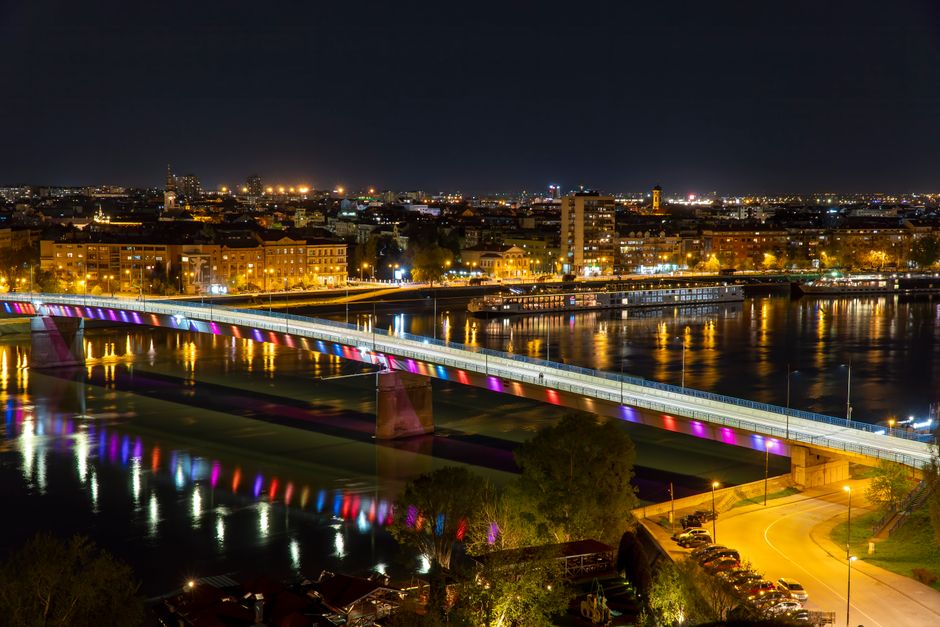
Novi Sad is Serbia’s second city and its most relaxed: a pastel, Central European old town of pedestrian streets and cafés on the left bank of the Danube, facing the great 18th-century Petrovaradin Fortress on the right. It was built by the Habsburgs as a frontier town, it has long been home to Serbs, Hungarians, Slovaks and others, and it is a lively university city that was European Capital of Culture in 2022. You come to stroll Liberty Square and Zmaj Jovina, climb to the fortress for sunset and its upside-down clock, swim from the Štrand beach in summer, and drive out to the baroque town of Sremski Karlovci and the monasteries and wineries of Fruška Gora. Give it a day from Belgrade, or two or three days with the hills.
Right now in Novi Sad
- Wed 11–25°C 51–77°F Clear
- Thu 11–27°C 51–80°F Clear
- Fri 16–21°C 60–69°F 1 mm Partly cloudy
Weather: MET Norway (CC BY 4.0) · Air quality: OpenAQ
Top tours in Novi Sad
See all tours for Novi Sad →
From local operators, with prices and reviews; you check availability and book on Viator, our partner. We may earn a commission at no extra cost to you. How we earn money
Novi Sad at a glance
- Best for: a laid-back old town, the Petrovaradin Fortress, the Danube, wine and monasteries in Fruška Gora, and an easy break from Belgrade.
- How long: 1 day for the old town and the fortress; 2–3 days to add Sremski Karlovci, Fruška Gora or Subotica.
- Best time: May, June and September; July and August for the beach, but it is hot.
- Getting in: Soko high-speed trains from Belgrade take about 34 minutes; they stop at Petrovaradin, because Novi Sad’s main station has been closed since its canopy collapsed in November 2024.
- Getting around: the old town is walkable, and the fortress is a 20-minute walk across the Danube; city buses are run by GSP.
- Before you go: Serbia uses the dinar; entry rules, police registration and money are covered on our Serbia country page. EXIT, the festival that made the fortress famous, moved to Montenegro in 2026.
Novi Sad, area by area
The city lies on the flat left bank of the Danube, with the fortress and the old suburb of Petrovaradin on the hilly right bank, at the foot of Fruška Gora.
The old town (Stari grad)
Pedestrian streets fan out from Liberty Square (Trg slobode), with the neo-Gothic Name of Mary Church, the City Hall and the statue of Svetozar Miletić. Zmaj Jovina and Dunavska streets are lined with cafés and courtyards, and the leafy Danube Park is a short walk away. Best for: first visits, cafés and evenings out.
Petrovaradin
Across the river, the fortress sits above the Lower Town (Podgrađe), a quiet grid of baroque streets with small restaurants and artists’ studios. Best for: views and quieter stays.
Liman and the Danube bank
South of the centre, the modern Liman neighbourhoods lead to the Štrand, the city’s sandy river beach, and the Danube quay, popular with joggers and cyclists. Best for: summer and the river.
Top things to see in Novi Sad
Prices and hours below were checked in October 2026, mostly on official sites. They change, so check before you go.
Petrovaradin Fortress
Built by the Austrians between 1692 and 1780 on the site of older forts, Petrovaradin was one of the largest fortresses in Europe, designed to stop the Ottomans on the Danube. The ramparts, terraces and courtyards are free to walk at any time and give the best view of Novi Sad. Look for the clock tower, whose hands are reversed, with the small hand showing the minutes and the big hand the hours, so that boatmen on the river could read the hour from far away. Beneath the fortress run kilometres of underground military galleries. The City Museum of Novi Sad, in the fortress, runs the museum and guided tours of the galleries; its published price list gives 400 dinars for the museum and 300 dinars for the galleries, with a minimum group charge and an extra fee for an English-speaking guide, but the list dates from 2019, so check with the museum before you go.
Liberty Square and the Name of Mary Church
The main square is framed by the City Hall (1895) and the Catholic Name of Mary Church, with its tall spire and colourful roof tiles, built in 1895 in neo-Gothic style. In December the square fills with a Christmas market and lights. Free.
Zmaj Jovina, Dunavska and the Bishop’s Palace
The two main pedestrian streets are lined with 18th- and 19th-century houses, shops and terraces. At the end of Zmaj Jovina stand the Orthodox Bishop’s Palace and the Cathedral of St George, with an elegant iconostasis. Dunavska leads down to the Danube Park, a romantic 19th-century park with a pond and old plane trees.
The Synagogue
Novi Sad’s Art Nouveau synagogue, completed in 1909 to designs by the Hungarian architect Lipót Baumhorn, survived the Second World War but lost most of its congregation in the Holocaust. It is now used mainly as a concert hall, so you can usually see inside only during events.
The Matica srpska Gallery
One of the most important collections of Serbian art from the 16th to the 20th century, with icons, baroque portraits and 19th-century painting, in a building just off the old town.
The Štrand and the Danube quay
In summer, the Štrand, a long sandy beach on the Danube by the Liberty Bridge, is where the city goes to swim, play beach volleyball and drink in its bars. Swim only in the marked bathing area, as the river’s current is strong. Out of season, walk or cycle along the quay, part of the EuroVelo 6 Danube route.
Cafés, wine and Novi Sad evenings
Novi Sad is a city of cafés: start the day with coffee and a kifla pastry on Zmaj Jovina, and spend the evening in the bars of Laze Telečkog street. Vojvodina’s food reflects its mix of peoples: try riblja čorba (fish soup) and perkelt (a paprika stew of Hungarian origin) in the čardas, the riverside inns, and štrudla with poppy seeds or walnuts. Local wines from Fruška Gora and the sweet, spiced bermet of Sremski Karlovci are served everywhere. In summer, the riverside bars at the Štrand and in Petrovaradin’s Lower Town stay open late.
Day trips from Novi Sad
- Sremski Karlovci: 12 km south-east, a small baroque town with the Patriarchate, the Four Lions fountain, the old seminary and wine cellars where you can taste bermet. City buses run there in about half an hour; in January 2026 the fare was about 190 dinars with an electronic ticket or 250 dinars from the driver.
- Fruška Gora National Park: the wooded ridge south of the city has 16 Orthodox monasteries, including Krušedol, Novo Hopovo and Grgeteg, along with hiking and cycling trails and wineries. As of 2026, the park charges 100 dinars per person on foot and 300 dinars per car per day (it was reported that the fee may apply only at weekends); entry to the monasteries is separate, usually free with a donation. A car or tour is the easiest way to visit.
- Subotica and Palić: about 45 minutes north on the Soko train, Subotica’s Art Nouveau town hall and synagogue are among the most beautiful buildings in Serbia; the lake resort of Palić is 8 km further.
- Belgrade: about 34 minutes by Soko train to Belgrade Centar; see our Belgrade guide.
Nearby destinations
- Belgrade70 km
- Zlatibor180 km
- Sarajevo193 km
- Lake Balaton240 km
- Durmitor National Park243 km
- Budapest256 km
- Hévíz266 km
- Mostar268 km
Getting to Novi Sad
By train. The fastest way: Soko high-speed trains run frequently from Belgrade Centar (about 34 minutes) and from Subotica (about 45 minutes). In Novi Sad they stop at Petrovaradin station, across the Danube from the centre, because the main station has been closed since its entrance canopy collapsed on 1 November 2024, killing 16 people. As of late September 2026, a new stop on Rumenački put, on the north side of the city, had its operating permit and was due to open soon; check Srbijavoz before you travel. A second-class ticket from Belgrade costs roughly 700–770 dinars, a little less online. From Budapest, there is no direct train: you change at Szeged and Subotica (from about €28 on Srbijavoz’s special fare).
By bus. Buses from Belgrade’s New Belgrade bus station take about an hour and a half; international buses run to Budapest, Vienna and further afield. By air. The nearest airport is Belgrade (about 80 km, around an hour by road); Budapest Airport is about three and a half to four hours away. By car. The A1 motorway links Novi Sad with Belgrade (a 340-dinar toll for a car as of 2026) and with the Hungarian border.
Getting around Novi Sad
The old town is small and flat, and almost everything is within walking distance; the walk from Liberty Square across the Varadin Bridge to the fortress takes about 20 minutes. GSP, the city bus company, runs city and suburban buses; as of October 2026, a day ticket for all city lines costs 278 dinars, and electronic tickets are cheaper than paying the driver. Taxis are cheap and plentiful; use registered ones or order by phone. Cycling is easy on the flat streets and the Danube quay.
When to go and how long to stay
Novi Sad has a continental climate: hot summers, cold winters with frost, and changeable springs and autumns. The table uses the official 1991–2020 averages for the Novi Sad (Rimski Šančevi) station that Serbia’s Republic Hydrometeorological Service submitted to the World Meteorological Organization.
| Season | Average daily high | Average nightly low | Rain per month | What it’s like |
|---|---|---|---|---|
| Winter (Dec–Feb) | 4.3–6.9 °C | −2.5 to −1.2 °C | 36–49 mm | Cold and often foggy, with occasional snow; Christmas lights on Liberty Square |
| Spring (Mar–May) | 12.7 °C rising to 23.1 °C | 1.9 °C rising to 11.5 °C | 39–78 mm | Fresh and green, the best time for Fruška Gora’s trails |
| Summer (Jun–Aug) | 26.6–29.2 °C | 14.9–16.1 °C | 60–93 mm | Hot and sunny, with storms; the Štrand beach and riverside bars |
| Autumn (Sep–Nov) | 23.9 °C falling to 11.5 °C | 11.8 °C falling to 3.2 °C | 52–59 mm | Warm in September, with the grape harvest in Sremski Karlovci |
Novi Sad gets about 680 mm of rain a year and about 2,200 hours of sunshine; June is the wettest month and August the warmest.
Novi Sad in 1 day
Arrive by Soko train in the morning and walk from Petrovaradin station up to the fortress for the views and the clock tower. Cross the bridge to the old town for lunch, then explore Liberty Square, Zmaj Jovina, the Bishop’s Palace and the Danube Park, and end with dinner on Laze Telečkog, or catch the evening train back to Belgrade.
Novi Sad in 3 days
Add a day in Sremski Karlovci and Fruška Gora, with a monastery or two and a wine tasting, and a day trip north to Subotica and Palić, or a lazy summer day at the Štrand.
Where to stay in Novi Sad
- The old town: boutique hotels and apartments around Liberty Square and Zmaj Jovina, close to everything; the best choice for a short stay.
- Petrovaradin and the fortress: a few hotels in and below the fortress, with river views and quiet nights.
- Liman: modern hotels and apartments near the Štrand and the quay, 15–20 minutes’ walk from the centre.
- Sremski Karlovci: small guesthouses and wine estates, for a quieter, rural base.
Hotels add a small city tourist tax per person per night; from 15 October 2026, towns set it within national ranges of 90–240 dinars, depending on their category.
Practical tips for Novi Sad
- Check which station you need: trains use Petrovaradin while the main station is closed; allow time to get across the river.
- Be respectful: the canopy collapse at the railway station is a deep wound for the city, and it has sparked large protests across Serbia; keep away from demonstrations, and be mindful at memorials.
- Carry some cash: for buses, markets, the fortress museum and small wineries.
- Mosquitoes: bring repellent for summer evenings by the Danube.
- Monasteries: cover shoulders and knees, and women may be asked to wear a skirt or scarf.
- Fruška Gora by car: keep some dinars for the park fee and parking.
What to pack for Novi Sad
Comfortable shoes for the cobbled fortress and the old town, light clothes, sunscreen and a swimsuit for summer, insect repellent for the river, a warm coat for winter, and a scarf and long trousers or a skirt for monasteries. Hiking shoes help on Fruška Gora’s trails, and a light rain jacket covers spring and early-summer storms. Serbia uses type F sockets, so bring a travel adapter if you come from the UK, North America or Australia.
Novi Sad travel FAQ
Is Novi Sad railway station open?
No. The main station has been closed since its canopy collapsed on 1 November 2024. As of October 2026, trains stop at Petrovaradin across the Danube, and a new stop on Rumenački put was due to open soon.
How do I get from Belgrade to Novi Sad?
Take the Soko high-speed train from Belgrade Centar: about 34 minutes, with second-class fares of roughly 700–770 dinars. Buses take about an hour and a half, and the drive about an hour on the A1 motorway.
Is the EXIT festival still held in Novi Sad?
No. EXIT held its last edition at the Petrovaradin Fortress in 2025 and moved to Montenegro in 2026. The fortress still hosts concerts and events in summer.
Is the Petrovaradin Fortress free?
Yes, the ramparts, terraces and courtyards are free to walk at any time. The City Museum inside and the guided tours of the underground galleries charge a fee.
How much is Fruška Gora National Park?
As of 2026, 100 dinars per person on foot and 300 dinars per car per day; the monasteries are separate and usually free, with donations welcome.
How many days do you need in Novi Sad?
One day covers the old town and the fortress. Two or three days let you add Sremski Karlovci, the Fruška Gora monasteries and wineries, or Subotica.
Can you swim in the Danube in Novi Sad?
Yes, in summer at the Štrand, the city’s sandy river beach, in the marked bathing area. The current is strong, so don’t swim elsewhere in the river.
How do I get to Sremski Karlovci from Novi Sad?
By city bus in about half an hour (about 190 dinars with an electronic ticket in 2026), by taxi in 15–20 minutes, or by bike along the river.
Do I need cash in Novi Sad?
Cards are accepted in most hotels, restaurants and shops, but carry some dinars for buses, markets, small wineries and the fortress museum.
Sources and last review
Researched and last reviewed on 4 October 2026. Soko trains and Budapest connections: Srbijavoz; city bus day ticket: GSP Novi Sad; climate: the official 1991–2020 normals for Novi Sad submitted to the World Meteorological Organization; tourist tax ranges: the national decree as reported in the press. The closure of the main station and the new stop, the fortress museum and galleries prices (a 2019 price list), Fruška Gora fees, the Sremski Karlovci bus fare, the train fare range and the end of EXIT in Novi Sad come from press reports or secondary sources and are flagged for checking. Prices, timetables and rules change, so check the official sites before you go.
Plan your trip
Partner links: TravelerCenter may earn a commission if you book, at no extra cost to you.
🇷🇸 Useful Serbian phrases for Novi Sad
All 38 Serbian phrases: restaurant, hotel, emergencies, romance (printable) →