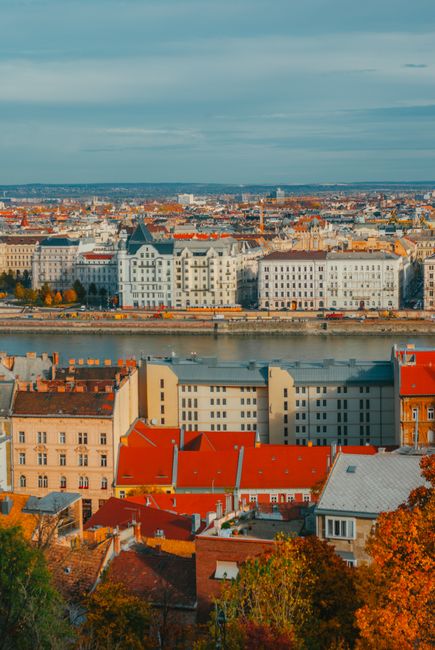
Budapest is two cities joined by the Danube and a string of handsome bridges: hilly Buda, with its castle, churches and wooded hills, and flat, busy Pest, with the Parliament, grand boulevards, coffee houses and the ruin bars of the old Jewish Quarter. It is one of Europe’s great spa cities, with more than a hundred hot springs feeding steaming outdoor pools and Ottoman domes. You come to tour the Parliament, walk the Castle District to Fisherman’s Bastion, soak at Széchenyi, cruise the river at night and eat well for less than in Vienna or Prague. Give it three days for the highlights, four or five to add a day trip to the Danube Bend or Eger.
Right now in Budapest
- Wed 9–23°C 48–74°F Mostly clear
- Thu 12–26°C 53–79°F 6 mm Partly cloudy
- Fri 12–17°C 54–62°F Clear
Weather: MET Norway (CC BY 4.0) · Air quality: OpenAQ · Rates: ECB
Top tours in Budapest
See all tours for Budapest →
From local operators, with prices and reviews; you check availability and book on Viator, our partner. We may earn a commission at no extra cost to you. How we earn money
Budapest at a glance
- Best for: thermal baths, grand architecture, Danube views, nightlife and ruin bars, food and wine, Christmas markets and good-value city breaks.
- How long: 3 days for the Parliament, Buda Castle, a bath and the river; 4–5 days to add museums and a day trip.
- Best time: April to June and September to October for mild weather; November to March for baths and lower prices; late November and December for the Christmas markets.
- Getting in: Budapest Airport is about 40 minutes from the centre on the 100E express bus; direct trains arrive from Vienna in under three hours.
- Getting around: metro, trams and buses run by BKK. As of October 2026, a single ticket costs 500 Ft and a 24-hour travelcard 2,750 Ft.
- Before you go: Hungary uses the forint, not the euro; it is in the Schengen area. Country-wide entry rules, money and driving are covered on our Hungary country page.
Budapest, area by area
Budapest has 23 districts, written in Roman numerals. The Danube banks, the Castle District and Andrássy Avenue are a UNESCO World Heritage Site.
The Castle District and the Buda riverside (District I)
A long limestone hill topped by the Royal Palace, Matthias Church, Fisherman’s Bastion and quiet streets of baroque houses, with the Víziváros (Watertown) neighbourhood below it along the river. Best for: views, romantic hotels and early-morning walks before the tour groups arrive.
Belváros and Lipótváros (District V)
The heart of Pest: the Parliament, St Stephen’s Basilica, the Danube promenade, Vörösmarty Square, the shopping street Váci utca and the Central Market Hall at its southern end. Best for: first visits, walking everywhere and Christmas markets.
The Jewish Quarter and Terézváros (Districts VII and VI)
The old Jewish Quarter around the Dohány Street Synagogue is now the nightlife district, packed with ruin bars and restaurants; next door, Andrássy Avenue leads to City Park and the Széchenyi Baths. Best for: food, bars and an easy metro ride to everything.
Gellért Hill, Óbuda and the Buda Hills
Gellért Hill rises above the river with the Citadella on top; Óbuda has Roman ruins and old taverns; and the forested Buda Hills have trails, a chairlift and the Children’s Railway. Best for: walks and quieter stays.
Top things to see in Budapest
Prices and hours below were checked on the official sites in October 2026. They change, so check before you go.
The Hungarian Parliament
Completed in 1904, the Parliament (Országház) is Hungary’s largest building, with a 96-metre dome. Inside, guided tours of about 45 minutes visit the grand staircase, the Dome Hall where the Holy Crown of Hungary is kept under guard, and the old upper house chamber. Visits start at the underground visitor centre on the north side of Kossuth Square, after a security check. Tickets: as of October 2026, adult tickets cost 7,000 Ft for citizens of the EU and EEA and 14,000 Ft for everyone else; students aged 6 to 24 pay 3,500 Ft or 7,000 Ft, and children under 6 go free. Tours run in English and other languages and often sell out days ahead, so book online and bring the ID you booked with. Tours may not run when Parliament is sitting or hosting state events.
Buda Castle and the Royal Palace
The Royal Palace, rebuilt many times since the Middle Ages, holds the Hungarian National Gallery and the Budapest History Museum; the courtyards, terraces and the Habsburg Steps are free to wander, with some of the best views of the Parliament. In September 2026 the government halted reconstruction work on part of the palace pending a review, so expect fences and closed areas. Walk up from the Chain Bridge, take bus 16 from Deák tér, or ride the Castle Hill Funicular (Budavári Sikló), which has run since 1870: as of October 2026, it costs 4,500 Ft one way or 5,500 Ft return for adults (2,000 Ft one way for children aged 3 to 14) and runs 8:00–22:00, but it is closed for maintenance from 5 to 16 October 2026 and on alternate Mondays.
Matthias Church and Fisherman’s Bastion
Matthias Church, with its patterned tile roof and soaring Gothic spire, was the coronation church of Hungary’s last kings. As of October 2026, entry costs 3,400 Ft for adults (2,700 Ft for students and seniors, 9,500 Ft for a family), with an audio guide for 1,600 Ft extra; the tower climb, 197 steps with a short guided tour, costs 4,000 Ft. Visiting hours change daily around Masses and events, so check the church’s website on the day. Next to it, the white turrets of Fisherman’s Bastion (built 1895–1902) frame the classic view over the Danube to the Parliament. The lower terraces are free; the upper towers cost 1,700 Ft (850 Ft reduced) and open 9:00–19:00 from October to 23 December 2026. Come at sunrise or after dark, when it is free and almost empty.
St Stephen’s Basilica
Budapest’s largest church, finished in 1905, is the same height as the Parliament, 96 metres, and keeps the mummified right hand of St Stephen, Hungary’s first king. You pay separately for the church, the treasury and the panorama terrace around the dome, which you can reach by lift or stairs for a 360-degree view; combined tickets are sold online. As of October 2026, the church opens 9:00–18:00 Monday to Saturday and 13:00–18:00 on Sundays, and the terrace daily from 9:00.
The Danube embankment and the Shoes on the Danube Bank
Walk the Pest riverbank from the Parliament past the Chain Bridge, reopened in 2023 after renovation. Near the Parliament, sixty pairs of cast-iron shoes remember the Jews shot into the river by the Arrow Cross militia in 1944–45. It is free and moving; be respectful.
The Citadella and Gellért Hill
The 19th-century fortress on top of Gellért Hill reopened in April 2026 after a long renovation, with a restored Liberty Statue, a park and viewing terraces that are free to visit, and a new paid exhibition on Hungary’s struggles for freedom. The climb from the Elizabeth Bridge takes 20 to 30 minutes, past the statue of St Gellért; bus 27 goes most of the way.
Andrássy Avenue, the Opera and Heroes’ Square
Budapest’s grand boulevard runs 2.5 km to Heroes’ Square past the State Opera House and the House of Terror, a museum about the fascist and communist dictatorships. Under it runs the M1, continental Europe’s oldest underground railway (1896). City Park, beyond the square, has Vajdahunyad Castle, the House of Music and the Museum of Ethnography.
The Dohány Street Synagogue
Europe’s largest synagogue (1859), with the Jewish Museum and the weeping-willow Holocaust memorial. It closes on Saturdays and Jewish holidays; dress modestly.
Palaces
- Buda Castle
Viewpoints
- Fisherman's Bastion
Churches and cathedrals
- Matthias Church
- St Stephen's Basilica
Monuments
- Heroes' Square
- Hungarian Parliament Building
Museums
- Dohány Street Synagogue
Budapest’s thermal baths
Bathing is a way of life in Budapest. Bring a swimsuit, flip-flops and a towel (or rent one); you get a locker or a cabin with your ticket. Weekday mornings are the quietest time, and evenings at weekends the busiest.
- Széchenyi Baths: the famous yellow palace in City Park, with three big outdoor pools (open all year, gloriously steamy in winter) and more than a dozen indoor thermal pools and saunas. As of October 2026, a day ticket with a locker costs 13,200 Ft Monday to Thursday, 14,800 Ft from Friday to Sunday and on holidays, and 15,800 Ft on peak days (including 23–25 October and 18 December 2026 to 6 January 2027); a “Good Morning” ticket for entry before 9:00 costs 10,500 Ft on weekdays, and Fast Track tickets bought online cost 2,000 Ft more. It opens at 7:00 on weekdays and 8:00 at weekends, closing at 20:00, or 22:00 on Fridays. Metro M1 to Széchenyi fürdő.
- Gellért Baths: closed. The Art Nouveau bath at the Gellért Hotel, with its mosaics and columned indoor pool, closed on 30 September 2025 for a full restoration planned to finish in 2028. Ignore any website still selling tickets.
- Rudas Baths: by the Elizabeth Bridge, a 16th-century Ottoman bath with an octagonal pool under a dome, plus a modern wellness wing with a rooftop hot tub overlooking the Danube. The historic Turkish section has separate men’s and women’s days and mixed days, and late-night bathing at weekends.
- Lukács Baths: in north Buda, a calmer bath popular with locals, and free with the Budapest Card.
- Etiquette and health: take a shower before you get in, wear a swimming cap in lap pools, keep soaks in the hottest medicinal pools to about 20 minutes, and drink water. People with heart problems or high blood pressure, and pregnant women, should check with a doctor first.
Ruin bars, cafés and the river at night
The ruin bars of District VII grew up in abandoned courtyard buildings; Szimpla Kert is the most famous. Residents ask visitors to keep the noise down on the streets late at night. For a calmer evening, take a Danube cruise after dark, when the Parliament, the Castle and the bridges are lit, or see a performance at the Opera House or the Liszt Academy. By day, try the grand coffee houses and the Central Market Hall.
Activities and best months
- Boat tripsBKK's public transport includes Danube boat lines, and the Budapest Card includes a Danube sightseeing cruise; after dark the Parliament, the Castle and the bridges are lit along the river (UNESCO-listed Danube banks). · source
- City sightseeingThe Budapest Card, sold by BKK, includes unlimited public transport in the city, a Danube sightseeing cruise, the Lukács Baths, the Buda Hills chairlift and free entry to more than 30 museums (including the Museum of Fine Arts and the Hungarian National Gallery), with discounts at St Stephen's Basilica, the Dohány Street Synagogue and the zoo; tram 2 along the Pest riverbank passes the Parliament. · source
Day trips from Budapest
- Szentendre: a cobbled artists’ town 40 minutes north on the H5 HÉV suburban railway from Batthyány tér, with Serbian churches, galleries and the Skanzen open-air village museum; boats go up the river in summer.
- Visegrád and Esztergom: the hilltop citadel above the Danube Bend and Hungary’s biggest basilica, about an hour or so by train, bus or seasonal boat; combine them by car or on a tour.
- Eger: castle, minaret and wine cellars, just under two hours by direct train from Keleti station; better with a night.
- Lake Balaton: Siófok is about an hour and a quarter by train, Balatonfüred and Tihany about an hour and a half to two hours; best overnight.
- Vienna: under three hours by direct train; see our Vienna guide.
Nearby destinations
- Banská Štiavnica107 km
- Eger109 km
- Lake Balaton123 km
- Hévíz161 km
- Bratislava161 km
- High Tatras202 km
- Zakopane211 km
- Vienna214 km
Getting to Budapest
By air. Budapest Ferenc Liszt International Airport (BUD) is about 16 km south-east of the centre. The 100E airport express bus runs from outside Terminal 2 to Kálvin tér, Astoria and Deák Ferenc tér in about 40 minutes, around the clock and every 10 minutes or so in the daytime. As of October 2026, it needs an airport ticket for 2,500 Ft (normal tickets and travelcards are not valid, but holders of a monthly Budapest pass can buy a 1,000 Ft supplement); buy it from the purple machines, in the BudapestGO app, or tap a contactless bank card on the readers on board. Official airport taxis wait outside arrivals.
By train. International trains from Vienna, Munich, Prague, Bratislava and Zagreb arrive at Keleti or Kelenföld stations; Railjets from Vienna take under three hours. By car. Motorways need an e-matrica vignette (as of October 2026, 5,550 Ft for one day or 6,900 Ft for ten days for a car); in the city, park at your hotel or a park-and-ride, as central street parking is expensive and limited.
Getting around Budapest, BKK tickets and the Budapest Card
BKK runs four metro lines, trams, buses, trolleybuses, the HÉV suburban railways and public boats. Tram 2 along the Pest riverbank is a sightseeing ride in itself. As of October 2026:
- Single ticket (vonaljegy): 500 Ft, or 700 Ft if bought from the driver; 4,500 Ft for a pack of ten. A single ticket is valid for one journey without changes, except between metro lines.
- Time tickets: 30 minutes for 600 Ft or 90 minutes for 850 Ft, with unlimited changes.
- Travelcards: Budapest 24-hour ticket 2,750 Ft and 72-hour ticket 5,750 Ft, the easiest choice for most visitors (not valid on the 100E).
- How to pay: use the BudapestGO app, the purple ticket machines, or tap a contactless card on the Budapest Pay&GO readers, which charge the fare automatically. Paper tickets must be validated before or as you board, and inspectors are common.
The Budapest Card, sold by BKK, includes unlimited public transport within the city, entry to the Lukács Baths, a Danube sightseeing cruise, a ride on the Buda Hills chairlift, a vintage tram ride in season and free entry to more than 30 museums, including the Museum of Fine Arts, the Hungarian National Gallery and the Hungarian National Museum, plus discounts on others such as the Basilica, the Dohány Street Synagogue and the zoo. As of October 2026, it costs 17,990 Ft for 24 hours, 23,990 Ft for 48 hours, 29,990 Ft for 72 hours and 38,990 Ft for 96 hours; a 72-hour PLUS version (39,990 Ft) adds more extras, and a 72-hour FLEXI version costs 27,990 Ft.
When to go and how long to stay
Budapest has hot summers and cold winters, with most rain in early summer, often in short thunderstorms. The table uses HungaroMet’s official 1991–2020 averages for Budapest (Pestszentlőrinc station, near the airport).
| Season | Average daily high | Average nightly low | Rain per month | What it’s like |
|---|---|---|---|---|
| Winter (Dec–Feb) | 3.0–5.8 °C | −2.5 to −1.3 °C | 31–40 mm | Cold, grey, occasional snow; steaming outdoor baths and Christmas markets |
| Spring (Mar–May) | 11.3 °C rising to 22.6 °C | 2.3 °C rising to 11.6 °C | 32–67 mm | Fresh, blossoming, café terraces reopen; the Budapest Spring Festival |
| Summer (Jun–Aug) | 26.2–28.1 °C | 15.2–16.7 °C | 61–75 mm | Hot, often above 30 °C, with storms; open-air bars, Sziget and the Grand Prix |
| Autumn (Sep–Nov) | 22.5 °C falling to 9.4 °C | 12.2 °C falling to 3.1 °C | 45–52 mm | Warm and settled in September, golden in October; wine festival in the castle |
Budapest gets about 586 mm of rain a year; July is the warmest and busiest month.
Budapest in 2 days
Day 1: a morning Parliament tour, the Shoes on the Danube Bank, St Stephen’s Basilica and its dome, then across the Chain Bridge and up to the Castle District for Matthias Church and Fisherman’s Bastion at sunset; dinner and a ruin bar in District VII. Day 2: Andrássy Avenue on the old M1 metro, Heroes’ Square and an afternoon at the Széchenyi Baths, then an evening Danube cruise.
Budapest in 4 days
Add the Central Market Hall, the Dohány Street Synagogue and the House of Terror on day 3, with a climb to the Citadella and a soak at the Rudas Baths in the evening. On day 4, take the HÉV to Szentendre or spend the day at Visegrád and Esztergom on the Danube Bend.
Weather month by month
Averages from HungaroMet normals 1991–2020, Budapest Pestszentlőrinc · Last reviewed 4 Oct 2026
Where to stay in Budapest
- District V (Belváros-Lipótváros): central, walkable and close to the river, with hotels for every budget; the best choice for a first visit.
- District VII (Erzsébetváros): lively and good value, close to the nightlife; ask for a room away from the street if you want to sleep.
- District VI (Terézváros): elegant streets around Andrássy Avenue and the Opera, a short walk from the centre and handy for Széchenyi.
- Castle District and Víziváros (District I): quiet, historic and scenic, but hilly and further from restaurants and nightlife.
Prices peak around the Grand Prix, Sziget, New Year’s Eve and December weekends. A local tourist tax (idegenforgalmi adó), set by each district and often 4% of the room price, is added to the bill or paid at the hotel.
Practical tips for Budapest
- Book the Parliament early: tours sell out days ahead in high season, and EU and non-EU visitors pay different prices, so bring the ID you booked with.
- Use forints and bank ATMs: avoid the independent cash machines in tourist streets and choose to be charged in forints.
- Check the bill: many restaurants add a 10–15% service charge; if so, don’t tip on top.
- Taxis: order by phone or app (licensed taxis are yellow, with fixed metered rates) rather than hailing cars at the station.
- Watch your bag on trams 2, 4 and 6, in the metro and in the nightlife district.
- Free views: the Bastion’s lower terraces, the Citadella park and the castle terraces cost nothing.
What to pack for Budapest
A swimsuit and flip-flops for the baths (or water shoes with grip on wet tiles), a quick-dry towel, comfortable shoes for cobbles and the climbs to the Castle and the Citadella, a light rain jacket for spring and summer storms, and a warm coat, hat and gloves from November to March. Hungary uses type F sockets, so bring a travel adapter if you come from the UK, North America or Australia.
What to pack
- City walking shoesLisbon and Porto are steep, with polished limestone cobbles that get slippery, so grippy soles matter.
- Day packs and anti-theft bagsA small zipped or anti-theft bag makes crowded trams and viewpoints less stressful.
- Dry bags and phone pouchesSpray soaks phones and cameras on open boats to the Algarve caves and on whale-watching trips.
- Fleeces and warm layersIt is cooler at sea than on land, especially on morning whale-watching trips.
- Rain jacketsA windproof, waterproof shell keeps you warm on open boats, where wind and spray cool you quickly.
- Reef-friendly sunscreenSun reflects off the water on cruises and cave tours.
- Travel adapters and convertersPortugal uses Type C and F sockets at 230 V, so most visitors from outside Europe need an adapter.
- Water shoesKayak and small-boat trips to the Algarve grottoes land on rock and wet sand.
Budapest travel FAQ
How much does a Hungarian Parliament tour cost?
As of October 2026, 7,000 Ft for adult EU and EEA citizens and 14,000 Ft for other visitors; students aged 6 to 24 pay half, and children under 6 are free. Book online in advance.
Is the Gellért Baths open?
No. It closed on 30 September 2025 for a restoration planned to last until 2028. Go to Széchenyi, Rudas or Lukács instead.
How much is the Széchenyi Baths?
As of October 2026, a day ticket with a locker costs 13,200 Ft from Monday to Thursday and 14,800 Ft from Friday to Sunday, with higher prices on peak days. Entry before 9:00 is cheaper.
How do I get from Budapest Airport to the city centre?
Take the 100E express bus to Deák Ferenc tér, about 40 minutes. As of October 2026, it needs its own 2,500 Ft airport ticket, or tap a contactless card on board. Travelcards aren’t valid on it.
Is the Budapest Card worth it?
If you plan several museums, yes: as of October 2026 it costs 17,990 Ft for 24 hours and includes public transport, the Lukács Baths and a river cruise. It does not include the Parliament or Széchenyi, so if those are your priorities, a 24- or 72-hour travelcard is better value.
Is Fisherman’s Bastion free?
The lower terraces are free. The upper towers cost 1,700 Ft as of October 2026 during opening hours (9:00–19:00 until 23 December 2026), and are free outside them.
How much is public transport in Budapest?
As of October 2026, a single ticket costs 500 Ft, a 24-hour travelcard 2,750 Ft and a 72-hour one 5,750 Ft. You can pay by tapping a contactless card on the Pay&GO readers.
Do I have to pay a tourist tax in Budapest?
Yes. Each district sets its own tourist tax per night, often 4% of the room price; hotels and apartments add it to the bill.
How many days do you need in Budapest?
Three days for the Parliament, the Castle District, a bath, the Basilica and a cruise; four or five to add museums and a day trip to the Danube Bend or Eger.
Can I pay in euros in Budapest?
Sometimes, but at a poor rate. Hungary uses the forint, and cards are accepted almost everywhere, so pay by card in forints or withdraw forints from a bank ATM.
Sources
- © OpenStreetMap contributors · ODbL · fetched 4 Oct 2026
- Wikidata · CC0 · fetched 4 Oct 2026
Sources and last review
Researched and last reviewed on 4 October 2026. Parliament ticket prices: Hungarian Parliament visitor pages; Széchenyi prices and hours: the Széchenyi Baths; the Gellért closure: Budapest Spas and the Hungarian press; Matthias Church: the church; Fisherman’s Bastion: the Castle District’s operating company; the funicular: BKV; St Stephen’s Basilica hours: the Basilica; BKK fares, the 100E ticket and the Budapest Card: BKK; e-matrica prices: National Toll Payment Services; climate: HungaroMet 1991–2020 averages. The Citadella reopening, the halt to palace works, 100E frequency, the district tourist tax and train times come from press reports or secondary sources and are flagged for checking. Prices, timetables and rules change, so check the official sites before you go. For the other side of the border, see our Vienna guide.
Plan your trip
Partner links: TravelerCenter may earn a commission if you book, at no extra cost to you.
🇭🇺 Useful Hungarian phrases for Budapest
All 38 Hungarian phrases: restaurant, hotel, emergencies, romance (printable) →