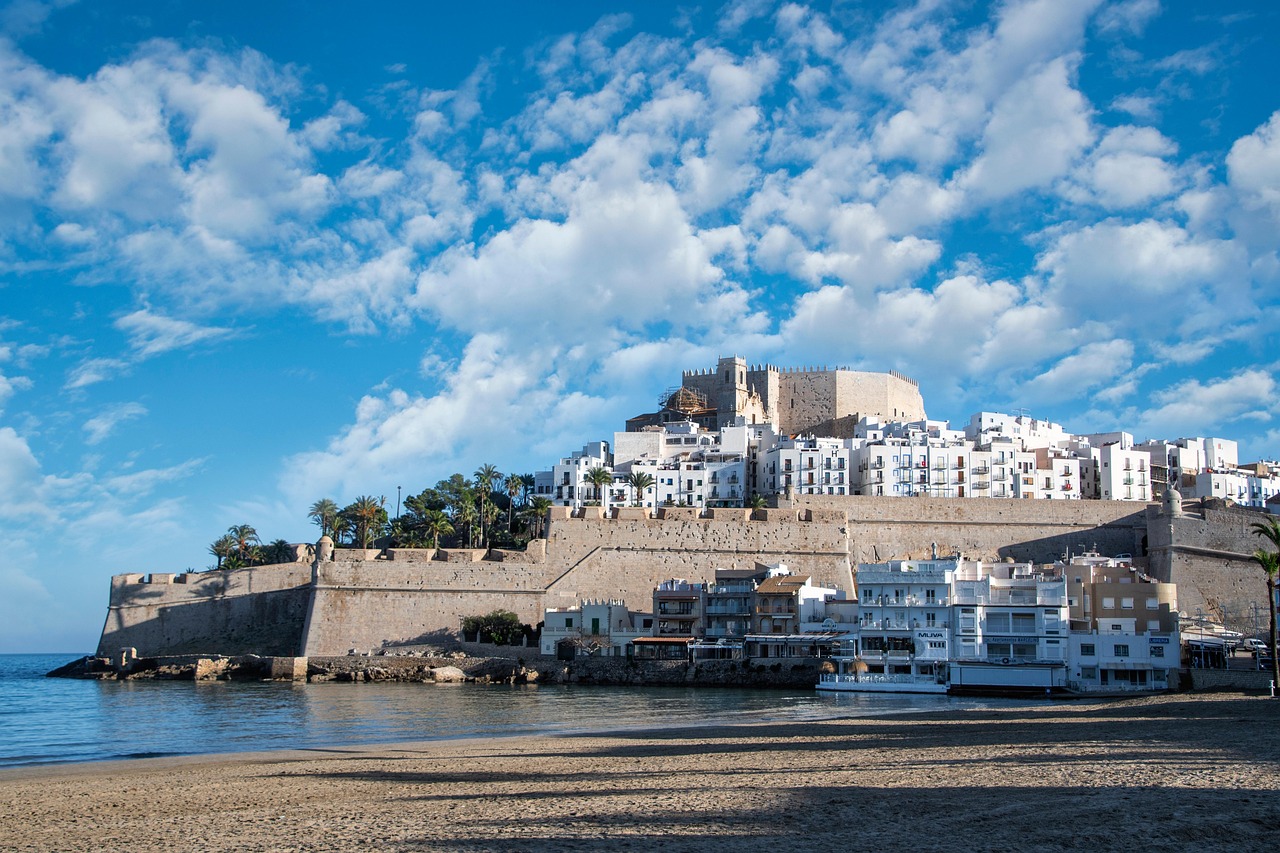
Peñíscola (Peníscola in Valencian) is a walled town on a rocky peninsula on the Costa del Azahar, in the far north of the Valencian Community, roughly halfway between Valencia and Barcelona. Its whitewashed old town climbs to a Templar castle where Pope Benedict XIII, the “Papa Luna”, held court in the 15th century, and the views from its walls take in two very different coasts: a long sandy beach lined with hotels to the north and, to the south, the wild cliffs and coves of the Serra d’Irta natural park. Film-makers love it, from El Cid to Game of Thrones. Summer is busy and hot; May, June and September are the sweet spot for beaches, walking and quieter streets.
Right now in Peñíscola
- Wed 18–23°C 65–74°F 1 mm Showers
- Thu 18–22°C 64–72°F Clear
- Fri 13–19°C 56–66°F Cloudy
- Mon 12 Oct National Day of Spain (Fiesta Nacional de España)
Weather: MET Norway (CC BY 4.0) · Sea temperature: NOAA CoastWatch · Rates: ECB · Holidays: Nager.Date
Top tours in Peñíscola
See all tours for Peñíscola →
From local operators, with prices and reviews; you check availability and book on Viator, our partner. We may earn a commission at no extra cost to you. How we earn money
Peñíscola at a glance
- Best for: a castle and a medieval old town by the sea, sandy beaches, coastal walks and cycling in the Serra d’Irta, seafood and film locations.
- How long: 2 days for the castle, the old town and a beach; 4–5 days to add the Serra d’Irta, Morella and the Ebro Delta.
- Best time: May, June and September; July and August are hot (average highs of about 30–31 °C) and crowded. The castle and many hotels stay open all year.
- Getting there: trains to Benicarló-Peñíscola station; Castellón airport is the closest, with Valencia and Reus airports about 1 h 30 away by car.
- Getting around: on foot in town and along the seafront, a local bus to Benicarló and Vinaròs, and a car or bike for the Serra d’Irta and day trips.
- Before you go: entry rules, money, trains and general safety are on our Spain travel guide.
Peñíscola’s areas and who each one suits
Peñíscola is small: the old town sits on its rock in the middle, with the modern resort spread along the beaches on either side.
The old town on the rock
Inside the walls, about 27 steep, narrow streets of whitewashed houses lead up to the castle. There are a few small hotels and many holiday flats, plus restaurants and souvenir shops. It is magical in the evening once the day visitors leave, and cars are restricted, but expect steps and cobbles: not ideal with heavy luggage or limited mobility.
Playa Norte and the Avenida Papa Luna
Most hotels and apartments line the seafront avenue behind the 5.5 km Playa Norte, which runs from the foot of the castle all the way to Benicarló. Flat, family-friendly and with a long promenade for walking and cycling, it is the best base for a beach holiday. Hotels nearest the old town are the most convenient; those further north are quieter.
Playa Sur and the port
South of the rock, the fishing and leisure port shelters the small Playa Sur, with calm water thanks to the breakwater. This side is more local, with seafood restaurants near the fish market and boat trips leaving from the harbour. Good for couples and anyone who wants to be close to both the old town and the Serra d’Irta.
Towards the Serra d’Irta
South of the port, villas, apartments and campsites spread up the hills towards the natural park. It is quieter, greener and has sea views, but you will need a car or a good walk to reach the town. Best for walkers, cyclists and longer self-catering stays.
Top things to see in Peñíscola
Prices and hours below were checked on the official sites in October 2026, unless we say otherwise; check again before you go.
Papa Luna Castle
The Knights Templar built the castle in the early 14th century on the remains of an Arab fortress. From 1411 it became the home of Benedict XIII, the Aragonese anti-pope Pedro de Luna, who refused to give up his title during the Great Western Schism and turned Peñíscola into a papal seat, with Avignon and Rome. Visit the Gothic halls, the papal basilica, the old stables and the terraces, with wide views over the sea and the town. The castle belongs to the Provincial Council of Castellón (Diputació de Castelló). As of October 2026 entry costs €5, or €3.50 for ages 9–16, students, teachers, the unemployed and over-60s, and it is free for children up to 8 accompanied by an adult. Only card payments are accepted. From Palm Sunday to 15 October it opens 9:30–21:30; from 16 October to Palm Sunday, 10:30–17:30. The ticket office closes 30 minutes earlier. It closes on 1 and 6 January, 9 September, 9 October and 25 December, and also during weather alerts.
The old town, the bufador and the lighthouse
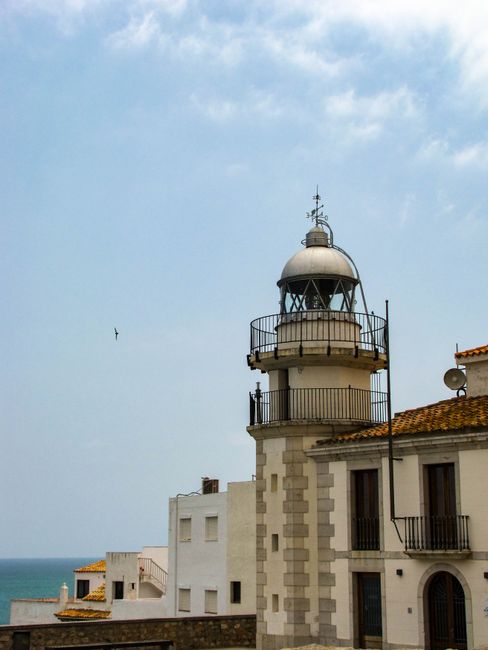
Enter through the Portal Fosc, the 16th-century gateway built for Philip II, at the top of a ramp framed by Renaissance walls, or through the Portal de Sant Pere, built in 1411 by Benedict XIII when the sea still lapped the walls. Wander up past the Casa de les Petxines, a house whose facade is entirely covered in seashells, the parish church of Santa María, where the Papa Luna celebrated Mass, and the Plaza de Armas in front of the castle. On the north side, the bufador is a natural tunnel through the rock to the sea; on stormy days, waves surge up it with a roar. The lighthouse dates from 1892, and the Museu de la Mar, in the Baluarte del Príncipe, tells the story of the town’s fishermen. The town hall’s tourist office runs free guided walks; ask about times there.
Playa Norte and Playa Sur
The Playa Norte is a 5.5 km sweep of fine sand from the castle to Benicarló, with Blue Flag status, lifeguards, accessible points and a promenade the whole way. The sea shelves gently, so it is ideal for families. The Playa Sur, about 650 m long, lies next to the fishing port and has very calm water, showers and a play area; beyond a small breakwater is the Playa de las Viudas, where Berlanga filmed Calabuch. For more natural beaches, head into the Serra d’Irta. See our beaches guide.
Serra d’Irta Natural Park
Just south of town begins one of the last undeveloped stretches of the Spanish Mediterranean: 7,743 hectares of hills, pines and scrub, and 12 km of coast of low cliffs, coves and pebble beaches, protected as a natural park and marine reserve since 2002. A dirt track and footpaths run along the shore past the round Torre Badum watchtower, perched on a cliff, to the beaches of El Pebret and Russo and on to Alcossebre. Inland, the ruined castles of Xivert and Pulpís recall the Templars, and the highest point, Campanilles, reaches 572 m. In summer, cars need a booked parking place: in 2026, from 20 June to 6 September, barriers at Peñíscola (before Torre Badum) and Alcossebre let in only vehicles with a reservation made 2 to 7 days ahead in the GVA Parcs Naturals app. On foot or by bike, access is free all year.
Peñíscola on screen
Peñíscola has been a film set since 1913. Anthony Mann’s El Cid (1961), with Charlton Heston and Sophia Loren, used the walled town as Valencia; Luis García Berlanga shot Calabuch here in 1956; and in 2015 the old town became part of the city of Meereen in the sixth season of Game of Thrones, including scenes in the Plaza de Santa María. The tourist office’s “Ruta de Cine” leaflet guides you to 14 locations at your own pace.
More to see
- Parque de Artillería: gardens and bastions between the medieval and Renaissance walls, with a hidden passage down to the sea.
- Ermita de la Virgen de la Ermitana: the early-18th-century Baroque shrine of the town’s patron saint, next to the castle.
- Font de la Petxina: a 16th-century fountain and washhouse built under Philip II.
- Papa Luna statue: a bronze of the pontiff in his tiara, unveiled in 2007.
- The fishing port: watch the fishing boats come in, below the castle walls.
Other things to do in Peñíscola
Boat trips and water sports
From spring to autumn, sightseeing boats leave the port for short trips around the rock, the best way to see the castle and walls rising from the sea, and longer cruises along the Serra d’Irta coast. On the Playa Norte, sailing and paddleboard schools and kayak hire run in summer. See our boat trips and snorkeling guides.
Hiking and cycling in the Serra d’Irta
Signposted routes include the easy coastal walk from Peñíscola past Torre Badum to the Pebret dunes, the route from the Irta lighthouse to Cala Cubanita, and climbs to the castles of Pulpís and Xivert or along the ridges to Campanilles. The town also promotes five circular dry-stone routes. Mountain bikers can follow the Ruta del Cranc along the coast or the Ruta del Xoriguer through the hills. Paths are stony and there is little shade, so walk early and carry plenty of water. See our hiking and cycling guides.
Seafood
Peñíscola’s fishing fleet supplies the restaurants around the port and in the old town. Try arroz a banda and other rice dishes, suquet fish stew, cuttlefish, and the prawns of neighbouring Vinaròs. Rice dishes are usually for a minimum of two people and are best at lunchtime.
Day trips and onward travel
Morella and the Maestrat
About an hour inland by car, Morella is one of Spain’s most striking walled towns, a ring of medieval walls around a hill crowned by a castle, with an arcaded main street and a Gothic basilica. The drive climbs through the dry, rugged hills of the Maestrat. Wear good shoes for the castle climb and bring a jacket: Morella is around 1,000 m up and much cooler than the coast.
Vinaròs, the Ebro Delta and Benicàssim
Vinaròs, the next town north, is known for its prawns and its Sunday seafront; the local bus links it with Peñíscola and Benicarló. About an hour north, across the border in Catalonia, the Ebro Delta is a flat world of rice fields, lagoons, flamingos and empty sand spits, best by bike; see our Costa Daurada guide for more of the coast beyond. To the south, Benicàssim has long beaches and a summer music festival, and the city of Valencia is about 1 h 30 to 2 h by car.
Nearby destinations
- Costa Daurada85 km
- Valencia119 km
- Sitges153 km
- Ibiza177 km
- Zaragoza180 km
- Barcelona187 km
- Formentera205 km
- Benidorm208 km
Getting there and getting around
By air
Castellón airport (CDT), inland near Vilanova d’Alcolea, is the closest, about 45 minutes by car, with a small number of routes. According to the airport, an Autos Mediterráneo bus timed to flights runs to Castellón bus station for €12 (tickets online only), and a shuttle bus links the airport with Torreblanca train station for €1.65 as of October 2026, about seven times a day, from where regional trains run north towards Benicarló-Peñíscola. Valencia airport (VLC) and Reus airport (REU) are each roughly 1 h 30 to 1 h 45 by car, and Barcelona airport about 2 h 30; all three have far more flights, but you will need a car, or a train and a connection.
By train and bus
Peñíscola has no station of its own. Benicarló-Peñíscola station, in Benicarló about 7 km away, is on the coastal line between Valencia, Castellón and Tortosa, with regional trains and some long-distance services towards Valencia and Barcelona. From the station, take a taxi or the local bus. The town hall points to Autos Mediterráneo for the local bus between Peñíscola, Benicarló and Vinaròs, and to HIFE for coaches to other towns. Check timetables on the operators’ sites, as services are reduced outside summer.
Driving, parking and the old town
The AP-7 motorway and the N-340 pass just inland, with exits for Peñíscola and Benicarló. Since 2021 an automatic number-plate barrier controls access to the walled old town 24 hours a day: only registered residents, deliveries, taxis and other authorised vehicles may enter, so park outside the walls. Much of the street parking in town is in a paid ORA zone, and in summer the car parks near the port and the castle rock fill early. For the Serra d’Irta coast in summer, remember to book your parking place in advance.
When to go and how long to stay
Peñíscola has a mild Mediterranean climate, with hot, dry summers, mild winters and most of its rain in autumn, often in short, heavy downpours. There is no long-term AEMET station in the town, so the table uses AEMET’s 1991–2020 climate normals for the Castellón-Almassora weather station, also on the coast, about 60 km south-west: average daily highs and lows, and days with at least 1 mm of rain. Peñíscola’s figures are very similar.
| Season | Average high / low | Rainy days per month | What it’s like | Good for |
|---|---|---|---|---|
| Winter (Dec–Feb) | 16 °C / 6–8 °C | 3–4 | Mild and mostly sunny; quiet, with some places closed | The castle, walking, low prices |
| Spring (Mar–May) | 19–24 °C / 9–15 °C | 4 | Warm, sunny and green, the sea still cool | Serra d’Irta, cycling, Morella |
| Summer (Jun–Aug) | 28–31 °C / 19–22 °C | 2–3 | Hot, humid and very busy; warm sea | Beaches, boat trips, the theatre festival |
| Autumn (Sep–Nov) | 28 °C falling to 19 °C / 19 °C falling to 10 °C | 4–5 | Warm sea in September; the wettest season, with occasional storms | Swimming in September, walking in October and November |
Castellón averages about 437 mm of rain a year on only 43 days, with September and October the wettest months, and about 3,060 hours of sunshine. The sea is warmest from July to September. These are long-term averages; recent summers have often been hotter.
Events worth planning around
- July: the Festival de Teatro Clásico in the castle; the 2026 edition ran from 6 to 18 July.
- Summer: concerts in the castle, including a festival of early and Baroque music.
- Early September: the patron saint’s festival of the Virgen de la Ermitana, of national tourist interest, with traditional dances on 8 and 9 September around the shrine and the Plaza de Armas. The castle closes on 9 September.
How long to stay: 2, 3 and 5 days
2 days: day one, the castle in the morning, lunch by the port and the old town, the bufador and the walls at sunset; day two, a boat trip round the rock and an afternoon on the Playa Norte.
3 days: add a walk or bike ride along the Serra d’Irta coast to Torre Badum and the Pebret beach. 5 days: add a day in Morella and a day in the Ebro Delta, or Vinaròs and Benicàssim.
Where to stay in Peñíscola and the tourist tax
- Old town: small hotels and flats with character; many steps and limited car access.
- Playa Norte: the widest choice of hotels and apartments, right on the beach.
- Playa Sur and the port: close to the old town, restaurants and boats.
- Serra d’Irta side: villas, apartments and campsites for quiet, longer stays; a car helps.
Book well ahead for July and August and for Spanish holiday weekends; outside summer, prices drop sharply and some seasonal hotels close. There is no tourist tax in Peñíscola: as of October 2026 there is none anywhere in the Valencian Community, after the regional tax passed in 2022 was repealed in November 2023, before it took effect.
Practical tips for Peñíscola
- Castle tickets: pay by card only, and arrive at least 30 minutes before closing time.
- Beat the heat: in summer, visit the old town early in the morning or in the evening, when it is cooler and less crowded.
- Book Irta parking: from late June to early September, reserve your car space in the GVA Parcs Naturals app 2 to 7 days ahead.
- Leave the car outside the walls: the old town is closed to unauthorised vehicles, and cameras read number plates.
- Language: Valencian and Spanish are both official; signs may read Peníscola.
- Emergencies: call 112.
What to pack for Peñíscola
Pack light summer clothes, a swimsuit, a hat, sunglasses and high-factor sunscreen, plus a beach towel and water shoes for the pebble coves of the Serra d’Irta. Comfortable shoes with good grip are essential for the old town’s steep, polished cobbles and the castle steps; for the Irta trails, bring walking shoes, a daypack and at least a litre and a half of water per person in warm weather. A light jacket is enough for spring and autumn evenings, and a warmer layer for winter and for Morella.
Peñíscola travel FAQ
How much is Peñíscola Castle?
As of October 2026, €5 for adults and €3.50 reduced for ages 9–16, students, teachers, the unemployed and over-60s; children up to 8 go free. Payment is by card only.
What are the castle’s opening hours?
From Palm Sunday to 15 October, 9:30–21:30; from 16 October to Palm Sunday, 10:30–17:30. It closes on 1 and 6 January, 9 September, 9 October and 25 December, and during weather alerts.
Was Game of Thrones filmed in Peñíscola?
Yes. In 2015 the old town was used for the city of Meereen in season six, including the Plaza de Santa María. Earlier, El Cid (1961) was filmed on its walls.
Can I drive into Peñíscola’s old town?
No, not as a visitor. A number-plate barrier lets in only residents, deliveries, taxis and other authorised vehicles. Park outside the walls and walk up.
Do I need to book to visit the Serra d’Irta?
Only by car in summer: in 2026, from 20 June to 6 September, you needed a parking reservation in the GVA Parcs Naturals app, made 2 to 7 days ahead. Walkers and cyclists can enter freely all year.
Which airport is closest to Peñíscola?
Castellón airport, about 45 minutes by car. Valencia and Reus airports have many more flights and are roughly 1 h 30 to 1 h 45 away; Barcelona is about 2 h 30.
Is there a train station in Peñíscola?
No. The nearest is Benicarló-Peñíscola station in Benicarló, about 7 km away, on the Valencia–Castellón–Tortosa line. Take a taxi or the local bus to Peñíscola.
Is there a tourist tax in Peñíscola?
No. As of October 2026 there is no tourist tax anywhere in the Valencian Community; the regional tax was repealed in November 2023 before it took effect.
When is the best time to visit Peñíscola?
May, June and September, with warm weather, a swimmable sea from June and fewer crowds than in July and August. October and spring are best for walking in the Serra d’Irta.
Sources and last review
Researched and last reviewed on 4 October 2026. Castle prices, hours and closures: the Provincial Council of Castellón (Diputació de Castelló); old town, beaches, Serra d’Irta routes, film locations and events: Peñíscola Town Council and its tourism site; Serra d’Irta summer access: the Generalitat Valenciana’s natural parks service; Castellón airport buses: Aeroport de Castelló; theatre festival: the Diputació; tourist tax: the Generalitat Valenciana’s Decree-Law 12/2023; climate: AEMET’s 1991–2020 normals for Castellón-Almassora, published through the WMO. Driving times, boat trips, train services, the Game of Thrones details and the music festival are general references and flagged for checking. Prices, hours and timetables change, so check the official sites before you go. For entry rules, money and general safety, see our Spain travel guide.
Plan your trip
Partner links: TravelerCenter may earn a commission if you book, at no extra cost to you.
🇪🇸 Useful Spanish phrases for Peñíscola
All 38 Spanish phrases: restaurant, hotel, emergencies, romance (printable) →