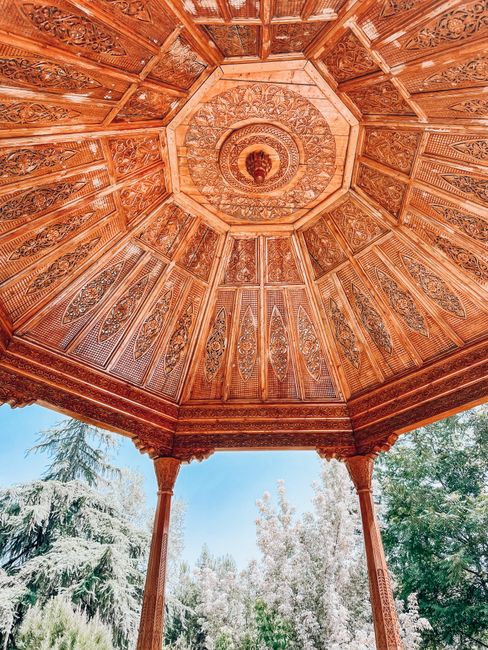
Dushanbe, the capital of Tajikistan, lies in the green Hissar Valley at about 800 m (2,600 ft), with the snowy Hissar range rising to the north. Its name means “Monday” in Tajik, after the weekly market held in the village that stood here a century ago; in the Soviet era, as Stalinabad, it grew into a city of tree-lined avenues and pastel neoclassical buildings, and since independence, it has been transformed by vast new monuments, palaces, parks and towers. It is a friendly, easygoing city and the gateway to the country’s mountains. Come for the long, leafy Rudaki Avenue, the golden Ismoil Somoni monument, the National Museum, the 13 m (43 ft) reclining Buddha in the Museum of Antiquities, the carved halls of Navruz Palace, the bustling Mehrgon and Shah Mansur bazaars and teahouses serving kurutob, and day trips to the Hissar fortress, the Varzob gorge and the lake of Iskanderkul. Dushanbe is the starting point of the Pamir Highway, and the place to arrange vehicles, drivers and the GBAO permit for the Pamirs. The best months are April, May, September and October; summers are hot, and winters wet and cool.
Right now in Dushanbe
- Wed 12–24°C 53–75°F Partly cloudy
- Thu 15–26°C 59–78°F Clear
- Fri 15–24°C 58–75°F Clear
Weather: MET Norway (CC BY 4.0) · Air quality: OpenAQ
Top tours in Dushanbe
See all tours for Dushanbe →
From local operators, with prices and reviews; you check availability and book on Viator, our partner. We may earn a commission at no extra cost to you. How we earn money
Dushanbe at a glance
- Best for: monuments and museums, bazaars, teahouses, Soviet and new architecture, and organizing trips to the Pamirs and the Fann Mountains.
- How long: 1–2 days for the city, plus a day trip to Hissar or the Varzob gorge.
- Best time: April to May and September to October; June to August is hot, and December to February is cool and wet.
- Getting there: by air to Dushanbe International Airport, about 5 km (3 miles) from the center; by road from Uzbekistan, the Fann Mountains and the Pamirs.
- Getting around: on foot along Rudaki Avenue, by taxi app and by bus.
- Good to know: visa-free visitors must register within 10 working days; e-visa holders don’t.
- Before you go: visa-free entry, the e-visa, the GBAO permit, money and general safety are in our Tajikistan travel guide.
Dushanbe’s areas and where to stay
The city stretches north to south along the Dushanbinka (Varzob) River, with Rudaki Avenue, the main street, running parallel to it through the center.
The center along Rudaki Avenue
Between the railway station in the south and the Hotel Tajikistan, Rudaki Park and the Ismoil Somoni monument further north, Rudaki Avenue is lined with plane trees, ministries, theaters, banks, cafés and shops. Hotels here put you within walking distance of most sights.
The new government quarter
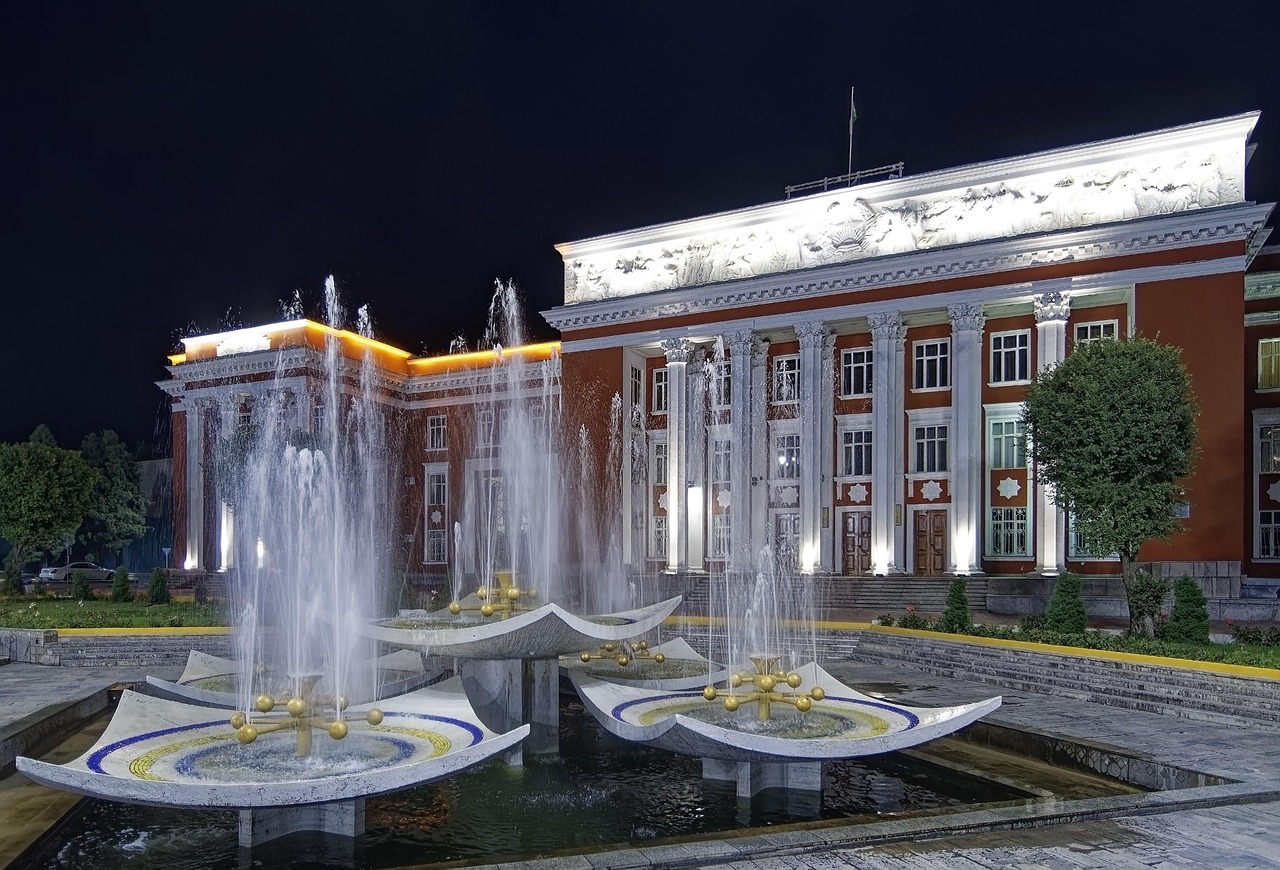
Around Rudaki Park, the Palace of Nations, the National Library and the giant flagpole, the area has new international hotels, wide boulevards and fountains, lit up at night.
North Dushanbe
North of the center, toward the Varzob road, quieter residential streets have guesthouses and smaller hotels, convenient for trips into the mountains.
Where to stay in Dushanbe
- Rudaki Avenue: mid-range and boutique hotels near cafés and sights.
- Around Rudaki Park: international hotels near the monuments.
- Guesthouses and hostels: budget options in the center and north, popular with Pamir travelers and cyclists.
- Apartments: good value for longer stays.
Rooms fill in July and August with travelers heading to the Pamirs; book ahead.
Top things to see in Dushanbe
Dushanbe’s story in brief
In the 1920s, Dushanbe was a village of a few thousand people with a Monday bazaar. When the Tajik Autonomous Republic was created in 1924, it became the capital, and the arrival of the railway in 1929 turned it into a Soviet city, renamed Stalinabad from 1929 to 1961. In the 1990s, the civil war brought fighting to its streets, but since peace in 1997, the city has been rebuilt on a grand scale, with new monuments celebrating Tajik history, from the Samanid ruler Ismoil Somoni to the poet Rudaki, and many Soviet-era buildings replaced by new towers.
Rudaki Avenue and Rudaki Park
The city’s long main street, Rudaki Avenue, is pleasant to walk along under its old plane trees, past the Opera and Ballet Theater, the Academy of Sciences and Soviet-era buildings. At its northern end, Rudaki Park has fountains, flower beds and a statue of the poet Rudaki, father of Persian poetry, beneath a gilded arch. Next to it rise the Palace of Nations (the presidential palace), which you can see but not photograph closely, and a flagpole of about 165 m (540 ft), briefly the tallest in the world when it was built in 2011.
The Ismoil Somoni monument
On Dousti (Friendship) Square, a gilded statue of Ismoil Somoni, the 10th-century Samanid ruler and national hero, stands beneath a golden crown-topped arch, with fountains and gardens around it. It is especially striking at night.
The National Museum of Tajikistan
Opened in 2013 in a vast building near the flagpole, the National Museum has galleries on natural history, archaeology, Tajik history from the Samanids to independence, and fine and decorative arts, including Pamiri crafts and Soviet-era painting.
The Museum of Antiquities and the reclining Buddha
The National Museum of Antiquities of Tajikistan holds finds from sites across the country, including Sogdian murals from Penjikent, Greco-Bactrian treasures, and its star exhibit, a reclining Buddha about 13 m (43 ft) long, from the 7th–8th-century Buddhist monastery of Ajina Tepa in southern Tajikistan, one of the largest surviving Buddha statues in Central Asia.
Navruz Palace
On the eastern edge of the city, the Navruz Palace (Kohi Navruz), completed in 2014 as a teahouse and event center, is a building of halls decorated by craftsmen from across the country with intricate carved wood and plaster, mirror mosaics, marble and painted ceilings. It hosts weddings and official events; check whether visits are possible during your stay.
More classic sights
- Mehrgon Market: a large modern market hall, busy with fruit, nuts, spices and bread.
- Shah Mansur (Green) Bazaar: a traditional bazaar with food stalls and household goods.
- Gurminj Museum of Musical Instruments: a private collection of Pamiri and Central Asian instruments, often with live music.
- Haji Yakoub Mosque: the city’s historic Friday mosque.
- Victory Park: a hilltop park with a World War II memorial and views over the city.
- The Botanical Garden: a shady escape in the north of the city.
Other things to do in Dushanbe
Food and drink
Eat kurutob, the national dish of torn flatbread with a dried-yogurt sauce, onions, tomatoes and herbs, shared from a wooden platter; plov (osh), cooked in huge pots and served at lunchtime; shashlik; sambusa baked in a tandoor; mantu; and shurbo soup. Teahouses (choikhona) with raised platforms are the place for long lunches and green tea, and the city has good Turkish, Georgian, Russian, Indian and international restaurants and cafés along Rudaki Avenue. Summer brings superb melons, apricots, grapes and pomegranates to the bazaars.
Markets and crafts
Dushanbe’s bazaars are the best places to see everyday life and to stock up for a trip into the mountains. Look for dried apricots, mulberries, almonds, pistachios and walnuts; round tandoor bread; local honey; and spices. For souvenirs, the city has shops and workshops selling suzani embroidery, chakan embroidered fabrics, Pamiri woolen socks, embroidered skullcaps (toki), ceramics and knives, and instruments such as the dutor and rubab. Ask before photographing traders, and expect friendly conversation and offers of tea.
Culture
The Ayni Opera and Ballet Theater on Rudaki Avenue stages opera, ballet and concerts; tickets are inexpensive. Look out for performances of traditional music, such as shashmaqam and Pamiri songs. See our city sightseeing guide.
Preparing for the Pamirs
Dushanbe is where most travelers organize their Pamir trip: agencies and guesthouses arrange 4x4s, drivers and guides; shared 4x4s to Khorog leave early in the morning from set departure points; and you can apply for the GBAO permit at the Consular Department of the Ministry of Foreign Affairs if it isn’t on your e-visa. Stock up on cash, as there are no ATMs along most of the Pamir Highway, and on snacks, a water filter and warm clothes.
Day trips from Dushanbe
- Hissar fortress: about 25 km (16 miles) west, a reconstructed fortress gate, an old madrasa and a caravanserai on the site of an ancient town, with a small museum.
- Varzob gorge: the river valley north of the city on the road to the Fann Mountains, with waterfalls, riverside teahouses and short hikes; the Safed Dara ski resort at Takob is about 1.5 hours away.
- Iskanderkul: a turquoise lake at about 2,200 m (7,200 ft) in the Fann Mountains, about 3 hours north via the Anzob Tunnel; better with a night at a guesthouse.
- Romit valley: a green mountain valley east of the city, with walnut forests and a nature reserve.
- Nurek reservoir: a long turquoise reservoir behind one of the tallest dams in the world, about 1.5 hours southeast; some areas need permission, so go with a local operator.
Nearby destinations
- Samarkand197 km
Getting there and getting around
By air
Dushanbe International Airport (DYU), about 5 km (3 miles) east of the center, has flights from Istanbul, Dubai, Moscow, Almaty, Tashkent, Urumqi and other cities; see our Istanbul guide. Taxis by app take 10–20 minutes to the center. According to the UK government, there have been cases of officials at the airport requesting payments for supposedly incorrect documents; make sure your visa or visa-free entry and registration are in order before departure, and report any harassment to the airport’s consular bureau.
By road
Shared taxis and 4x4s leave for Khorog and the Pamirs (about 12–16 hours), for Penjikent and the Fann Mountains, and for Khujand in the north via the Anzob and Shahristan tunnels, which can be dangerous in winter. The nearest border crossings to Uzbekistan are west of the city toward Denau and Termez, and Penjikent for Samarkand. See our Uzbekistan guide.
Around town
The center is easy to explore on foot along Rudaki Avenue. Taxi apps such as Yandex Go are cheap; use licensed taxis rather than unofficial cars. Buses and trolleybuses run along the main avenues.
When to go and how long to stay
Dushanbe has a warm continental climate. Spring, from March to May, is green and pleasant but the wettest season, with frequent showers. Summer, from June to September, is hot and almost completely dry, with average highs of 34–36 °C (93–98 °F) in July and August; it is also the season for the mountains and the Pamirs, so most travelers pass through. Autumn, from September to November, is warm and sunny at first, then cooler. Winter, from December to February, is mild for the region but damp, with frosty nights and occasional snow. Tajikistan’s stations are not included in the World Meteorological Organization’s 1991–2020 normals archive, so the table shows long-term averages for the Dushanbe station of Tajik Hydromet as compiled by a climate reference service (a secondary source): average daily highs and lows and average precipitation.
| Month | Average high / low | Precipitation | What to expect |
|---|---|---|---|
| January | 9 °C (48 °F) / −1 °C (30 °F) | 61 mm (2.4 in) | Cool and damp; frosty nights |
| February | 11 °C (52 °F) / 1 °C (33 °F) | 94 mm (3.7 in) | Wet; occasional snow |
| March | 17 °C (63 °F) / 6 °C (42 °F) | 103 mm (4.1 in) | Mild and showery; Navruz |
| April | 23 °C (73 °F) / 10 °C (50 °F) | 114 mm (4.5 in) | The wettest month; blossom |
| May | 28 °C (82 °F) / 13 °C (56 °F) | 77 mm (3.0 in) | Warm; ideal |
| June | 34 °C (92 °F) / 17 °C (63 °F) | 17 mm (0.7 in) | Hot; Pamir season begins |
| July | 36 °C (98 °F) / 19 °C (66 °F) | 3 mm (0.1 in) | The hottest month; dry |
| August | 36 °C (96 °F) / 17 °C (63 °F) | 1 mm (0.0 in) | Hot and dry |
| September | 31 °C (88 °F) / 13 °C (55 °F) | 4 mm (0.2 in) | Warm; Independence Day (September 9) |
| October | 24 °C (76 °F) / 8 °C (46 °F) | 29 mm (1.1 in) | Pleasant; harvest |
| November | 17 °C (62 °F) / 4 °C (39 °F) | 55 mm (2.2 in) | Cooler; rains return |
| December | 11 °C (52 °F) / 0 °C (33 °F) | 60 mm (2.4 in) | Cool and damp |
Dushanbe receives about 620 mm (24 in) of precipitation a year, almost all from November to May.
One day in Dushanbe
Walk Rudaki Avenue from the Opera to Rudaki Park, see the Ismoil Somoni monument and the flagpole, then visit the Museum of Antiquities and the National Museum. Have lunch at a teahouse or the Mehrgon Market, and end the day at Navruz Palace or with dinner on Rudaki Avenue.
Two to three days
Add the Hissar fortress, a day in the Varzob gorge, or a night at Iskanderkul before heading to the Fann Mountains or the Pamirs.
What a trip to Dushanbe costs
Prices are approximate, for October 2026, converted at about 9.2 somoni to the US dollar.
| Item | Typical cost |
|---|---|
| Taxi from the airport by app | 20–50 TJS (about US$2.20–5.40) |
| National Museum or Museum of Antiquities entry | 20–50 TJS (about US$2.20–5.40) |
| Kurutob or plov at a teahouse | 30–60 TJS (about US$3.25–6.50) |
| Dinner in a mid-range restaurant | 100–250 TJS (about US$11–27) per person |
| Opera or ballet ticket | 30–150 TJS (about US$3.25–16) |
| Taxi to the Hissar fortress and back | 150–300 TJS (about US$16–33) |
| Shared 4×4 seat to Khorog | 400–700 TJS (about US$43–76) |
| Mid-range hotel double, per night | 600–1,200 TJS (about US$65–130) |
Practical tips for Dushanbe
- Register if you need to: visa-free visitors must register within 10 working days; keep the documents for departure.
- Get cash before the mountains: ATMs mostly accept Visa, and there are none along most of the Pamir Highway.
- Sort your GBAO permit: add it to your e-visa, or apply at the Ministry of Foreign Affairs in Dushanbe.
- Book Pamir transport early in summer: good drivers are in demand in July and August.
- Ask before photographing: avoid government buildings, the presidential palace and police.
- Dress modestly: especially outside the center and at mosques.
Safety
Dushanbe is generally safe, with little violent crime against visitors, though there have been occasional muggings and petty theft: keep valuables out of sight in markets and on buses, avoid walking alone late at night, and use licensed or app taxis. Drink spiking has been reported, so keep your drink in sight. Carry your passport or a notarized copy, as police checks are common. Avoid demonstrations and large gatherings. Don’t photograph government buildings, the presidential palace or police, and note that smoking in the street is illegal. Traffic is fast on the main avenues. Women traveling alone may receive unwanted attention. In an emergency, call 102 for police and 103 for an ambulance; the Tourist Police can be reached on +992 37 231 80 36.
What to pack for Dushanbe
Light clothes for summer and layers for the mountains, modest clothing that covers shoulders and knees, a scarf for women at mosques, comfortable walking shoes, sunscreen and a hat, a rain jacket for spring, and US dollars in clean, recent notes for the rest of the trip. Tajikistan uses 220 V, with round two-pin plugs. See our hiking shoes, rain jackets and travel adapters guides.
Dushanbe travel FAQ
How many days do I need in Dushanbe?
One to two days for the city, plus a day trip to Hissar or the Varzob gorge before heading to the mountains.
What does Dushanbe mean?
“Monday” in Tajik, after the weekly market held in the village that stood here before the city was built.
Where can I get the GBAO permit in Dushanbe?
At the Consular Department of the Ministry of Foreign Affairs, or through a travel agency; you can also add it to your e-visa before you travel.
How do I get from Dushanbe to Khorog?
By shared or private 4×4 in about 12–16 hours along the Pamir Highway, or by irregular, weather-dependent flights.
How far is Iskanderkul from Dushanbe?
About 3 hours by road via the Anzob Tunnel; it is best with a night at the lake.
What is the best time to visit Dushanbe?
April to May and September to October. Summers are hot, and winters are damp and cool.
Do I need to register in Dushanbe?
Visa-free visitors must register within 10 working days of arrival; e-visa holders do not.
Can I use cards in Dushanbe?
In some hotels, supermarkets and restaurants, but Tajikistan is mainly a cash economy; ATMs mostly accept Visa.
Is Dushanbe safe?
Generally yes. Take normal care with belongings, use licensed taxis at night and avoid photographing official buildings.
What is the giant Buddha in Dushanbe?
A reclining Buddha about 13 m long from the Ajina Tepa monastery, displayed in the National Museum of Antiquities.
Sources and last review
Researched and last reviewed on 4 October 2026. Visa-free entry, registration within 10 working days and the e-visa: the Ministry of Foreign Affairs of Tajikistan; the GBAO permit, ID, drink spiking, muggings, airport harassment, smoking, photography, the Tourist Police and road conditions: the UK government’s factual entry and safety pages; the exchange rate: the National Bank of Tajikistan. Tajik stations are not in the WMO 1991–2020 normals archive; the climate table uses long-term averages for the Dushanbe station of Tajik Hydromet compiled by a climate reference service, flagged as secondary. The city’s history, monument and museum dates, the Buddha’s size and origin, distances, journey times, entry fees and typical prices are general references or estimates, flagged for checking. Prices and rules change, so check locally before you go. For entry rules, money and general safety, see our Tajikistan travel guide.
Plan your trip
Partner links: TravelerCenter may earn a commission if you book, at no extra cost to you.
🇷🇺 Useful Russian phrases for Dushanbe
All 38 Russian phrases: restaurant, hotel, emergencies, romance (printable) →