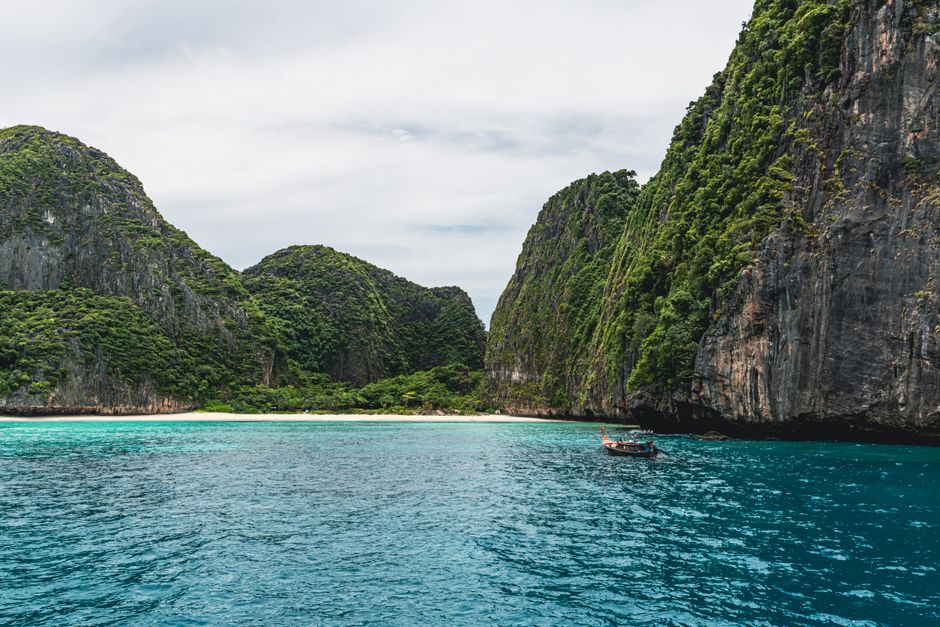
The Phi Phi Islands are a small group of limestone islands in the Andaman Sea, between Phuket and the Krabi coast, and one of the most famous sights in Thailand: sheer jungle-topped cliffs dropping into turquoise water, white beaches and coral reefs. Only the largest island, Phi Phi Don, is inhabited, with a lively village squeezed onto a sandy isthmus between two bays; its smaller neighbor, Phi Phi Leh, is uninhabited and holds Maya Bay, made world-famous by the film The Beach, and the emerald Pileh Lagoon. The islands are part of Hat Noppharat Thara–Mu Ko Phi Phi National Park, and since Maya Bay’s long closure for reef recovery from 2018 to 2022, visits are carefully managed. Come for the viewpoints, beaches and snorkeling, diving with reef sharks, boat trips around the cliffs and an easygoing beach-bar nightlife. The best months are November to April; from about May to October the southwest monsoon brings rain and rough seas, and Maya Bay closes every year from August 1 to September 30.
Right now in Ko Phi Phi (Ko Phi Phi Don)
- Wed 27–29°C 80–83°F 8 mm Light rain
- Thu 26–29°C 79–84°F 7 mm Rain
- Fri 27–28°C 81–83°F 6 mm Partly cloudy
Weather: MET Norway (CC BY 4.0) · Sea temperature: NOAA CoastWatch · Rates: ECB
Top tours in Ko Phi Phi
See all tours for Ko Phi Phi →
From local operators, with prices and reviews; you check availability and book on Viator, our partner. We may earn a commission at no extra cost to you. How we earn money
Ko Phi Phi at a glance
- Best for: island scenery, snorkeling and diving, boat trips, beach bars, backpackers and couples.
- How long: 2–3 nights on Phi Phi Don; a day trip from Phuket or Ao Nang if time is short.
- Best time: December to March, with highs of about 33–34 °C (91–93 °F) and calm, clear water.
- Getting there: by ferry or speedboat only: about 1.5–2 hours from Phuket, Ao Nang or Krabi Town, and about 1–1.5 hours from Ko Lanta.
- Getting around: on foot (there are no cars on Phi Phi Don) and by long-tail boat taxi.
- Fees to know: Phi Phi Leh and Maya Bay are in a national park with an entry fee for foreign visitors, usually included in tour prices; Maya Bay, Loh Samah and Ao Loko close from August 1 to September 30 every year.
- Before you go: entry rules, the Thailand Digital Arrival Card, money and general safety are in our Thailand travel guide.
The Phi Phi Islands: where things are
The group has six main islands. Phi Phi Don, shaped like a butterfly, is about 8 km (5 miles) long; Phi Phi Leh lies about 2 km (1.2 miles) to the south; Bamboo Island and Mosquito Island are to the northeast, and Bida Nok and Bida Nai are small dive islands to the south.
Tonsai Village and Loh Dalum
The heart of Phi Phi Don is the narrow, flat isthmus between Tonsai Bay, where the ferries dock, and the shallow, curving bay of Loh Dalum. It is packed with guesthouses, restaurants, dive shops, bars and massage shops along car-free lanes. Convenient and lively, but noisy at night, especially near Loh Dalum’s beach bars.
Long Beach and the south coast
A 20-minute walk or a short long-tail ride south of Tonsai, Long Beach (Hat Yao) has softer sand, clear water good for snorkeling, and quieter resorts and bungalows with views of Phi Phi Leh.
Laem Tong and the north
At the northern tip of Phi Phi Don, Laem Tong has a few upscale resorts on a fine beach, a small sea-gypsy (Chao Leh) village and calm water, about 45 minutes by boat from Tonsai. Loh Bagao and Pak Nam bays on the east coast are also quiet resort areas.
Phi Phi Leh
The smaller, uninhabited island is a wall of cliffs surrounding Maya Bay, Loh Samah Bay and Pileh Lagoon. You can only visit by boat in daytime; overnight stays are not allowed.
Top things to see on the Phi Phi Islands
Maya Bay
A cove of white sand almost enclosed by 100 m (330 ft) cliffs on Phi Phi Leh. After years of mass tourism damaged its coral, the national park closed it from 2018 to 2022 to let the reef and blacktip reef sharks recover. Today boats no longer enter the bay: they drop visitors at a floating pier in Loh Samah Bay on the other side of the island, and a boardwalk leads through the forest to the beach. Swimming in Maya Bay is not allowed, and visits are timed to spread the crowds. According to the national parks department, Maya Bay, Loh Samah Bay and Ao Loko close every year from August 1 to September 30. Arrive early in the morning or late in the afternoon for the fewest people.
Pileh Lagoon
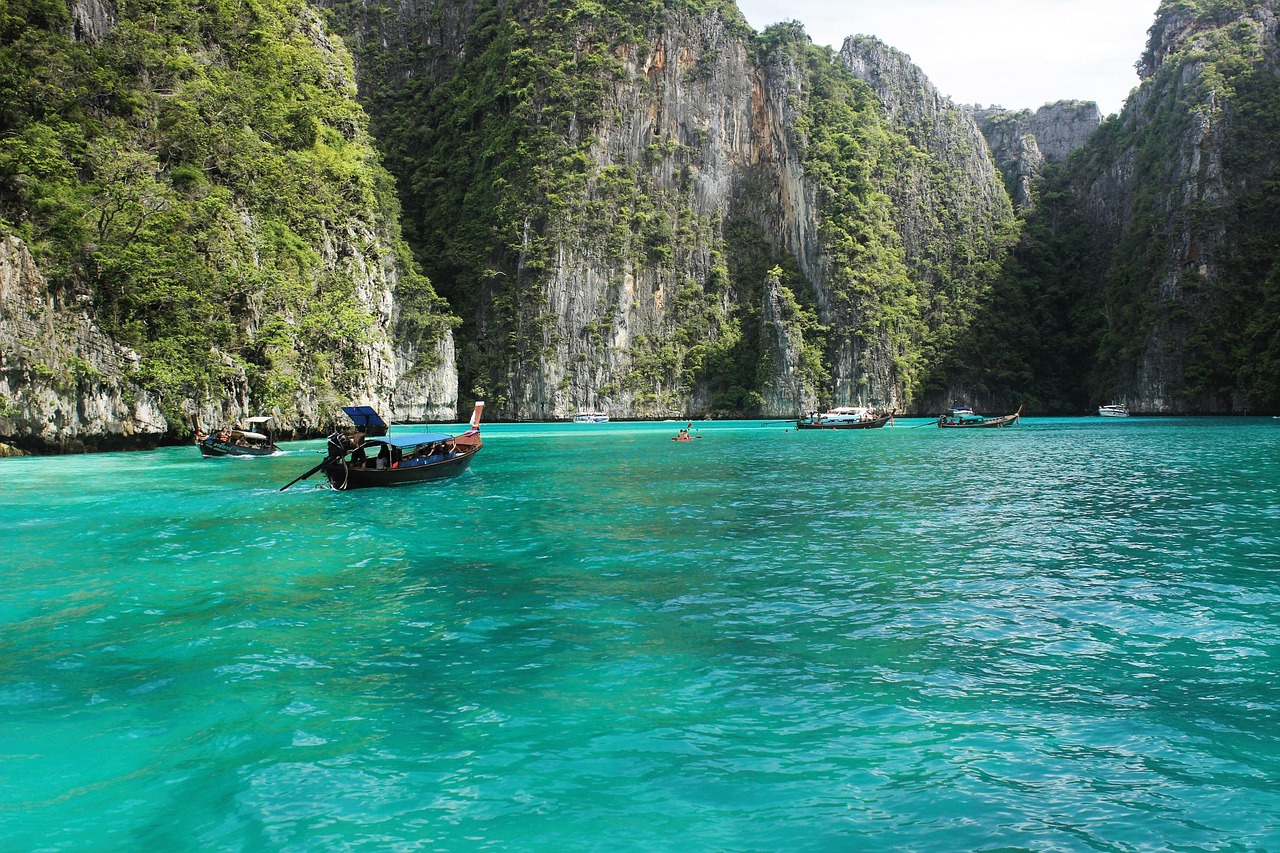
A lagoon of brilliant green water inside a ring of cliffs on Phi Phi Leh’s east coast, where boats anchor so visitors can swim and kayak. It is a highlight of most boat tours, and best early in the day.
The Phi Phi viewpoints
From Tonsai, steep steps climb about 30 minutes to the viewpoints above the village, with the famous view of the twin bays of Tonsai and Loh Dalum joined by the sandy isthmus. Go for sunrise or sunset; there is a small entry fee and a café at the top.
Viking Cave
A large cave on Phi Phi Leh’s northeast coast where swiftlets nest; their nests are collected for bird’s nest soup by licensed collectors on bamboo scaffolding. You can see it only from a boat, as entry is not allowed.
Bamboo Island and Mosquito Island
Bamboo Island (Ko Mai Phai), about 30 minutes north of Phi Phi Don by long-tail, has a ring of white sand and good snorkeling. Neighboring Mosquito Island (Ko Yung) has been closed to visitors indefinitely, according to the national parks department.
More classic sights
- Long Beach: the best swimming beach near the village, with views of Phi Phi Leh.
- Monkey Beach: a small beach where macaques live; don’t feed them or carry food, as they bite.
- Loh Dalum at low tide: the shallow bay empties at low tide, and you can wade far out.
- Tsunami memorial: a small memorial garden in Tonsai remembers those who died when the 2004 tsunami swept across the isthmus.
Nature
- Ko Phi Phi Le
Viewpoints
- Maya Bay
Snorkeling, diving and boat trips
The waters around the islands are among the best in Thailand for snorkeling and diving, with hard and soft corals, turtles, leopard sharks and blacktip reef sharks.
- Boat tours: half-day and full-day long-tail or speedboat tours from Tonsai visit Phi Phi Leh (Maya Bay, Pileh Lagoon, Viking Cave), Monkey Beach and snorkeling spots, and sometimes Bamboo Island. Sunset tours include a swim in the bioluminescent plankton when conditions are right.
- Snorkeling: Shark Point off the east coast, Long Beach and Bamboo Island are good spots; blacktip reef sharks are shy and harmless.
- Diving: Bida Nok and Bida Nai, Hin Bida, Ko Pai and the wreck of the Kled Kaeo, a navy ship sunk as an artificial reef, are among the main dive sites; dive shops in Tonsai offer courses for beginners.
- Kayaking: rent a kayak to explore the bays and cliffs of Phi Phi Don, or join a guided paddle in Pileh Lagoon.
Don’t touch, stand on or kick coral, wear reef-safe sunscreen, and choose operators that respect national park rules, such as no feeding fish. See our guides to snorkeling, diving and boat trips.
Activities and best months
- Boat tripsMaya Bay, Loh Samah and Ao Loko in Hat Noppharat Thara-Mu Ko Phi Phi National Park close every year from 1 August to 30 September; Mosquito Island (Ko Yung) is closed indefinitely. · source
Other things to do on Ko Phi Phi
Food and drink
Tonsai’s lanes are full of restaurants serving Thai and international food, from pad thai stalls and roti carts to seafood barbecues where you pick your fish. Southern dishes such as gaeng som sour curry and massaman curry are worth trying, and the bakeries do a brisk trade in breakfast. Prices are higher than on the mainland, as nearly everything arrives by boat. Many local people are Muslim; dress modestly in the village away from the beach.
Nightlife
Loh Dalum’s beach bars host fire shows, buckets and loud music until late every night; the scene is youthful and boisterous. For a quieter evening, choose a resort on Long Beach or in the north.
Rock climbing and hiking
Climbing schools in Tonsai run courses on the limestone cliffs at Ton Sai Tower, and footpaths link the village with the viewpoints and Long Beach.
Day trips and onward travel
- Ao Nang and Railay: about 1.5–2 hours by ferry, for Railay’s cliffs and beaches. See our Ao Nang guide.
- Ko Lanta: about 1–1.5 hours by ferry, for long, quiet beaches.
- Phuket: about 2 hours by ferry to Rassada Pier, for the airport and more beaches. See our Phuket guide.
- Bamboo Island: a half-day by long-tail from Tonsai.
- Ko Ha and Hin Daeng: remote dive sites south of Ko Lanta, open from October to July (closed August 1 to September 30).
Nearby destinations
- Ao Nang (Krabi)35 km
- Ko Lanta36 km
- Phuket55 km
- Khao Lak115 km
- Ko Lipe150 km
- Langkawi191 km
- Ko Samui239 km
- Ko Pha Ngan263 km
Getting there and getting around
Ferries and speedboats
There is no airport on the Phi Phi Islands. The nearest airports are Phuket (HKT) and Krabi (KBV). Ferries run daily from Rassada Pier in Phuket (about 2 hours), from Klong Jilad Pier near Krabi Town (about 1.5–2 hours), from Noppharat Thara near Ao Nang (in high season) and from Ko Lanta; speedboats are faster but cost more and can be uncomfortable in waves. Book a ticket that includes the transfer from your hotel or the airport. Ferries are reduced from May to October and can be canceled when the sea is rough. All ferries arrive at Tonsai Pier, where a small fee is collected from arriving visitors to help keep the island clean.
On the island
There are no cars or motorbikes on Phi Phi Don. You walk everywhere in the village, and porters with trolleys carry luggage to hotels for a fee. Long-tail boats act as taxis to Long Beach, the north coast resorts and Phi Phi Leh; agree the price before you get in. The paths to the viewpoints and some resorts are steep, so pack light.
When to go and how long to stay
The Phi Phi Islands are on the Andaman coast, where the southwest monsoon brings most of the rain from May to October. There is no international climate-normals station on the islands; the table uses the 1991–2020 normals of the Thai Meteorological Department (TMD) for its Ko Lanta station, about 40 km (25 miles) to the east-southeast, as submitted to the World Meteorological Organization (WMO): average daily highs and lows, total rain, and days with at least 1 mm of rain.
| Month | Average high / low | Rain (days with 1 mm or more) | What to expect |
|---|---|---|---|
| January | 33 °C (91 °F) / 24 °C (75 °F) | 31 mm (1.2 in), 3 days | Dry and calm; excellent visibility; peak season |
| February | 34 °C (92 °F) / 24 °C (76 °F) | 24 mm (0.9 in), 2 days | The driest month; best for diving |
| March | 34 °C (93 °F) / 25 °C (76 °F) | 69 mm (2.7 in), 5 days | Hot and mostly dry; plankton blooms can attract whale sharks |
| April | 34 °C (93 °F) / 25 °C (77 °F) | 122 mm (4.8 in), 9 days | Hot; first storms; Songkran |
| May | 33 °C (91 °F) / 25 °C (78 °F) | 228 mm (9.0 in), 14 days | Monsoon begins; fewer ferries; low prices |
| June | 32 °C (89 °F) / 25 °C (78 °F) | 286 mm (11.3 in), 15 days | Showers and sunny spells; choppy crossings |
| July | 32 °C (89 °F) / 25 °C (77 °F) | 288 mm (11.4 in), 15 days | Wet and changeable; some trips canceled |
| August | 31 °C (88 °F) / 25 °C (77 °F) | 342 mm (13.5 in), 15 days | Wet; Maya Bay, Loh Samah and Ao Loko closed |
| September | 31 °C (88 °F) / 25 °C (77 °F) | 319 mm (12.6 in), 17 days | Wet and windy; closures continue to September 30 |
| October | 31 °C (88 °F) / 24 °C (76 °F) | 298 mm (11.7 in), 18 days | Maya Bay reopens; still rainy; the sea calms late in the month |
| November | 31 °C (88 °F) / 24 °C (76 °F) | 148 mm (5.8 in), 12 days | Drying out; high season begins |
| December | 31 °C (89 °F) / 24 °C (75 °F) | 65 mm (2.5 in), 8 days | Sunny and busy; book ahead for Christmas and New Year |
The area gets about 2,200 mm (87 in) of rain a year, mostly from May to October. In the rainy season there are still many sunny hours, but crossings can be rough, underwater visibility drops, and boat tours may be canceled at short notice.
Weather month by month
Averages from TMD normals 1991–2020, Ko Lanta · Last reviewed 5 Oct 2026
Two nights on Phi Phi Don
Day one, arrive by midday ferry, walk to Long Beach for a swim, and climb to the viewpoint for sunset. Day two, an early boat tour to Maya Bay, Pileh Lagoon, Viking Cave and Monkey Beach, then snorkeling at Bamboo Island; dinner and the fire shows at Loh Dalum. Leave on the third morning, or stay to dive.
A day trip
From Phuket or Ao Nang, a speedboat tour can cover Maya Bay, Pileh Lagoon and Phi Phi Don in a day; choose an early departure to beat the crowds.
Where to stay on the Phi Phi Islands
- Tonsai Village: guesthouses and hotels close to restaurants, the pier and nightlife; noisy at night.
- Loh Dalum: beachfront hotels on the party bay.
- Long Beach: quieter bungalows and resorts with great snorkeling.
- Laem Tong, Loh Bagao and Pak Nam: secluded resorts reached by boat, for couples and families.
Accommodation on Phi Phi is more expensive than on the mainland for the same standard, and the cheapest rooms in Tonsai can be basic. Water and electricity are limited on the island, so use them sparingly.
What a trip to Phi Phi costs
Prices are approximate, for October 2026, converted at about 33 baht to the US dollar.
| Item | Typical cost |
|---|---|
| Ferry from Phuket or Krabi, one way | 500–1,000 baht (about US$15–30) |
| Half-day long-tail tour of Phi Phi Leh, plus park fee | 800–1,500 baht (about US$24–45) |
| Long-tail taxi to Long Beach | about 100–150 baht per person (about US$3–4.50) |
| Two fun dives with equipment | 3,000–4,500 baht (about US$90–135) |
| Pad thai or curry in Tonsai | 100–200 baht (about US$3–6) |
| Beer in a beach bar | 100–150 baht (about US$3–4.50) |
| Guesthouse double in Tonsai | 1,200–2,500 baht (about US$36–75) |
| Beach resort, high season | 4,000–12,000 baht (about US$120–360) |
Practical tips for Phi Phi
- Cash: there are ATMs in Tonsai, but they charge foreign cards a fee; bring enough cash, as small places don’t take cards.
- Pack light: there are no taxis, and paths can be steep and sandy.
- Book ferries in advance in high season, and allow a buffer day before flights in the rainy season.
- National park rules: no feeding fish, no touching coral, no taking shells or sand, and no swimming in Maya Bay.
- Cannabis and vaping: cannabis flower needs a Thai prescription, and e-cigarettes are illegal in Thailand.
- Help: the Tourist Police (1155) speak English, and the TAT Contact Center (1672) answers tourist questions.
Safety
Phi Phi is safe and friendly; the sea and the island’s limited facilities are the main things to plan around.
- Sea conditions and monsoon flags: from about May to October, crossings can be rough, and swimming may be unsafe on exposed beaches; follow posted flags and the advice of boat crews, and don’t insist on sailing in bad weather.
- Boat safety: choose licensed operators, wear the life jacket provided, and keep clear of long-tail propellers when swimming.
- Jellyfish: box jellyfish have occasionally been reported in Hat Noppharat Thara–Mu Ko Phi Phi National Park, mostly in the rainy season; swim where notices are posted and call 1669 if stung.
- Tsunamis: the 2004 tsunami struck Tonsai; evacuation routes are signposted up to the viewpoints. If you feel a strong earthquake or hear a warning, climb to high ground at once.
- Medical care: there is only a small health center on Phi Phi Don; serious cases go by boat to Krabi or Phuket, so make sure your insurance covers evacuation.
- Nightlife and heat: watch your drinks and belongings in the bars, avoid swimming after drinking, and drink plenty of water.
- Emergencies: call 1155 for the Tourist Police (English spoken), 191 for the police and 1669 for an ambulance.
What to pack for Phi Phi
Swimwear and a rash guard, reef-safe sunscreen, a hat, water shoes, a dry bag, a torch for the dark paths at night, a light rain jacket from May to October, and enough cash for a few days. Pack in a backpack or soft bag rather than a heavy suitcase. Thailand uses 220 V; sockets take both flat two-pin and round two-pin plugs.
What to pack
- Dry bags and phone pouchesSpray soaks phones and cameras on open boats to the Algarve caves and on whale-watching trips.
- Fleeces and warm layersIt is cooler at sea than on land, especially on morning whale-watching trips.
- Rain jacketsA windproof, waterproof shell keeps you warm on open boats, where wind and spray cool you quickly.
- Reef-friendly sunscreenSun reflects off the water on cruises and cave tours.
- Water shoesKayak and small-boat trips to the Algarve grottoes land on rock and wet sand.
Ko Phi Phi travel FAQ
When is Maya Bay closed?
Every year from August 1 to September 30, together with Loh Samah Bay and Ao Loko, according to Thailand’s national parks department.
Can you swim at Maya Bay?
No. Swimming is not allowed in Maya Bay; visitors land at Loh Samah Bay and walk to the beach on a boardwalk.
How do I get to Ko Phi Phi?
By ferry or speedboat from Phuket, Krabi Town, Ao Nang or Ko Lanta, in about 1 to 2 hours; there is no airport.
What is the best time to visit Ko Phi Phi?
December to March, for calm seas and the best visibility; November and April are also good.
Should I stay on Phi Phi or visit on a day trip?
Stay at least one or two nights if you can, to see the viewpoints at sunrise or sunset and Maya Bay before the day-trippers arrive.
Which part of Phi Phi Don is best to stay in?
Tonsai for convenience and nightlife, Long Beach for snorkeling and quiet, and Laem Tong or Loh Bagao for secluded resorts.
Are there cars on Ko Phi Phi?
No. You walk, and use long-tail boats as taxis; porters carry luggage from the pier.
Is there an entry fee for the Phi Phi Islands?
Yes. Phi Phi Leh is in a national park that charges foreign visitors an entry fee, usually included in tour prices, and a small fee is collected at Tonsai Pier.
Can I see sharks at Phi Phi?
Yes. Harmless blacktip reef sharks are often seen when snorkeling at Shark Point and in the shallows.
Is Ko Phi Phi good in the rainy season?
It is quieter and cheaper, but crossings can be rough, some tours are canceled, and Maya Bay is closed in August and September.
Sources
- © OpenStreetMap contributors · ODbL · fetched 5 Oct 2026
- Wikidata · CC0 · fetched 5 Oct 2026
Sources and last review
Researched and last reviewed on 4 October 2026. Maya Bay, Loh Samah, Ao Loko, Ko Yung (Mosquito Island) and Ko Ha closures: the Department of National Parks, Wildlife and Plant Conservation; jellyfish areas, cannabis and e-cigarette rules and the Tourist Police: the Tourism Authority of Thailand (TAT); climate normals: the Thai Meteorological Department via the World Meteorological Organization’s 1991–2020 normals for Ko Lanta; exchange rate: the US Federal Reserve. The Maya Bay visiting arrangements, the 2018–2022 closure, the Tonsai Pier fee, ferry times, dive sites and typical prices are general references or estimates, flagged for checking. Prices and schedules change, so check the official sites before you go. For entry rules, money and general safety, see our Thailand travel guide.
Plan your trip
Partner links: TravelerCenter may earn a commission if you book, at no extra cost to you.
🇹🇭 Useful Thai phrases for Ko Phi Phi
All 38 Thai phrases: restaurant, hotel, emergencies, romance (printable) →