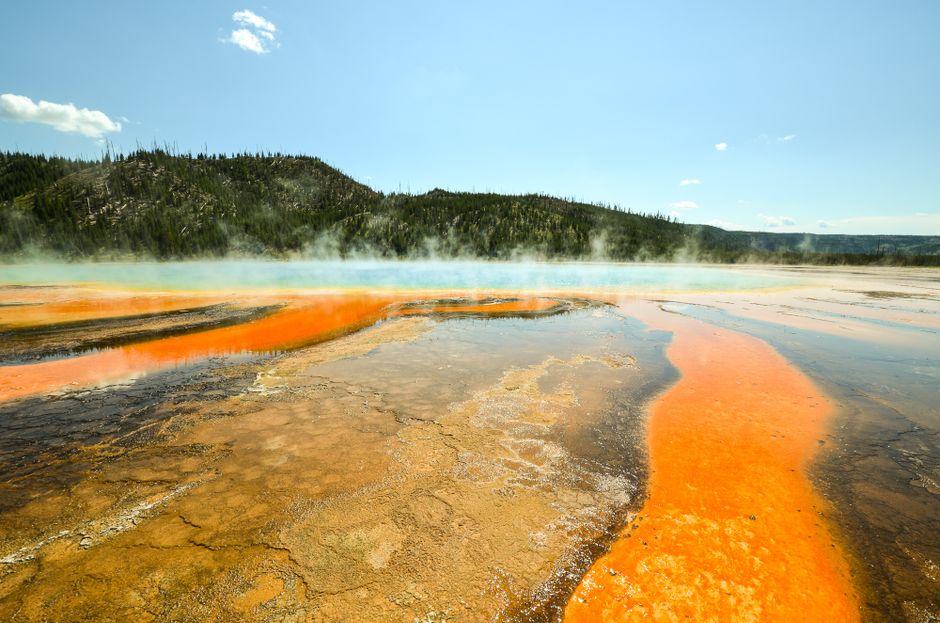
Yellowstone National Park, created in 1872 as the world’s first national park, covers nearly 3,500 square miles (9,000 km²) of high plateau in the northwest corner of Wyoming, with small slices in Montana and Idaho. It sits on top of an active volcanic system, and that heat powers more geysers, hot springs, mud pots and steam vents than anywhere else on Earth, from Old Faithful to the rainbow rings of Grand Prismatic Spring and the travertine terraces of Mammoth Hot Springs. Between the thermal basins are the Grand Canyon of the Yellowstone with its two great waterfalls, the huge cold expanse of Yellowstone Lake, and wide valleys where bison, elk, wolves and grizzly bears live. Distances are long, the park sits mostly above 7,000 ft (2,100 m), and most roads are open to cars only from spring to the end of October, so a good trip starts with the season, the entrance and the roads.
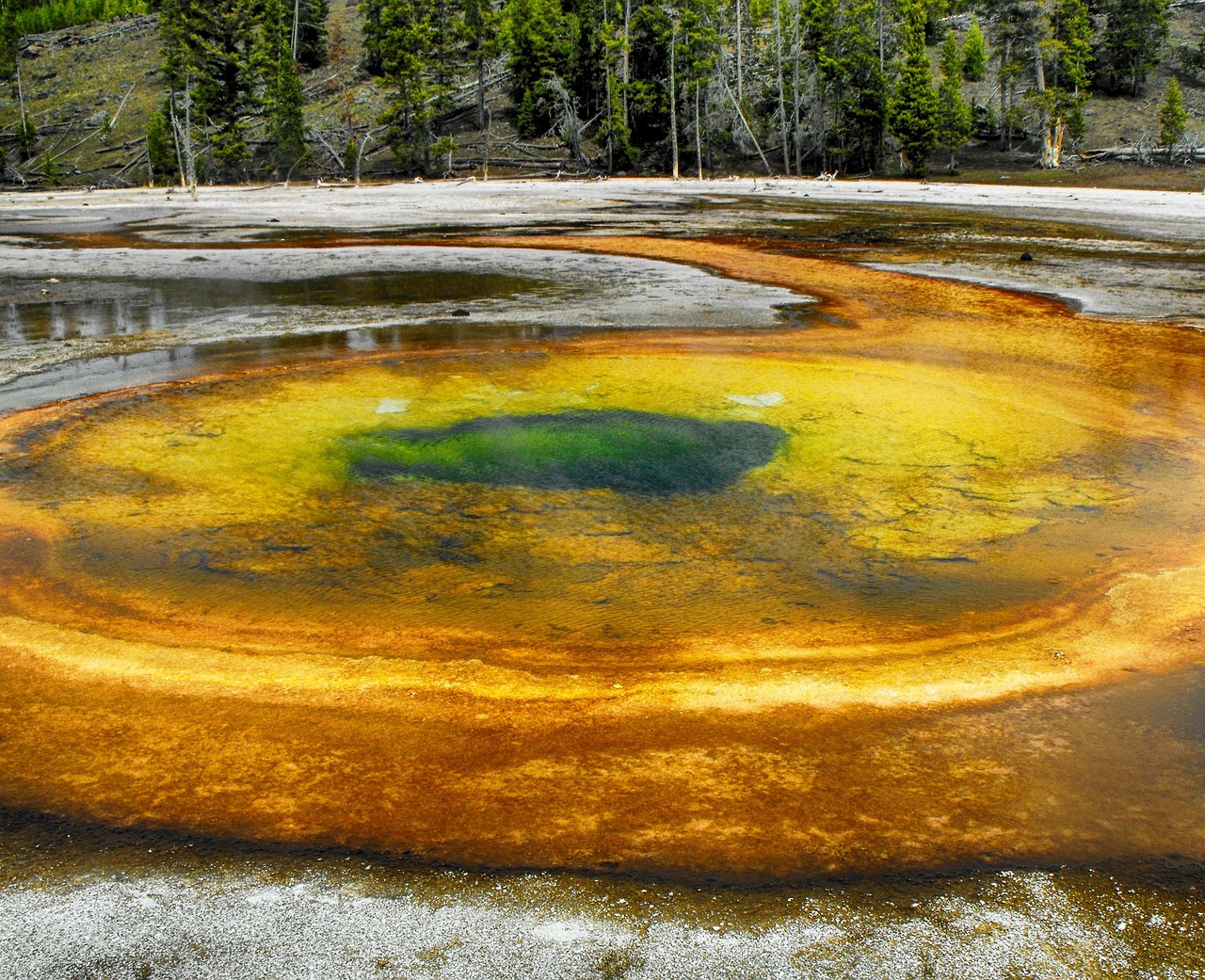
Right now in Yellowstone National Park (Old Faithful)
- Tue5–20°C42–68°FClear
- Wed4–20°C39–68°FClear
- Thu3–18°C37–64°FClear
- Mon 12 Oct Columbus Day
Top tours in Yellowstone National Park
See all tours for Yellowstone National Park →
From local operators, with prices and reviews; you check availability and book on Viator, our partner. We may earn a commission at no extra cost to you. How we earn money
Yellowstone at a glance
- Best months: late May–June for baby animals and waterfalls, July–August for the full road network and warm days, and September for thinner crowds and the elk rut. In 2026 most roads close to cars after 31 October; winter visits from mid-December are by guided snowcoach or snowmobile.
- Time needed: two full days for the Grand Loop highlights (Old Faithful, Grand Prismatic, the Grand Canyon of the Yellowstone); three to five days to add Lamar Valley wildlife, Mammoth Hot Springs, Yellowstone Lake and some hikes.
- Getting there: five entrances in three states. The closest year-round airports are Bozeman and Billings (Montana), Jackson and Cody (Wyoming) and Idaho Falls (Idaho); West Yellowstone airport has summer flights from Salt Lake City.
- Fees (as of October 2026): $35 per car for 7 days, plus $100 per person for non-US residents aged 16 and over without an annual or America the Beautiful pass. No vehicle reservation is needed.
- Before you go: entry rules for international visitors (ESTA or visa), driving and tipping are in our United States travel guide.
Entrance fees and passes (as of October 2026)
Everyone entering Yellowstone needs an entrance pass, but no reservation. Buy it online before you arrive to save time, or at any of the five entrance stations, which take cash and cards. Keep it with you: annual-pass holders must show the pass itself with photo ID, and photos or receipts are not accepted. Remember that the road between the South Entrance and Jackson runs through Grand Teton National Park, which charges its own, separate fee.
| Pass | Price | What it covers |
|---|---|---|
| Private vehicle | $35 | One non-commercial vehicle (up to 15 seats) and everyone in it, 7 days |
| Motorcycle or snowmobile | $30 | Up to 2 machines and 4 riders, 7 days |
| Per person (foot, bike, ski) | $20 | Each person 16 or over; under-16s free; 7 days |
| Non-resident fee | +$100 per person | Non-US residents 16 and over, unless entering with an annual or America the Beautiful pass; also charged on commercial and concessioner tours |
| Yellowstone annual pass | $70 | This park only, valid through the month of purchase a year later; US citizens and residents |
| America the Beautiful pass | $80 residents / $250 non-residents | All national parks and federal recreation lands for 12 months; one vehicle or four people paying per person |
For international visitors: two adults from abroad in a rental car would pay $35 plus $200 in non-resident fees at Yellowstone, and the same again at Grand Teton next door. The $250 non-resident America the Beautiful pass covers the car’s entrance and waives the $100 fee for the pass holder and up to three other adults, so on a Yellowstone and Grand Teton trip it saves money even for one person, and it also covers Glacier, Rocky Mountain and every other national park. US seniors 62 and over can buy a $20 annual or $80 lifetime pass; US military, US 4th graders and US residents with a permanent disability get free passes. US citizens and residents enter free on the remaining 2026 fee-free days, 27 October and 11 November; other fees still apply.
Roads and seasonal closures for 2026–27
The 142-mile (229 km) Grand Loop Road links the main sights in a figure eight, with five entrance roads leading in. The speed limit is 45 mph (72 km/h) unless posted lower, wildlife jams are common, and the park warns that it takes several hours to drive between entrances. Only one road stays open to ordinary cars all year: from the North Entrance at Gardiner, Montana, through Mammoth Hot Springs, Tower Junction and Lamar Valley to the Northeast Entrance and Cooke City, Montana. Everything else closes to wheeled vehicles for the winter.
| Road | 2026 season for cars (projected) | Notes |
|---|---|---|
| North Entrance to Northeast Entrance (via Mammoth, Tower, Lamar Valley) | Open all year | Beyond Cooke City, 9 miles (14 km) of the Chief Joseph road east to Pilot Creek close to cars in winter |
| Canyon Village to Tower Fall (Dunraven Pass) | 22 May to 12 October | High pass; often the first to close for snow |
| Beartooth Highway (US 212) and Chief Joseph Scenic Byway (WY 296) | 22 May to 12 October | Outside the park beyond the Northeast Entrance; Montana’s transportation department scheduled the Beartooth closure for 8 a.m. on 13 October |
| West Entrance to Madison, Old Faithful, Norris; Mammoth to Norris; Norris to Canyon | 17 April to 31 October | The first roads to open each spring |
| East Entrance to Fishing Bridge (Sylvan Pass); Canyon to Bridge Bay | 1 May to 31 October | Sylvan Pass can close for snow at short notice |
| South Entrance to West Thumb, Old Faithful (Craig Pass) and Lake Village; Tower-Roosevelt to Tower Fall | 8 May to 31 October | The South Entrance road continues to Grand Teton and Jackson |
All dates depend on the weather, and roads can close early or for a day or two at any time in fall. If snow or ice is bad enough to need chains, the park usually closes the road until it is safe. Check the park roads page, call (307) 344-2117 for recorded road information, or text 82190 to 888-777 for road alerts on your phone. Recreational vehicles can be up to 75 ft (23 m) long overall. In fall 2026, also expect delays of up to 15–30 minutes for bridge work at Bridge Bay and on the Firehole River south of Old Faithful (October), the Gardner River High Bridge near Mammoth (single lane through late October) and paving at the Yellowstone River bridge on the Northeast Entrance Road (through November).
Winter 2026–27 and spring 2027: once there is enough snow, the interior roads open to oversnow travel only, by commercially guided snowmobile and snowcoach, from 15 December 2026. The groomed season ends in stages: Mammoth to Norris on 7 March 2027, Norris to Madison and Canyon on 9 March, Canyon to Fishing Bridge on 14 March, and the West, South and East entrances on 15 March 2027. A small number of non-commercially guided snowmobile permits are issued by lottery on Recreation.gov each August ($40 per day plus a $6 application fee); unclaimed permits are released first come, first served from 1 October. As of October 2026 the park had not published its spring 2027 opening dates for cars; in 2026 the West Entrance roads opened on 17 April, the East Entrance on 1 May, the South Entrance on 8 May and Dunraven Pass on 22 May, at 8 a.m. on each first day.
The North and Northeast entrances since the 2022 flood
On 13 June 2022 a 500-year flood, with 7.5–9.5 inches (190–240 mm) of rain and snowmelt in 24 hours, washed out several sections of the North Entrance Road between Gardiner and Mammoth Hot Springs and three sections of the Northeast Entrance Road near Lamar Valley and Cooke City. Both are open again. The Northeast Entrance Road reopened on 15 October 2022 after rapid repairs, and traffic between Gardiner and Mammoth has used the rebuilt Old Gardiner Road, the park’s original 1879 entrance route, since 30 October 2022; it is the only winter road into the park by car. Some flood effects remain: Pebble Creek Campground on the Northeast Entrance Road is still closed for flood recovery, and swimming at Boiling River near Gardiner is not possible because of changes to the river.
Safety in thermal areas and around wildlife
Hot springs: the ground around Yellowstone’s thermal features can be a thin crust over boiling water, and more than 20 people have died from burns after entering or falling into hot springs. Always stay on the boardwalks and marked trails, keep children close and don’t let them run, never touch thermal water or runoff, and leave any thermal area at once if you start to feel sick, as gases can build up. Pets are not allowed on boardwalks or in thermal areas, even when carried. Swimming or soaking in water of entirely thermal origin is illegal; in 2026 the Firehole River swim area is closed too.
- Keep your distance: stay at least 100 yards (91 m) from bears, wolves and cougars and at least 25 yards (23 m) from all other animals, including bison and elk. Bison look slow but can sprint, and they injure more visitors than any other animal; if an animal moves toward you, back away. The best view is often from inside your car.
- Bear country: all of Yellowstone is grizzly and black bear habitat, even the Old Faithful boardwalks. Carry bear spray where you can reach it (it can’t go on planes; rent it at Canyon and Old Faithful), hike in groups of three or more, make noise, and avoid dawn, dusk and carcasses. Since 1970, 91% of people injured by bears in the park were hiking alone or in pairs.
- Never feed wildlife, even birds and squirrels, and don’t leave food, packs or coolers unattended; ravens can open zippers. Store food in your car or in bear boxes at campsites.
- Cold water and weather: rivers and Yellowstone Lake are swift and very cold, and snow can fall in any month at this altitude. Fire danger was rated high in late September 2026, though the park’s 2026 wildfires were all very small and out; smoke from fires elsewhere in the region can still cause haze.
Top things to see in Yellowstone
Old Faithful and the Upper Geyser Basin
The world’s greatest concentration of geysers surrounds Old Faithful, which erupts roughly every 68 or 94 minutes (plus or minus about 10 minutes) for 1.5–5 minutes, reaching 106–184 ft (32–56 m). Rangers post the next predicted times for Old Faithful and the larger, less frequent Castle, Grand, Daisy and Riverside geysers at the Old Faithful Visitor Education Center, on the free NPS app and by phone. Predictions are not available when the visitor center is closed, typically early November to mid-December and mid-March to mid-April. Between eruptions, walk the boardwalks to Morning Glory Pool past dozens of hot springs, or climb to Observation Point for a view from above. The historic Old Faithful Inn, built of logs in 1904, is worth a look even if you don’t stay.
Grand Prismatic Spring and Midway Geyser Basin
Yellowstone’s largest hot spring, ringed in orange, yellow and green bacterial mats around deep blue water, lies between Old Faithful and Madison. A boardwalk loops past it from the Midway Geyser Basin parking area, which fills by mid-morning in summer; for the classic view from above, take the Fairy Falls Trail to the Grand Prismatic overlook. Nearby, the Firehole Lake Drive and Fountain Paint Pot show every kind of thermal feature on one short walk.
Grand Canyon of the Yellowstone
Near Canyon Village the Yellowstone River plunges over the Upper Falls and the much taller Lower Falls into a yellow, pink and ochre canyon. Drive the North Rim to Lookout Point, Grand View and the brink of the Lower Falls, then the South Rim to Artist Point, the most famous view. Some rim paths have many stairs at high altitude; take your time, and check which trails are open, as several have been rebuilt in recent years.
Mammoth Hot Springs
Just inside the North Entrance, hot water builds white and orange travertine terraces that change shape every year. Boardwalks climb the Lower Terraces past Minerva and Canary springs, and a one-way drive loops the Upper Terraces in summer. The village beside them, once the army’s Fort Yellowstone, has the year-round Albright Visitor Center, and elk often graze on the lawns; give them space, especially during the September–October rut.
Lamar and Hayden valleys
The two great wildlife valleys. Lamar Valley, on the year-round road toward the Northeast Entrance, is the best place in the park to see wolves (at dawn, through a spotting scope), plus large bison herds, pronghorn and sometimes grizzlies. Hayden Valley, between Canyon and Yellowstone Lake, has bison herds that stop traffic in summer. Use pullouts, stay in or next to your car, and don’t stop in the road.
Yellowstone Lake and West Thumb
North America’s largest high-elevation lake stays cold enough all year to be dangerous for swimming. At West Thumb Geyser Basin, hot springs and the Fishing Cone sit right on the shore; Lake Village has the elegant Lake Yellowstone Hotel, the park’s oldest operating hotel, and Fishing Bridge has a visitor center about the lake’s birds and geology. Lake boat tours ran from Bridge Bay from June to September in 2026.
Norris Geyser Basin
The hottest and most changeable thermal area in the park, with milky-blue Porcelain Basin and Steamboat Geyser, the world’s tallest active geyser, whose major eruptions are unpredictable. Allow an hour or two for the two boardwalk loops.
Other things to do in Yellowstone
- Day hikes: good short walks include Fairy Falls, Mount Washburn from Dunraven Pass (when the road is open), Storm Point by Yellowstone Lake and the Lone Star Geyser trail. Check the park’s backcountry situation report for bear closures. See our hiking guide for general advice.
- Cycling: bikes may use public roads when they are open to cars, and some roads open to bikes only for short windows in spring and fall; roads are narrow with little shoulder. See our cycling guide.
- Boating and fishing: the standard fishing season runs from the Saturday of Memorial Day weekend to 31 October, with a park fishing permit; boats need a permit and an aquatic invasive species inspection. Scenic cruises on Yellowstone Lake are a relaxed way to see it; see our boat trips guide.
- Horse rides and Old West cookouts: offered at Roosevelt Lodge in summer (in 2026 from early June to early September).
- Ranger programs and museums: the Old Faithful and Canyon visitor education centers explain the volcano and geysers; the Yellowstone Tribal Heritage Center at Old Faithful presents the work of Native artists in summer.
- Winter tours: from mid-December, guided snowcoach and snowmobile trips leave from West Yellowstone, Gardiner, Mammoth and the South Entrance to Old Faithful and the Grand Canyon of the Yellowstone; cross-country skiing and wolf-watching in Lamar Valley are winter highlights.
Getting there
Yellowstone has five entrances: North (Gardiner, Montana), Northeast (Cooke City and Silver Gate, Montana), East (toward Cody, Wyoming), South (from Grand Teton and Jackson, Wyoming) and West (West Yellowstone, Montana). There is no public transportation inside the park, and Old Faithful and the Grand Canyon of the Yellowstone are about 50 miles (80 km) apart, so most visitors drive a rental car or join a tour. Buses run all year from Bozeman to West Yellowstone, and commercial shuttles serve Gardiner, Cody and Jackson in season. There is no train to the park.
| From | Nearest entrance | Approximate distance and time |
|---|---|---|
| Bozeman, MT (BZN airport) | North (Gardiner) or West | about 80–90 miles (130–145 km); 1.5–2 hours |
| West Yellowstone, MT (WYS airport, early May to mid-October) | West | on the park boundary; flights from Salt Lake City |
| Jackson, WY (JAC airport) | South, through Grand Teton | about 60 miles (97 km) to the South Entrance; 1.5 hours |
| Cody, WY (COD airport) | East | about 50 miles (80 km); 1 hour |
| Idaho Falls, ID (IDA airport) | West | about 110 miles (177 km); 2 hours |
| Billings, MT (BIL airport) | North or Northeast | about 160 miles (257 km) to Gardiner; 3 hours |
| Salt Lake City, UT (SLC airport) | West or South | about 320 miles (515 km); 5–6 hours |
Inside the park, the park’s own average drive times are about 30 minutes from the West Entrance to Madison, 35–45 minutes from Madison to Old Faithful, 35 minutes from Lake Village to Canyon and 50–60 minutes from Canyon over Dunraven Pass to Tower, before stops and wildlife jams. A popular road trip links Yellowstone with Grand Teton and Jackson to the south; Salt Lake City and Denver are the big-city gateways for longer loops.
Around Yellowstone
- Grand Teton National Park and Jackson: jagged peaks, lakes and moose just south of the South Entrance, with its own entrance fee; Jackson is the lively Western town beyond.
- West Yellowstone, Gardiner and Cody: the main gateway towns, with motels, outfitters and winter tour companies; Cody adds the Buffalo Bill Center of the West.
- Beartooth Highway: a spectacular high road from the Northeast Entrance to Red Lodge, Montana, climbing to nearly 11,000 ft (3,350 m); open only from late May to mid-October.
- Bozeman and Paradise Valley: a lively college town with the Museum of the Rockies, and the Yellowstone River valley toward Gardiner with hot springs resorts.
Nearby destinations
- Grand Teton National Park87 km
- Jackson127 km
When to go and how long to stay
Most of Yellowstone lies at 7,000–8,000 ft (2,100–2,400 m), so summers are short and mild and winters long and very cold. Late spring brings bison calves and high waterfalls but snow can linger on trails into June; July and August are the busiest months, with warm days, cold nights and afternoon thunderstorms; September is quieter, crisp and golden, with bugling elk; October gets colder and services close one by one before the roads close to cars after 31 October. Winter, from mid-December to mid-March, is magical but reached only by snowcoach or snowmobile except on the northern road.
| Season | Average high | Average low | What it’s like |
|---|---|---|---|
| Spring (Mar–May) | 39–55 °F (4–13 °C) | 10–29 °F (−12 to −2 °C) | Snowy into May; roads open from mid-April; bison calves and bears waking up. |
| Summer (Jun–Aug) | 65–76 °F (18–24 °C) | 35–39 °F (2–4 °C) | All roads and lodges open; busy; afternoon storms; frost possible at night. |
| Fall (Sep–Nov) | 65–35 °F (18–2 °C) | 30–10 °F (−1 to −12 °C) | Elk rut and fewer people in September; services close in October; roads close after 31 October. |
| Winter (Dec–Feb) | 27–31 °F (−3 to −1 °C) | 1–2 °F (−17 °C) | Deep snow; oversnow tours only in the interior; steaming geyser basins. |
Figures are NOAA 1991–2020 normals for the Old Faithful weather station, at about 7,350 ft (2,241 m). It gets about 25.6 inches (651 mm) of precipitation a year, including around 197 inches (500 cm) of snow, most of it from November to April. Mammoth Hot Springs, lower down near the North Entrance, is a few degrees warmer, with July highs around 81 °F (27 °C).
Yellowstone in two days
Day one: start early at Grand Prismatic Spring before the lot fills, walk the Fairy Falls trail to the overlook, then spend the afternoon around Old Faithful, timing an eruption and walking the Upper Geyser Basin boardwalks. Day two: drive to the Grand Canyon of the Yellowstone for Artist Point and the brink of the Lower Falls, then south through Hayden Valley to Yellowstone Lake, or north to Mammoth Hot Springs via Norris.
Four or five days
Split your nights between the Old Faithful or Lake area and the Canyon or Mammoth area to cut driving. Add a dawn trip to Lamar Valley for wolves and bison, a day hike such as Mount Washburn, a lake cruise and Norris Geyser Basin, and leave by the South Entrance to continue into Grand Teton.
Where to stay in and near Yellowstone
- Park lodges: nine lodging areas run by Yellowstone National Park Lodges (operated by Xanterra), from the historic Old Faithful Inn and Lake Yellowstone Hotel to Canyon Lodge (more than 500 rooms and cabins), Grant Village, Old Faithful Lodge cabins, Lake Lodge cabins and rustic Roosevelt Lodge. Rooms have no air conditioning or TV, and Wi-Fi only in some. They fill early, so book as soon as you can. In 2026 most closed between 3 and 24 October.
- Winter stays: Mammoth Hot Springs Hotel and Cabins is reachable by car all year and lists dates through 7 March 2027; the Old Faithful Snow Lodge reopens in winter (dates to be confirmed) and can be reached only by snowcoach or snowmobile.
- Gateway towns: West Yellowstone has the most motels and is closest to the geyser basins; Gardiner suits Mammoth and Lamar Valley and stays reachable in winter; Cody, Cooke City and Silver Gate, and Jackson (via Grand Teton) are other bases.
- Camping: 11 campgrounds with more than 2,000 sites, all reserved in advance on a rolling basis exactly six months ahead (Recreation.gov or Yellowstone National Park Lodges). Fishing Bridge RV Park is the only one with full hookups and is for hard-sided RVs only. Mammoth Campground is open all year and first come, first served from 15 October to 1 April. Car camping or sleeping in pullouts and parking areas is not allowed.
Room taxes: rates are usually quoted before tax. Most of the park is in Wyoming, where hotel bills add the state’s 4% sales tax plus local sales tax and a 5% lodging tax; in Montana gateway towns such as West Yellowstone and Gardiner, rooms carry Montana’s 8% lodging facility sales and use tax, and some resort towns add a local resort tax. Check the total when you book.
Practical tips for Yellowstone
- Start early: the big parking lots at Grand Prismatic, Old Faithful and the canyon rims fill by mid-morning in summer; wildlife is also most active at dawn and dusk.
- Fuel and food: park gas stations have pumps open 24 hours, but stores and repair services close for the season; fill up when you can and carry snacks and water.
- Check conditions daily: road status, geyser predictions, bear closures and fire information change often; download the NPS app and maps before you arrive, as mobile signal is patchy.
- Drive with care: pull fully off the road to watch animals, never stop in a traffic lane, and expect bison on the road in Hayden and Lamar valleys.
- Altitude: at 7,000–8,000 ft you’ll tire faster; drink plenty of water and take it easy on the first day.
- Time zone and rules: the whole park uses Mountain Time (daylight saving time ends on 1 November 2026). Drones are not allowed, and pets must stay on roads, parking lots and within 100 ft (30 m) of them. Emergencies: call 911.
What to pack for Yellowstone
Pack layers for any season: a warm fleece or down jacket, a waterproof shell, a hat and gloves even in summer evenings, plus sunscreen, sunglasses and a sun hat for strong high-altitude sun. Bring sturdy walking shoes, binoculars or a spotting scope for wildlife, a refillable water bottle and bear spray in a holster (buy or rent it locally). For winter tours, add insulated boots, a warm parka, a neck gaiter and goggles; snowmobile outfitters usually supply suits and helmets.
Yellowstone travel FAQ
How much does it cost to enter Yellowstone in 2026?
$35 per car, $30 per motorcycle or snowmobile, or $20 per person on foot, bike or skis, valid 7 days. Non-US residents aged 16 and over also pay $100 each unless they have an annual or America the Beautiful pass ($250 for non-residents).
Do I need a reservation to enter Yellowstone?
No. Yellowstone has no vehicle reservation or timed entry system; you only need an entrance pass. Lodges and campgrounds do need reservations, often many months ahead.
When do Yellowstone’s roads close for winter in 2026?
Dunraven Pass and the Beartooth Highway were scheduled to close after 12 October 2026, and most other park roads after 31 October, weather permitting. The road from the North Entrance at Gardiner to the Northeast Entrance at Cooke City stays open to cars all year.
Can you visit Yellowstone in winter?
Yes. You can drive from Gardiner through Mammoth Hot Springs and Lamar Valley all year, and from 15 December 2026 to mid-March 2027 guided snowcoaches and snowmobiles reach Old Faithful and the canyon. Mammoth Hotel and the Old Faithful Snow Lodge open in winter.
How often does Old Faithful erupt?
About every 68 or 94 minutes, give or take 10 minutes, depending on the length of the previous eruption. Predicted times are posted at the visitor center and on the NPS app when the center is open.
How close can you get to bison and bears in Yellowstone?
Stay at least 25 yards (23 m) from bison, elk and other animals and at least 100 yards (91 m) from bears and wolves. Approaching or remaining near wildlife that is disturbed by you is illegal.
Does a Yellowstone pass also cover Grand Teton?
No. Each park charges its own entrance fee, and non-residents pay the $100 fee at each. The America the Beautiful pass covers both parks and waives the non-resident fee for up to four adults.
Which airport is closest to Yellowstone?
West Yellowstone airport sits at the West Entrance but has flights only from early May to mid-October. All year, Bozeman, Jackson, Cody, Billings and Idaho Falls are the main options; Bozeman has the most flights.
What is the best time to visit Yellowstone?
June and September balance open roads, wildlife and smaller crowds; July and August are warmest but busiest. For snow and solitude, come between mid-December and early March on a guided winter tour.
Plan your trip
Partner links: TravelerCenter may earn a commission if you book, at no extra cost to you.
Sources · last reviewed 4 October 2026
Researched and last reviewed on 4 October 2026. Fees, passes and fee-free days, 2026 road opening and closing dates, oversnow season dates, road construction, flood recovery, safety rules for thermal areas and wildlife, geyser predictions, wildfire activity, lodging and campground dates, airports and drive times inside the park come from Yellowstone National Park (National Park Service); climate from NOAA’s 1991–2020 normals for the Old Faithful station; Montana’s lodging tax from the Montana Department of Revenue. The Beartooth Highway closing time, distances from the gateway airports, the Xanterra operator name and the Wyoming sales tax details are flagged for checking. Conditions change quickly, so check the park’s road status and alerts before you travel. For entry rules, driving and tipping, see our United States travel guide.
Data: Weather: MET Norway (CC BY 4.0) · Rates: ECB · Holidays: Nager.Date · Costs: World Bank ICP and price levels · Wikidata (CC0)