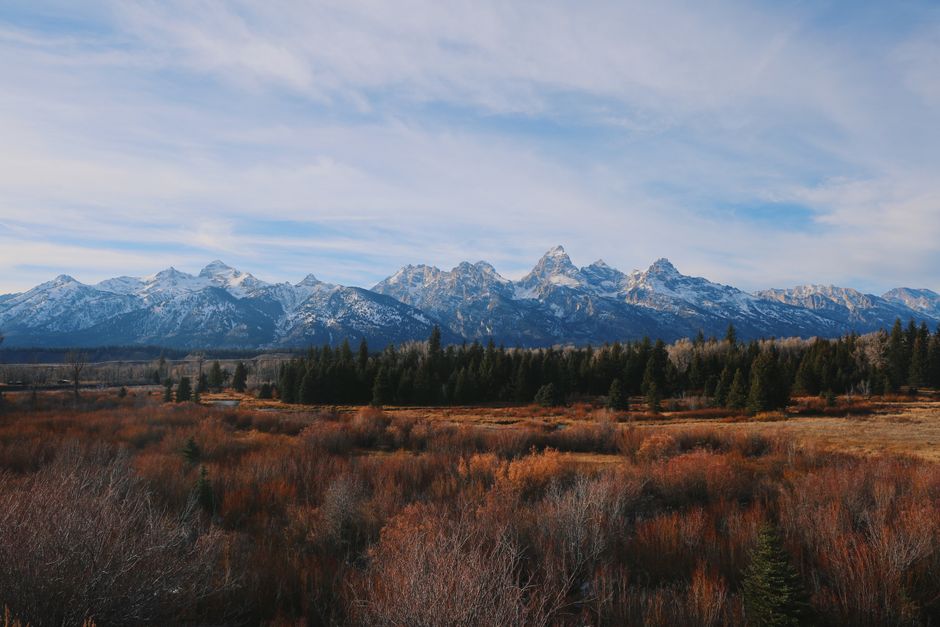
Grand Teton National Park protects the Teton Range, a wall of granite peaks that rises more than a mile straight up from the sagebrush flats of Jackson Hole in northwestern Wyoming, with no foothills in the way. Below the peaks lie a chain of glacier-carved lakes, from little Jenny Lake to big Jackson Lake, and the Snake River winds through the valley past moose, elk, bison, pronghorn and bears. The park covers nearly 310,000 acres (1,250 km²) just south of Yellowstone, linked to it by the John D. Rockefeller, Jr. Memorial Parkway, and the town of Jackson is a short drive from its southern entrance. It is easy to see the highlights from the road, but the best of it is on foot or on the water. Plan around the short summer season, the winter road closures and, in 2026 and 2027, a busy program of construction ahead of the park’s centennial in 2029.
Right now in Grand Teton National Park (Moose)
- Wed8–23°C46–73°FClear
- Thu7–22°C45–71°FClear
- Fri7–19°C45–66°FClear
- Mon 12 Oct Columbus Day
Top tours in Grand Teton National Park
See all tours for Grand Teton National Park →
From local operators, with prices and reviews; you check availability and book on Viator, our partner. We may earn a commission at no extra cost to you. How we earn money
Grand Teton at a glance
- Best months: late June to mid-September, when all roads, boats and lodges run; September adds golden aspens and the elk rut. From November to April the Teton Park Road and most facilities close, but the highways through the valley stay open for winter wildlife watching and skiing.
- Time needed: one full day for the scenic drives, Jenny Lake and Mormon Row; two or three days to add a long hike, a float on the Snake River and a dawn wildlife drive.
- Getting there: Jackson Hole Airport is inside the park, a few miles north of Jackson; Yellowstone’s South Entrance is about an hour’s drive north of Colter Bay; Salt Lake City is about 4.5–5 hours away by car.
- Fees (as of October 2026): $35 per car for 7 days, plus $100 per person for non-US residents aged 16 and over without an annual or America the Beautiful pass. No entry reservation is needed.
- Before you go: entry rules for international visitors (ESTA or visa), driving and tipping are in our United States travel guide.
Entrance fees and passes (as of October 2026)
You need an entrance pass to use the Teton Park Road and the park’s entrance stations at Moose, Moran and Granite Canyon; there is no timed entry or vehicle reservation. US Highway 26/89/191 through the eastern side of the valley, which also leads to the airport, has no entrance station. Buy your pass online or at an entrance station or the permit desks at the Craig Thomas Discovery and Visitor Center and Colter Bay. Grand Teton and Yellowstone charge separate fees.
| Pass | Price | What it covers |
|---|---|---|
| Private vehicle | $35 | One non-commercial vehicle and everyone in it, 7 days |
| Motorcycle | $30 | Up to 2 motorcycles, 4 riders, 7 days |
| Per person (foot, bike, ski) | $20 | Each person 16 or over; under-16s free; 7 days |
| Non-resident fee | +$100 per person | Non-US residents 16 and over, unless entering with an annual or America the Beautiful pass; also on commercial tours |
| Grand Teton annual pass | $70 | This park only, one vehicle, valid through the month of purchase a year later; US citizens and residents |
| America the Beautiful pass | $80 residents / $250 non-residents | All national parks and federal recreation lands for 12 months; one vehicle or four people paying per person |
For international visitors: two adults from abroad in a rental car would pay $35 plus $200 in non-resident fees here, and the same again at Yellowstone. The $250 non-resident America the Beautiful pass covers the car and waives the $100 fee for the pass holder and up to three other adults in both parks, so it pays for itself on the classic Grand Teton and Yellowstone trip and also covers Glacier and Rocky Mountain. US seniors 62 and over can buy a $20 annual or $80 lifetime pass; US military, US 4th graders and US residents with a permanent disability get free passes. US citizens and residents enter free on the remaining 2026 fee-free days, 27 October and 11 November.
Roads, winter closures and 2026–27 construction
Two roads run north–south through the park. The Teton Park Road hugs the foot of the mountains from Moose past Jenny Lake and Signal Mountain to Jackson Lake Junction. The Outer Park Road (US 26/89/191) runs along the east side of the valley past the airport, Snake River overlooks and Moran Junction, and on through the Rockefeller Parkway to Yellowstone. The highways from Jackson to Flagg Ranch, just south of Yellowstone, are plowed and open all winter, though often icy; Yellowstone’s South Entrance road closes to cars in winter.
- Teton Park Road winter closure: closed to cars from 1 November to 30 April between the Taggart Lake Trailhead and Signal Mountain Lodge. Before the snow arrives you can walk, run, cycle, rollerblade or walk a leashed dog on the empty road; from mid-December to mid-March it is groomed for cross-country skiing, snowshoeing and walking (no bikes once it is snow-covered).
- Moose-Wilson Road: the narrow, partly unpaved road between Moose and Teton Village, known for moose and bears, closes to cars every year from 1 November until mid-May and is not plowed between Death Canyon Road and the Granite Canyon Trailhead. In 2026 a realignment project (Phase II, May 2026 into 2027) means the stretch between the Laurance S. Rockefeller Preserve and Moose is closed to all use from 8 September to 15 November 2026, after summer closures and long delays. Large RVs and trailers are not allowed on this road at any time.
- Death Canyon Road and Trailhead: closed to all use, including walkers, from May 2026 to about June 2027 while a new trailhead is built about a mile closer to the road; reach Phelps Lake and Death Canyon from the Granite Canyon Trailhead or the Laurance S. Rockefeller Preserve (very limited parking).
- Delays in fall 2026: about 20 minutes at the new roundabout being built just north of the Moose Entrance Station (May 2026 to June 2027; Menor’s Ferry Road closes on some weekdays), and about 20 minutes on US 26/89/191 south of Moran Junction from October to December 2026.
- Other roads such as Antelope Flats, Schwabacher, Deadmans Bar, Pilgrim Creek, Two Ocean and Grassy Lake close for the season depending on conditions. The paved Grand Teton Pathway is closed at night, from half an hour after sunset to half an hour before sunrise.
For live road information, use the park’s road status map or call WYDOT on 511 (1-888-WYO-ROAD). In winter, carry chains or have winter tires, and expect white-outs and wildlife on the road. Spring 2027 opening dates follow the same rules: the Teton Park Road usually reopens to cars on 1 May and the Moose-Wilson Road in mid-May, depending on snow and on the construction schedule.
Wildlife and safety
Black and grizzly bears roam the whole park, near roads and trails as well as in the backcountry, and are active in most months, even in winter. Stay at least 100 yards (91 m) from bears and wolves and 25 yards (23 m) from moose, elk, bison and all other animals; never stop in a traffic lane to watch them. Hike in groups of three or more, make noise on the trail, carry bear spray where you can reach it, and store all food and scented items in your car or bear boxes. Moose are common along the Moose-Wilson Road, the Gros Ventre River and willow flats such as Oxbow Bend; they can be aggressive, especially cows with calves in spring and bulls in the fall rut.
Snow and frost are possible in any month, and summer afternoons often bring thunderstorms with lightning on exposed trails and peaks. The lakes and the Snake River are very cold, and the river has strong currents and logjams; only experienced paddlers should float it without a guide. Fire danger was moderate at the end of September 2026; smoke from regional fires can cause haze, so check air quality if you have breathing problems.
Top things to see in Grand Teton
Jenny Lake, Hidden Falls and Inspiration Point
The heart of the park: a clear lake at the foot of the highest peaks, with a visitor center, a ranger station for climbers and a trail all the way around. In summer a boat shuttle crosses the lake to the trail up to Hidden Falls and the Inspiration Point viewpoint, saving about 2 miles (3 km) each way; in 2026 it ran from 15 May to 30 September, and scenic cruises ran in the same period. Out of season you can walk around the south shore instead. The Jenny Lake Visitor Center stays open until 12 October 2026, and the parking lots fill early on summer mornings.
Mormon Row and Antelope Flats
The weathered barns of an early 1900s homesteader settlement, set against the Tetons, make one of the most photographed scenes in the West, especially the T.A. Moulton Barn at sunrise. From June to November 2026 the park is building a paved parking lot, restrooms, paths and viewing areas here; Mormon Row Road stays open, but some buildings are closed and you’ll hear and see machinery. Bison and pronghorn often graze the flats nearby.
Signal Mountain and Jackson Lake
A narrow summit road climbs about 5 miles (8 km) up Signal Mountain to views over the whole valley, Jackson Lake and the peaks (not for trailers or large RVs). Below, Jackson Lake stretches north toward Yellowstone; it is a reservoir, and in September 2026 its level was so low that the Signal Mountain, Colter Bay and Leeks marinas and most boat ramps were closed, with only hand-launching recommended at Signal Mountain. Signal Mountain Lodge and its campground closed for the season on 11 October 2026.
Oxbow Bend and Schwabacher Landing
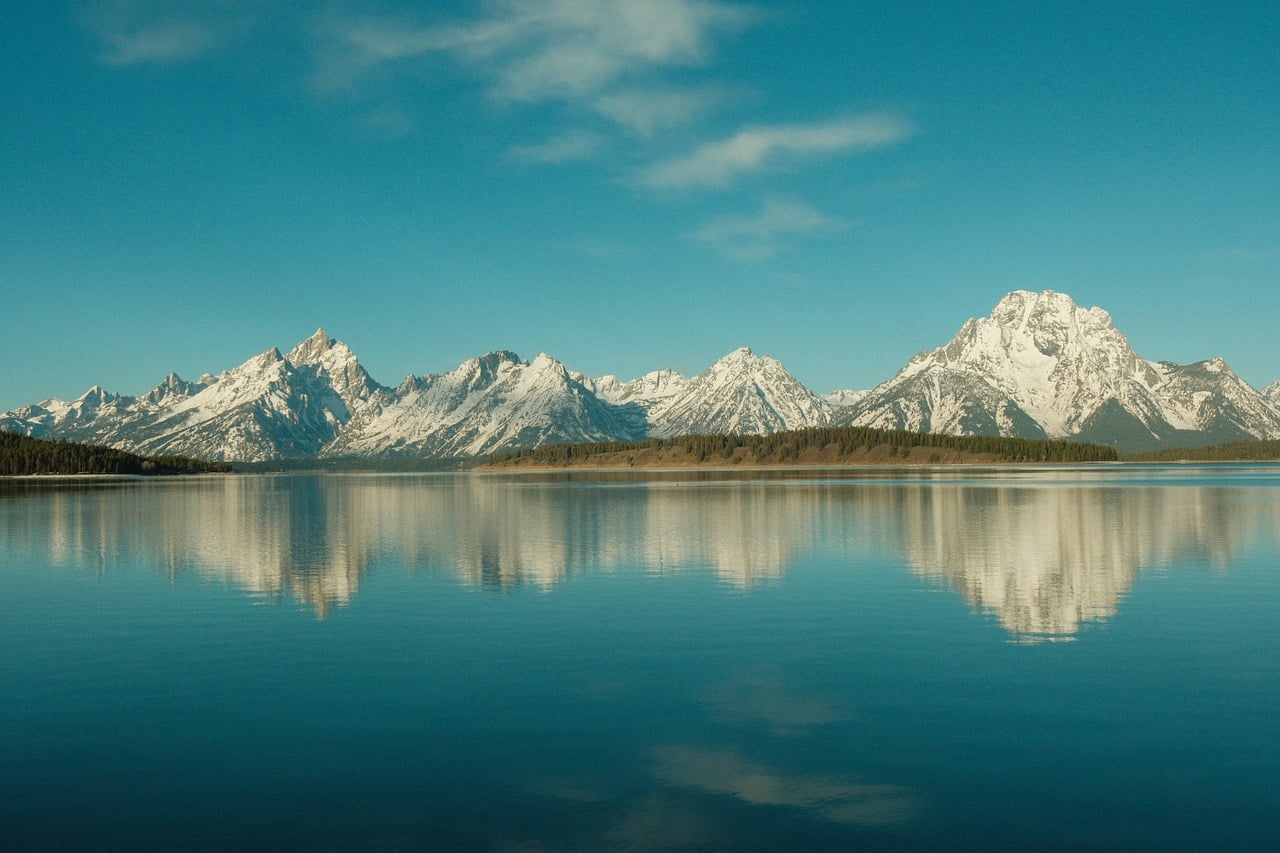
Two of the classic reflections of Mount Moran and the Grand Teton. Oxbow Bend, just east of Jackson Lake Junction, is a slow loop of the Snake River where moose, otters, pelicans and eagles feed; Schwabacher Landing, down a short gravel road off the Outer Park Road, has beaver ponds that mirror the peaks at dawn.
Moose, Menor’s Ferry and the Chapel of the Transfiguration
At Moose, the Craig Thomas Discovery and Visitor Center (open until 31 October 2026) has exhibits, the park film and the permit desk. Nearby, a short path through the Menor’s Ferry Historic District leads to a replica river ferry and a homestead cabin, and the small log Chapel of the Transfiguration frames the peaks through its altar window; it is open all year. Construction of the roundabout may limit access and parking here on weekdays.
Laurance S. Rockefeller Preserve and Taggart Lake
The preserve on the Moose-Wilson Road offers quiet trails to Phelps Lake and a thoughtful visitor center (open June to September); in fall 2026 it can be reached only from the Teton Village end while the road is closed south of Moose. Taggart Lake is a favorite short hike to a lake under the Grand Teton, but its shorter northern route is closed for renewal through 2026; use the longer, steeper southern route from the trailhead, which stays open.
Nature
- Hidden Falls
- Jackson Lake
- Jenny Lake
- Taggart Lake
Viewpoints
- Inspiration Point
Peaks and mountains
- Signal Mountain
Churches and cathedrals
- Chapel of the Transfiguration
Monuments
- Menor's Ferry
Nature reserves
- Laurance S. Rockefeller Preserve
Other things to do in Grand Teton
- Hiking: beyond Jenny Lake, try String Lake and Leigh Lake for easy lakeshore walks, Phelps Lake from Granite Canyon, or Cascade Canyon beyond Inspiration Point for a big day. See our hiking guide for general advice.
- Cycling: the paved Grand Teton Pathway runs from Jackson to Moose and on to Jenny Lake, and the closed Teton Park Road is a car-free ride in early November and late April. See our cycling guide.
- On the water: canoe or kayak on String and Leigh lakes, take a Jenny Lake cruise, or join a guided scenic float on the Snake River below the peaks. See our boat trips guide.
- Aerial tram to the park’s trails: from Teton Village, outside the park, the Jackson Hole Aerial Tram gave summer access to park trails high on Rendezvous Mountain from 16 May to 4 October 2026.
- Climbing: the Grand Teton (13,775 ft / 4,199 m) is a serious mountaineering objective; guide services work from Jackson and the park, and the Jenny Lake Ranger Station has climbing information in summer.
- Winter: cross-country ski or snowshoe the groomed Teton Park Road, watch for moose and bighorn sheep, and respect the winter wildlife closures that protect animals when food is scarce.
Getting there
Jackson Hole Airport (JAC) sits inside the park on the Outer Park Road, about 8 miles (13 km) north of Jackson; it is the only commercial airport in a US national park, with direct flights from several big US hubs, more in winter and summer. Most visitors rent a car, since there is no public transportation through the park. From Yellowstone, drive south from Grant Village about 20 miles (32 km) to the South Entrance and through the John D. Rockefeller, Jr. Memorial Parkway. From Idaho, the routes cross Teton Pass (WY 22, steep, closed to some large vehicles) or follow the Snake River Canyon via Alpine.
| From | Approximate distance to Moose | Route and time |
|---|---|---|
| Jackson, WY (town) | 12 miles (19 km) | US 26/89/191 north; about 20 minutes |
| Jackson Hole Airport (JAC) | about 5 miles (8 km) | Inside the park; about 10 minutes |
| Yellowstone South Entrance | about 55 miles (89 km) | US 89/191/287 through the Rockefeller Parkway; about 1.25 hours |
| Idaho Falls, ID (IDA airport) | about 100 miles (160 km) | Via Teton Pass or Snake River Canyon; about 2–2.5 hours |
| Salt Lake City, UT (SLC airport) | about 290 miles (467 km) | Via Interstate 15 or US 89; about 5 hours |
| Denver, CO (DEN airport) | about 540 miles (870 km) | Via Interstate 80 and US 191; about 8–9 hours |
Many road trips combine Grand Teton and Yellowstone with Salt Lake City or Park City to the south. Check WYDOT road reports before crossing mountain passes from October to May.
Around Grand Teton
- Jackson: the Western town at the south end of the valley, with the antler arches of Town Square, galleries, restaurants and the National Elk Refuge on its doorstep.
- Yellowstone National Park: geysers and wildlife beyond the Rockefeller Parkway; its South Entrance road closes to cars after 31 October and reopens in May.
- Teton Village and Jackson Hole Mountain Resort: skiing in winter and the aerial tram in summer, at the southwest edge of the park.
- Gros Ventre and Bridger-Teton National Forest: red hills, the 1925 Gros Ventre landslide and quieter trails east of the park.
Nearby destinations
- Jackson40 km
- Yellowstone National Park87 km
When to go and how long to stay
The valley floor lies at about 6,400–6,800 ft (1,950–2,070 m), and winters are long and cold. Most visitors come from May to September. Spring is mild by day with rain and snow, and some trails stay snowy into July; summer brings warm days, cool nights and afternoon thunderstorms; September and October bring sunny days, cold nights, gold aspens and red hawthorns, but lodges and campgrounds close between late September and mid-October; from December to April the valley is deep in snow, with sunny days between storms and frigid nights.
| Season | Average high | Average low | What it’s like |
|---|---|---|---|
| Spring (Mar–May) | 42–62 °F (6–16 °C) | 15–33 °F (−9 to 1 °C) | Snow lingers; Teton Park Road reopens 1 May; bears and newborn animals. |
| Summer (Jun–Aug) | 71–82 °F (22–28 °C) | 39–44 °F (4–7 °C) | Everything open and busy; afternoon thunderstorms; cold nights. |
| Fall (Sep–Nov) | 71–39 °F (22–4 °C) | 34–15 °F (1 to −9 °C) | Fall color and elk rut; services close by mid-October; road closures from 1 November. |
| Winter (Dec–Feb) | 27–32 °F (−3 to 0 °C) | 1–6 °F (−17 to −14 °C) | Deep snow; skiing and snowshoeing; highways open, park facilities mostly closed. |
Figures are NOAA 1991–2020 normals for the Moose weather station, at about 6,440 ft (1,964 m) near park headquarters. It gets about 23 inches (584 mm) of precipitation a year, including around 166 inches (421 cm) of snow, mostly from November to March.
Weather month by month
Grand Teton in one day
Watch sunrise at Mormon Row or Schwabacher Landing, then drive the Teton Park Road to Jenny Lake for the boat shuttle (in season) and the short climb to Hidden Falls and Inspiration Point. After lunch, continue north past Signal Mountain to Oxbow Bend and return south on the Outer Park Road, stopping at the Snake River Overlook in the late afternoon light.
Two or three days
Add a long hike into Cascade Canyon or around Phelps Lake, a paddle on String Lake, a guided float on the Snake River, and dawn and dusk wildlife drives. Spend one evening in Jackson, then continue north to Yellowstone.
Where to stay in and near Grand Teton
- Park lodges (summer only): Jackson Lake Lodge, a full-service resort with 37 rooms in the main lodge and 348 cottage rooms (mid-May to early October); Jenny Lake Lodge, small and upscale (early June to early October); Signal Mountain Lodge on Jackson Lake; Colter Bay Village with about 200 log cabins and tent cabins (late May to late September); Headwaters Lodge at Flagg Ranch in the Rockefeller Parkway; and the American Alpine Club’s rustic Climbers’ Ranch. All had closed for 2026 by mid-October.
- Jackson and Teton Village: the year-round base, with everything from motels to luxury hotels; Teton Village suits skiers and the aerial tram.
- Camping: campgrounds include Jenny Lake (tents only), Signal Mountain, Colter Bay (with an RV park), Lizard Creek, Gros Ventre and Headwaters. All are closed in winter; Gros Ventre, the last to close, shut on 10 October 2026. Reserve on Recreation.gov.
Room taxes: Grand Teton lies in Teton County, Wyoming. Room rates are quoted before tax; hotel bills add Wyoming’s 5% lodging tax (3% for the state and 2% for Teton County) plus state and local sales tax, which together come to roughly 11–12% of the room rate. Check the total when you book.
Practical tips for Grand Teton
- Go early: Jenny Lake, String Lake, Taggart Lake and the Laurance S. Rockefeller Preserve fill early on summer mornings; wildlife is also most active at dawn and dusk.
- Check construction: in 2026 and 2027 several roads and trailheads near Moose are closed or slow; look at the park’s road construction page the day you go.
- Fuel and food: gas pumps at Signal Mountain, Colter Bay and Headwaters are self-service and seasonal; in winter, buy fuel and food in Jackson or Moran.
- Drive slowly at night: moose, elk and bison cross the highways after dark; speed limits are lower at night on the Outer Park Road.
- Leave no trace: stay on trails, pack out trash, and never feed animals. Drones are not allowed in national parks.
- Time zone: Mountain Time, with daylight saving time ending on 1 November 2026. Emergencies: call 911; mobile signal is limited in canyons and on the west shore.
What to pack for Grand Teton
Bring layers even in July: a warm fleece, a rain jacket, a hat and light gloves for cold mornings, plus sunscreen, sunglasses and a sun hat for the strong mountain sun. Sturdy hiking shoes, a daypack with water and snacks, bear spray in a holster and binoculars for wildlife are essential. In fall and winter, add an insulated jacket, warm boots, traction devices for icy paths and, for skiing or snowshoeing, plenty of extra layers.
Grand Teton travel FAQ
How much does it cost to enter Grand Teton National Park in 2026?
$35 per car, $30 per motorcycle or $20 per person on foot or bike, valid 7 days. Non-US residents aged 16 and over also pay $100 each unless they have an annual or America the Beautiful pass ($250 for non-residents).
Do I need a reservation to visit Grand Teton?
No. There is no timed entry. You need reservations only for lodges, campgrounds, backcountry permits and guided trips such as floats and climbing.
When does the Teton Park Road close?
It closes to cars from 1 November to 30 April between the Taggart Lake Trailhead and Signal Mountain Lodge. In winter it is groomed for skiing, snowshoeing and walking.
Is the Moose-Wilson Road open?
Not in fall 2026: the section between the Laurance S. Rockefeller Preserve and Moose is closed to all use from 8 September to 15 November 2026 for construction, and the whole road closes to cars every winter from 1 November until mid-May.
When does the Jenny Lake boat shuttle run?
In 2026 it ran from 15 May (depending on ice) to 30 September. Outside those dates, walk around the south shore of the lake to reach Hidden Falls and Inspiration Point.
Is Jackson Hole Airport in Grand Teton National Park?
Yes. Jackson Hole Airport lies inside the park, about 8 miles (13 km) north of Jackson, on a highway without an entrance station.
Does the Grand Teton pass also cover Yellowstone?
No. Each park charges its own entrance fee, and non-residents pay the $100 fee at each. An America the Beautiful pass covers both.
Where can I see moose in Grand Teton?
Look in willow flats and along rivers: Oxbow Bend, the Gros Ventre River near Kelly, the Snake River near Moose and the Moose-Wilson Road when it is open. Early morning and evening are best; stay at least 25 yards (23 m) away.
What is the best time to visit Grand Teton?
Late June to mid-September for open roads, boats and lodges; September for fall color and fewer people. Winter is quiet and beautiful, with skiing and wildlife, but most park facilities are closed.
Plan your trip
Partner links: TravelerCenter may earn a commission if you book, at no extra cost to you.
Sources · last reviewed 4 October 2026
Researched and last reviewed on 4 October 2026. Fees, passes and fee-free days, winter road closures, 2026–27 road and park construction, Jackson Lake water levels and marina status, bear and wildlife safety, fire danger, facility and lodge opening dates, the Jenny Lake boat season and aerial tram dates come from Grand Teton National Park (National Park Service); climate from NOAA’s 1991–2020 normals for the Moose station; the lodging tax from Teton County. The airport and highway distances, Signal Mountain Road and Moose-Wilson vehicle limits, the combined room-tax estimate and some general details are flagged for checking. Conditions and construction schedules change, so check the park’s alerts before you travel. For entry rules, driving and tipping, see our United States travel guide.
Also: NOAA NCEI normals 1991–2020, Moose (climate)
Data: Weather: MET Norway (CC BY 4.0) · Rates: ECB · Holidays: Nager.Date · Costs: World Bank ICP and price levels · © OpenStreetMap contributors (ODBL) · Wikidata (CC0)