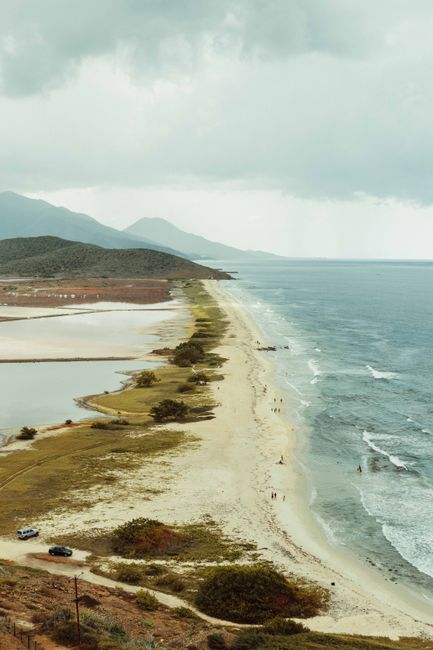
Margarita Island (Isla de Margarita) is Venezuela’s favorite holiday island, about 40 km (25 miles) off the northeastern coast in the Caribbean, and the “Pearl of the Caribbean” to Venezuelans, a name that recalls the pearl beds that made it famous in the 16th century. Covering about 1,020 km² (394 sq miles), it is really two islands joined by a long, thin sandbar: a greener, busier eastern half with the towns, the hills and most of the beaches, and the dry, wild Macanao peninsula to the west. In between lies La Restinga National Park, a lagoon of mangrove channels explored by boat. Margarita is a place to do very little in the sun: swim and surf at Playa El Agua and Playa Parguito, windsurf or kitesurf in the steady trade winds at El Yaque, one of the best-known spots in the Caribbean, watch the sunset from the old fort above Juangriego, and visit the colonial castles of Pampatar and La Asunción and the basilica of the Virgen del Valle. Boats run to the small islands of Coche and Cubagua. With an average of only about 530 mm (21 in) of rain a year at Porlamar, according to Venezuela’s official climate normals, Margarita is warm and sunny all year. Four or five days is a good first stay.
Right now in Margarita Island (Porlamar)
- Sat25–31°C78–88°FClear
- Sun26–31°C78–88°FClear
- Mon26–30°C78–86°F1 mm rain
Margarita Island: quick answers
- Things to do in Margarita Island
- The Castillo de San Carlos Borromeo, Pampatar, The Castillo de Santa Rosa and La Asunción, The Basilica of the Virgen del Valle, La Restinga National Park, Juangriego and the Fortín de La Galera. More
- Best time to visit Margarita Island
- Any time of year. January to May is driest, with only about 10 to 35 mm of rain a month at Porlamar, and the wind is usually strongest for windsurfing in the first half of the year. More
- How many days in Margarita Island
- Three days for the forts, the basilica, La Restinga and a beach day; four or five days or more to relax, add Coche and Cubagua, or take a wind-sports course. More
- Where to stay in Margarita Island
- Porlamar and Pampatar, The northeast coast, El Yaque, La Asunción, El Valle and Juangriego, The Macanao peninsula. More
Margarita Island at a glance
- Best for: beaches, windsurfing and kitesurfing, colonial forts and churches, boat trips through mangroves, seafood and duty-free shopping.
- How long: four or five days; a week to add Coche, Cubagua and the Macanao peninsula, or a course at El Yaque.
- Best time: any time; January to May is driest, and the trade winds that drive the windsurfing are usually strongest in the first half of the year. Venezuelan holidays (Christmas, carnival, Easter and late July to August) are the busiest.
- Getting there: by air to Santiago Mariño International Airport (PMV), or by ferry from the eastern mainland; check current flights and ferries with the operators.
- Getting around: by rental car, taxi, hotel transfer or local por puesto minibuses; the main sights are within about an hour’s drive of each other.
- Before you go: entry rules, money and general practical advice are in our Venezuela travel guide.
Explore Margarita Island in videos
Hand-picked travel videos from YouTube creators to help you picture the trip. They play from YouTube; the facts in this guide come from our own research.
Margarita’s areas and where to stay
Margarita, with its neighbors Coche and Cubagua, forms the state of Nueva Esparta, whose capital is La Asunción. Most hotels are on the eastern half of the island, between Porlamar and Playa El Agua.
Porlamar and Pampatar
Porlamar, on the southeastern coast, is the island’s largest town and commercial center, with shopping malls, duty-free stores, restaurants and city hotels along its seafront and the Avenida Santiago Mariño. Just east, the old port of Pampatar is quieter and more historic, with its 17th-century castle, a waterfront of fishing boats and a growing number of restaurants and hotels; the beaches of Playa Moreno and Playa Puerto Real are nearby.
The northeast coast: Playa El Agua and Parguito
The island’s most famous stretch of sand runs along the northeast coast. Playa El Agua is a long, palm-lined beach with beach bars, restaurants and hotels; next to it, Playa Parguito has bigger waves and is popular with surfers and bodyboarders. Further north, Playa Manzanillo is a fishing village with a quieter beach, and Playa Caribe, near Juangriego, has a young, lively crowd. This is the best area for a beach holiday.
El Yaque
On the dry south coast, near the airport, El Yaque is a small village built around windsurfing and kitesurfing, with a wide, shallow bay, flat water near the shore and steady cross-onshore trade winds. It has board-rental centers, schools, beach bars and simple hotels and is a favorite base for wind-sports fans.
La Asunción, El Valle and Juangriego
Inland, the green valleys of the east hold the state capital, La Asunción, with its colonial cathedral and the Castillo de Santa Rosa; the pilgrimage town of El Valle del Espíritu Santo, home of the basilica of the Virgen del Valle; and, on the north coast, the fishing town of Juangriego, on a sheltered bay famous for its sunsets.
The Macanao peninsula
West of La Restinga, Macanao is dry, hilly and thinly populated, with cactus scrub, fishing villages and empty beaches such as Playa La Pared and Punta Arenas. It suits a day trip by car, and a few small guesthouses offer a quieter stay.
Top things to see on Margarita
The Castillo de San Carlos Borromeo, Pampatar
Pampatar’s square stone fortress, built by the Spanish in the 17th century to defend the island’s harbor against pirates and rival powers, stands right on the seafront, with bastions at each corner, cannons on its walls and fine views over the bay. Next to it, the church of Cristo del Buen Viaje and the old customs house complete a pretty historic waterfront.
The Castillo de Santa Rosa and La Asunción
On a hill above La Asunción, the small Castillo de Santa Rosa dates from the 17th century and is linked in local tradition to Luisa Cáceres de Arismendi, a heroine of the independence era who was imprisoned there. Below, the town’s colonial cathedral, Nuestra Señora de la Asunción, is one of the oldest churches in Venezuela, and the quiet plaza around it is lined with government buildings and old houses.
The Basilica of the Virgen del Valle
In El Valle del Espíritu Santo, between Porlamar and La Asunción, a pink and white neo-Gothic basilica houses the image of the Virgen del Valle, patroness of eastern Venezuela and of fishermen and sailors. Pilgrims come all year, and on her feast day, 8 September, the town fills with crowds, processions and music. A small museum displays offerings left by the faithful, including pearls.
La Restinga National Park
The sandbar that joins Margarita’s two halves encloses a shallow lagoon threaded with mangrove channels, protected as a national park. From the boat dock at the park entrance, local boatmen take visitors on a tour of about an hour through tunnels of mangroves, where you can spot pelicans, frigatebirds, herons and oysters clinging to the roots, ending at the long, wild beach of La Restinga on the open sea, with shacks selling fried fish. Prices are set by the boat cooperative; check them at the dock.
Juangriego and the Fortín de La Galera
On a headland above Juangriego’s bay, the ruined Fortín de La Galera, a small fort from the independence era, is the island’s favorite sunset viewpoint, with cafés and stalls at the top and fishing boats bobbing in the bay below.
More sights
- Cerro El Copey National Park: the forested hills in the center of the eastern half, the island’s highest point, with cloud forest, hiking trails and views over both coasts.
- Museo Marino de Margarita: a marine museum at Boca del Río, on the Macanao side of La Restinga, with aquariums and exhibits on the island’s sea life.
- Santa Ana del Norte: a village with a fine colonial church, known for hammock weavers and crafts.
- The quiet north coast: quiet stretches such as Playa Puerto Cruz and Playa Zaragoza, near Pedro González, with white sand and clear water.
Other things to do on Margarita
Windsurfing and kitesurfing at El Yaque
El Yaque’s bay has shallow, standing-depth water for hundreds of meters, warm water all year and reliable trade winds, making it one of the Caribbean’s classic spots for learning and for freestyle sailing. Schools offer lessons and multi-day courses for beginners, and centers rent the latest boards and kites. The windiest months are usually from about December to June. See our surfing guide for general board-sports advice.
Beaches and surfing
Margarita has dozens of beaches. For swimming and beach bars, try Playa El Agua, Playa Caribe, Playa Guacuco and the calm bays of Pampatar; for surfing and bodyboarding, Playa Parguito; for quiet sand, the north-coast coves near Pedro González and the beaches of Macanao. Some beaches have strong waves and currents, especially on the north and east coasts, so swim where locals swim or where lifeguards are present. See our beaches guide.
Snorkeling, diving and boat trips
Dive and snorkel trips visit the reefs and rocky islets around the island, such as Los Frailes off the northeast coast, and boats run day trips to Coche and Cubagua. See our snorkeling, diving and boat trips guides.
Food and drink
Margarita is a fishing island, and seafood is the star: whole fried fish with tostones (fried green plantain) and salad at a beach shack, fish soup, oysters at La Restinga, and the island specialty, pastel de chucho, a layered pie of stingray, plantain and cheese. The island’s empanadas, filled with fish, cazón (small shark) or cheese, are a classic breakfast. Everywhere, you will find arepas, cachapas with cheese and fresh fruit juices; for a sundowner, try a rum cocktail or a cold beer at a beach bar. Drink bottled or purified water.
Shopping
Margarita has long been a duty-free shopping area, and Porlamar’s malls and stores draw Venezuelan shoppers from the mainland. For crafts, look for hammocks and woven goods from Santa Ana del Norte and pottery from El Cercado, and stalls selling shell jewelry and local sweets along the beaches.
Day trips from Margarita
- Isla de Coche: a small, flat, dry island south of Margarita, with the long white beach of Playa La Punta and good kitesurfing; reached by boat or ferry.
- Isla de Cubagua: an uninhabited island west of Coche, where the ruins of Nueva Cádiz, one of the earliest Spanish towns in South America, built for the pearl trade in the early 16th century, stand by turquoise water; visited on boat tours.
- La Restinga and Macanao: a mangrove boat tour, then a drive around the wild Macanao peninsula and a visit to the marine museum.
- Los Frailes: rocky islets off the northeast coast for snorkeling and diving, by boat from Playa El Agua or Manzanillo.
- The mainland: Mochima National Park and the city of Cumaná lie across the water on the eastern mainland; see our Venezuela guide.
Getting there and getting around
By air
Santiago Mariño International Airport (PMV) is in the south of the island, between El Yaque and Porlamar, and has domestic flights, including from Caracas, and some international services. Airlines and routes change often, so check current flights directly with the airlines before you plan your trip. Taxis and hotel transfers wait at arrivals; agree the fare before you get in, or book a transfer through your hotel.
By ferry
Passenger and car ferries connect Margarita, through the port of Punta de Piedras on the south coast, with the eastern mainland. Routes, companies and schedules change, so check current services with the ferry operators before you travel. Small boats also link Margarita with Coche.
Getting around
A rental car gives the most freedom; roads are mostly paved, and distances are short: Porlamar to Playa El Agua takes about 30 minutes, and Porlamar to La Restinga about 45 minutes. Drive on the right, carry an International Driving Permit, and stop at police and National Guard checkpoints when asked. Taxis are plentiful; agree the fare first or book through your hotel. Local por puestos (shared minibuses) run between the towns and the main beaches for a low fare. Many hotels also organize island tours.
When to go and how long to stay
Margarita is hot, sunny and breezy all year and far drier than the Venezuelan mainland. The table shows average daily highs and lows and monthly rainfall at the Porlamar weather station, from the official 1991–2020 climate normals that Venezuela’s meteorological service, INAMEH, submitted to the World Meteorological Organization (WMO). January to May is the driest period, with only a few rainy days a month; June to December brings short showers, usually in the afternoon or at night, with August the wettest month. The island lies south of the usual hurricane tracks, although the Atlantic hurricane season runs from 1 June to 30 November, according to the US National Hurricane Center. The sea is warm enough for swimming all year.
| Month | Average high | Average low | Rain at Porlamar |
|---|---|---|---|
| January | 30.6 °C (87 °F) | 23.0 °C (73 °F) | 34 mm (1.3 in) |
| February | 31.1 °C (88 °F) | 23.2 °C (74 °F) | 20 mm (0.8 in) |
| March | 31.9 °C (89 °F) | 23.8 °C (75 °F) | 14 mm (0.6 in) |
| April | 32.9 °C (91 °F) | 24.7 °C (76 °F) | 11 mm (0.4 in) |
| May | 33.1 °C (92 °F) | 25.3 °C (78 °F) | 20 mm (0.8 in) |
| June | 32.3 °C (90 °F) | 25.1 °C (77 °F) | 59 mm (2.3 in) |
| July | 31.9 °C (89 °F) | 24.9 °C (77 °F) | 66 mm (2.6 in) |
| August | 32.6 °C (91 °F) | 25.3 °C (78 °F) | 78 mm (3.1 in) |
| September | 33.2 °C (92 °F) | 25.7 °C (78 °F) | 49 mm (1.9 in) |
| October | 32.9 °C (91 °F) | 25.5 °C (78 °F) | 59 mm (2.3 in) |
| November | 32.1 °C (90 °F) | 24.8 °C (77 °F) | 62 mm (2.4 in) |
| December | 30.9 °C (88 °F) | 23.7 °C (75 °F) | 57 mm (2.3 in) |
Rainfall adds up to about 527 mm (21 in) a year. The busiest times are the Venezuelan holidays: Christmas and New Year, carnival, Easter week and the school holidays from late July to mid-September, as well as the Virgen del Valle festival on 8 September. Book well ahead for these dates.
3 days on Margarita
Day 1: Pampatar’s castle and waterfront in the morning, the basilica in El Valle and La Asunción’s cathedral and castle in the afternoon. Day 2: a beach day at Playa El Agua or Parguito, ending with sunset at the Fortín de La Galera in Juangriego. Day 3: a boat tour of La Restinga’s mangroves, a fish lunch on the beach, and an afternoon watching the windsurfers at El Yaque.
5 days with Coche, Cubagua and Macanao
Add a boat day to Coche’s Playa La Punta and the ruins of Nueva Cádiz on Cubagua, and a drive around the Macanao peninsula, or spend two days on a windsurfing or kitesurfing course at El Yaque.
Where to stay on Margarita
- Playa El Agua and the northeast: beach hotels and posadas, the best base for a classic beach holiday.
- Pampatar: resort and boutique hotels near the historic waterfront and calm beaches, close to Porlamar’s restaurants.
- Porlamar: city hotels near the shops and restaurants, convenient but less scenic.
- El Yaque: small hotels and guesthouses for windsurfers and kitesurfers, close to the airport.
- Juangriego and the north coast: quieter posadas with sunset views.
What a trip to Margarita costs
Prices for visitors are commonly quoted in US dollars, which are widely accepted alongside the bolívar; the Banco Central de Venezuela publishes the official exchange rate daily. These are our rough estimates for November 2026, not official figures.
| Item | Typical cost |
|---|---|
| Taxi from the airport to Porlamar or Pampatar | US$15–30 |
| Por puesto ride between towns | US$1–2 |
| Fish empanada and fresh juice for breakfast | US$2–5 |
| Fried-fish lunch at a beach restaurant | US$10–20 |
| Beach chairs and umbrella for the day | US$5–15 |
| La Restinga mangrove boat tour, per boat | US$20–50 |
| Windsurf or kitesurf lesson, per hour | US$40–80 |
| Rental car, per day | US$40–80 |
| Mid-range hotel or posada double, per night | US$50–120 |
Practical tips for Margarita
- Bring small dollar notes: for taxis, beach chairs, boats and tips; card machines do not always accept foreign cards.
- Agree prices first: for taxis and boat tours, settle the price, and the currency, before you set off.
- Beat the heat: visit the castles and churches in the morning, and save the afternoon for the beach.
- Book holidays early: hotels and flights fill up at Christmas, carnival, Easter and in August.
- Respect the basilica: dress modestly and keep quiet during Mass.
Safety
For most visitors, the main practical risks on Margarita are the sun and the sea. The tropical sun is intense, so use high-factor sunscreen, wear a hat and drink plenty of water. Waves and currents can be strong on some north- and east-coast beaches, so swim where locals swim or near lifeguards, and take lessons with a recognized school before windsurfing or kitesurfing. Choose boat operators with life jackets. Keep valuables out of sight on the beach and in busy shopping areas, use taxis booked through your hotel at night, and follow your hotel’s advice. For emergencies, call 911 for police, fire and ambulance.
What to pack for Margarita
Light summer clothes, swimwear, a sun hat, sunglasses and high-factor, reef-friendly sunscreen; water shoes for rocky beaches and boat landings; a rash vest for long days on the water; a light layer for air-conditioned rooms and breezy evenings; insect repellent for La Restinga; small US dollar notes; a power bank; and a type A or B adapter if your devices are not North American. See our water shoes, wetsuits and travel adapters guides.
Margarita Island travel FAQ
How do I get to Margarita Island?
By air to Santiago Mariño International Airport (PMV), with domestic flights from Caracas and other cities and some international services, or by ferry from the eastern mainland to Punta de Piedras. Check current flights and ferries with the operators.
What is the best beach on Margarita?
Playa El Agua is the most famous, a long palm-lined beach on the northeast coast; Parguito is best for surfing, El Yaque for windsurfing and kitesurfing, and Playa La Punta on nearby Coche for a quiet day trip.
When is the best time to visit Margarita?
Any time of year. January to May is driest, with only about 10 to 35 mm of rain a month at Porlamar, and the wind is usually strongest for windsurfing in the first half of the year. Avoid Venezuelan holidays if you want quiet beaches.
Why is Margarita called the Pearl of the Caribbean?
Its name comes from the Greek word for pearl, and in the 16th century the oyster beds around Margarita and Cubagua produced pearls that were among the first great riches Spain took from the Americas.
Is El Yaque good for beginners?
Yes. The bay is shallow and the water flat close to shore, and schools offer beginner lessons and courses in windsurfing and kitesurfing.
How many days do I need on Margarita?
Three days for the forts, the basilica, La Restinga and a beach day; four or five days or more to relax, add Coche and Cubagua, or take a wind-sports course.
When is the Virgen del Valle festival?
On 8 September, at the basilica in El Valle del Espíritu Santo, with processions, Masses and celebrations around the date.
Can I combine Margarita with Angel Falls?
Yes. Many visitors spend a few days on Margarita and fly on to Canaima, usually on a package with a licensed tour operator, connecting through a mainland airport. See our Venezuela guide.
Plan your trip
Partner links: TravelerCenter may earn a commission if you book, at no extra cost to you.
🇪🇸 Useful Spanish phrases for Margarita Island
All 38 Spanish phrases: restaurant, hotel, emergencies, romance (printable) →
Before you go: guidebooks and travel gear
Affiliate links: we may earn a commission at no extra cost to you. As an Amazon Associate we earn from qualifying purchases. We pick items for the place, not for the commission. How we earn money
Sources · last reviewed 10 November 2026
Researched and last reviewed on 10 November 2026. Temperatures and rainfall: INAMEH’s official 1991–2020 WMO climate normals for the Porlamar station (NOAA NCEI archive); hurricane season: the US National Hurricane Center; payment in bolívars, US dollars and cards, and the 911 emergency number: the UK government’s foreign travel information (gov.uk); checkpoints: the Government of Canada (travel.gc.ca); exchange rate: Banco Central de Venezuela (bcv.org.ve); area and coordinates: Wikidata and OpenStreetMap. History, monument dates, sight descriptions, beaches, wind seasons, ferries and ports, transport, travel times and prices are general references or our estimates and are flagged for checking. Flights, ferries and prices change, so check them before you go. For entry rules, money and general practical advice, see our Venezuela travel guide.
Data: Weather: MET Norway (CC BY 4.0) · Sea temperature: NOAA CoastWatch · Rates: ECB · Wikidata (CC0)