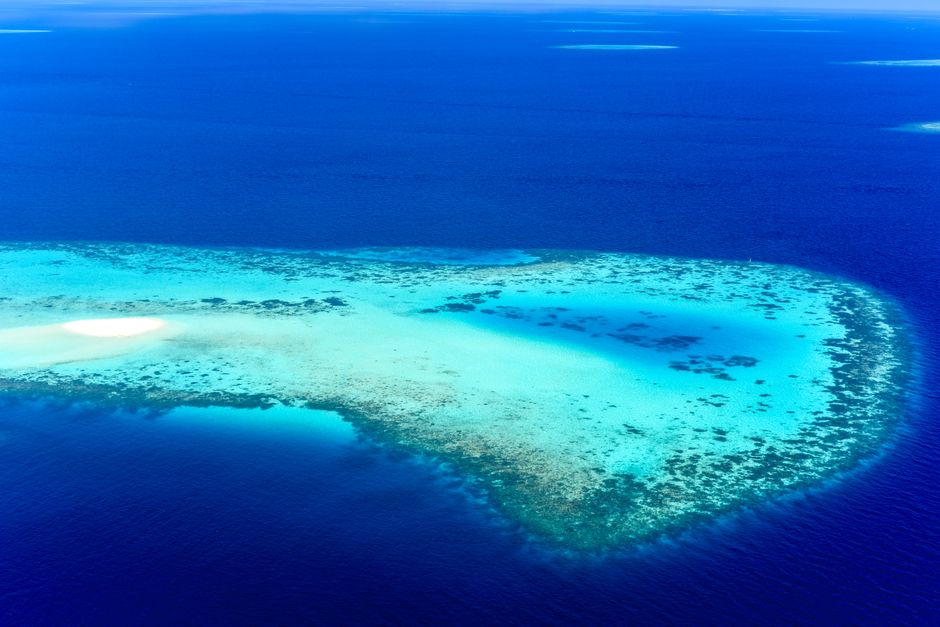
Baa Atoll, about 100 km (60 miles) northwest of Malé, is the Maldives’ showcase of marine conservation. In 2011, the whole atoll was designated a UNESCO Biosphere Reserve, the first in the country, in recognition of its rich reefs and the way local communities use them, and at its heart lies Hanifaru Bay, a small reef inlet where, during the southwest monsoon, plankton is trapped by currents and draws reef manta rays, sometimes in their hundreds, along with whale sharks, in one of the largest known manta feeding aggregations in the world. To protect them, Hanifaru Bay is a marine protected area where scuba diving is not allowed and snorkelers visit in limited numbers with approved guides. Baa also has some of the Maldives’ best-known luxury and eco-minded resorts, around a dozen local islands, including the guesthouse island of Dharavandhoo, with the atoll’s domestic airport, and Thulhaadhoo, home of the traditional Maldivian lacquer craft. Resorts are reached by seaplane in about 35 to 45 minutes or by domestic flight and speedboat. The manta season runs from about May or June to October or November; the driest months are December to April.
Right now in Baa Atoll
- Wed 28–29°C 82–85°F 4 mm Mostly clear
- Thu 26–28°C 79–83°F 15 mm Showers
- Fri 27–28°C 81–83°F 6 mm Showers
Weather: MET Norway (CC BY 4.0) · Sea temperature: NOAA CoastWatch
Top tours in Baa Atoll
See all tours for Baa Atoll →
From local operators, with prices and reviews; you check availability and book on Viator, our partner. We may earn a commission at no extra cost to you. How we earn money
Baa Atoll at a glance
- Best for: manta rays at Hanifaru Bay, whale sharks, reef snorkeling and diving, luxury and eco resorts, and quiet local islands.
- How long: 4–7 nights; plan at least three days in the manta season to allow for conditions at Hanifaru.
- Best time: for mantas, about June to October, the peak of the southwest monsoon; for dry, calm weather, December to April.
- Getting there: seaplane (about 35–45 minutes) or a domestic flight to Dharavandhoo (about 30–35 minutes) and a speedboat to your island.
- Getting around: by resort or guesthouse boat; shared speedboats and ferries link the local islands.
- Rules to know: Hanifaru Bay is snorkel-only, with approved guides and limited numbers; keep your distance from mantas and whale sharks.
- Before you go: the visa on arrival, the IMUGA Traveller Declaration, taxes, money and general safety are in our Maldives travel guide.
Baa Atoll: where things are
Baa is an oval atoll about 40 km (25 miles) long, with dozens of islands on its rim and many reefs (faru) and pinnacles inside its lagoon. Goidhoo, a small separate atoll to the south, is part of the administrative atoll. About a dozen islands are inhabited, and a similar number are resorts.
The local islands
Eydhafushi is the atoll capital, with the main harbor, shops and a hospital. Dharavandhoo, on the eastern side close to Hanifaru Bay, has the domestic airport, the Hanifaru Bay visitor center and most of the guesthouses. Thulhaadhoo is famous for its lacquerwork, Fehendhoo and Fulhadhoo in Goidhoo Atoll have long, quiet beaches, and Kamadhoo, Kendhoo, Kihaadhoo, Kudarikilu, Maalhos and Dhonfanu are small fishing and farming communities.
The resort islands
Baa’s resorts range from family-friendly islands to some of the country’s most exclusive retreats, several with marine biologists, research centers and coral restoration programs; many run guided trips to Hanifaru Bay in season.
Hanifaru Bay
A small, funnel-shaped bay on a reef in the east of the atoll, near the uninhabited island of Hanifaru, about 15 minutes by boat from Dharavandhoo. It is a core zone of the Biosphere Reserve.
Top things to see in Baa Atoll
The manta rays of Hanifaru Bay
According to Visit Maldives, whale sharks travel to Baa for the yearly plankton feeding in Hanifaru Bay during the southwest monsoon, when currents push plankton into the bay; the aggregation period runs from about May or June to October or November. On the best days, usually around the new and full moons and with the right tide and wind, dozens or even hundreds of reef mantas spiral through the bay in “cyclone feeding,” joined at times by whale sharks. On other days, there may be few or none; trips go when the conditions are right.
Rules at Hanifaru Bay
Hanifaru Bay has been a marine protected area since 2009, and scuba diving is no longer permitted: visitors snorkel only, accompanied by a certified guide approved by the Baa Atoll Conservation Fund, with limits on the number of boats and people in the bay and a time limit for each group. Visitors buy a token or ticket, reported at about US$30 per person, through the Hanifaru visitor center on Dharavandhoo or their resort, with the money going to the conservation fund. Keep at least 3 m (10 ft) from mantas and from a whale shark’s head and 4 m (13 ft) from its tail, do not touch them or block their path, do not use flash, and do not dive down onto feeding animals.
Other manta and whale shark sites
Outside Hanifaru’s season and in other parts of the atoll, mantas visit cleaning stations such as Dhigu Thila and Nelivaru Thila, and whale sharks sometimes cruise the outer reefs.
Reefs and the Biosphere Reserve
The Baa Atoll UNESCO Biosphere Reserve covers the whole atoll, including its reefs, islands, mangroves and seagrass beds, with core protected areas such as Hanifaru, transition zones where fishing and tourism continue, and community conservation programs. Its reefs host turtles, reef sharks, eagle rays and more than a thousand species of fish.
Mangroves, seagrass and turtles
Away from the reefs, Baa’s islands hold small mangrove wetlands and lagoons where young fish and birds shelter, and seagrass meadows in the shallow lagoons feed green turtles, which snorkelers often meet grazing near resort jetties and house reefs. Hawksbill turtles feed on the sponges of the outer reefs. Some resorts and local groups monitor turtle nesting and lead guided snorkels to the seagrass beds; keep a respectful distance, do not touch or chase turtles, and never stand on seagrass or coral.
Thulhaadhoo’s lacquerwork
On Thulhaadhoo, craftsmen still make liyelaa jehun, traditional Maldivian lacquerware: wooden boxes, vases and bowls turned on a lathe and decorated with layers of red, yellow and black lacquer carved into floral patterns. Excursions from resorts and guesthouses visit the workshops.
Eydhafushi and local craftsmanship
Eydhafushi, the atoll capital, has a busy harbor, a school, shops, cafés and the atoll’s hospital; it is known for its boat-building yards, where traditional dhonis and modern fishing vessels are built, and for its women’s cooperatives that make reed mats (kunaa) and coconut-rope products. Excursions from guesthouses sometimes visit for a walk around the island and a stop at a tea shop.
Sandbanks and local island life
Boat trips visit sandbanks and uninhabited islands for snorkeling and picnics. On Dharavandhoo, Eydhafushi or the Goidhoo islands, you can walk sandy streets, watch boat-builders and fishermen, and eat in tea shops.
Snorkeling, diving and boat trips
Diving
Diving is not allowed in Hanifaru Bay, but Baa has many other good dive sites: thilas with soft corals and schooling fish, manta cleaning stations, channels on the outer rim and caves. Visibility is best from December to April, and the manta season brings plankton-rich water from May to November. Resorts and some guesthouses have dive centers. See our diving guide.
Snorkeling
Baa’s house reefs and lagoon reefs are excellent for snorkeling, with turtles, reef sharks and colorful fish; many resorts have marine biologists who lead guided snorkels and run coral-planting programs. See our snorkeling guide.
Boat trips
Dolphin cruises, sunset fishing, sandbank picnics and excursions to local islands and Thulhaadhoo are offered everywhere. See our boat trips guide.
Other things to do in Baa Atoll
Food and drink
Resorts serve international menus, often with beach, sandbank and private dinners. On local islands, guesthouses cook Maldivian dishes such as mas huni, garudhiya, fish curries and grilled reef fish, and tea shops sell hedhikaa such as gulha and bajiya. Local islands are dry; alcohol is served only at resorts and on licensed boats.
Conservation activities
Many resorts and guesthouses offer talks on mantas and reefs, coral restoration, turtle identification and beach cleanups, some in partnership with research groups that monitor the atoll’s mantas.
Beaches and water sports
Resort beaches, designated tourist beaches on local islands, and the long beaches of Fulhadhoo and Fehendhoo are perfect for swimming; kayaks and paddleboards are widely available. See our beaches guide.
Day trips and onward travel
- Hanifaru Bay: a short boat trip from Dharavandhoo or nearby resorts in the manta season.
- Thulhaadhoo: the lacquerwork island, as a half-day excursion.
- Goidhoo Atoll: Fulhadhoo and Fehendhoo, for beaches and quiet villages.
- Raa and Lhaviyani atolls: neighboring atolls to the north and east, reached by seaplane or speedboat.
- Malé and Kaafu Atoll: by domestic flight from Dharavandhoo. See our Kaafu Atoll guide.
Nearby destinations
- Kaafu Atoll (North & South Malé)100 km
- Ari Atoll142 km
Getting there and getting around
By seaplane
Most Baa resorts are reached by seaplane from the water aerodrome at Velana International Airport, a flight of about 35 to 45 minutes. Seaplanes fly only in daylight, so late international arrivals may need a night near Malé.
By domestic flight
Dharavandhoo Airport has domestic flights from Velana, taking about 30 to 35 minutes, after which resorts and guesthouses meet guests with speedboats. This is the usual route for guesthouse visitors and is often cheaper than a seaplane.
By speedboat and ferry
A few operators run shared speedboats between Malé and Baa, taking about 2.5 to 3 hours across open water, rough in the southwest monsoon. Public ferries link Baa’s local islands with each other and with neighboring atolls on certain days.
When to go and how long to stay
Baa has a hot equatorial climate. The southwest monsoon, from about May to November, brings more rain, wind and swell, but it is the season for the Hanifaru manta aggregation, which usually peaks from about June to October. The northeast monsoon, from December to April, brings dry, sunny weather and calm seas, with the best visibility for diving, though mantas are absent from Hanifaru. There is no long-term climate station in Baa in the World Meteorological Organization’s (WMO) public lists, so the table uses the 1991–2020 normals for Hulhulé (Malé airport), about 110 km (70 miles) southeast, from the Maldives Meteorological Service; the northern atolls are slightly drier from January to April.
| Month | Average high / low | Rain (rainy days) | What to expect in Baa |
|---|---|---|---|
| January | 31 °C (87 °F) / 26 °C (79 °F) | 87 mm (3.4 in), 6 days | Sunny and calm; good visibility |
| February | 31 °C (88 °F) / 26 °C (79 °F) | 38 mm (1.5 in), 3 days | Driest month |
| March | 32 °C (89 °F) / 27 °C (80 °F) | 49 mm (1.9 in), 4 days | Hot and calm |
| April | 32 °C (89 °F) / 27 °C (81 °F) | 127 mm (5.0 in), 8 days | Hottest month; end of the dry season |
| May | 32 °C (89 °F) / 27 °C (80 °F) | 238 mm (9.4 in), 15 days | Monsoon change; first mantas in some years |
| June | 31 °C (88 °F) / 26 °C (80 °F) | 146 mm (5.8 in), 13 days | Manta season under way |
| July | 31 °C (87 °F) / 26 °C (79 °F) | 198 mm (7.8 in), 14 days | Hanifaru manta peak in many years |
| August | 31 °C (87 °F) / 26 °C (79 °F) | 193 mm (7.6 in), 13 days | Hanifaru manta peak in many years |
| September | 30 °C (87 °F) / 26 °C (78 °F) | 214 mm (8.4 in), 15 days | Mantas; showers |
| October | 30 °C (87 °F) / 26 °C (78 °F) | 245 mm (9.7 in), 15 days | Late manta season; wetter |
| November | 30 °C (87 °F) / 26 °C (78 °F) | 236 mm (9.3 in), 14 days | End of the manta season |
| December | 30 °C (87 °F) / 26 °C (78 °F) | 212 mm (8.4 in), 12 days | Drying out; holiday peak |
4 nights on Dharavandhoo in the manta season
Fly to Dharavandhoo, check the daily Hanifaru conditions with your guesthouse, and plan two or three snorkeling trips to the bay, with a sandbank picnic, a visit to Thulhaadhoo and a sunset fishing trip in between.
A week at a resort
Stay at a Baa resort with a house reef and a marine biologist, join the resort’s Hanifaru trips in season, and add a few dives on the atoll’s thilas.
Where to stay in Baa Atoll
- Resort islands: luxury and eco-minded resorts reached by seaplane, many with manta programs.
- Dharavandhoo: guesthouses closest to Hanifaru Bay and the airport.
- Eydhafushi and other local islands: a few guesthouses on the atoll capital and smaller islands.
- Fulhadhoo and Fehendhoo (Goidhoo Atoll): small guesthouses on quiet beach islands.
In the manta season, guesthouses on Dharavandhoo fill early; book ahead for July and August.
What a trip to Baa Atoll costs
Prices are approximate, for October 2026, in US dollars with rufiyaa at about 15.4 to the dollar; taxes are those of MIRA.
| Item | Typical cost |
|---|---|
| Green tax at a resort, per person per night | US$12 (about MVR 185) |
| Green tax at a guesthouse with 50 or fewer rooms, per person per night | US$6 (about MVR 92) |
| Hanifaru Bay snorkel token | about US$30 (about MVR 460) |
| Guided Hanifaru snorkeling trip from Dharavandhoo, including boat | US$60–120 (about MVR 925–1,850) |
| Domestic flight Malé–Dharavandhoo, return | US$200–350 (about MVR 3,080–5,390) |
| Seaplane transfer, return, per person | US$700–1,100 (about MVR 10,780–16,940) |
| Guesthouse double, per night, before taxes | US$70–160 (about MVR 1,080–2,460) |
| Luxury resort villa, per night, before taxes | US$1,000 and up |
Practical tips for Baa Atoll
- Allow several days for Hanifaru: manta numbers vary daily with tides, moon and wind.
- Be flexible: trips to Hanifaru are often decided on the morning of the day.
- Snorkel calmly: float at the surface, avoid splashing and let the mantas come to you.
- Book flights early: domestic flights to Dharavandhoo fill in the manta season.
- Respect local-island rules: no alcohol, modest dress in the village, swimwear only on bikini beaches.
Safety
Baa’s hazards are mainly in the water. Currents can be strong in Hanifaru Bay and on the outer reefs; according to the UK government, tidal currents in the Maldives have dragged swimmers away from the shore, resulting in drownings, so snorkel only with approved guides, stay with your group and wear a buoyancy aid if you are not a strong swimmer. Busy boat traffic at Hanifaru in peak season can be dangerous; follow your guide’s instructions about when to enter and leave the water. Crossings between atolls can be rough in the southwest monsoon, and seaplanes do not fly after dark or in storms. Medical facilities are limited to the hospital in Eydhafushi and basic health centers, and divers should note that many islands are more than an hour from a hyperbaric chamber. For emergencies, call 119 for police, 102 for an ambulance and 191 for the coast guard.
What to pack for Baa Atoll
Reef-safe sunscreen, a rash guard or thin wetsuit for long snorkels, a mask and snorkel that fit well, reef shoes, a light rain jacket for the monsoon season, a dry bag for boat trips, and modest clothes for local islands. Most sockets take British-style (type G) plugs. See our water shoes, wetsuits and travel adapters guides.
Baa Atoll travel FAQ
When is manta season in Baa Atoll?
According to Visit Maldives, the aggregation at Hanifaru Bay runs from about May or June to October or November, during the southwest monsoon; numbers peak on days with the right tides and winds.
Can I dive in Hanifaru Bay?
No. Scuba diving is not permitted in Hanifaru Bay; visitors snorkel only, with approved guides.
How much does it cost to visit Hanifaru Bay?
Visitors buy a token, reported at about US$30 per person, through the Hanifaru visitor center on Dharavandhoo or their resort, plus the cost of the boat trip.
How do I get to Baa Atoll?
By seaplane in about 35 to 45 minutes, or by domestic flight to Dharavandhoo in about 30 to 35 minutes and a speedboat transfer.
Where should I stay to see the mantas?
On Dharavandhoo, the guesthouse island closest to Hanifaru Bay, or at a Baa resort that runs Hanifaru trips.
Are there whale sharks in Baa Atoll?
Yes, at times. Whale sharks join the mantas to feed in Hanifaru Bay during the plankton season, though sightings are less regular than in South Ari.
Why is Baa Atoll a UNESCO Biosphere Reserve?
For its rich reefs, mangroves and seagrass beds and the sustainable use of its resources by local communities; it was designated in 2011, the first in the Maldives.
What is the best time to visit Baa Atoll outside the manta season?
December to April, for dry, sunny weather, calm seas and the best visibility for diving and snorkeling.
What is lacquerwork in Baa Atoll?
Liyelaa jehun, the traditional Maldivian craft of decorating turned wooden objects with colored lacquer, still practiced on Thulhaadhoo.
Can I drink alcohol on Dharavandhoo?
No. Local islands are dry; alcohol is available only at resorts and on licensed boats.
Sources and last review
Researched and last reviewed on 4 October 2026. The Hanifaru plankton feeding season and whale sharks in Baa: Visit Maldives; green tax and T-GST rates: the Maldives Inland Revenue Authority (MIRA), whose site could not be read directly for this review; currents, boats and hyperbaric chambers: the UK government’s travel pages (factual content only); climate normals for Hulhulé: the Maldives Meteorological Service, via the World Meteorological Organization (1991–2020 normals archived by NOAA’s National Centers for Environmental Information). The 2011 UNESCO designation, the 2009 protected area, the end of scuba diving in the bay, the snorkel token price, guide and group rules, distance rules, dive sites, island descriptions, transfer times and all typical prices are general references or estimates, flagged for checking. Prices and rules change, so check with your resort, guesthouse or the Hanifaru visitor center before you go. For the visa, taxes, money and general safety, see our Maldives travel guide.
Plan your trip
Partner links: TravelerCenter may earn a commission if you book, at no extra cost to you.