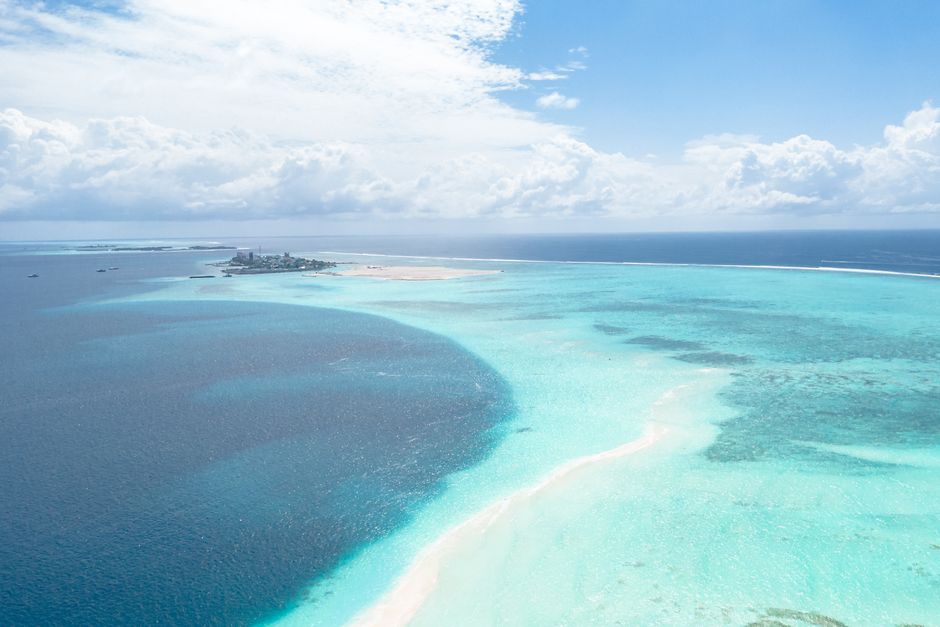
Kaafu Atoll is the Maldives’ front door. The administrative atoll takes in the two natural atolls of North Malé and South Malé, plus the outlying islands of Kaashidhoo and Gaafaru, and surrounds the capital, Malé, and Velana International Airport, where almost every visitor lands. It was here that Maldivian tourism began, in 1972, and it still has the country’s highest concentration of resorts, many of them 15 minutes to an hour by speedboat from the airport, so no seaplane is needed. Kaafu also has the busiest guesthouse islands, such as Maafushi, Thulusdhoo, Himmafushi, Huraa, Guraidhoo and Dhiffushi, where travelers on smaller budgets stay among Maldivian families; the country’s best-known surf breaks along the eastern rim of North Malé Atoll; well-established dive sites, from manta cleaning stations to the Maldives Victory wreck; and, in Malé and Hulhumalé, a glimpse of urban Maldivian life, with coral-stone mosques, a fish market and seaside promenades. The driest months are December to April; from May to November, the southwest monsoon brings showers, wind and the surf season.
Right now in Kaafu Atoll (North & South Malé) (Hulhule)
- Wed 28–29°C 83–85°F 2 mm Light showers
- Thu 27–29°C 80–84°F 9 mm Showers
- Fri 27–28°C 81–83°F 8 mm Showers
Weather: MET Norway (CC BY 4.0) · Sea temperature: NOAA CoastWatch · Air quality: OpenAQ
Top tours in Kaafu Atoll (North & South Malé)
See all tours for Kaafu Atoll (North & South Malé) →
From local operators, with prices and reviews; you check availability and book on Viator, our partner. We may earn a commission at no extra cost to you. How we earn money
Kaafu Atoll at a glance
- Best for: short transfers, resorts close to the airport, guesthouse stays on local islands, surfing, diving and a day in Malé.
- How long: 4–7 nights at a resort or guesthouse; one night in Hulhumalé or Malé works well on arrival or departure.
- Best time: December to April, for sunshine and calm seas; March to May and September to November for surf.
- Getting there: all islands are reached by speedboat or public ferry from Velana International Airport or Malé, in about 10 minutes to 2 hours.
- Getting around: by resort or guesthouse transfer, shared speedboat, public ferry, or taxi and bus across the Sinamalé Bridge between Malé, the airport and Hulhumalé.
- Taxes to know: green tax of US$12 per person per night at resorts, and US$6 at guesthouses with 50 or fewer rooms, plus 17% T-GST, according to the Maldives Inland Revenue Authority.
- Before you go: the visa on arrival, the IMUGA Traveller Declaration, money and general safety are in our Maldives travel guide.
Kaafu Atoll: where things are
North Malé Atoll is the larger of the two natural atolls, about 60 km (37 miles) from north to south, with Malé, the airport island of Hulhulé and the reclaimed city of Hulhumalé on its southern rim. South Malé Atoll lies across the Vaadhoo Channel, a few kilometers to the south. The surf breaks and many resorts line the eastern, ocean-facing rim of North Malé Atoll; Kaashidhoo, a farming island about 86 km (53 miles) north of Malé, and Gaafaru, with its wreck-strewn reef, lie in separate small atolls to the north.
Malé and Hulhumalé
Malé, the capital, packs about a third of the country’s population onto an island of less than 2 km² (0.8 sq miles), with high-rise apartments, mosques, markets, government buildings and a lively harbor front. It is administered as a city separate from Kaafu. Hulhumalé, a planned city on reclaimed land next to the airport, linked to Malé by the Sinamalé Bridge, has hotels, a long public beach, cafés and parks, a convenient base for a first or last night.
The guesthouse islands
The inhabited islands of Kaafu have dozens of guesthouses and small hotels, with tourist beaches set aside for swimwear. Maafushi, in South Malé Atoll, is the largest and busiest guesthouse island, with excursion operators, cafés and a bikini beach. Guraidhoo and Gulhi are smaller and quieter nearby. In North Malé Atoll, Thulusdhoo and Himmafushi are surf bases, Huraa has a mangrove lake and a 17th-century mosque, and Dhiffushi is one of the more remote islands, with long beaches.
The resort islands
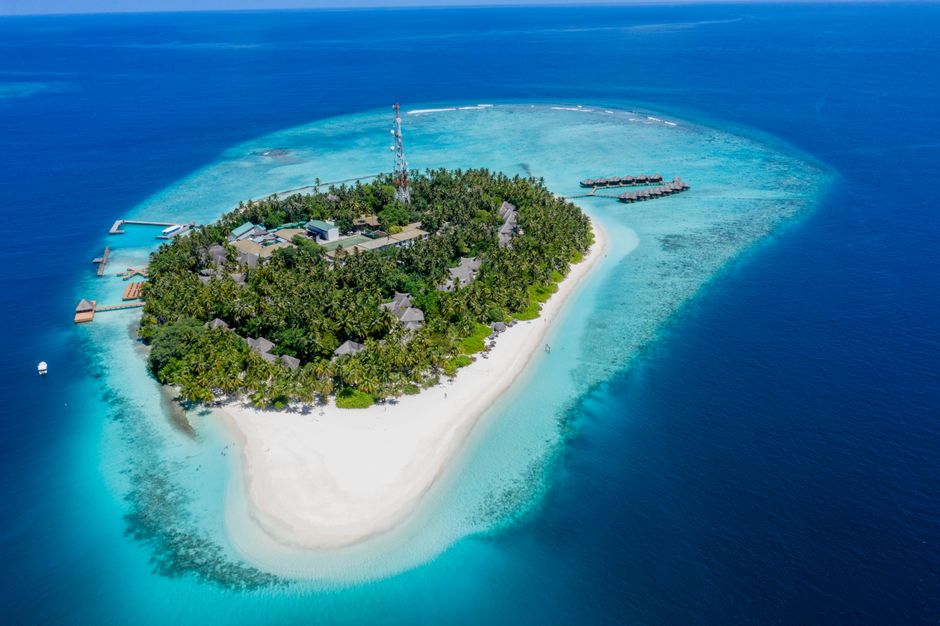
Resorts range from family-friendly islands with kids’ clubs to adults-only and ultra-luxury properties with overwater villas, many within 20 to 50 minutes of the airport by speedboat. Several resorts sit on the outer reef near the surf breaks.
Top things to see in Kaafu Atoll
Malé’s old mosques and monuments
The Hukuru Miskiy (Old Friday Mosque), built in 1658 from carved coral stone, is one of the finest examples of traditional Maldivian architecture, with lacquerwork and carved wood inside and a cemetery of carved coral tombstones; visiting requires permission outside prayer times and modest dress. Next to it stands the blue-and-white Mulee Aage, built between 1914 and 1919 for a prince and later used as the official residence of the President, according to Visit Maldives. Nearby are the gold-domed Islamic Center (Grand Friday Mosque), Sultan Park on the site of the old sultans’ palace, and the National Museum, with royal artifacts and Buddhist-era coral carvings.
Malé’s markets and waterfront
The fish market on the northern waterfront comes alive in the afternoon, when dhonis unload skipjack and yellowfin tuna, which is cleaned on the tiled floors; the local market next door sells fruit, betel nut, smoked fish and chili. The Artificial Beach in the east of the city and the seafront walk are where Malé’s residents gather in the evening.
Hulhumalé beach and the bridge
Hulhumalé’s long beach, with cafés and water sports, is the closest swimming beach to the airport. The Sinamalé Bridge, opened in 2018, crosses the channel between Malé and the airport island, best seen lit up at night.
Sandbanks and picnic islands
Excursions from guesthouses and resorts visit sandbanks, small strips of white sand surrounded by lagoon, and uninhabited picnic islands for swimming, snorkeling and barbecues.
Kaashidhoo’s Buddhist ruins
On the farming island of Kaashidhoo, about 86 km (53 miles) north of Malé, excavations from 1996 to 1998 uncovered the Kuruhinna Tharaagandu, the ruins of a large pre-Islamic Buddhist monastery with more than 60 coral-stone structures, according to Visit Maldives; the island is linked to Malé by ferry.
Snorkeling, diving and surfing
Diving
As the first atoll to develop tourism, Kaafu has many well-established dive sites. According to Visit Maldives, the Maldives Victory, a cargo ship that sank in 1981 near the airport and lies at about 35 m (115 ft), is the atoll’s most popular wreck dive, encrusted with coral and home to groupers and batfish; Manta Point (Lankan), in the southeast of North Malé Atoll, draws manta rays to feed and clean during the southwest monsoon from May to October; and Nassimo Thila, HP Reef and Banana Reef are known for caves, soft corals and abundant fish. South Malé Atoll has channel dives with reef sharks, eagle rays and turtles, such as those of the Vaadhoo and Guraidhoo channels. Dive centers operate at most resorts and on the main guesthouse islands. See our diving guide.
Snorkeling
Many resorts have a house reef you can reach from the beach or your villa; on guesthouse islands, boat trips go to nearby reefs, turtle spots and sandbanks, and dolphin cruises at sunset are popular. Snorkel with a guide where currents are strong. See our snorkeling guide.
Surfing
North Malé Atoll was the first part of the Maldives discovered for its waves and is still the most popular with surfers, thanks to its consistent breaks and easy access. Visit Maldives lists Cokes at Thulusdhoo, Lohis, Jailbreaks, Honky’s, Malé Island Point, Sultans and Ninjas along the eastern rim; the season runs from mid-February to November, with the best conditions from March to May and September to November. Many breaks are reef breaks over shallow coral, suited to intermediate and experienced surfers; surf camps on Thulusdhoo and Himmafushi run lessons and boat trips. See our surfing guide.
Other things to do in Kaafu Atoll
Food and drink
In Malé and on local islands, eat at tea shops (hotaa), where trays of hedhikaa (short eats) such as gulha, bajiya and kavaabu appear in the afternoon, and try mas huni with roshi for breakfast and garudhiya (fish broth) with rice, lime and chili. Hulhumalé and Malé have cafés and international restaurants. Alcohol is served only at resorts, and at some hotels on uninhabited islands near the airport; guesthouse islands are dry.
Water sports and boat trips
Resorts and guesthouse operators offer kayaking, paddleboarding, jet skis, parasailing, catamaran sailing, big-game and night fishing, and trips in a traditional dhoni. See our boat trips and beaches guides.
Island hopping
From Maafushi or Thulusdhoo, you can visit neighboring local islands by public ferry or excursion boat, combining a guesthouse stay with a day pass to a resort, which many resorts sell including lunch and drinks.
Day trips and onward travel
- Malé city tour: a half-day walk from the ferry terminal through the mosques, markets and waterfront.
- Resort day passes: many Kaafu resorts sell day visits with transfers, lunch and use of the beach.
- Vaavu Atoll: south of South Malé Atoll, with channel dives and the guesthouse island of Fulidhoo, about 1.5 hours by speedboat.
- Ari Atoll: west of Kaafu, about 1.5 to 2 hours by speedboat or 25 minutes by seaplane, for whale sharks and mantas. See our Ari Atoll guide.
- Baa Atoll: north, by domestic flight or seaplane, for Hanifaru Bay. See our Baa Atoll guide.
Getting there and getting around
Arriving at Velana International Airport
Velana International Airport (MLE) on Hulhulé island receives almost all international flights. Before you fly, every traveler must complete the IMUGA Traveller Declaration within 96 hours before arrival, according to Maldives Immigration. Resort representatives meet guests in arrivals and walk them to the speedboat jetties in front of the terminal; guesthouse guests are met by their hosts or take a shared speedboat or the ferry.
Speedboats and ferries
Resorts and guesthouses in Kaafu use speedboats, which take about 15 minutes to 1.5 hours depending on distance. Shared speedboats run on schedules from the airport and Malé to the main guesthouse islands, such as Maafushi (about 30 to 45 minutes) and Thulusdhoo (about 30 minutes). Public ferries, slower and much cheaper, connect Malé with local islands on set days, but not every day and rarely on Fridays.
Malé, the airport and Hulhumalé
Taxis and buses run between Malé, the airport and Hulhumalé over the Sinamalé Bridge, in about 15 to 25 minutes; ferries also cross the channel from Malé to the airport. Malé itself is compact and easily walked; taxis charge low fixed fares.
When to go and how long to stay
Kaafu is hot all year, with highs of about 30–32 °C (86–89 °F) and nights rarely below 25 °C (77 °F). The northeast monsoon, from December to April, is the dry season, with the most sunshine, calm seas and the best visibility on the eastern reefs. The southwest monsoon, from May to November, brings showers, sometimes heavy, and occasional stormy days, with stronger winds and swell: the season for surf and for mantas at Manta Point, and lower prices. The table shows the 1991–2020 climate normals for the Hulhulé (Malé airport) station from the Maldives Meteorological Service, as submitted to the World Meteorological Organization (WMO).
| Month | Average high / low | Rain (rainy days) | What to expect |
|---|---|---|---|
| January | 31 °C (87 °F) / 26 °C (79 °F) | 87 mm (3.4 in), 6 days | Sunny; northeast winds; peak season |
| February | 31 °C (88 °F) / 26 °C (79 °F) | 38 mm (1.5 in), 3 days | The driest month; calm seas |
| March | 32 °C (89 °F) / 27 °C (80 °F) | 49 mm (1.9 in), 4 days | Hot and dry; surf season begins |
| April | 32 °C (89 °F) / 27 °C (81 °F) | 127 mm (5.0 in), 8 days | Hottest month; humidity rising |
| May | 32 °C (89 °F) / 27 °C (80 °F) | 238 mm (9.4 in), 15 days | Monsoon change; heavy showers |
| June | 31 °C (88 °F) / 26 °C (80 °F) | 146 mm (5.8 in), 13 days | Wind and swell; surf season |
| July | 31 °C (87 °F) / 26 °C (79 °F) | 198 mm (7.8 in), 14 days | Mixed sun and showers |
| August | 31 °C (87 °F) / 26 °C (79 °F) | 193 mm (7.6 in), 13 days | Mixed; mantas at Manta Point |
| September | 30 °C (87 °F) / 26 °C (78 °F) | 214 mm (8.4 in), 15 days | Showers; good surf |
| October | 30 °C (87 °F) / 26 °C (78 °F) | 245 mm (9.7 in), 15 days | One of the wettest months |
| November | 30 °C (87 °F) / 26 °C (78 °F) | 236 mm (9.3 in), 14 days | Wet early, drying late |
| December | 30 °C (87 °F) / 26 °C (78 °F) | 212 mm (8.4 in), 12 days | Drying out; holiday peak |
Hulhulé receives about 1,980 mm (78 in) of rain a year, mostly in short, heavy showers.
5 nights in Kaafu
Arrive and transfer to a guesthouse on Maafushi or Thulusdhoo; spend three days on snorkeling trips, a sandbank picnic and a dolphin cruise, or surf; finish with a night in Hulhumalé and a morning in Malé.
A week with a resort
Stay a week at a resort within an hour of the airport, with house-reef snorkeling, a few boat dives on the Maldives Victory and Manta Point, and a sunset cruise.
Where to stay in Kaafu Atoll
- Resort islands: from family resorts to overwater-villa luxury, with speedboat transfers of 15 minutes to 1.5 hours.
- Maafushi and South Malé Atoll guesthouses: the widest choice of budget and mid-range guesthouses, busy with excursions.
- Thulusdhoo and Himmafushi: surf guesthouses near the North Malé breaks.
- Huraa, Dhiffushi, Guraidhoo and Gulhi: quieter local islands with small guesthouses.
- Hulhumalé and Malé: city hotels near the airport for arrival and departure nights.
Book resorts and guesthouses early for Christmas, New Year, February and Easter.
What a trip to Kaafu Atoll costs
Prices are approximate, for October 2026, in US dollars with rufiyaa at about 15.4 to the dollar; taxes are those of MIRA.
| Item | Typical cost |
|---|---|
| Green tax at a resort, per person per night | US$12 (about MVR 185) |
| Green tax at a guesthouse with 50 or fewer rooms, per person per night | US$6 (about MVR 92) |
| Shared speedboat from the airport to Maafushi or Thulusdhoo, one way | US$20–40 (about MVR 310–615) |
| Resort speedboat transfer, return, per person | US$100–400 (about MVR 1,540–6,160) |
| Guesthouse double, per night, before taxes | US$60–150 (about MVR 925–2,310) |
| Mid-range resort double, half board, per night, before taxes | US$350–700 (about MVR 5,400–10,800) |
| Snorkeling or sandbank trip from a guesthouse | US$30–80 (about MVR 460–1,230) |
| Surf boat trip, half day | US$40–80 (about MVR 615–1,230) |
| Tea and hedhikaa in a Malé café | MVR 30–80 (about US$2–5) |
Practical tips for Kaafu Atoll
- Submit IMUGA before you fly: within 96 hours of arrival, for every traveler.
- Check ferry days: public ferries do not run every day; shared speedboats are more flexible.
- Respect local-island rules: no alcohol, modest dress in the village, swimwear only on the bikini beach.
- Visit Malé on a weekday morning: mosques and the museum close at prayer times and on Friday mornings.
- Book a day pass for a resort: if you stay on a local island and want a drink or a day of luxury.
Safety
Kaafu’s islands are generally safe. In the water, currents can be strong at reef edges and in the channels between islands; according to the UK government, tidal currents have dragged swimmers away from the shore, resulting in drownings, so swim in supervised areas, follow warning flags and snorkel with a guide where currents run. Surf breaks are over shallow reef; wear reef boots and know your limits. Speedboat transfers can be rough in the southwest monsoon; make sure life jackets are provided. Divers should note that hyperbaric facilities are limited. Outside the resorts, there have been incidents of gang-related violence, mainly in Malé and Hulhumalé, and petty theft occurs, so keep valuables locked. Alcohol is available only at resorts; drug laws are very strict. Flash flooding can affect streets in Malé during heavy rain. For emergencies, call 119 for police, 102 for an ambulance and 191 for the coast guard; Malé and Hulhumalé have the country’s main hospitals.
What to pack for Kaafu Atoll
Light clothes, reef-safe sunscreen, a hat and sunglasses, a rash guard and reef shoes for snorkeling and surfing, a light rain jacket from May to November, and, for local islands and Malé, clothes that cover shoulders and knees and a T-shirt and shorts for swimming away from the bikini beach. Most sockets take British-style (type G) plugs. See our water shoes, wetsuits and travel adapters guides.
Kaafu Atoll travel FAQ
What is Kaafu Atoll?
The administrative atoll around Malé, made up of the natural North Malé and South Malé atolls plus Kaashidhoo and Gaafaru, with the airport, the capital and the country’s densest cluster of resorts and guesthouses.
How do I get from Malé airport to Maafushi?
By shared speedboat in about 30 to 45 minutes, or by the cheaper public ferry from Malé, which takes longer and does not run every day.
Do I need a seaplane for Kaafu resorts?
No. Kaafu resorts are reached by speedboat, usually in 15 minutes to 1.5 hours, which saves money and allows late arrivals.
Can I drink alcohol on Maafushi?
No. Maafushi and other local islands are dry; alcohol is served only at resorts and on some licensed boats, and many visitors buy a resort day pass or join a “floating bar” excursion boat anchored offshore.
Where can I surf in the Maldives near Malé?
On the eastern rim of North Malé Atoll, at breaks such as Cokes at Thulusdhoo, Jailbreaks, Sultans and Honky’s, from mid-February to November.
Is Malé worth visiting?
For half a day, yes: the coral-stone Old Friday Mosque, the fish market, Sultan Park and the National Museum give a sense of Maldivian life beyond the resorts.
When is the best time to visit Kaafu Atoll?
December to April for dry, sunny weather and calm seas; March to May and September to November for surf.
Can I see manta rays in Kaafu Atoll?
Yes. Manta Point in North Malé Atoll draws mantas to feed and clean during the southwest monsoon, from May to October.
Where should I stay before an early flight?
In Hulhumalé, next to the airport, with hotels, a beach and cafés, or at one of the resorts closest to the airport.
How much is the green tax in Kaafu?
US$12 per person per night at resorts and US$6 at guesthouses with 50 or fewer rooms on inhabited islands, according to MIRA.
Sources and last review
Researched and last reviewed on 4 October 2026. The IMUGA Traveller Declaration: Maldives Immigration; green tax and T-GST rates: the Maldives Inland Revenue Authority (MIRA), whose site could not be read directly for this review; dive sites (Maldives Victory, Manta Point and its season, Nassimo Thila, HP Reef, Banana Reef), surf breaks and the surf season, Mulee Aage and the Kuruhinna Tharaagandu at Kaashidhoo: Visit Maldives; currents, crime, flash floods and boats: the UK government’s travel pages (factual content only); climate normals for Hulhulé: the Maldives Meteorological Service, via the World Meteorological Organization (1991–2020 normals archived by NOAA’s National Centers for Environmental Information). The start of tourism in 1972, mosque and bridge dates, island descriptions, transfer times, ferry schedules, emergency numbers and all typical prices are general references or estimates, flagged for checking. Prices and rules change, so check with your resort or guesthouse before you go. For the visa, taxes, money and general safety, see our Maldives travel guide.
Plan your trip
Partner links: TravelerCenter may earn a commission if you book, at no extra cost to you.