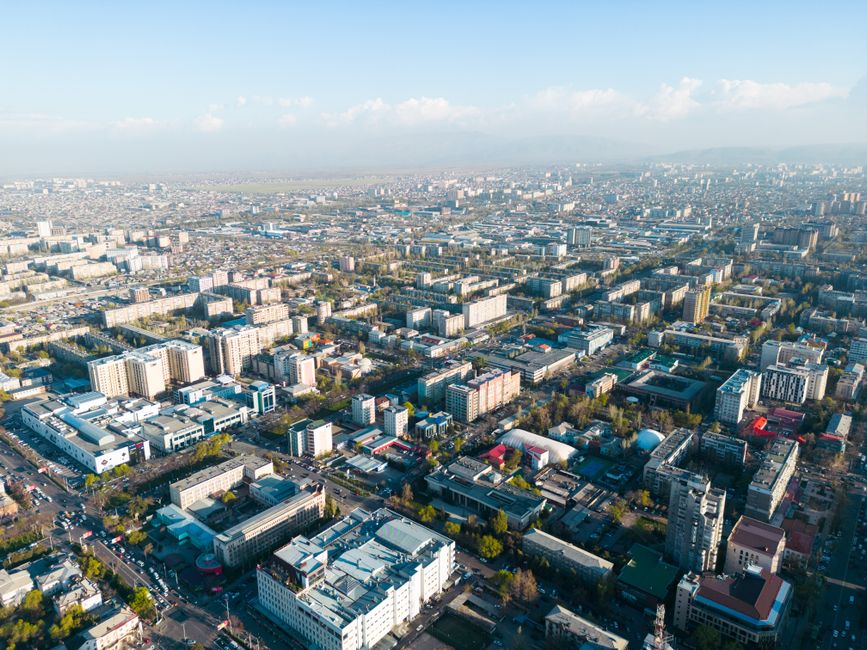
Bishkek, the capital of Kyrgyzstan, is a relaxed, green city of wide Soviet avenues, shady parks and irrigation channels lined with trees, set in the Chuy Valley with the snowy wall of the Kyrgyz Ala-Too range rising to the south. Founded as a Kokand fortress called Pishpek and known as Frunze in the Soviet era, it has few grand monuments, but it is an easygoing and friendly place to start a trip, with good cafés and restaurants, lively bazaars, Soviet mosaics and memorials, and mountains within an hour. Come for Ala-Too Square and its monuments, the State Historical Museum, the bustle of the Osh Bazaar, the parks and boulevards, and day trips to the alpine gorge of Ala-Archa National Park, the 11th-century Burana Tower and the memorial of Ata-Beyit. Bishkek is also the hub for transport to Issyk-Kul, Song-Kul and the south, and only about four hours by road from Almaty in Kazakhstan. The best months are May, June and September; July and August are hot, and winters are cold, with poor air quality on still days.
Right now in Bishkek
- Wed 6–17°C 42–62°F Mostly clear
- Thu 8–20°C 47–67°F Mostly clear
- Fri 9–18°C 48–64°F Clear
Weather: MET Norway (CC BY 4.0)
Top tours in Bishkek
See all tours for Bishkek →
From local operators, with prices and reviews; you check availability and book on Viator, our partner. We may earn a commission at no extra cost to you. How we earn money
Bishkek at a glance
- Best for: a relaxed start to a Kyrgyz trip, bazaars, Soviet architecture and mosaics, cafés, and the mountains of Ala-Archa.
- How long: 1–2 days for the city, plus a day for Ala-Archa.
- Best time: May to June and September to October; July and August are hot; winter is cold and often smoggy.
- Getting there: by air to Manas International Airport, about 25 km (16 miles) north; by road from Almaty in about 4 hours; by minibus from Issyk-Kul, Naryn and Osh.
- Getting around: on foot in the center, by ride-hailing taxi, minibus and bus.
- Good to know: the city is laid out on a grid, and the mountains are always to the south.
- Before you go: visa-free stays, registration, money and general safety are in our Kyrgyzstan travel guide.
Bishkek’s areas and where to stay
Bishkek’s center lies around Ala-Too Square and the parallel avenues of Chuy and Kievskaya, crossed by the shady Erkindik Boulevard; residential districts of Soviet apartment blocks (microdistricts) spread south toward the foothills.
The center
Between Ala-Too Square, the Philharmonic and Erkindik Boulevard, the center has hotels, hostels, cafés, restaurants and most of the sights within walking distance. It is the best base for a short stay.
Around the Osh Bazaar
West of the center, the streets around the Osh Bazaar have budget guesthouses and hostels and the Western bus station nearby, convenient for minibuses to Issyk-Kul and Talas, though the area is busy and less polished.
The south and the foothills
South of the center, quieter residential districts have apartments and boutique hotels, and on the city’s southern edge, toward the mountains, villa hotels and guesthouses offer fresh air and views, about 20–30 minutes by taxi from the center.
Where to stay in Bishkek
- Center: hotels and hostels near Ala-Too Square and Erkindik Boulevard.
- Osh Bazaar area: budget guesthouses near the western bus station.
- The south: apartments and boutique hotels in quieter streets.
- Foothills: guesthouses and resort hotels close to the mountains.
Book ahead for July and August, when Bishkek fills with travelers on their way to the mountains and the lake.
Top things to see in Bishkek
Bishkek’s story in brief
Bishkek began as Pishpek, a clay fortress built in 1825 by the Khanate of Kokand on a caravan route, which Russian troops destroyed in 1862. A Russian settlement grew in its place, and in 1926 it was renamed Frunze, after the Red Army commander Mikhail Frunze, who was born here. As the capital of the Kirghiz SSR, it was rebuilt as a planned Soviet city of parks, boulevards and public buildings. It took the Kyrgyz name Bishkek, after a churn used to make kymyz, in 1991. Since independence, it has seen several waves of protest on its central squares, and today it is a lively, young city whose population has more than doubled since Soviet times.
Ala-Too Square
The city’s main square, Ala-Too, was built in 1984 for the 60th anniversary of the Kirghiz SSR. A tall flagpole stands at its center, where soldiers perform a changing of the guard every hour during the day, and a statue of the hero Manas on horseback faces the square. The fountains, the State Historical Museum and the government buildings around it are the stage for national celebrations, including Nooruz and Independence Day.
State Historical Museum
On the north side of Ala-Too Square, the State Historical Museum, in a large Soviet modernist building, covers Kyrgyz history from the Stone Age to the present, with Saka gold, Silk Road finds, yurts, nomadic crafts and costumes, and Soviet-era murals on the upper floors. It reopened after a long renovation; check opening days before visiting.
The Osh Bazaar
West of the center, the Osh Bazaar is Bishkek’s busiest market, a maze of stalls selling spices, dried fruit, nuts, honey, kurut, bread, meat, felt hats, shyrdak carpets, household goods and Chinese imports. It is lively and atmospheric, but crowded, and pickpockets target visitors; keep your phone and wallet secure.
Parks, boulevards and monuments
Bishkek is one of the greenest cities in Central Asia. Walk Erkindik Boulevard, a long promenade of oaks and benches; Oak Park (Dubovy Park), with an open-air sculpture garden; Panfilov Park, with its old Soviet fairground rides; and Victory Square, where a monument shaped like a yurt frame honors those who died in World War II. In front of the Philharmonic, an ensemble of statues shows Manas fighting a dragon, surrounded by characters from the epic.
Soviet heritage and mosaics
Bishkek is a good place to see Soviet modernist architecture and the large mosaics that decorate apartment blocks, schools and public buildings across the city, many depicting cosmonauts, scientists, workers and Kyrgyz folk themes. The Frunze House Museum preserves the small house where Mikhail Frunze was born, under a large Soviet pavilion.
More classic sights
- Gapar Aitiev Museum of Fine Arts: Kyrgyz painting, felt carpets, embroidery and Soviet art.
- The White House: the presidential and government building, seen from the outside; don’t photograph security personnel.
- The Central Mosque: a large mosque with blue domes in the eastern part of the city, built with Turkish support and opened in 2018.
- Dordoi Bazaar: a vast wholesale market of shipping containers on the northern edge of the city, one of the largest in Central Asia.
Other things to do in Bishkek
Food and drink
Bishkek has a good food scene for its size. Try Kyrgyz dishes such as beshbarmak, kuurdak, manti, samsy from the tandoor and boorsok with tea, Uyghur and Dungan lagman and ashlan-fu, Uzbek plov, and shashlik grilled over coals. Drinks include kymyz (fermented mare’s milk) in summer and maksym and chalap, fermented cereal and yogurt drinks sold from street barrels. The center has many cafés, coffee shops, craft beer bars and restaurants serving Georgian, Turkish, Korean, Russian and international food. Bishkek’s café culture has boomed in recent years: specialty coffee shops, bakeries and brunch spots line the streets around Erkindik Boulevard and Kievskaya Street, and the city has a small but lively scene of bars, live music and clubs, busiest on Friday and Saturday nights.
Shopping and crafts
Look for shyrdak felt carpets, felt slippers and toys, kalpak hats and silver jewelry in fair-trade shops and cooperatives in the center, and at the bazaars. See our city sightseeing guide.
Culture and evenings
The Opera and Ballet Theater and the Philharmonic have inexpensive performances; check programs locally. On summer evenings, families crowd Ala-Too Square, the fountains and the parks.
Hiking in Ala-Archa
Ala-Archa National Park, founded in 1976, protects a steep alpine gorge of juniper (archa) forests, rushing rivers and peaks above 4,000 m (13,100 ft), the closest real mountains to any capital in Central Asia. From the park’s alpine camp, at about 2,150 m (7,050 ft), easy paths follow the river, while the popular trail to the Ak-Sai waterfall takes about two to three hours each way. The longer, steeper climb to the Ratsek hut, at about 3,350 m (11,000 ft), below the Ak-Sai glacier, takes a full day for fit hikers, or two days with a night at the hut; from there, mountaineers set out for peaks such as Korona and Uchitel. The altitude gain is significant, so take it slowly, carry warm layers and plenty of water, and start early, as afternoon storms are common in summer. In winter, the lower trails are good for snowshoeing, and there is a small ski area near the park entrance. See our hiking guide.
Day trips from Bishkek
- Ala-Archa National Park: an alpine gorge about 40 km (25 miles) south, 45 minutes by car, with trails along the river, through juniper forests and up to the Ak-Sai glacier and the Ratsek hut at about 3,350 m (11,000 ft); an entry fee is charged at the gate.
- Burana Tower: an 11th-century minaret near Tokmok, about 80 km (50 miles) east, the remains of the Karakhanid city of Balasagun, part of the UNESCO Silk Roads site, with a field of balbal stone figures and a small museum.
- Ata-Beyit: a memorial complex about 30 km (19 miles) south, where victims of the Stalinist purges of 1938 are buried, along with the writer Chingiz Aitmatov, whose father was among them.
- Chunkurchak and Kegeti gorges: mountain valleys with waterfalls, horse riding and a small ski area in winter.
- Chon-Kemin valley: a green valley about 2.5 hours east, with homestays, horse riding and rafting, on the way to Issyk-Kul.
- Issyk-Kul: best with several nights; see our Issyk-Kul guide.
Getting there and getting around
By air
Manas International Airport (FRU), about 25 km (16 miles) north of the center, has flights from Istanbul, Dubai, Moscow, Almaty, Tashkent, Seoul, Delhi and other cities, and domestic flights to Osh and, in summer, to Issyk-Kul; see our Istanbul guide. Taxis by app take about 30–40 minutes to the center; minibuses also run.
By road from Almaty
Many visitors arrive from Almaty, about 240 km (150 miles) away, by bus, shared taxi or private transfer, crossing the border at Korday; the trip takes about 4 hours, including the border. See our Almaty guide.
Minibuses to the rest of the country
Minibuses and shared taxis to Issyk-Kul, Naryn and Kochkor leave from the Western (Zapadny) and Eastern (Vostochny) bus stations, and shared taxis to Osh (about 10–12 hours) from the south of the city.
Around town
The center is compact and flat enough to walk. Ride-hailing apps such as Yandex Go are cheap and reliable; use them rather than hailing cars on the street. City buses and minibuses cover all districts, paid with a card or app.
When to go and how long to stay
Bishkek, at about 760–800 m (2,500–2,600 ft), has a continental climate. Spring (April–May) is green and pleasant, with occasional rain. Summer, from June to August, is hot and dry, with daytime highs often 30–35 °C (86–95 °F), while the mountains nearby are cool. Autumn, from September to October, is sunny and mild, one of the best times to visit. Winter, from December to February, is cold, with snow and frequent temperature inversions that trap smog from coal heating over the city; on such days, air quality is among the poorest in the region. Kyrgyzhydromet’s 1991–2020 normals for the Bishkek station, as submitted to the World Meteorological Organization (WMO), include only average monthly temperatures, shown below; summer afternoons are typically about 7–9 °C (13–16 °F) warmer than these averages.
| Month | Average temperature | What to expect |
|---|---|---|
| January | −2.5 °C (27.5 °F) | The coldest month; snow and smog on still days |
| February | −0.4 °C (31 °F) | Cold; skiing nearby |
| March | 6.2 °C (43 °F) | Thaw; Nooruz on March 21 |
| April | 12.9 °C (55 °F) | Mild; blossom; showers |
| May | 18.0 °C (64 °F) | Warm and green; great for Ala-Archa |
| June | 23.1 °C (74 °F) | Warm to hot; mountain season begins |
| July | 25.5 °C (78 °F) | The hottest month |
| August | 24.3 °C (76 °F) | Hot; Independence Day (August 31) |
| September | 18.8 °C (66 °F) | Sunny and pleasant |
| October | 11.6 °C (53 °F) | Mild; autumn colors |
| November | 4.2 °C (40 °F) | Cool; heating season begins |
| December | −1.1 °C (30 °F) | Cold; New Year lights |
One day in Bishkek
Start at Ala-Too Square for the changing of the guard and the State Historical Museum, walk Erkindik Boulevard and Oak Park to the Philharmonic, have lunch at a café, then spend the afternoon at the Osh Bazaar and end with dinner and a performance at the opera or a bar in the center.
Two to three days
Add a day hiking in Ala-Archa National Park and a half-day trip to the Burana Tower, or Ata-Beyit, before heading to Issyk-Kul or Song-Kul.
What a trip to Bishkek costs
Prices are approximate, for October 2026, converted at about 87.5 som to the US dollar.
| Item | Typical cost |
|---|---|
| Taxi from Manas Airport to the center by app | 700–1,200 KGS (about US$8–14) |
| City bus or minibus ride | about 20–30 KGS (about US$0.25–0.35) |
| State Historical Museum entry | 200–500 KGS (about US$2.30–5.70) |
| Ala-Archa National Park entry | 300–700 KGS (about US$3.40–8) |
| Taxi to Ala-Archa and back, with waiting | 2,000–3,500 KGS (about US$23–40) |
| Lunch of lagman or plov | 250–450 KGS (about US$2.90–5.15) |
| Dinner in a mid-range restaurant | 800–1,800 KGS (about US$9–21) per person |
| Mid-range hotel double, per night | 4,000–8,000 KGS (about US$46–91) |
Practical tips for Bishkek
- Use taxi apps: they are cheap and avoid overcharging.
- Watch your phone at the Osh Bazaar: pickpockets are active in the crowds.
- Start early for Ala-Archa: weekend crowds and afternoon storms are common in summer.
- Check air quality in winter: on smoggy days, head for the mountains.
- Carry your passport or a notarized copy: police checks happen.
- Get cash for the road: ATMs are plentiful in Bishkek but scarce in the mountains.
Safety
Bishkek is generally safe, but take normal city precautions. Bag snatching and pickpocketing happen in the bazaars, on minibuses and in crowded places, and there have been muggings at night; use pre-booked or app taxis after dark rather than walking alone. Drink spiking has been reported in nightclubs, so keep your drink in sight. Police may ask for your passport or a notarized copy. Avoid demonstrations, which happen regularly and can turn violent with little warning. Drivers often ignore pedestrian crossings, so take care crossing wide avenues. In winter, smog from coal heating can be severe; people with breathing problems should limit time outdoors on bad days. In an emergency, call 112, or 102 for police and 103 for an ambulance.
What to pack for Bishkek
Light clothes for summer and a warm coat for winter, layers, sturdy shoes and a waterproof jacket for Ala-Archa, sunscreen and a hat, a face mask for smoggy winter days, a scarf for women at mosques, and a copy of your passport. Kyrgyzstan uses 220 V, with round two-pin plugs. See our hiking shoes, rain jackets and travel adapters guides.
Bishkek travel FAQ
How many days do I need in Bishkek?
One to two days for the city, plus a day for Ala-Archa National Park.
How do I get from Almaty to Bishkek?
By bus, shared taxi or private transfer in about 4 hours via the Korday border crossing, or by a short flight.
How far is Manas Airport from the center?
About 25 km, or 30–40 minutes by taxi.
How do I get to Ala-Archa National Park?
By taxi or private car in about 45 minutes; there is no regular public transport to the park gate. An entry fee is charged.
When is the changing of the guard on Ala-Too Square?
Every hour during the day at the flagpole in the center of the square.
Is Bishkek safe?
Generally yes. Watch for pickpockets in bazaars, use app taxis at night, and avoid demonstrations.
What is the best time to visit Bishkek?
May to June and September to October. Summers are hot, and winters are cold and often smoggy.
What is the Burana Tower?
An 11th-century minaret near Tokmok, about 80 km east, the remains of the medieval city of Balasagun, part of a UNESCO World Heritage Site.
How do I get from Bishkek to Issyk-Kul?
By minibus or shared taxi from the bus stations, about 4 hours to Cholpon-Ata and 6–7 hours to Karakol; or by seasonal flights in summer.
Can I use cards in Bishkek?
Yes, in most hotels, restaurants and shops, and QR payments are common; carry cash for bazaars and minibuses.
Sources and last review
Researched and last reviewed on 4 October 2026. Visa-free entry and registration: Kyrgyzstan’s official e-visa portal and the UK government’s factual entry page; crime, drink spiking, demonstrations, ID, taxis and photography: the UK government’s factual safety pages; climate normals: Kyrgyzhydromet via the World Meteorological Organization’s 1991–2020 normals for the Bishkek station (average temperatures only); the exchange rate: the National Bank of the Kyrgyz Republic. The city’s history and names, building dates, the museum’s reopening, the guard-changing schedule, distances, entry fees, journey times and typical prices are general references or estimates, flagged for checking. Prices and rules change, so check locally before you go. For entry rules, money and general safety, see our Kyrgyzstan travel guide.
Plan your trip
Partner links: TravelerCenter may earn a commission if you book, at no extra cost to you.
🇷🇺 Useful Russian phrases for Bishkek
All 38 Russian phrases: restaurant, hotel, emergencies, romance (printable) →