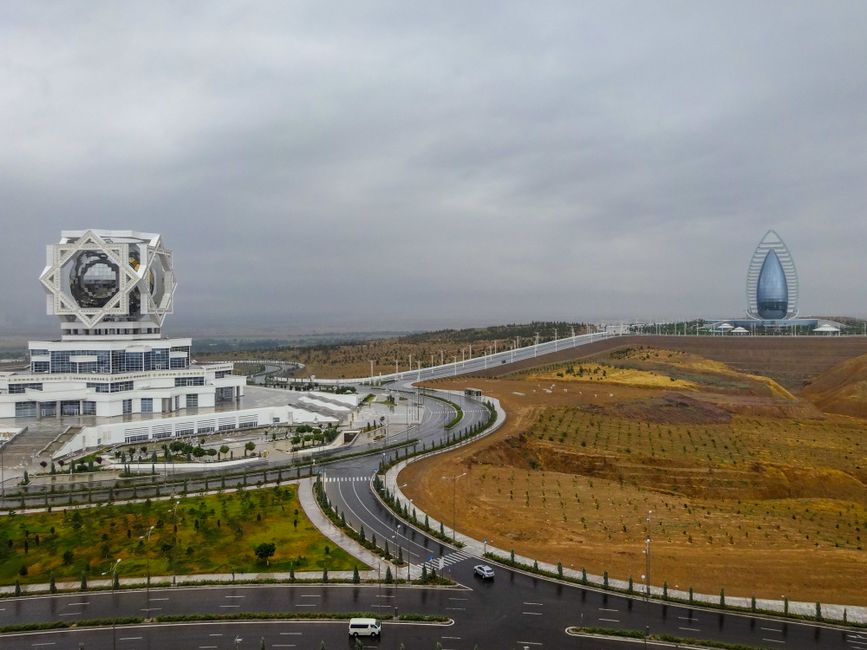
Turkmenistan is one of the least visited and most intriguing countries in Asia: a land of desert, ruined Silk Road cities and a capital clad in white marble, on the eastern shore of the Caspian Sea. About four-fifths of the country is covered by the Karakum Desert, where the famous Darvaza gas crater, the “Door to Hell,” has burned since the 1970s, though far less brightly since a government effort to curb it began in 2022. The capital, Ashgabat, rebuilt after an earthquake in 1948 and again in the 2000s, is a surreal city of gleaming white buildings, golden domes, fountains and monuments, empty boulevards and spotless parks. Beyond it lie the ancient oasis cities of Merv, once one of the largest cities in the world, Konye-Urgench and Nisa, all UNESCO World Heritage Sites, and the canyons and Caspian coast of the west. Turkmenistan is also one of the most closed countries in the world, and visiting takes planning: almost everyone needs a visa backed by a letter of invitation, most tourists travel on an itinerary arranged by a licensed travel agency with a guide, the internet is heavily restricted, and photography and personal conduct are closely regulated. For those who make the effort, it is an unforgettable trip.
Right now in Turkmenistan
- Wed 13–25°C 55–78°F Mostly clear
- Thu 14–27°C 58–80°F Partly cloudy
- Fri 17–28°C 62–82°F Clear
Weather: MET Norway (CC BY 4.0)
Multi-day tours of Turkmenistan
Multi-day tours from local operators. You check dates and book on Viator, our partner; we may earn a commission at no extra cost to you. How we earn money
Turkmenistan at a glance
Turkmenistan has a population of about 7 million and covers about 491,000 km² (190,000 sq miles), a little smaller than Spain. It borders Kazakhstan, Uzbekistan, Afghanistan and Iran, with a long coastline on the Caspian Sea. The country is divided into five regions (welayatlar), Ahal, Balkan, Dashoguz, Lebap and Mary, plus the capital, Ashgabat, and the new city of Arkadag, built near the capital and inaugurated in 2023. Turkmen, a Turkic language written in the Latin alphabet, is the state language; Russian is widely understood, especially in Ashgabat. Most Turkmens are Sunni Muslims, and tribal traditions, horses and carpets are central to national identity. Turkmenistan has declared itself a permanently neutral state since 1995, recognized by the United Nations.
Turkmenistan uses UTC+5 all year, with no daylight saving time. Electricity is 220 V, with round two-pin sockets (types C and F). The currency is the Turkmen manat (TMT).
A short history
The oases of today’s Turkmenistan have been settled for at least 5,000 years: Bronze Age Margiana, around Gonur Depe, and the Parthian capital of Nisa flourished here. Merv was a great Silk Road city and, under the Seljuks in the 11th and 12th centuries, one of the largest cities in the world, until the Mongols destroyed it in 1221; Konye-Urgench was the capital of Khorezm until the Amu Darya changed course. The Turkmen tribes, famed horse breeders and fighters, resisted Russian expansion until the battle of Geok Tepe in 1881. In the Soviet era, the Turkmen SSR became a land of cotton and gas, and Ashgabat was destroyed by an earthquake in 1948. Since independence in 1991, Turkmenistan has been ruled by strong presidents, with heavy spending on monumental architecture funded by its large natural gas reserves.
Turkmenistan’s regions
- Ahal and Ashgabat: the capital, the ruins of Nisa, the Kow Ata underground lake, the Geok Tepe fortress and the Kopetdag mountains on the Iranian border.
- The Karakum Desert: the Darvaza gas crater and nearby craters, desert villages and camel herders.
- Mary: the ruins of ancient Merv, the Bronze Age site of Gonur Depe and the city of Mary.
- Dashoguz: Konye-Urgench and its minarets, near the border with Uzbekistan’s Khorezm.
- Balkan: the Caspian port of Turkmenbashi, the Awaza resort zone, the Yangykala Canyon and the ruins of Dehistan.
- Lebap: the Amu Darya valley, the Koytendag mountains with dinosaur footprints, and the Repetek desert reserve.
Where to go: marble, fire and ancient cities
Most tours start in Ashgabat and include an overnight trip to the Darvaza crater, often entering or leaving overland via Dashoguz and Konye-Urgench to Khiva in Uzbekistan, or via Mary and Merv to Bukhara. See our guide to the capital:
- Ashgabat: the white-marble capital, with the Independence Monument, the Arch of Neutrality, the Turkmen Carpet Museum, the National Museum, the Tolkuchka Bazaar and the ruins of Nisa nearby.
The Darvaza gas crater, about 260 km (160 miles) north of Ashgabat in the Karakum Desert, is a pit about 70 m (230 ft) wide and 20–30 m (65–100 ft) deep, which, according to the most common account, collapsed during Soviet gas exploration and was set alight to burn off the methane. In January 2022, the president ordered experts to find a way to extinguish it, and in June 2025 the state gas company Türkmengaz said that drilling wells around the crater to capture the gas had reduced the burning about threefold, according to media reports. As of 2026, the crater is still burning, with smaller flames concentrated in parts of the crater, and tours still camp nearby; check the current situation with your agency, as plans to extinguish it completely could change what you see. Two other craters nearby, one filled with water and one with bubbling mud, are often visited on the way.
Merv, near the city of Mary in the southeast, is a vast archaeological park of several walled cities from different eras, from the Achaemenid Erk Kala to the Seljuk Sultan Kala, with the mausoleum of Sultan Sanjar and the mud-brick Kyz Kala fortresses. North of Merv, the Bronze Age palace and temples of Gonur Depe lie in the desert. Konye-Urgench, in the north near the Uzbek border, has the tallest minaret in Central Asia, the Kutlug Timur Minaret, and the turquoise-domed mausoleum of Turabeg Khanum. In the west, the colorful Yangykala Canyon and the medieval minarets of Dehistan are reached from the Caspian port of Turkmenbashi, and the Awaza resort zone has large beach hotels.
Near Ashgabat, the Kow Ata underground lake, in a cave about 100 km (60 miles) west of the city, is fed by warm sulfurous springs at about 33–36 °C (91–97 °F), and visitors climb down a long staircase to swim in it. The Kopetdag mountains along the Iranian border offer short walks in green valleys such as Archabil and Nokhur, a mountain village known for its traditions and its graves decorated with horns of wild goats. In the southeast, the Koytendag range, near the Uzbek border, has canyons, caves and a plateau of dinosaur footprints, but is rarely visited and may need extra permits.
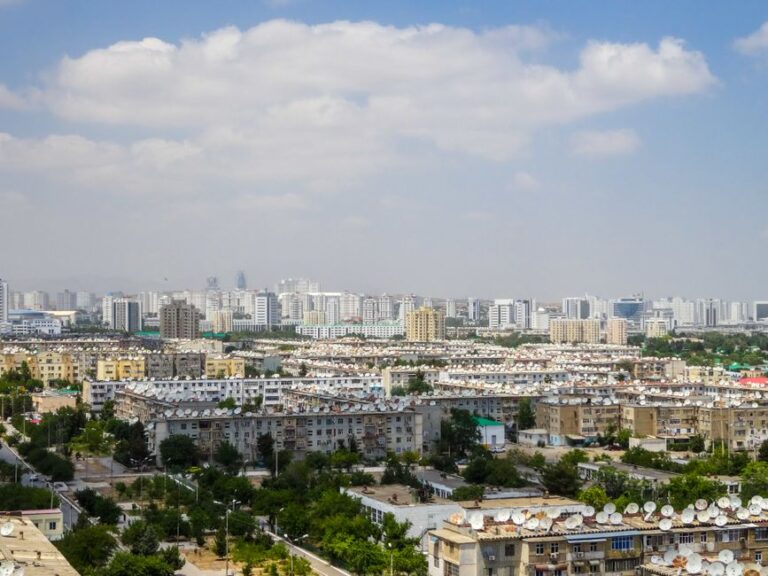
Ashgabat Travel Guide
Plan a trip to Ashgabat: where to stay, the white-marble center, the Independence Monument, the Arch of Neutrality, the Carpet Museum and National Museum,…
Best time to visit Turkmenistan
Turkmenistan has a hot, dry desert climate with sharp seasonal contrasts. Spring, from April to May, and autumn, from September to October, are the best times to visit, with warm days, cool nights and comfortable conditions for sightseeing and desert camping at Darvaza. Summer, from June to August, is extremely hot, with afternoon temperatures in the desert and in Ashgabat often above 40 °C (104 °F); travel is possible but tiring. Winter, from December to February, is cool, with frosty nights and occasional snow, and camping in the desert is cold. For Darvaza, the most comfortable months are April, May, late September and October, when evenings are mild and nights cool; in summer, camping is possible but the heat lingers well into the evening, and from November to March, desert nights fall below freezing and you need a warm sleeping bag. Merv and Konye-Urgench have almost no shade, so visit them in the early morning or late afternoon from May to September.
The table uses the 1991–2020 climate normals of Turkmenistan’s National Meteorological Service (Turkmenhydromet), as submitted to the World Meteorological Organization (WMO). The WMO set has no station in Ashgabat itself and, for Turkmen stations, reliable figures for average temperature and precipitation only; the stations below are the nearest to the main sights.
| Area (station) | January average | July average | Precipitation a year | Wettest months |
|---|---|---|---|---|
| Near Ashgabat: Baherden, 90 km (55 miles) west | 3.7 °C (39 °F) | 32.3 °C (90 °F) | about 180 mm (7 in) | February to April |
| Karakum Desert: Erbent, on the road to Darvaza | 2.1 °C (36 °F) | 33.1 °C (92 °F) | about 105 mm (4 in) | February to April |
| Merv: Bayramaly | 4.3 °C (40 °F) | 31.5 °C (89 °F) | about 155 mm (6 in) | January to March |
| Amu Darya valley: Kerki | 4.7 °C (40 °F) | 31.0 °C (88 °F) | about 185 mm (7 in) | February and March |
Average temperatures combine day and night: in July, afternoons are typically about 10 °C (18 °F) hotter than the average, often reaching 40 °C (104 °F), and in January, nights are usually below freezing.
Turkmenistan month by month
| Month | Weather | Highlights | Crowds and prices |
|---|---|---|---|
| January | Cool days, frosty nights | Quiet; cold desert nights | Low |
| February | Cool and showery | Quiet monuments | Low |
| March | Mild; spring rains | Novruz (March 21–22) | Moderate |
| April | Warm; desert in bloom | Ideal for Darvaza and Merv; Turkmen Racehorse Day (last Sunday of April) | High |
| May | Warm to hot | Excellent for sightseeing; Turkmen Carpet Day (last Sunday of May) | High |
| June | Hot | Early-morning sightseeing only | Moderate |
| July | Extremely hot | Caspian beaches at Awaza | Low |
| August | Extremely hot | Melon Day (second Sunday of August) | Low |
| September | Hot to warm | Good for Darvaza; Independence Day (September 27) | Moderate |
| October | Warm and dry | One of the best months | High |
| November | Cool | Quieter; pleasant sightseeing | Moderate |
| December | Cool; cold nights | Neutrality Day (December 12) | Low |
Festivals and holidays
- Novruz: the spring new year, a public holiday on March 21–22, with music, horse racing and feasts.
- Turkmen Racehorse Day: the last Sunday of April, celebrating the famous Akhal-Teke horses with races and shows.
- Turkmen Carpet Day: the last Sunday of May, with exhibitions and events honoring the national craft.
- Independence Day: September 27, and Neutrality Day on December 12, with parades and concerts in Ashgabat.
- Kurban Bayram: Eid al-Adha, a public holiday whose date moves about 11 days earlier each year.
Heat and desert conditions
Summer heat in the Karakum is extreme, with sandstorms possible in spring and summer; carry plenty of water, cover up from the sun and avoid the middle of the day. Desert nights are cold from October to April. Earthquakes are a risk: the country lies in an active seismic zone, and Ashgabat was destroyed by a strong earthquake in 1948.
How long to stay: sample itineraries
- 3–4 days: Ashgabat (2 nights) with Nisa, and an overnight trip to the Darvaza crater, entering or leaving via Dashoguz and Konye-Urgench to Khiva.
- 5–7 days: add Merv and Gonur Depe from Mary, crossing to or from Bukhara via Turkmenabat.
- 8–10 days: add the west: Yangykala Canyon, Dehistan and the Caspian at Turkmenbashi or Awaza.
- Combined trips: most visitors combine Turkmenistan with Uzbekistan, crossing at Dashoguz (near Khiva) or Turkmenabat (near Bukhara); overland trips also connect with Azerbaijan by ferry across the Caspian from Turkmenbashi to Baku, though schedules are irregular.
Entry, rules and money
The letter of invitation and visa (last reviewed October 2026)
Almost all visitors need a visa, and every visa requires a letter of invitation (LOI). According to the Embassy of Turkmenistan in the United States, the LOI must be certified by the State Migration Service of Turkmenistan and is valid for three months from certification; tourists who are not visiting anyone in particular must obtain it through a tourist agency. Agencies apply on your behalf with your passport details and itinerary; the UK government says approval can take up to a month, so apply well in advance. Applications can be refused without explanation.
With the approved LOI, you can either apply for a visa at a Turkmen embassy, where applications are referred to Ashgabat and can take up to a month, or obtain a visa on arrival at Ashgabat International Airport and some land borders, by presenting your passport and the original or a copy of the certified LOI. The embassy in Washington lists visa fees from US$35 for a single-entry visa of up to 10 days to US$55 for up to a month, with higher fees for expedited and multiple-entry visas; fees at the airport and other embassies differ, and you should bring cash in clean US dollars. Your passport must be valid for at least six months after you plan to leave Turkmenistan.
Transit visas of up to five days, often used by overland travelers between Uzbekistan and Iran or the Caspian, also need an LOI, sponsored by the State Migration Service, and require you to enter and leave through the border crossings named on it; they cannot be converted into tourist visas, and they are not issued at the Baku ferry port.
Guided tours
Tourist visas are issued for itineraries arranged by licensed travel agencies, and in practice tourists travel with a guide for most of their trip, especially outside Ashgabat; your guide usually meets you at the border or the airport to help with the visa-on-arrival process. Independent travel is possible mainly on transit visas. Choose an agency registered in Turkmenistan, confirm what the price includes (LOI, guide, transport, camping at Darvaza, permits) and follow the agreed itinerary.
What to expect on a tour
A typical tour begins with your guide meeting you at Ashgabat airport or the Uzbek border, helping with the visa-on-arrival paperwork, fees and customs forms, and taking you to your hotel. Days in Ashgabat are spent on the monuments, museums and bazaar, with excursions to Nisa and the Kopetdag. For Darvaza, you leave the asphalt for the last stretch in a 4×4 across the dunes, arriving in the late afternoon to see the crater at sunset and after dark, when its glow is strongest, and spend the night in a tent or a simple yurt camp nearby, with dinner cooked over a fire; there are no facilities beyond basic toilets. Hotels in the cities range from large state-built hotels to a few international-brand ones; outside the capital, choice is limited. Guides are generally knowledgeable and speak good English, and they will advise on rules and photography as you go.
Fees, taxes and registration
According to the UK government, all foreign visitors pay a migration fee of US$14 on arrival and a tourism tax of US$2 per day, usually added to hotel bills, and all travelers entering Turkmenistan undergo a COVID-19 test on arrival, costing US$31; confirm the current requirements with your agency. If you stay more than three working days, you must be registered with the State Migration Service within three days of arrival; hotels or your sponsor normally do this.
Customs and rules to know
According to the UK government, you may bring in only two packs of tobacco products, and giving tobacco as a gift is illegal. Drinking alcohol in public places, including parks, squares, stations and airports, can bring a fine, and smoking outdoors or in communal spaces is illegal except in designated areas. Possession of drugs brings long prison sentences. VPNs are illegal, and many websites and apps are blocked. By law, a sexual relationship between a Turkmen woman and a foreign national is illegal, and foreigners can be fined and deported. Male same-sex relations are illegal. Comments interpreted as negative about the country’s political system, including on social media, can be treated as an offense. Carry your passport at all times, with a copy of your LOI kept separately.
Photography
It is illegal to photograph certain buildings. According to the UK government, check before taking photos of or near airports, military sites, police stations, government buildings and embassies; guards at the presidential palace may tell you not to photograph it, and you should ask before photographing anything of possible security interest, including food markets. Turkmens can be sensitive about being photographed without consent, so always ask. Your guide will tell you where photography is allowed. Flying a drone requires permission and is best avoided.
Money and cards
The currency is the manat (TMT). The Central Bank of Turkmenistan’s official rate is 3.50 manat to the US dollar. Turkmenistan is largely a cash society: bring enough clean, recent US dollars for your whole trip (some places refuse US$100 bills printed before 2009) and exchange them at banks or official exchange offices at the official rate. Only some large hotels accept US dollars or international cards, and international ATMs in Ashgabat are few, charge fees and can run out of cash. Manat cannot be changed back, so exchange only what you need. Most tour costs are paid to your agency in advance.
Tipping
Tipping your guide and driver at the end of a tour is customary; in restaurants, rounding up or leaving about 10% is appreciated.
What a trip costs
Most visitors pay for an organized tour, which typically costs about US$150–300 per person per day for a small group, including the LOI support, guide, transport, hotels and some meals, depending on group size and comfort. Prices below are approximate, for October 2026, at the official rate of 3.50 manat to the US dollar.
| Item | Typical cost |
|---|---|
| Migration fee on arrival | US$14 |
| Tourism tax | US$2 per day |
| Visa at the embassy in Washington, single entry, up to 10 days | US$35 |
| Meal in a local café | 60–150 TMT (about US$17–43) at the official rate |
| Dinner in a hotel restaurant | 150–350 TMT (about US$43–100) |
| Licensed taxi across central Ashgabat | about 20 TMT (about US$5.70) |
| Overnight Darvaza tour with camping | US$150–350 per person, depending on group size |
| Mid-range hotel double in Ashgabat, per night | US$80–150 |
Getting there and getting around
Airports
Ashgabat International Airport (ASB), with its striking terminal shaped like a bird, has flights from Istanbul, Dubai, Frankfurt, Moscow, Almaty and some other cities, mostly on Turkmenistan Airlines and Turkish Airlines; see our Istanbul guide. Domestic flights link Ashgabat with Mary, Dashoguz, Turkmenabat and Turkmenbashi.
Land borders
Overland visitors usually cross from Uzbekistan, via Dashoguz (Shavat), near Khiva, or Farap–Turkmenabat, near Bukhara; see our Khiva and Bukhara guides. Crossings with Iran and Afghanistan are sensitive, and the UK government notes that British nationals entering from Iran need special authorization. Border posts may close without notice. Bringing your own vehicle costs up to US$150.
Around the country
Most tourists travel with their agency’s vehicles and drivers; the trip to Darvaza is by 4×4 across the desert. Trains and domestic flights link the regional cities. Domestic flights on Turkmenistan Airlines are cheap at the official rate and save long drives, for example from Ashgabat to Mary for Merv or to Dashoguz for Konye-Urgench, while overnight trains connect Ashgabat with Mary, Turkmenabat, Dashoguz and Turkmenbashi. In Ashgabat, licensed taxis, white with green markings, are the easiest way around.
Driving
Turkmens drive on the right. You need an international driving permit. Driving standards are poor, and roads outside cities are dangerous at night. Much of Ashgabat has a 60 km/h (37 mph) speed limit, enforced by cameras and police without warning signs.
World Heritage Sites and nature
Turkmenistan’s UNESCO World Heritage Sites are:
- State Historical and Cultural Park “Ancient Merv”: the remains of successive oasis cities over 4,000 years, inscribed in 1999.
- Kunya-Urgench: the medieval capital of Khorezm, with its minaret and mausoleums, inscribed in 2005.
- Parthian Fortresses of Nisa: the ruins of a Parthian royal city near Ashgabat, inscribed in 2007.
- Silk Roads: Zarafshan–Karakum Corridor: caravan routes and sites shared with Uzbekistan and Tajikistan, inscribed in 2023.
- Cold Winter Deserts of Turan: desert ecosystems, including the Repetek reserve, inscribed in 2023.
Nature lovers can visit the Kopetdag mountains near Ashgabat, the Koytendag range in the east, with canyons, caves and dinosaur footprints, and the Yangykala Canyon in the west. See our hiking guide.
Culture, food and everyday etiquette
Food
Turkmen food is simple and filling. Try plov (palow), with lamb and carrots; dograma, torn bread in a mutton broth; ishlekli, a meat pie baked in the sand; chorek bread from the tandoor; manty and gutap (fried pastries filled with meat or greens); and shashlik. Fermented camel’s milk, chal, is a desert specialty, and green tea is drunk throughout the day. Melons are a national pride, celebrated with their own holiday in August.
Carpets and horses
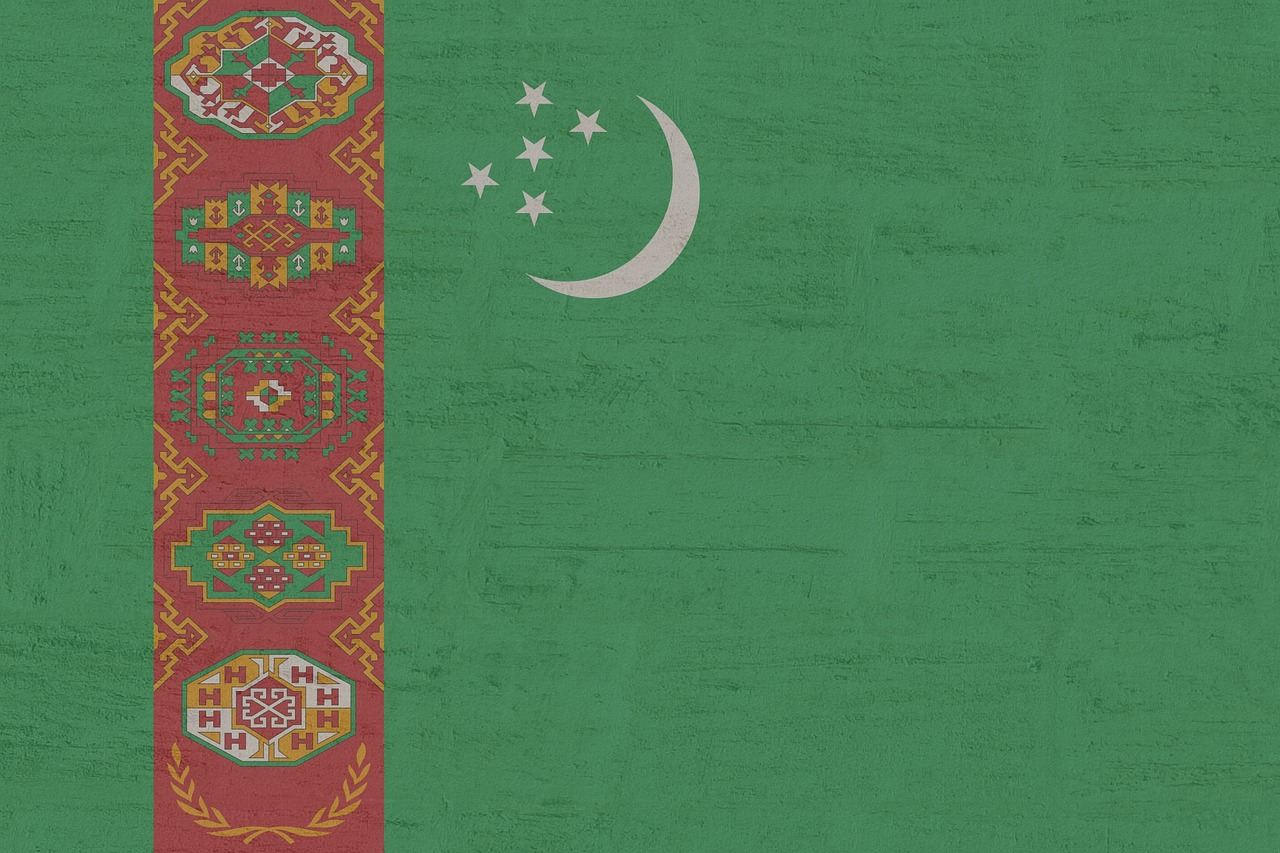
Turkmen carpets, with their deep red colors and gul (medallion) patterns specific to each tribe, are among the finest in the world; one appears on the national flag. Exporting a carpet requires a certificate from the authorities, which shops can arrange; keep your receipts. The Akhal-Teke horse, a slender, golden-coated breed prized for its endurance and speed, is a national symbol, shown on the coat of arms.
Shopping
The best place to shop is Ashgabat’s huge Tolkuchka (Altyn Asyr) Bazaar on the edge of the desert, busiest on weekends, where you can find carpets, embroidered robes and skullcaps (tahya), silver jewelry, felt goods, camel-wool socks and the tall sheepskin hats (telpek) worn by Turkmen men. Prices are in manat at the official rate; carpets need an export certificate, and anything that looks old may need proof that it is not an antique.
A few words of Turkmen
Russian is widely understood, and English by guides and in big hotels. A few words of Turkmen are appreciated: salam (hello), sag bol (thank you), hoş gal (goodbye), hawa (yes), ýok (no) and näçe? (how much?).
Responsible travel
Follow your guide’s advice on where you may go and what you may photograph, respect local customs and avoid political discussions, which can put your hosts at risk. Take your trash out of the desert and don’t drive off-track around Darvaza, where the crust is fragile. Buy carpets and crafts with proper receipts and export certificates.
Etiquette
Dress modestly, covering shoulders and knees, especially at mosques, shrines and in the countryside; women should cover their hair at religious sites. Remove your shoes before entering homes. Bread is sacred: never put it on the ground or upside down. Avoid public displays of affection. Many Turkmens are uncomfortable discussing politics.
Safety, health and connectivity
Turkmenistan has a low crime rate, and organized tours are generally smooth. These are the main things to know:
- Rules and documents: follow the rules on photography, alcohol, smoking and internet use described above, carry your passport, and keep copies of your LOI and visa.
- Border areas: areas near the borders with Afghanistan and Iran are tightly restricted; stay on your agreed itinerary.
- Photography: don’t photograph government buildings, the presidential palace, airports, military and police sites or embassies, and ask before photographing people.
- Heat and desert: summer temperatures exceed 40 °C (104 °F); carry water, and at Darvaza, stay back from the crater edge, which is unfenced and crumbling, and keep children close.
- Roads: driving standards are poor, and night driving outside cities is dangerous.
- Earthquakes: the country lies in an active seismic zone.
- Internet and phones: many websites and apps are blocked, VPNs are illegal, international roaming is not available on the state network, and internet outside large hotels is unreliable; tell family you may be out of contact.
- Health: drink bottled water and have travel insurance; medical care is limited.
The single state mobile operator, Altyn Asyr (TMCELL), sells SIM cards with your passport, but coverage and data quality are low. Many apps, including WhatsApp, YouTube, Facebook and X, are blocked.
Things to do: desert fire and marble monuments
Camp beside the Darvaza gas crater, explore Ashgabat’s marble monuments and the Tolkuchka Bazaar, wander the vast ruins of Merv and the Bronze Age palace of Gonur Depe, climb toward the Kutlug Timur Minaret at Konye-Urgench, swim in the warm underground lake of Kow Ata, see Akhal-Teke horses at a stud farm, hike the Yangykala Canyon and swim in the Caspian at Awaza. See our city sightseeing and hiking guides. Turkmenistan combines naturally with Uzbekistan and, by ferry across the Caspian, Azerbaijan.
Turkmenistan travel FAQ
Do I need a visa to visit Turkmenistan?
Yes, almost all visitors do, and every visa requires a letter of invitation certified by the State Migration Service. Tourists get the letter through a licensed travel agency.
How long does a Turkmenistan letter of invitation take?
Usually two to four weeks, and up to a month; apply well in advance, as applications can be refused without explanation.
Can I get a visa on arrival in Turkmenistan?
Yes, at Ashgabat International Airport and some land borders, if you have an approved letter of invitation; pay the fee in cash in US dollars.
Do I need a guide in Turkmenistan?
Tourist visas are issued for itineraries arranged by licensed agencies, and tourists usually travel with a guide, especially outside Ashgabat. Independent travel is possible mainly on transit visas.
Is the Darvaza gas crater still burning?
Yes, as of 2026, but much less brightly: in June 2025, Türkmengaz said wells drilled around the crater had reduced the burning about threefold, and plans to extinguish it completely could change what visitors see.
How do I get to the Darvaza crater?
By 4×4 with a tour from Ashgabat, about 260 km north, usually with an overnight camp or yurt stay near the crater.
What fees do I pay on arrival in Turkmenistan?
According to the UK government, a migration fee of US$14 and a COVID-19 test costing US$31, plus a tourism tax of US$2 per day, usually added to hotel bills.
Can I take photos in Turkmenistan?
Yes, of most tourist sights, but not of government buildings, the presidential palace, airports, military and police sites or embassies; ask before photographing people.
Does the internet work in Turkmenistan?
Partly. Many websites and apps are blocked, VPNs are illegal, and connections outside large hotels are unreliable.
What currency is used in Turkmenistan?
The manat, at an official rate of 3.50 to the US dollar. Bring clean US dollars in cash, as cards and ATMs are of limited use.
What is the best time to visit Turkmenistan?
April to May and September to October. Summers are extremely hot, and winter desert nights are cold.
Can I visit Turkmenistan overland from Uzbekistan?
Yes, via Dashoguz near Khiva or Turkmenabat near Bukhara, with a visa or transit visa arranged in advance.
Is Turkmenistan safe for tourists?
Yes, crime is low. The main issues are strict rules on photography, conduct and internet use, desert heat and road safety.
Sources and last review
Researched and last reviewed on 4 October 2026. The letter of invitation, its certification by the State Migration Service and three-month validity, the tourist-agency requirement, visa on arrival at Ashgabat airport and the embassy visa fees: the Embassy of Turkmenistan in the United States; embassy processing times, transit visas, the migration fee, tourism tax, COVID-19 test, registration, tobacco, alcohol, smoking, VPNs, relationship and same-sex laws, social media, photography, money, the mobile network, taxis, speed cameras and border restrictions: the UK government’s factual entry and safety pages; the official exchange rate: the Central Bank of Turkmenistan; climate normals: Turkmenhydromet via the World Meteorological Organization’s 1991–2020 normals (average temperature and precipitation). The Darvaza crater’s 2022 order and the June 2025 Türkmengaz statement are from media reports; the guide requirement, crater size, population, area, history, UNESCO inscriptions, holidays, tour prices and typical costs are general references or estimates, flagged for checking. The State Migration Service website could not be reached. Rules change at short notice, so confirm with your agency and the official sources before you go.
Plugs and power in Turkmenistan
Turkmenistan uses 220 V, 50 Hz and these plugs (left) and wall sockets (right):
All plug types and voltages by country → · Check what you need to pack →
Plan your trip
Partner links: TravelerCenter may earn a commission if you book, at no extra cost to you.
🇷🇺 Useful Russian phrases for Turkmenistan
All 38 Russian phrases: restaurant, hotel, emergencies, romance (printable) →