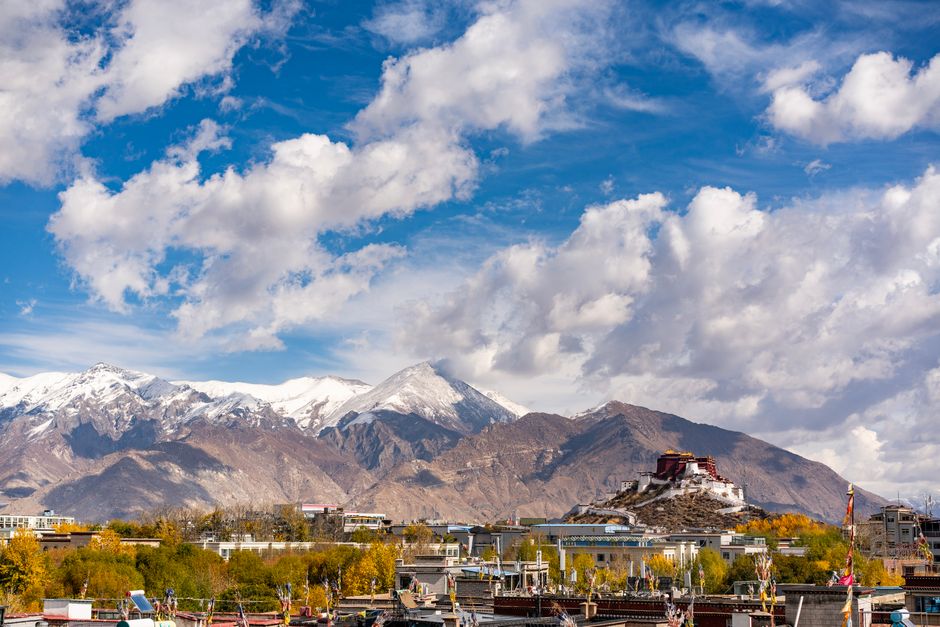
Lhasa, the capital of the Tibet Autonomous Region in southwest China, lies at about 3,650 m (11,975 ft) in a wide valley of the Lhasa River, ringed by bare brown mountains under an intensely blue sky. For more than a thousand years it has been the spiritual center of Tibetan Buddhism. Above the city rises the Potala Palace, the vast white-and-red winter palace of the Dalai Lamas, stacked thirteen stories up the Red Hill and part of a UNESCO World Heritage Site with the Jokhang Temple and the summer palace of Norbulingka. Around the Jokhang, pilgrims spin prayer wheels and prostrate themselves along the Barkhor, the circular pilgrim street of the old town, and on the edge of the city the great monasteries of Sera and Drepung still hold lively debates among monks. Lhasa is also the starting point for journeys to turquoise high lakes such as Yamdrok and Namtso. Visiting is different from the rest of China: foreign visitors need a Tibet Travel Permit and travel on an organized itinerary with a licensed guide, arranged through a travel agency, and the altitude demands a slow start. The best months are April to October, with clear, dry autumns.
Right now in Lhasa
- Wed 3–14°C 37–57°F Clear
- Thu 4–13°C 40–55°F 6 mm Showers
- Fri 2–11°C 36–52°F 15 mm Light showers
Weather: MET Norway (CC BY 4.0)
Top tours in Lhasa
See all tours for Lhasa →
From local operators, with prices and reviews; you check availability and book on Viator, our partner. We may earn a commission at no extra cost to you. How we earn money
Lhasa at a glance
- Best for: the Potala Palace, the Jokhang and Barkhor, Tibetan Buddhist monasteries, high-altitude landscapes and Tibetan food and culture.
- How long: 3–4 days in Lhasa, including time to adjust to the altitude; a week or more with lakes and other regions.
- Best time: April to October; September and October are clear and dry; July and August bring afternoon rain and the most visitors.
- Getting there: by air to Lhasa Gonggar (LXA) or by the Qinghai–Tibet Railway from Xining, with through trains from other cities.
- Good to know: foreign visitors need a Tibet Travel Permit, arranged with an organized tour by a licensed agency; the Potala Palace must be booked in advance.
- Before you go: visa-free entry, the arrival card, payments and general safety are in our China travel guide.
Permits and how visits are organized
Travel to Tibet works differently from the rest of China for visitors who hold foreign passports. In addition to your entry to China (a visa or visa-free entry), you need a Tibet Travel Permit (officially the “Tibet tourism entry approval letter”). Here is how it works in practice, according to the Tibet regional government’s published guidance.
- Who needs it: holders of foreign passports, including overseas Chinese without a Chinese passport, and travelers from Taiwan. Mainland Chinese citizens and residents of Hong Kong and Macau traveling on their mainland travel permits do not need it.
- How to get it: through a licensed travel agency in Tibet, which applies on your behalf with a copy of your passport and China visa (or entry details), your planned route and dates. Approval usually takes a few working days, but agencies ask for several weeks’ notice to arrange guides, vehicles and hotels.
- Organized travel: foreign visitors may not travel independently in Tibet. Whatever the size of your group, you travel on an organized itinerary booked through the agency, with a licensed guide who accompanies you to sights and holds the permit. Many agencies offer small-group tours and private tours for one or two people.
- Using the permit: airlines and the railway check the permit (or its confirmation) when you buy a ticket to Lhasa or board; hotels and checkpoints also check it.
- Other areas: for regions outside Lhasa that are not open to foreigners without approval, the agency also obtains an Alien’s Travel Permit from the public security bureau, and for border areas, such as the Everest region and the road to Nepal, a border area permit. These are arranged with the same itinerary; allow extra time.
The 240-hour visa-free transit does not cover Tibet, which is not among its permitted areas. Rules for foreign visitors can change at short notice, including temporary closures of some areas, so plan through an agency and check the latest arrangements before you book flights.
Lhasa’s areas and where to stay
Lhasa stretches along the north bank of the Lhasa River. Most visitors stay in or near the old town.
The old town and the Barkhor
The old town, east of the Potala, is the Tibetan heart of Lhasa: whitewashed houses with black-framed windows, courtyards, prayer-flag rooftops, markets and teahouses around the Jokhang and the Barkhor. Guesthouses and boutique hotels in traditional buildings put you within walking distance of the main sights.
Around the Potala Palace
The streets around Beijing Middle Road, west of the old town, have mid-range and upscale hotels, restaurants and shops, a short walk or taxi ride from both the Potala and the Barkhor.
West Lhasa and the Lhasa River
Newer districts to the west and along the river have large international hotels, malls and the Tibet Museum area, quieter and more modern, with easy taxi access to the center.
Where to stay in Lhasa
- Old town and Barkhor: atmosphere and walkability; many hotels in traditional style.
- Beijing Middle Road: central and well served by restaurants.
- West Lhasa: larger modern hotels, often with oxygen-enriched rooms.
Your agency usually books hotels as part of the itinerary; rooms are busiest from July to early October.
Top things to see in Lhasa
Potala Palace
The Potala Palace, rebuilt in its present form from the 17th century on foundations dating from the 7th century, rises some 117 m (384 ft) above the valley floor. The White Palace held the living quarters and offices of the Dalai Lamas; the Red Palace at its center holds chapels, gilded stupa-tombs of past Dalai Lamas, murals and thousands of statues. The visit climbs long stone stairways to the Deyang Shar courtyard and then threads through the halls along a fixed, one-way route.
Visits require a real-name advance booking. Book on the official “Potala Palace ticket booking system” (Budala Gong Piaowu Yuding Xitong) WeChat mini program or through the “Budala Gong Guanfang” WeChat account, up to about 10 days ahead; tickets are released at midnight and again at 8:30, and unused or returned tickets go back into the pool at 16:00. In the 2026 high season (1 May–31 October), the palace opens at 9:00 and last entry is at 15:40; in winter (1 November–30 April), it opens at 9:30 with last entry at 15:20. Full-price tickets cost 200 yuan for route 1 and 100 yuan for route 2, with concessions at 100 and 50 yuan. Since 1 December 2025 the palace is closed on Mondays, except on national public holidays (Monday opening was temporarily restored from 1 July to 15 September 2026). Visitor numbers are capped: the regional government has set a daily limit of 5,000 visitors on route 1, with route 2 adding up to 2,000 when route 1 is full, and entry is staggered in timed slots, with about one hour inside the main building. Visitors aged 60 and over and some others can book in person the day before at the palace’s booking office.
Dress modestly (no shorts, short skirts, bare shoulders or open sandals), take off hats and sunglasses inside, and do not take photos in the halls. The climb is steep at this altitude, so visit after a day or two of acclimatization. For the classic photo, cross to Yaowang Hill (Chakpori) to the southwest, or see the palace lit up from Potala Square at night.
Jokhang Temple and the Barkhor
The Jokhang Temple, founded in the 7th century, is the holiest temple in Tibet, built to house the Jowo Shakyamuni, a revered statue of the Buddha. Pilgrims from all over Tibet arrive to circle it, prostrating at the entrance amid juniper smoke and butter lamps. Book a time slot a day ahead on the temple’s “Dazhao Si” WeChat mini program for the morning (8:30–13:30); afternoon visits need no time slot; pay at the temple on the day. Walk the Barkhor clockwise with the pilgrims, past stalls of prayer flags, incense and jewelry.
Sera Monastery
Sera Monastery, founded in 1419 at the northern edge of the city, is one of the great Gelug monasteries. Its highlight is the monks’ debate in a walled courtyard on most afternoons, where monks question each other on Buddhist philosophy with dramatic hand claps. Tickets are sold at the gate; no booking needed.
Drepung Monastery
Drepung Monastery, founded in 1416 on a mountainside west of Lhasa, was once among the largest monasteries in the world. It hosts the unveiling of a giant thangka at the Shoton (Yogurt) Festival in summer. Tickets are sold on site.
Norbulingka
Norbulingka, the summer palace of the Dalai Lamas from the 18th century, is a large park of pavilions, palaces and gardens in the west of the city. Buy tickets online through its “Luobulinka” mini program or at the gate.
More classic sights
- Tibet Museum: free with an advance booking on its WeChat account; Tibetan history, art, thangkas and crafts; closed Mondays except public holidays.
- Ramoche Temple: the sister temple of the Jokhang, in the old town; tickets on site.
- Drak Yerpa: meditation caves in cliffs about 30 km (19 miles) northeast of Lhasa.
Other things to do in Lhasa
Walking the koras
A kora is a clockwise pilgrim circuit around a holy site. Besides the Barkhor, walk the Potala kora, lined with prayer wheels, in the early morning with local pilgrims, or the longer Lingkhor around the old city. They are gentle walks and a good way to acclimatize. See our city sightseeing and hiking guides.
Food and drink
Tibetan food is simple and filling, built for the altitude. Try tsampa, roasted barley flour mixed with butter tea; momos, steamed or fried dumplings of yak meat or vegetables; thukpa noodle soup; dried yak meat; and yogurt. Butter tea, salty and rich, is offered everywhere; Lhasa’s crowded sweet tea houses serve milky sweet tea by the thermos and bowls of noodles for very little. Chang, a mild barley beer, and Lhasa Beer are local drinks. Go easy on alcohol for the first days at altitude.
Day trips from Lhasa
Trips outside the city are arranged by your agency as part of the permit itinerary.
- Yamdrok Lake: a turquoise sacred lake beyond the Kamba La pass, at about 4,440 m (14,570 ft), about 100 km (62 miles) southwest; a long day trip.
- Namtso: one of the highest large lakes on Earth, at about 4,700 m (15,400 ft), about 240 km (150 miles) north; usually a long day or an overnight trip, best after acclimatization.
- Ganden Monastery: the first Gelug monastery, spread across a mountain ridge with a fine kora, about 50 km (31 miles) east.
- Shigatse: Tibet’s second city and the Tashilhunpo Monastery, about 3 hours by train or 4–5 hours by road.
Getting there and getting around
By air
Lhasa Gonggar International Airport (LXA), about 60 km (37 miles) southwest of the city by expressway, has flights from Chengdu, Chongqing, Beijing, Shanghai, Xi’an, Kunming and other cities, and seasonal international flights to Kathmandu; overland routes to Nepal need extra permits and depend on current rules. Your agency normally arranges the airport transfer; the drive takes about an hour.
By train
The Qinghai–Tibet Railway, opened in 2006, crosses the high plateau from Xining in Qinghai, reaching more than 5,000 m (16,400 ft) at the Tanggula Pass; the trip from Xining takes about 21–22 hours, and through trains run from cities such as Beijing, Shanghai, Guangzhou, Chengdu and Chongqing. Carriages have supplemental oxygen. Book on the 12306 website or app with your passport; your permit details are required.
Around town
The old town is best on foot. Taxis and DiDi are cheap and plentiful, and city buses cover the main roads; for monasteries and sights, your guide and vehicle will usually take you.
When to go and how long to stay
Lhasa has a high-altitude semi-arid climate with strong sunshine, nicknamed the “city of sunlight.” Spring (April–May) is dry, mild by day and cold at night. Summer (June–September) brings most of the year’s rain, usually as afternoon or night showers, with green hills and highs around 23 °C (74 °F). Autumn (October) is clear, crisp and stable, a favorite season for photography. Winter (November–February) is cold at night, with lows of −7 °C (19 °F) in January, but days are sunny and often around 8–10 °C (46–50 °F), and Lhasa is very quiet, with pilgrims arriving from the countryside. The table uses the 1991–2020 climate normals for the Lhasa station of the China Meteorological Administration (CMA), as submitted to the World Meteorological Organization (WMO): average daily highs and lows, total precipitation, and days with at least 1 mm of rain or snow.
| Month | Average high / low | Rain (days with 1 mm or more) | What to expect |
|---|---|---|---|
| January | 8 °C (47 °F) / −7 °C (19 °F) | 1 mm (under 0.1 in), under 1 day | Sunny days, freezing nights; quiet season |
| February | 10 °C (51 °F) / −4 °C (24 °F) | 2 mm (0.1 in), under 1 day | Cold and dry; Tibetan New Year often in February or March |
| March | 13 °C (56 °F) / −1 °C (31 °F) | 4 mm (0.1 in), 1 day | Warming; dry and windy |
| April | 17 °C (62 °F) / 3 °C (38 °F) | 8 mm (0.3 in), 2 days | Mild days; spring begins |
| May | 21 °C (69 °F) / 7 °C (45 °F) | 31 mm (1.2 in), 5 days | Pleasant; rain starts late |
| June | 24 °C (75 °F) / 11 °C (52 °F) | 84 mm (3.3 in), 11 days | Warm; showers in the afternoons |
| July | 23 °C (74 °F) / 12 °C (53 °F) | 141 mm (5.5 in), 16 days | The wettest month; green hills |
| August | 22 °C (72 °F) / 11 °C (52 °F) | 130 mm (5.1 in), 15 days | Rainy evenings; festival season |
| September | 21 °C (70 °F) / 9 °C (49 °F) | 65 mm (2.6 in), 10 days | Clearing; fine late in the month |
| October | 18 °C (64 °F) / 4 °C (39 °F) | 7 mm (0.3 in), 2 days | Clear and dry; excellent views |
| November | 13 °C (56 °F) / −3 °C (28 °F) | 1 mm (under 0.1 in), under 1 day | Cool, sunny and dry |
| December | 10 °C (49 °F) / −6 °C (21 °F) | 1 mm (under 0.1 in), under 1 day | Cold nights; quiet and sunny |
Lhasa receives about 470 mm (19 in) of rain a year, nearly all from June to September; sunshine is strong year-round.
Three days in Lhasa
Day one: arrive, rest and take an easy walk around the Barkhor. Day two: the Potala Palace (booked ahead) in the morning and the Jokhang in the afternoon. Day three: Drepung Monastery in the morning and the debate at Sera in the afternoon, with the Potala lit up at night.
Five days or more
Add Norbulingka, the Tibet Museum and the Potala kora, then a day trip to Yamdrok Lake or an overnight trip to Namtso; or continue to Shigatse, Everest Base Camp on the Tibetan side, or Nyingchi on a longer itinerary.
What a trip to Lhasa costs
Prices are approximate, for October 2026, converted at about 6.74 yuan to the US dollar. Agency tours, which are compulsory for foreign visitors, are the main cost: they usually bundle the permit, guide, vehicle, hotels and entrance tickets, and vary widely by group size and season.
| Item | Typical cost |
|---|---|
| Potala Palace, route 1 (full price) | 200 CNY (about US$30) |
| Potala Palace, route 2 (full price) | 100 CNY (about US$15) |
| Jokhang Temple | about 85 CNY (about US$13) |
| Sera or Drepung Monastery | about 50–100 CNY (about US$7–15) |
| Momos, a plate | 15–30 CNY (about US$2–4.50) |
| Small-group tour with permit, guide and hotels, 4 days | about 4,000–8,000 CNY (about US$590–1,190) per person |
| Mid-range hotel double, per night | 300–700 CNY (about US$45–104) |
Practical tips for Lhasa
- Plan with an agency early: arrange your permit and itinerary weeks ahead, before you book flights or trains.
- Book the Potala: your agency usually reserves it; if not, book on the official mini program as soon as slots open, and avoid Mondays.
- Acclimatize: plan an easy first day, do not schedule the Potala on the day you arrive and avoid alcohol for a day or two.
- Respect customs: walk clockwise around temples and stupas, do not touch religious objects, ask before photographing people, and dress modestly.
- Carry your passport and permit: they are checked at hotels, sights and checkpoints.
- Bring cash and cards: mobile payments work widely, but small temples and stalls may prefer cash.
Safety
The main health issue in Lhasa is altitude. At about 3,650 m (11,975 ft), many visitors feel headaches, breathlessness, poor sleep or nausea in the first days; this is acute mountain sickness. Ascend gradually if you can, rest on arrival, drink enough water, avoid alcohol and heavy exertion, and do not go higher, to lakes like Namtso, until you feel well. Severe symptoms such as confusion, loss of coordination, breathlessness at rest or a persistent cough need immediate descent and medical care; hotels and clinics can provide oxygen, and Lhasa has hospitals. If you have heart or lung conditions, consult a doctor before you go. The sun is fierce at this altitude, so use sunscreen, sunglasses and a hat. Nights are cold most of the year, and roads to high passes can be icy. Lhasa has a visible security presence, with checkpoints and bag checks at the Barkhor and other areas; carry your passport and permit, follow instructions and keep to your itinerary. In an emergency, call 110 for police, 120 for an ambulance and 119 for fire.
What to pack for Lhasa
Layers for big temperature swings: a warm jacket, fleece and hat for evenings even in summer, a down jacket in winter, a light rain jacket for summer showers, sturdy walking shoes for stairs and koras, sunscreen, sunglasses, lip balm and a refillable water bottle. Pack clothes that cover shoulders and knees for temples. China uses 220 V, with flat two-pin, round two-pin and angled three-pin sockets. See our hiking shoes, rain jackets and travel adapters guides.
Lhasa travel FAQ
Do I need a permit to visit Lhasa?
Yes, if you hold a foreign passport. You need a Tibet Travel Permit in addition to your entry to China, arranged by a licensed travel agency in Tibet with an organized itinerary and a guide.
Can I travel independently in Tibet?
No. Foreign visitors travel on an organized itinerary booked through a licensed agency and are accompanied by a licensed guide at sights, though private tours for one or two people are available.
Can I use the 240-hour visa-free transit to visit Lhasa?
No. Tibet is not in the permitted areas of the 240-hour transit; you need a visa or visa-free entry to China plus the Tibet Travel Permit.
How do I book the Potala Palace?
Book a real-name time slot on the official Potala Palace ticket booking WeChat mini program, up to about 10 days ahead; tickets are released at midnight and 8:30. Agencies usually book it for their guests.
How much is the Potala Palace ticket?
200 yuan for route 1 and 100 yuan for route 2 at full price, with concessions at 100 and 50 yuan.
Is the Potala Palace open on Mondays?
It is normally closed on Mondays, except on national public holidays; Monday opening was temporarily restored in summer 2026.
How high is Lhasa?
About 3,650 m (11,975 ft) above sea level; take it easy for the first day or two.
How long is the train to Lhasa?
About 21–22 hours from Xining on the Qinghai–Tibet Railway, and longer on through trains from Beijing, Shanghai, Chengdu or Chongqing.
What is the best time to visit Lhasa?
April to October; September and October are especially clear and dry.
How many days do I need in Lhasa?
At least three to four days, including a gentle first day to adjust to the altitude.
Sources and last review
Researched and last reviewed on 5 October 2026. The Potala Palace’s 2026 high-season dates, opening hours, route 1 and route 2 prices and booking period: the Potala Palace Management Office notice of April 2026, published by the Tibet Autonomous Region Department of Culture and Tourism; Monday closures from 1 December 2025 and winter hours: the Management Office notice of November 2025; the summer 2026 Monday opening: the Management Office notice of June 2026; ticket release times, in-person booking for older visitors, dress rules and the Jokhang, Sera, Drepung, Tibet Museum and Norbulingka booking arrangements: Lhasa culture and tourism, republished by the regional Department of Culture and Tourism in July 2026; the daily visitor limits: the regional government’s 2024 public reply, reported by People’s Daily; the Tibet Travel Permit, organized travel and border permits: the Tibet regional government’s guidance, republished by the Taiwan Affairs Office; the Alien’s Travel Permit: the National Immigration Administration; Tibet’s absence from the 240-hour transit areas: the National Immigration Administration; climate normals: the China Meteorological Administration via the World Meteorological Organization’s 1991–2020 normals; the exchange rate: the CFETS central parity rate. Building dates and heights, monastery details, festival timing, distances, train and flight details, the Nepal crossing and typical prices are general references or estimates, flagged for checking. Rules for Tibet change, so check with your agency before you go. For entry rules, money and general safety, see our China travel guide.
Plan your trip
Partner links: TravelerCenter may earn a commission if you book, at no extra cost to you.
🇨🇳 Useful Mandarin Chinese phrases for Lhasa
All 38 Mandarin Chinese phrases: restaurant, hotel, emergencies, romance (printable) →