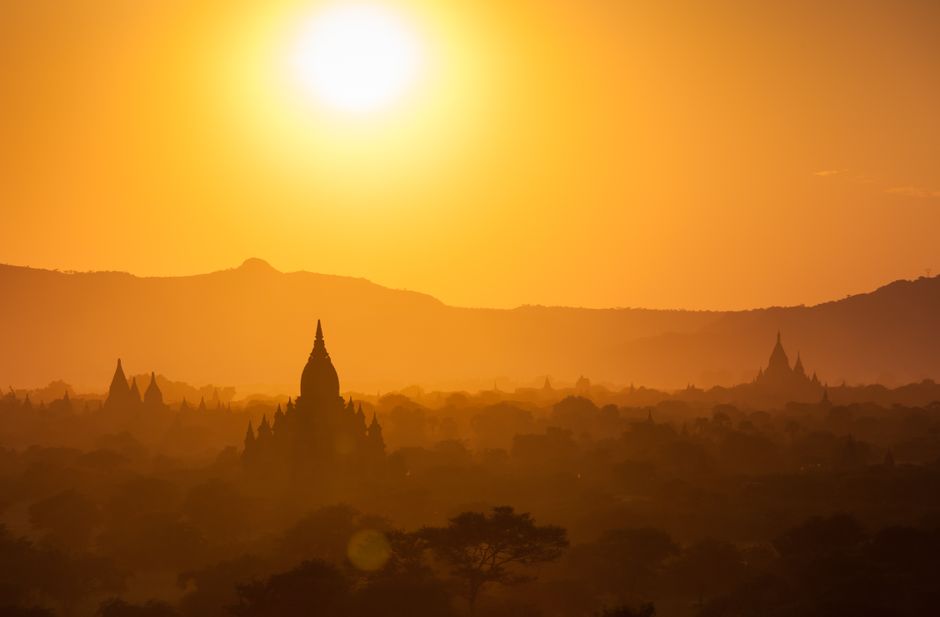
Bagan, on a bend of the Ayeyarwady River in central Myanmar, is one of the great archaeological sites of Asia: a dry plain scattered with more than 3,500 Buddhist temples, stupas and monasteries built between the 11th and 13th centuries, when it was the capital of the first kingdom to unify the country. From the gilded bell of the Shwezigon Pagoda and the white, gold-spired Ananda Temple to the massive brick bulk of Dhammayangyi and the painted corridors of Sulamani, the monuments rise above palm trees, peanut fields and dusty tracks for some 50 km² (20 sq miles), and at dawn, in season, hot-air balloons drift over them. Bagan was inscribed as a UNESCO World Heritage Site in 2019. It is also a place recovering from shocks: the plain was hit by earthquakes in 2016 and again in March 2025, when some temples and stupas were cracked or lost brickwork, and visitor numbers have fallen sharply since 2021 because of the conflict in the surrounding regions. Today most visitors fly in from Yangon, pay the zone fee on arrival and explore by e-bike or with a driver. The best months are November to February, when mornings are cool and skies clear.
Right now in Bagan (Nyaung-U)
- Wed24–31°C75–88°F1 mm rain
- Thu25–32°C77–90°F2 mm rain
- Fri25–31°C77–87°F2 mm rain
Top tours in Bagan
See all tours for Bagan →
From local operators, with prices and reviews; you check availability and book on Viator, our partner. We may earn a commission at no extra cost to you. How we earn money
Bagan at a glance
- Best for: temples and stupas, Buddhist murals, sunrise and sunset views, hot-air balloons, lacquerware workshops, and cycling or e-biking across the plain.
- How long: 2–3 full days; the zone fee covers three days.
- Best time: November to February, when it is dry and cool in the mornings; March to May is extremely hot.
- Getting there: fly from Yangon to Nyaung-U airport in about 1 hour 20 minutes; long road journeys cross areas affected by fighting.
- Getting around: by e-bike, bicycle, horse cart or car with a driver.
- Fee: the Bagan Archaeological Zone fee is 30,000 kyat for foreigners, valid for three days.
- Before you go: the e-visa, restricted areas, money and current conditions are in our Myanmar travel guide.
Access, fees and rules (as of October 2026)
The zone fee
All foreign visitors must buy a Bagan Archaeological Zone ticket. Since October 1, 2023, the fee has been 30,000 kyat, valid for three days, according to the Department of Archaeology and National Museum’s Bagan branch; it was previously 25,000 kyat for five days. It is collected at Nyaung-U airport, at checkpoints on the roads into the zone and at hotels, and you may be asked to show the ticket at major temples, so keep it with you. Additional days are charged if you stay longer.
Rules to know
- No climbing: climbing temples and stupas for views has been banned for several years to protect the monuments; use the official viewing mounds and the few designated viewpoints instead.
- Barefoot inside: remove shoes and socks at every temple, cover shoulders and knees, and do not touch murals.
- No drones without a permit, and no flash photography of murals.
- Damaged monuments: some temples are closed or fenced off for repairs after the 2025 earthquake; follow signs and caretakers’ instructions.
Getting into the area
Bagan lies in Mandalay Region, near the border with Magway Region, and both regions are affected by armed conflict, especially away from the main towns. Flights into Nyaung-U are the usual way in. Roads to Bagan from Yangon, Mandalay and Inle Lake pass through military checkpoints and areas where fighting has taken place, and routes can close at short notice; ask your hotel or a licensed agent before traveling by road.
The main areas of Bagan
The archaeological zone spreads between three settlements along the river, linked by the main road.
Nyaung-U
The largest town lies in the north, near the airport and the Shwezigon Pagoda, with the local market, the jetty, budget guesthouses, restaurants along “Restaurant Row” and the bus station.
Old Bagan
The walled core of the ancient city, beside the river, holds the Tharabar Gate, the Thatbyinnyu and Gawdawpalaing temples, the Bupaya stupa, the Archaeological Museum and a handful of upscale resorts that were allowed to stay when villagers were moved out in 1990.
New Bagan and Myinkaba
New Bagan (Bagan Myothit), built in the south for the families moved from Old Bagan, has mid-range hotels, restaurants and many lacquerware workshops. The village of Myinkaba, between Old and New Bagan, has the Manuha and Nanpaya temples and lacquer studios.
Where to stay in Bagan
- Old Bagan: riverside resorts among the temples, the most atmospheric and expensive choice.
- New Bagan: good-value mid-range hotels with pools, quieter at night.
- Nyaung-U: guesthouses and budget hotels, closest to the airport and restaurants.
Many hotels have reduced their services or closed since 2021, so confirm bookings directly and ask about generators, as power cuts are common.
Top things to see in Bagan
Ananda Temple
Completed around 1105 under King Kyansittha, the Ananda Temple is Bagan’s most revered and best-preserved temple: a white, cross-shaped building crowned by a gilded spire, with four standing teak Buddhas, each about 9.5 m (31 ft) tall, facing the cardinal points. Corridors lined with niches of carved stone reliefs and glazed plaques tell the life of the Buddha. The Ananda Pagoda festival, around the full moon of January or February, brings pilgrims, ox carts and a fair.
Shwezigon Pagoda
In Nyaung-U, the gold-covered bell of the Shwezigon Pagoda, completed under Kyansittha around 1102, is the prototype of the Burmese stupa and one of the country’s most important pilgrimage sites, said to hold relics of the Buddha. Its terraces are decorated with glazed plaques of Jataka tales, and shrines around it hold images of the 37 nats, Myanmar’s spirits. Some of the smaller stupas around it were damaged in the 2025 earthquake.
Thatbyinnyu and Dhammayangyi
The Thatbyinnyu Temple, built in the mid-12th century in Old Bagan, is the tallest on the plain, at about 61 m (200 ft). The vast, pyramid-shaped Dhammayangyi Temple, built by King Narathu around 1170, is the largest in volume, with some of the finest brickwork in Bagan; its inner corridors were mysteriously bricked up.
Sulamani and Htilominlo
The Sulamani Temple, built in 1183, has a striking two-story exterior and interior walls covered in later murals; the Htilominlo Temple, from around 1218, has fine stucco carvings and remains of murals.
Gawdawpalaing, Mingalazedi and Bupaya
The tall Gawdawpalaing Temple in Old Bagan was badly damaged in the 1975 earthquake and restored. Mingalazedi, built in 1284 just before the fall of the kingdom, has glazed terracotta tiles, and the gilded, bulb-shaped Bupaya stupa stands on the riverbank, a favorite spot for sunset over the Ayeyarwady.
Manuha and Nanpaya
In Myinkaba, the Manuha Temple, attributed to the captive Mon king Manuha in the 11th century, squeezes huge Buddha images into rooms far too small for them, said to express his captivity; the nearby Nanpaya has finely carved sandstone pillars.
More classic sights
- Bagan Archaeological Museum: sculptures, inscriptions and models that explain the kingdom.
- Shwesandaw Pagoda: a terraced stupa once famous for sunset views; climbing it is no longer permitted.
- Lawkananda Pagoda: a riverside stupa south of New Bagan, popular at sunset.
- Tharabar Gate: the main surviving gate of the old city walls, with shrines to the guardian nats.
- Viewing mounds: man-made hills built for sunrise and sunset views over the plain.
Other things to do in Bagan
Balloons over Bagan
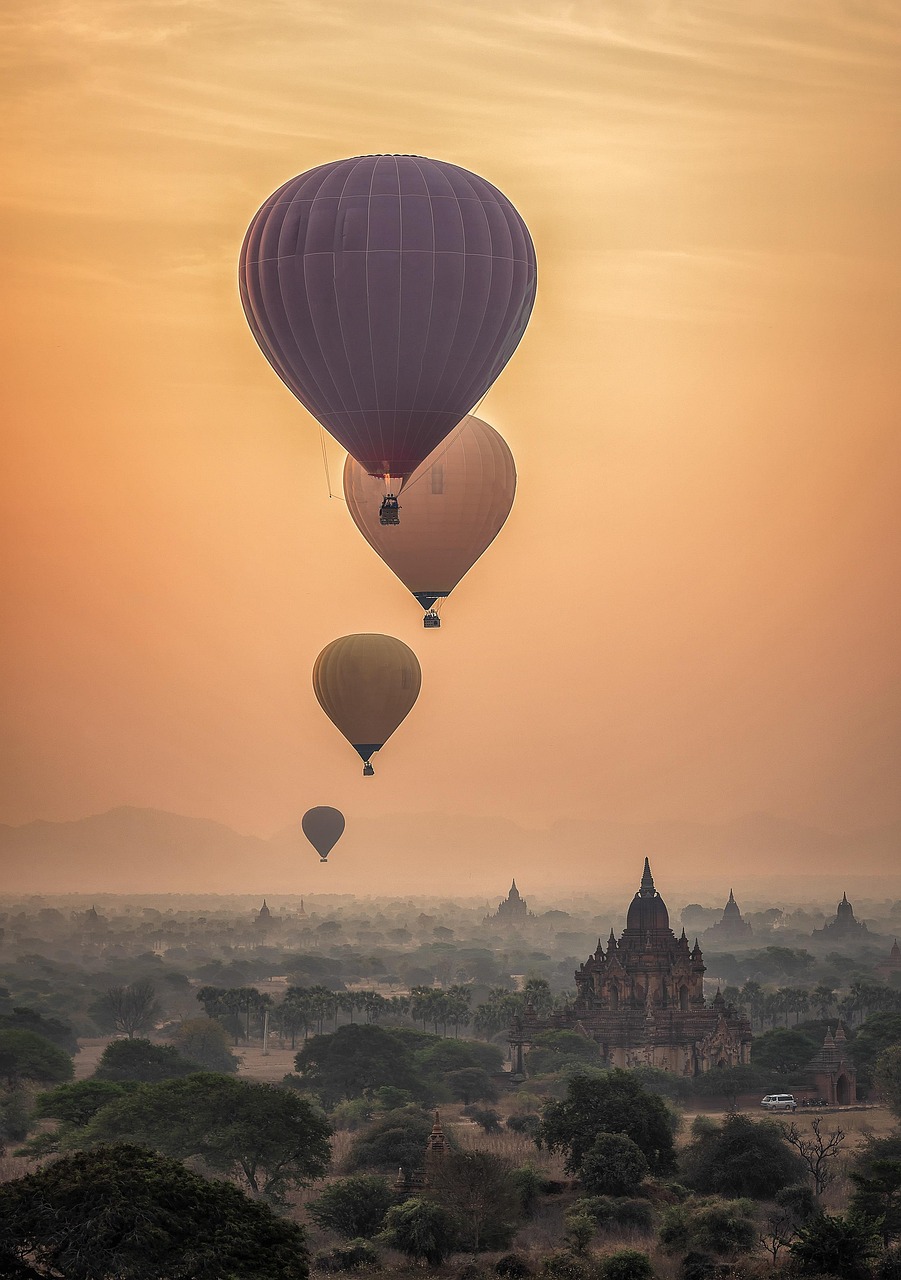
In the dry season, usually from about October to March, hot-air balloons lift off at dawn for flights of about 45 minutes to an hour over the plain. Flights are expensive, weather-dependent and book up early, and operations have been reduced since 2021, so check whether flights are running this season. Watching the balloons from the ground is free.
Exploring by e-bike or bicycle
The most popular way to see the plain is by e-bike, a quiet electric scooter rented from guesthouses by the day; bicycles are fine for the paved roads but hard work on sandy tracks. Horse carts give a slower, traditional tour. Take water, a hat and a flashlight for dark temple interiors. See our cycling guide.
Lacquerware and crafts
Bagan is the center of Myanmar’s lacquerware, made from bamboo or horsehair layered with lacquer, polished and engraved by hand. Watch the process in workshops in Myinkaba and New Bagan, and buy bowls, boxes and trays.
Food and drink
Restaurants in Nyaung-U and New Bagan serve Burmese curries with many side dishes, Shan noodles, tamarind flakes and tea-leaf salad, plus Indian, Chinese and Western food; try palm sugar sweets and toddy from the palm trees that dot the plain. See our city sightseeing guide.
River trips
Short boat trips on the Ayeyarwady at sunset leave from the Nyaung-U and Old Bagan jetties. See our boat trips guide.
Around Bagan
- Mount Popa: an extinct volcano about 50 km (30 miles) southeast, with the Taung Kalat monastery on a volcanic plug reached by 777 steps, home to Myanmar’s nat spirits and many monkeys; check that the road is open.
- Salay: a riverside town about 35 km (22 miles) south, in Magway Region, with the teak Yoke Sone Kyaung monastery; Magway Region is affected by fighting, so ask locally first.
- Pakokku: a river town across the Ayeyarwady with a lively market and tobacco-rolling workshops.
- Mandalay: the last royal capital, about 170 km (105 miles) northeast, heavily damaged by the 2025 earthquake.
- Inle Lake and Yangon: reached by domestic flights. See our Inle Lake and Yangon guides.
Nearby destinations
- Inle Lake225 km
- Cox's Bazar298 km
Getting there
By air
Nyaung-U Airport (NYU) lies just outside Nyaung-U, about 15 minutes by taxi from most hotels. Domestic airlines fly from Yangon in about 1 hour 20 minutes, from Mandalay and from Heho (Inle Lake), often on multi-stop morning flights. Schedules are thinner than before 2021 and can change at short notice; reconfirm the day before. The zone fee is collected in the arrivals hall.
By road
Express buses and private cars connect Bagan with Mandalay, Yangon and the Inle area, but these routes pass checkpoints and areas affected by fighting, and can close at short notice. Most visitors fly.
By boat
Before 2021, daily boats ran down the Ayeyarwady from Mandalay to Bagan in about 9–11 hours; check whether any services are operating.
Getting around: practical details
Rent an e-bike from your hotel or a shop in Nyaung-U or New Bagan; you do not need a license, but ride slowly on sandy tracks, which cause falls. A car with a driver for the day, or a horse cart, can be arranged through hotels. Temples are spread over a wide area, so plan routes by area: the Old Bagan core, the central plain around Dhammayangyi and Sulamani, Nyaung-U and the Shwezigon, and Myinkaba and New Bagan.
When to go and how long to stay
Bagan lies in Myanmar’s central dry zone, much drier and hotter than Yangon. The cool, dry season from November to February is ideal, with clear mornings, highs of 30–33 °C (85–92 °F) and cool nights around 13–15 °C (56–59 °F). March to May is fiercely hot, with April highs around 40 °C (103 °F). The rainy season, from May to October, brings occasional storms rather than daily downpours, with most rain in September and October; the plain turns green, and there are few visitors. The table uses the 1991–2020 climate normals for Nyaung-U from Myanmar’s Department of Meteorology and Hydrology, as submitted to the World Meteorological Organization (WMO): average daily highs and lows, total rain, and days with at least 1 mm of rain.
| Month | Average high / low | Rain (days with 1 mm or more) | What to expect |
|---|---|---|---|
| January | 30 °C (86 °F) / 13 °C (56 °F) | 4 mm (0.2 in), 1 day | Cool mornings, clear skies; balloon season; Ananda festival around the full moon (January or February) |
| February | 33 °C (92 °F) / 15 °C (59 °F) | 2 mm (0.1 in), under 1 day | Dry and warming |
| March | 37 °C (99 °F) / 20 °C (68 °F) | 5 mm (0.2 in), 1 day | Hot and hazy |
| April | 40 °C (103 °F) / 25 °C (76 °F) | 12 mm (0.5 in), 2 days | The hottest month; Thingyan |
| May | 38 °C (100 °F) / 26 °C (79 °F) | 106 mm (4.2 in), 6 days | Very hot; first storms |
| June | 35 °C (96 °F) / 26 °C (80 °F) | 68 mm (2.7 in), 7 days | Hot; occasional storms |
| July | 35 °C (95 °F) / 27 °C (80 °F) | 39 mm (1.5 in), 5 days | Hot and humid |
| August | 34 °C (94 °F) / 26 °C (79 °F) | 97 mm (3.8 in), 9 days | Green landscapes |
| September | 34 °C (92 °F) / 25 °C (78 °F) | 144 mm (5.6 in), 10 days | The wettest month |
| October | 33 °C (91 °F) / 24 °C (75 °F) | 129 mm (5.1 in), 8 days | Rains easing; Thadingyut |
| November | 32 °C (89 °F) / 20 °C (68 °F) | 26 mm (1.0 in), 2 days | Dry and pleasant |
| December | 30 °C (85 °F) / 15 °C (59 °F) | 4 mm (0.2 in), 1 day | Cool and dry; peak season |
Bagan receives only about 640 mm (25 in) of rain a year.
Three days in Bagan
Day 1: sunrise from a viewing mound, the Shwezigon and Nyaung-U market, and the Ananda Temple in the afternoon, with sunset at Bupaya. Day 2: the central plain, with Dhammayangyi, Sulamani, Htilominlo and smaller temples with murals, by e-bike. Day 3: Old Bagan, the Archaeological Museum, Myinkaba’s temples and lacquer workshops, and a sunset boat on the river.
Two days
Combine the highlights of the first two days, starting early and resting at midday.
What a trip to Bagan costs
Prices are approximate, for October 2026, converted at the Central Bank of Myanmar’s reference rate of 2,100 kyat to the US dollar; money changers may give a different rate.
| Item | Typical cost |
|---|---|
| Bagan Archaeological Zone fee, 3 days | 30,000 MMK (about US$14) |
| E-bike rental, per day | 10,000–15,000 MMK (about US$4.80–7) |
| Car with driver, per day | 50,000–90,000 MMK (about US$24–43) |
| Horse cart, half day | 25,000–40,000 MMK (about US$12–19) |
| Curry meal with side dishes | 8,000–15,000 MMK (about US$3.80–7) |
| Balloon flight, when operating | US$300–450 per person |
| Mid-range hotel double, per night | US$35–80 |
Practical tips for Bagan
- Keep your zone ticket: it may be checked at major temples.
- Start at dawn: temples are coolest and emptiest early; rest at midday.
- Carry a flashlight: to see murals in dark corridors, without flash photography.
- Wear slip-on shoes: you remove them at every temple.
- Bring cash: ATMs may not accept foreign cards.
- Ride carefully: sandy tracks cause many e-bike accidents.
Safety
Bagan itself has remained one of the few places in central Myanmar still visited by foreign tourists, but it lies close to conflict areas in Mandalay and Magway regions, and conditions can change quickly: check with your hotel before traveling outside the main temple area, and avoid road travel after dark. There are police and military checkpoints, and you should carry your passport with your visa. The March 2025 earthquake cracked some monuments and loosened brickwork, so keep out of fenced or damaged buildings, and remember that earthquakes are a continuing risk. Heat is the main everyday hazard: drink plenty of water and avoid the midday sun from March to May. E-bike falls on sand are common; ride slowly and wear a helmet if one is offered. Watch for snakes in overgrown areas and dogs around temples. In an emergency, call 199 for police and 192 for an ambulance; medical care is basic, and serious cases go to Yangon or abroad.
What to pack for Bagan
Light clothes that cover shoulders and knees, slip-on sandals, a wide-brimmed hat, sunglasses, sunscreen, a scarf against dust, a flashlight, a refillable water bottle, a light sweater for cool mornings from December to February, and clean US dollar notes. See our travel adapters guide.
Bagan travel FAQ
How much is the Bagan zone fee?
30,000 kyat for foreigners, valid for three days, since October 2023.
Can you still climb the temples in Bagan?
No. Climbing temples and stupas is banned to protect them; use the official viewing mounds for sunrise and sunset.
Was Bagan damaged in the 2025 earthquake?
Some temples and stupas, including small stupas at the Shwezigon, were cracked or lost brickwork, and repairs are continuing; the archaeological zone remains open.
Are the hot-air balloons flying over Bagan?
Balloon flights run in the dry season when operators are working, but operations have been reduced since 2021; check before you go.
How do I get to Bagan from Yangon?
By domestic flight to Nyaung-U, in about 1 hour 20 minutes. Road routes cross areas affected by fighting.
How many days do I need in Bagan?
Two to three full days, which matches the three-day zone ticket.
What is the best time to visit Bagan?
November to February, when mornings are cool and skies clear. April is the hottest month.
Where should I stay in Bagan?
Old Bagan for riverside resorts among the temples, New Bagan for mid-range hotels and Nyaung-U for budget guesthouses near the airport.
How do you get around Bagan?
By e-bike, bicycle, horse cart or car with a driver.
Which temples should I not miss in Bagan?
Ananda, the Shwezigon, Thatbyinnyu, Dhammayangyi, Sulamani and Htilominlo.
Plan your trip
Partner links: TravelerCenter may earn a commission if you book, at no extra cost to you.
🇲🇲 Useful Burmese phrases for Bagan
All 38 Burmese phrases: restaurant, hotel, emergencies, romance (printable) →
Sources · last reviewed 5 October 2026
Researched and last reviewed on 5 October 2026. The zone fee and its three-day validity from October 1, 2023: the Department of Archaeology and National Museum (Bagan branch) as reported by CNI Myanmar; UNESCO inscription in 2019: UNESCO; climate normals: the Department of Meteorology and Hydrology via the World Meteorological Organization’s 1991–2020 normals; exchange rate: the Central Bank of Myanmar. Conflict in Mandalay and Magway regions, checkpoints, road conditions and the March 2025 earthquake: the UK government’s factual safety pages and ICOMOS. Temple dates and dimensions, the number of monuments, the climbing ban, balloon seasons, earthquake damage at individual temples, travel times, emergency numbers and typical prices are general references or estimates, flagged for checking. Conditions change quickly, so check locally before you go. For entry rules, money and current conditions across the country, see our Myanmar travel guide.
Data: Weather: MET Norway (CC BY 4.0) · Rates: ECB · Costs: World Bank ICP and price levels · Wikidata (CC0)