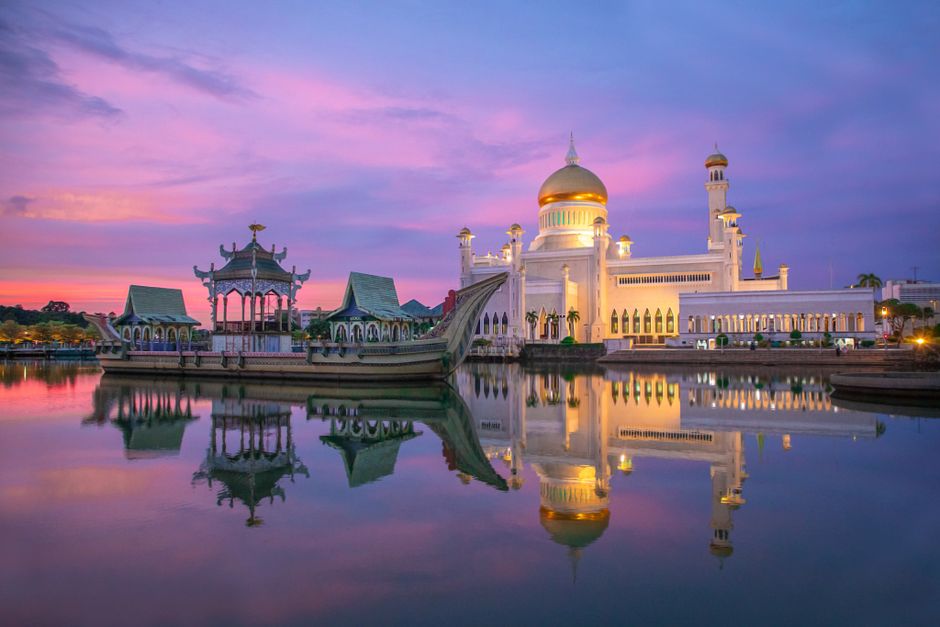
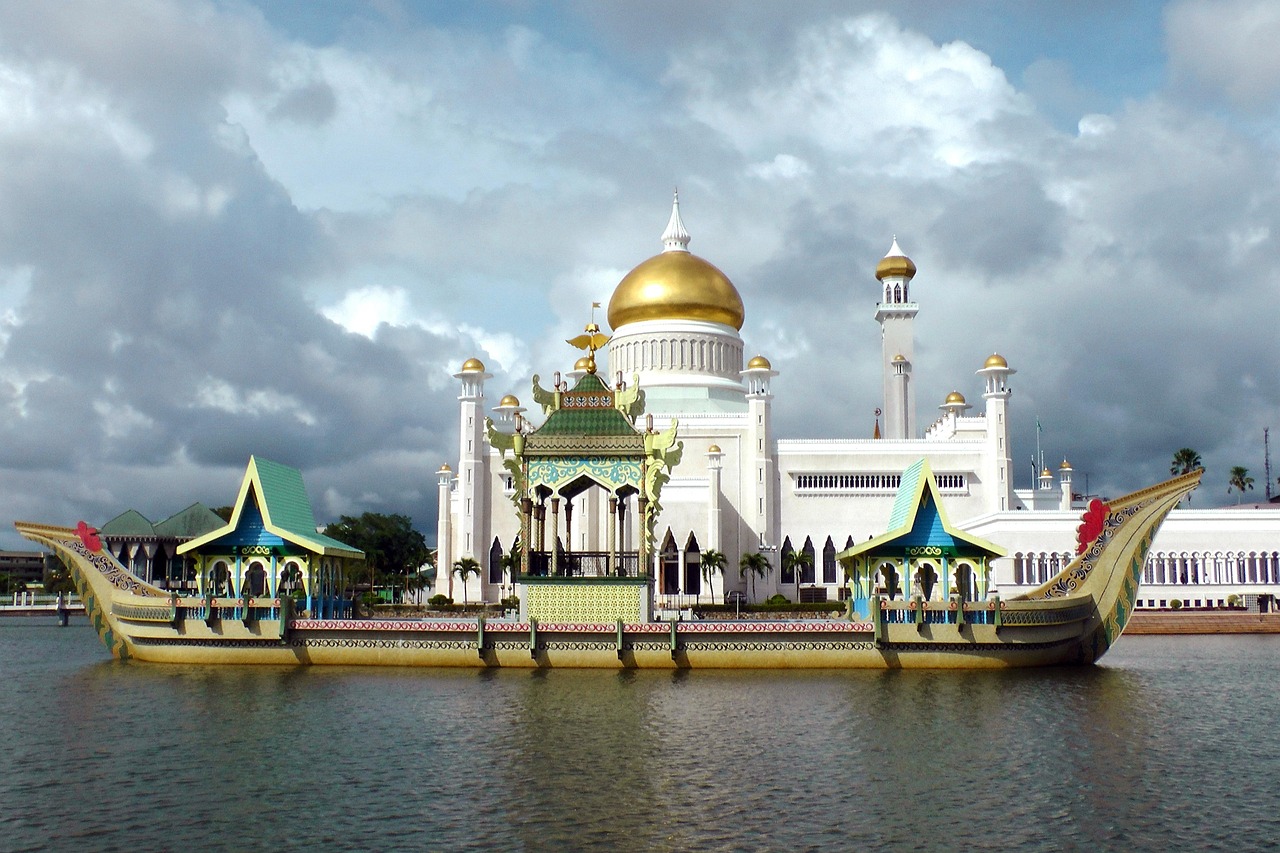
Brunei Darussalam, the “Abode of Peace”, is a small, wealthy Islamic sultanate on the north coast of Borneo, wedged between the Malaysian state of Sarawak and the South China Sea. Oil and gas discovered in the early 20th century have made it one of the richest countries in Asia, and it shows in the gold-domed mosques, royal palaces and immaculate roads of the capital, Bandar Seri Begawan. Yet much of Brunei remains a quiet, green land, with about 70% of its territory still covered in rainforest. The highlights are easy to reach and uncrowded: the floating mosque of Omar Ali Saifuddien reflected in its lagoon; Kampong Ayer, the largest water village in the world still lived in, where thousands of people live in stilt houses over the Brunei River; dusk boat trips to see wild proboscis monkeys in the mangroves; and the pristine jungle of Ulu Temburong National Park, with a canopy walkway high above the trees. Brunei is a conservative, deeply religious country: the sale of alcohol is banned, dress codes apply at mosques and government buildings, and everything closes for Friday prayers, but visitors who respect local customs find it safe, calm and welcoming. Citizens of many countries can visit visa-free, and the weather is hot and humid all year.
Right now in Brunei
- Wed 24–30°C 75–86°F 6 mm Rain
- Thu 23–29°C 74–84°F 18 mm Rain
- Fri 24–29°C 75–85°F 2 mm Cloudy
Weather: MET Norway (CC BY 4.0)
Multi-day tours of Brunei
Multi-day tours from local operators. You check dates and book on Viator, our partner; we may earn a commission at no extra cost to you. How we earn money
Brunei at a glance
Brunei covers about 5,770 km² (2,230 sq miles), a little smaller than Delaware, and has a population of about 455,000. It is split into two parts by the Limbang district of Sarawak: the larger western part holds the districts of Brunei-Muara, with the capital, Tutong and Belait, while the eastern district of Temburong is now linked to the rest of the country by the Temburong Bridge. Malay is the official language, and English is widely spoken; Chinese dialects are spoken by the Chinese community. Islam is the state religion, followed by about 80% of the population, and the country is governed under the national philosophy of Melayu Islam Beraja (Malay Islamic Monarchy). The head of state and government is Sultan Hassanal Bolkiah, on the throne since 1967.
Brunei uses Brunei Time (UTC+8), with no daylight saving time, the same as Singapore and Malaysia. Electricity is 240 V, with British-style three-pin sockets (type G). The currency is the Brunei dollar (BND), which is pegged at par with the Singapore dollar.
A short history
From the 15th to the 17th centuries, the Sultanate of Brunei was a maritime power that controlled much of the coast of Borneo and parts of the southern Philippines. Its territory shrank in the 19th century as land passed to the Rajahs of Sarawak and to North Borneo, and in 1888 Brunei became a British protectorate. Oil was discovered at Seria in 1929 and transformed the economy. Brunei chose not to join Malaysia in 1963 and became fully independent on January 1, 1984; National Day is celebrated on February 23. In 2014, it began phasing in a Sharia penal code, fully implemented in 2019.
Oil, wealth and everyday life
Oil and natural gas, produced onshore around Seria and from offshore fields, provide most of Brunei’s export earnings and government revenue. They fund free healthcare and education, subsidized fuel and housing, and there is no personal income tax. For visitors, this means excellent roads and infrastructure, very cheap fuel, and a relaxed pace of life, but also a car-centered country with little public transport and quiet evenings, when families gather at night markets and food courts rather than bars.
Brunei’s districts
- Brunei-Muara: the capital, Bandar Seri Begawan, with its mosques, museums, palace and water village, the port of Muara and nearby beaches.
- Tutong: a rural district of beaches, the Tamu market and Tasek Merimbun, Brunei’s largest lake.
- Belait: the oil town of Seria and the town of Kuala Belait near the Sarawak border, with forest at Labi and Sungai Liang.
- Temburong: the forested eastern exclave, with Ulu Temburong National Park, longhouses and rivers, now reached by bridge.
Where to go: mosques, water villages and rainforest
Most visitors base themselves in the capital and make day trips. See our guide:
- Bandar Seri Begawan: the Omar Ali Saifuddien and Jame’ ‘Asr Hassanil Bolkiah mosques, Kampong Ayer, the Royal Regalia Museum, the Istana Nurul Iman palace, river trips to see proboscis monkeys and the Gadong night market.
Temburong, the eastern district, was once reached only by speedboat through the mangroves; since 2020, the Temburong Bridge, about 30 km (19 miles) long and one of the longest in Southeast Asia, has linked it to the capital in about 45 minutes. The district’s highlight is Ulu Temburong National Park, a protected area of primary rainforest about 50,000 hectares (124,000 acres) in size, reached by longboat up the Temburong River and visited mainly on guided tours, with a steel canopy walkway that rises about 50 m (160 ft) above the forest floor, waterfalls, river swimming and stays in a rainforest lodge. Iban longhouses near Bangar offer homestays.
In Tutong, the Sunday-morning Tamu, a market of jungle produce and food, and Tasek Merimbun, a black-water lake with an island linked by a wooden bridge, are the main attractions, along with the long beach at Seri Kenangan. In Belait, Seria has the Billionth Barrel Monument, marking the billionth barrel of oil produced there in 1991, nodding donkeys along the coast and the Oil and Gas Discovery Centre; the town of Kuala Belait is the gateway to Miri in Sarawak. Near Labi, the Luagan Lalak recreational park has a swampy lake that floods in the wet season.
Closer to the capital, the Jerudong Park Playground, a theme park built by the royal family, the opulent Empire Brunei resort and golf course on the coast, and Muara Beach and Serasa Beach are popular with families on weekends.
Kampong Ayer, the water village
Spread along both banks of the Brunei River opposite the capital’s waterfront, Kampong Ayer is a cluster of more than 40 villages of wooden and concrete houses on stilts, linked by kilometers of plank walkways and home to several thousand people. It has been inhabited for centuries; early European visitors in the 16th century called it the “Venice of the East”. Today the villages have their own schools, mosques, clinics, police and fire stations, and residents commute to the city by water taxi. Visitors can walk the boardwalks, visit the Kampong Ayer Cultural and Tourism Gallery, with exhibits on village life and a viewing tower, and drop into a family-run café or handicraft workshop.
Ulu Temburong in more detail
A typical trip to Ulu Temburong starts with the drive across the Temburong Bridge to Bangar, the district’s small town, then continues by road to Batang Duri, where narrow wooden longboats, steered by Iban boatmen, take you up the Temburong River through rapids to the park headquarters. From there, a steep boardwalk of about 1,000 steps climbs to the canopy walkway, a series of aluminum towers linked by bridges, where sunrise over the misty forest is the highlight; other activities include river tubing, swimming at the Sungai Apan waterfall and night walks to spot insects and frogs. Most visits are on day or overnight tours from the capital, including lodge accommodation, meals and the park fee; independent visits are limited, and numbers are capped to protect the forest.
The royal sights
Brunei’s royal family is central to national identity, and several sights reflect it. The Istana Nurul Iman, the Sultan’s official residence on the Brunei River, is said to be the largest residential palace in the world, with about 1,788 rooms; it is closed to visitors except during the three days of Hari Raya Aidilfitri, when thousands line up to greet the royal family. The Royal Regalia Museum in the capital displays the golden chariot used at the Sultan’s coronation and jubilees, crowns, ceremonial weapons and gifts from heads of state. The Jame’ ‘Asr Hassanil Bolkiah Mosque, with its 29 golden domes, was built to mark the Sultan’s 25th year on the throne.
Bandar Seri Begawan Travel Guide
Plan a trip to Bandar Seri Begawan: the center, Gadong and Jerudong and where to stay, the Omar Ali Saifuddien and Jame' 'Asr Hassanil…
Best time to visit Brunei
Brunei has a hot, humid equatorial climate with little variation through the year: average temperatures stay around 27–28 °C (81–83 °F), with daytime highs usually in the low 30s °C (around 90 °F) and warm nights. It rains in every month, often in heavy afternoon or evening showers. The wettest period is October to January, during the northeast monsoon, and February to April is the driest, making it the best time to visit, especially for Ulu Temburong, when rivers are calmer; the southwest monsoon from May to September brings moderate rain. Smoke haze from forest fires in Borneo and Sumatra occasionally reduces air quality in dry years, usually from about August to October.
The table uses the 1991–2020 climate normals for the Brunei Meteorological Department’s station at the international airport, as submitted to the World Meteorological Organization (WMO): average daily mean temperature, total rain and days with at least 1 mm of rain.
| Month | Average temperature | Rain (days with 1 mm or more) | What to expect |
|---|---|---|---|
| January | 27 °C (81 °F) | 321 mm (12.6 in), 18 days | Wet; northeast monsoon |
| February | 27 °C (81 °F) | 163 mm (6.4 in), 12 days | Drier; good for visiting |
| March | 28 °C (82 °F) | 143 mm (5.6 in), 13 days | The driest month |
| April | 28 °C (82 °F) | 242 mm (9.5 in), 16 days | Warm; showers |
| May | 28 °C (83 °F) | 260 mm (10.2 in), 18 days | The warmest month |
| June | 28 °C (82 °F) | 238 mm (9.4 in), 17 days | Showers; possible haze later in the year |
| July | 28 °C (82 °F) | 242 mm (9.5 in), 17 days | Sultan’s Birthday celebrations on July 15 |
| August | 28 °C (82 °F) | 232 mm (9.1 in), 17 days | Showers; haze possible in dry years |
| September | 28 °C (82 °F) | 235 mm (9.3 in), 18 days | Showers |
| October | 27 °C (81 °F) | 314 mm (12.3 in), 21 days | Wetter; northeast monsoon begins |
| November | 27 °C (81 °F) | 323 mm (12.7 in), 22 days | Wet |
| December | 27 °C (81 °F) | 359 mm (14.1 in), 22 days | The wettest month |
Brunei receives about 3,070 mm (121 in) of rain a year at the airport, and more inland.
Festivals and holidays
- Hari Raya Aidilfitri: the end of Ramadan, Brunei’s biggest celebration, when the Istana Nurul Iman opens its doors to the public for three days and the Sultan greets visitors; dates move about 11 days earlier each year.
- Ramadan: during the fasting month, eating, drinking and smoking in public in daylight are illegal, and restaurants serve only takeaway during fasting hours; evening food markets are lively.
- National Day: February 23, with parades in the capital.
- Sultan’s Birthday: July 15, with celebrations, fireworks and events across the country.
- Chinese New Year: celebrated by the Chinese community with lion dances and temple visits.
Traveling during Ramadan
Visiting during Ramadan has its rewards and its challenges. During fasting hours, from dawn to sunset, restaurants and food courts sell only takeaway or delivery, and you must not eat, drink or smoke in public, including in your car; hotels usually serve breakfast and meals discreetly to non-Muslim guests. Office and shop hours are shortened. At sunset, families break the fast together, and the Ramadan markets (tamu Ramadan) that set up in the late afternoon, with dozens of stalls selling kuih, grilled meats, drinks and rice dishes, are among the best food experiences in Brunei. The month ends with Hari Raya Aidilfitri, when the palace opens to visitors and families hold open houses.
Brunei on a budget
Brunei has a reputation for being expensive, but food is cheap, buses cost a dollar, and many of the best sights, including the mosques, Kampong Ayer, the Royal Regalia Museum and the waterfront, are free or nearly so. The main costs are accommodation, tours to Ulu Temburong and getting around without a car; sharing tours and using Dart cars between bus routes keeps them down.
How long to stay: sample itineraries
- 2 days: Bandar Seri Begawan, with the mosques, Kampong Ayer, the Royal Regalia Museum, a sunset river trip and the Gadong night market.
- 3–4 days: add an overnight trip to Ulu Temburong National Park.
- 5 days: add Tutong and Seria, continuing overland to Miri in Sarawak, or the ferry to Labuan and Kota Kinabalu in Sabah. See our Kota Kinabalu and Kuching guides.
Entry, money and costs
Visas (last reviewed October 2026)
According to Brunei’s Ministry of Foreign Affairs, many nationalities can visit without a visa. Citizens of the United States, the United Kingdom, Canada, Switzerland, Norway, Iceland, Liechtenstein and most European Union countries, including France, Germany, Italy, Spain, the Netherlands and Ireland, can stay up to 90 days; citizens of Japan, South Korea, Malaysia, Singapore, New Zealand, Oman, the United Arab Emirates, Turkey and Laos, among others, up to 30 days; and citizens of China, Thailand, Indonesia, the Philippines, Vietnam, Cambodia, Myanmar, Russia, Hong Kong, Macau and Taiwan up to 14 days with ordinary passports. Australians, and citizens of a few other countries, such as Kuwait, can get a visa on arrival valid for 30 days, for BND20 (single entry) or BND30 (multiple entry). Citizens of most other countries, including India, Pakistan and Bangladesh with ordinary passports, need a visa from a Brunei mission before traveling. If you want to stay longer than your visa-free period, apply for a visa.
Your passport must be valid for at least six months on arrival and undamaged. All foreign visitors must complete the E-Arrival Card online before arriving by air, land or sea, and the health declaration before or on arrival. Overstaying can lead to detention and caning.
Alcohol rules
The sale of alcohol is banned in Brunei, and no bars, restaurants or shops sell it. According to Brunei Tourism, non-Muslim visitors over 18 may bring in up to two bottles of liquor and twelve 330 ml cans of beer, declared to customs on arrival, which issues a liquor declaration form that must be kept with the alcohol; it may be drunk only in private, such as a hotel room, never in public. Muslims may not drink at all. Some restaurants allow non-Muslims to bring their own drinks discreetly, but ask first. Declarations can be made in advance through the Customs.BN app.
Dress codes and mosque visits
Dress modestly in public, and do not wear shorts in government buildings. At mosques, visitors must be properly dressed: according to Brunei Tourism, women must cover their head, shoulders and knees, and some mosques provide robes and headscarves; men should wear long trousers and shirts with sleeves. Remove your shoes, keep silent, and visit outside prayer times; non-Muslims have set visiting hours and are not admitted on Friday mornings or during prayers.
Customs and rules to know
Brunei applies a Sharia penal code alongside its civil laws, with severe penalties for some offenses. Criticism of the Sultan and the royal family causes great offense and can lead to legal action. Drug offenses carry very severe penalties, including the death penalty. Possession of pornography is illegal, and same-sex sexual activity is criminalized. Firearms, ammunition and fireworks are strictly banned. The sale of tobacco is also banned, and smoking is prohibited in many public places; bring only a limited, declared amount for personal use. During Ramadan, eating, drinking or smoking in public during fasting hours is illegal.
Money and cards
The Brunei dollar (BND) is pegged one-to-one with the Singapore dollar, and Singapore notes are accepted throughout Brunei (Brunei notes are also accepted in Singapore). In early October 2026, it traded at about 1.28 Brunei dollars to the US dollar; prices on this site use about 1.28. ATMs in shopping centers accept international Visa and Mastercard cards, and cards are accepted in hotels, malls and larger restaurants, but carry cash for markets, food stalls and water taxis.
Tipping
Tipping is not expected; many restaurants add a service charge, and rounding up or leaving small change for good service is appreciated.
What a trip costs
Prices are approximate, for October 2026, converted at about 1.28 Brunei dollars to the US dollar.
| Item | Typical cost |
|---|---|
| Nasi katok from a food stall | BND1–3 (about US$0.80–2.35) |
| Meal at a food court or night market | BND3–8 (about US$2.35–6.25) |
| Dinner in a mid-range restaurant | BND15–35 (about US$12–27) per person |
| Bus ride | BND1 (about US$0.80) |
| Water taxi across the river to Kampong Ayer | BND1–3 (about US$0.80–2.35) per person |
| Mangrove and proboscis monkey boat trip | BND20–40 (about US$16–31) per person |
| Ulu Temburong National Park tour, overnight | BND150–300 (about US$117–234) per person |
| Mid-range hotel double, per night | BND80–150 (about US$62–117) |
A comfortable mid-range trip costs roughly BND150–250 (about US$117–195) per person per day, sharing a double room; budget travelers in the few hostels and guesthouses can manage on BND60–90 (about US$47–70).
Where to stay
Brunei has a small but comfortable range of hotels. In Bandar Seri Begawan, choose between business hotels in the center, a short walk from the mosques and waterfront, and larger hotels in Gadong near the night market and malls. The Empire Brunei, on the coast at Jerudong, is a vast luxury resort with beaches, pools and a golf course, about 25 minutes from the capital. Ulu Temburong has a rainforest lodge used by tour operators, and there are homestays in Temburong’s longhouses and villages. Budget options are limited to a few hostels and guesthouses. Hotels fill around National Day, the Sultan’s Birthday and Hari Raya.
Getting there and getting around
By air
Brunei International Airport (BWN), about 10 km (6 miles) north of the capital, is the base of Royal Brunei Airlines, with flights from Singapore, Kuala Lumpur, Kota Kinabalu, Bangkok, Manila, Ho Chi Minh City, Hong Kong, Shanghai, Dubai, Melbourne and other cities, and connections to London via Dubai; other airlines fly from Singapore, Kuala Lumpur and Manila. See our Singapore, Malaysia, Kuala Lumpur, Thailand and Philippines guides.
By land from Sarawak and Sabah
Brunei has land borders with Sarawak at Sungai Tujoh (to Miri), Kuala Lurah (to Limbang), and Labu and Ujung Jalan in Temburong. Buses and shared cars connect the capital with Miri in about 3–4 hours, and direct buses run to Kota Kinabalu in Sabah in about 8–9 hours, crossing the borders several times; border posts are not open 24 hours, so check times. Make sure your passport is stamped at every crossing.
By sea
Ferries sail from the Serasa terminal near Muara to Labuan island in Malaysia in about 1.5 hours, with onward ferries to Kota Kinabalu, and boats run to Limbang and Lawas in Sarawak.
Around the country
Public buses cover the capital and main routes for BND1 a ride, from about 6 a.m. to 8 p.m., but services are infrequent, especially outside the capital. Most residents drive, and taxis are scarce: use Dart, Brunei’s ride-hailing app, or rent a car, which you can drive with a valid foreign license for up to 90 days. Foreign-registered cars may buy fuel only at designated stations. Water taxis, small speedboats, cross the Brunei River to Kampong Ayer and can be hired for river tours. Brunei drives on the left.
National parks and nature
About 70% of Brunei remains forested, much of it primary rainforest. The main protected areas are Ulu Temburong National Park, with its canopy walkway, waterfalls and research station; the Tasek Merimbun Heritage Park in Tutong, an ASEAN Heritage Park; the peat swamp and heath forests around Labi and Badas; and the mangroves of the Brunei Bay, where proboscis monkeys, monitor lizards, crocodiles and hornbills live close to the capital. In the city, the Bukit Shahbandar Forest Recreation Park and Tasek Lama have walking trails, waterfalls and viewpoints. See our hiking and boat trips guides.
Culture, food and everyday etiquette
Food
Bruneian food shares much with Malay cooking, with Chinese and Indian influences. The national dish is ambuyat, a sticky, glue-like starch from the sago palm, twirled around bamboo chopsticks and dipped in a sour, spicy sauce called cacah, eaten with fish, vegetables and beef. Everyone’s favorite snack is nasi katok, a packet of rice, fried chicken and sambal sold around the clock for a dollar or two. Try beef rendang, satay, kelupis (sticky rice steamed in leaves), nasi lemak, roti canai, soto noodle soup and colorful kuih cakes, ideally at the Gadong night market or a tamu (market). All food is halal, and there is no alcohol.
A few words of Malay
English is widely understood, but a few Malay words are appreciated: selamat pagi (good morning), terima kasih (thank you), sama-sama (you’re welcome), berapa harga? (how much?), sedap (delicious) and assalamualaikum, the Islamic greeting.
Responsible travel
Choose licensed operators for Ulu Temburong and river trips, keep a distance from wildlife and do not feed monkeys, and take your rubbish with you. In Kampong Ayer, remember that the stilt houses are people’s homes, and ask before photographing residents.
Etiquette
Greet people with a light handshake, or by touching your heart after a handshake, but do not offer to shake hands with someone of the opposite sex unless they offer first. Use your right hand for giving and receiving, and point with your thumb rather than your finger. Remove shoes before entering homes and mosques. Public displays of affection are frowned upon, and you should not make loud noises during the call to prayer. Note that banks, businesses, offices, shops and restaurants close between 12 noon and 2 p.m. on Fridays for Friday prayers, and government offices close on Fridays and Sundays and open on Saturdays.
Safety, health and connectivity
Brunei is one of the safest countries in Asia for visitors. These are the main things to know:
- Crime: crime levels are low, with occasional petty theft and burglaries; don’t leave valuables in cars.
- Laws: see the rules on alcohol, Ramadan, dress, drugs and the royal family above; penalties can be severe.
- Wildlife: saltwater crocodiles live in the rivers and mangroves and have attacked people fishing on riverbanks; heed warning signs and stay away from the water’s edge. Venomous snakes are found in forests and gardens.
- Forest hiking: it is easy to get lost in the rainforest; use recognized guides, stay on trails, carry water and a flashlight, and don’t hike alone.
- Roads: driving standards are variable, with speeding and red-light running; if you are in an accident, do not move your vehicle until the police arrive.
- Boats: check that life jackets are available on water taxis and river cruises, and keep your hands inside the boat.
- Health: dengue occurs, so use insect repellent; tap water in the capital is treated, but most visitors drink bottled water. Hospitals in the capital, including the RIPAS public hospital and private clinics, are good.
- Emergencies: call 993 for police, 991 for an ambulance, 995 for fire and 998 for search and rescue.
Mobile coverage is good throughout the populated areas. Buy a prepaid SIM or eSIM from Imagine, Progresif or DST at the airport arrival hall with your passport.
Things to do: mosques, water villages and wildlife
Visit the Omar Ali Saifuddien Mosque at sunset, take a water taxi to Kampong Ayer and its cultural gallery, cruise the mangroves at dusk to see proboscis monkeys, walk the canopy walkway in Ulu Temburong, eat nasi katok and satay at the Gadong night market, see the treasures of the Royal Regalia Museum, and join the crowds at the Istana Nurul Iman during Hari Raya. See our boat trips, hiking and city sightseeing guides. Brunei combines easily with Sabah and Sarawak in Malaysia, and with Singapore.
Brunei travel FAQ
Do I need a visa for Brunei?
Many visitors do not. Citizens of the United States, the United Kingdom, Canada and most of Europe can stay 90 days visa-free; Japan, South Korea, Malaysia, Singapore and New Zealand 30 days; and China, Thailand, Indonesia, the Philippines and Vietnam 14 days. Australians can get a visa on arrival.
Do I need to fill in an arrival card for Brunei?
Yes. All foreign visitors must complete the online E-Arrival Card before arriving, and a health declaration.
Can you drink alcohol in Brunei?
Alcohol is not sold anywhere. Non-Muslim visitors over 18 may bring up to two bottles of liquor and twelve cans of beer, declared on arrival, to drink in private.
What should I wear to visit a mosque in Brunei?
Women must cover their head, shoulders and knees, and men should wear long trousers; some mosques lend robes and headscarves. Remove your shoes and visit outside prayer times.
Can I use Singapore dollars in Brunei?
Yes. The Brunei dollar is pegged at par with the Singapore dollar, and Singapore notes are accepted everywhere in Brunei.
What is the best time to visit Brunei?
February to April, the driest months. It is hot all year, and October to January is the wettest period.
How do I get to Ulu Temburong National Park?
On a guided tour from Bandar Seri Begawan, crossing the Temburong Bridge by road and continuing by longboat up the Temburong River.
Is Brunei safe for tourists?
Yes. Crime is low; the main things to respect are the strict laws on alcohol, drugs, dress and behavior, and to watch for crocodiles near rivers.
Is everything closed on Fridays in Brunei?
Businesses, shops and restaurants close from 12 noon to 2 p.m. on Fridays for prayers, and government offices close all day Friday and Sunday.
How many days do I need in Brunei?
Two days for the capital, three or four with an overnight trip to Ulu Temburong.
What can I eat during Ramadan in Brunei?
Restaurants sell food for takeaway or delivery during fasting hours; eating, drinking or smoking in public in daylight is illegal. Evening Ramadan markets are a highlight.
How do I get around Brunei without a car?
By bus in the capital, the Dart ride-hailing app, water taxis on the river and organized tours; taxis are scarce.
Can I travel overland between Brunei and Malaysia?
Yes. Buses run to Miri in Sarawak and to Kota Kinabalu in Sabah, and ferries sail to Labuan.
Sources and last review
Researched and last reviewed on 5 October 2026. Visa-free periods by nationality, the visa on arrival and its fees: Brunei’s Ministry of Foreign Affairs (mfa.gov.bn); the E-Arrival Card, alcohol import limits, mosque dress code, Friday closures, public buses, Dart, SIM operators and the search-and-rescue number: Brunei Tourism, the official tourism site; climate normals: the Brunei Meteorological Department via the World Meteorological Organization’s 1991–2020 normals. Passport rules, the health declaration, overstay penalties, the ban on alcohol and tobacco sales, the Sharia penal code, laws on the royal family, drugs, pornography and same-sex relations, crocodiles, snakes, hiking, road rules, fuel for foreign cars and border posts are from the UK government’s factual entry and safety pages. The exchange rate is a cross rate from the Central Bank of Myanmar’s published rates, consistent with the Singapore dollar peg. Population, area, forest cover, history, the Temburong Bridge, park sizes, flight routes, journey times, emergency numbers other than search and rescue, and typical prices are general references or estimates, flagged for checking. Rules change, so check official sites before you go.
Plugs and power in Brunei
Brunei uses 240 V, 50 Hz and these plugs (left) and wall sockets (right):
All plug types and voltages by country → · Check what you need to pack →
Plan your trip
Partner links: TravelerCenter may earn a commission if you book, at no extra cost to you.
🇲🇾 Useful Malay phrases for Brunei
All 38 Malay phrases: restaurant, hotel, emergencies, romance (printable) →