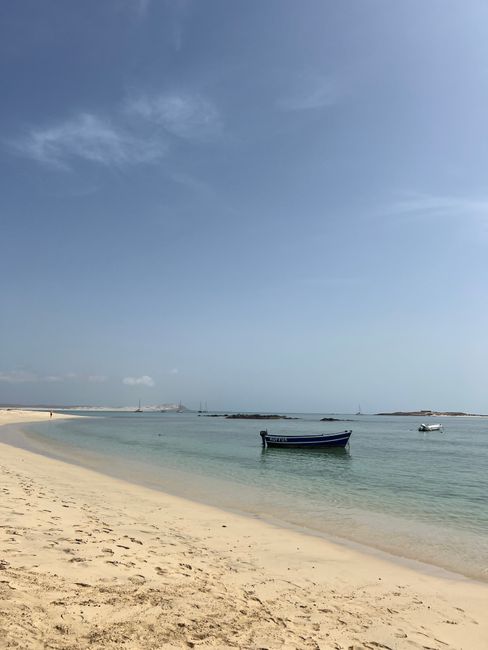
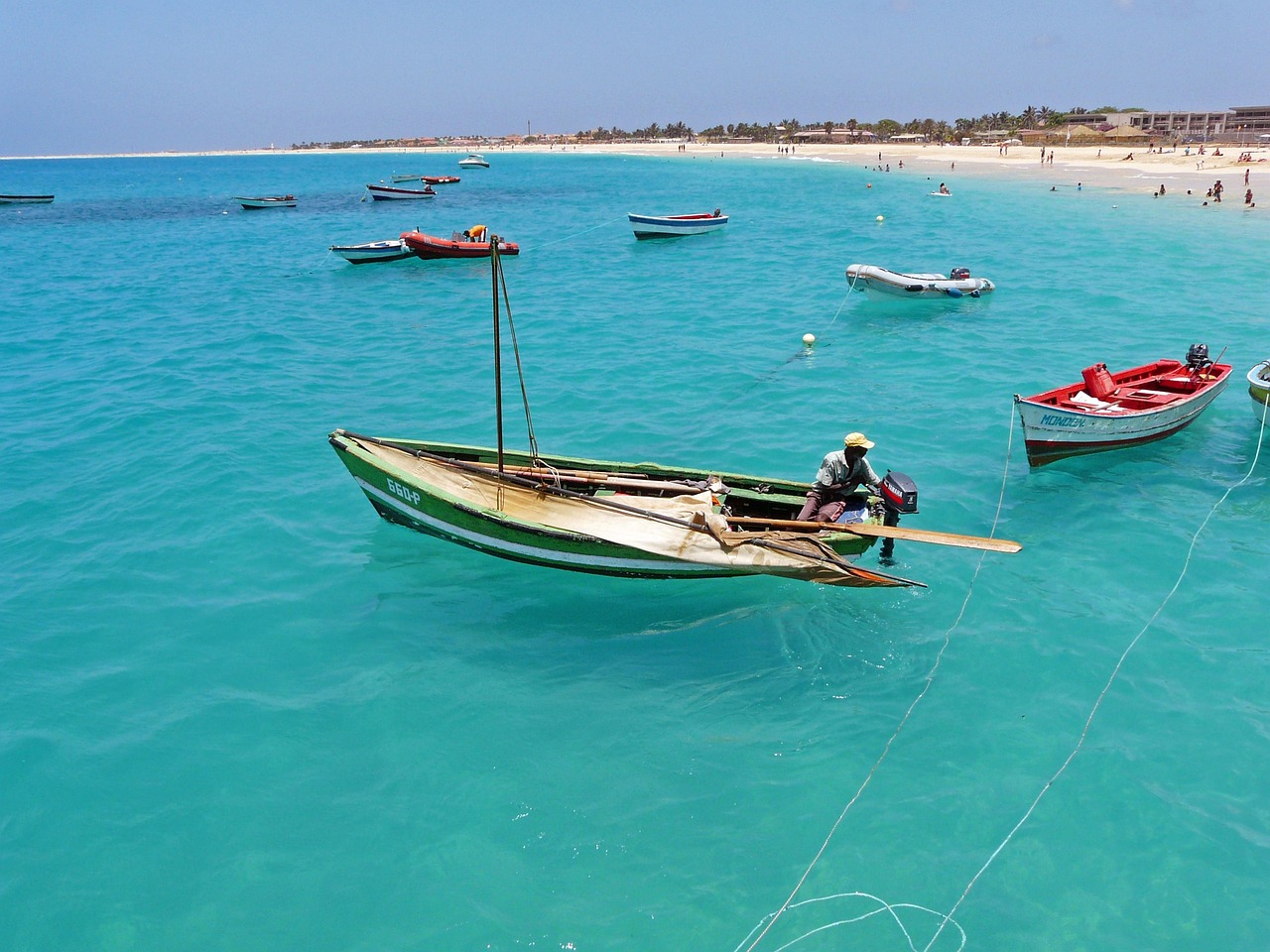
Sal is Cabo Verde’s sunniest, flattest and busiest holiday island, and for most visitors it’s their first taste of the archipelago. Its name means “salt,” after the salt pans that once made it rich, and its landscape is mostly bare desert of sand and volcanic rock, broken by a few small hills. What draws people is the coast: the long white beach of Santa Maria, turquoise water, steady trade winds that make it one of the world’s great kitesurfing and windsurfing spots, and sunshine on almost every day of the year. The island’s international airport receives more holiday flights than any other in the country, and the southern tip around Santa Maria is lined with hotels and all-inclusive resorts. Beyond the beach, you can float in the salt pools inside the old volcanic crater at Pedra de Lume, wade among baby lemon sharks at Shark Bay, watch waves surge into the natural pool at Buracona, see loggerhead turtles nesting on summer nights, and dive on reefs and wrecks. Sal is small, about 30 km (19 miles) from north to south, so everything is a short drive away, and it’s a convenient base for flying on to the other islands.
Right now in Sal (Santa Maria)
- Wed 26–29°C 79–83°F 1 mm Cloudy
- Thu 27–28°C 80–83°F 7 mm Showers
- Fri 27–28°C 80–83°F 8 mm Cloudy
Weather: MET Norway (CC BY 4.0) · Sea temperature: NOAA CoastWatch
Top tours in Sal
See all tours for Sal →
From local operators, with prices and reviews; you check availability and book on Viator, our partner. We may earn a commission at no extra cost to you. How we earn money
Sal at a glance
- Best for: beach holidays, kitesurfing and windsurfing, diving, turtle watching in summer and an easy winter-sun break.
- How long: 5–7 nights for a beach holiday; 3–4 nights if you’re combining Sal with other islands.
- Best time: November to June for dry, sunny, windy weather; June to October for turtles; August to October is hotter and more humid.
- Getting there: fly into Amílcar Cabral International Airport (SID), with direct flights from Europe and domestic links across Cabo Verde.
- Getting around: taxis, aluguer minibuses between Santa Maria and Espargos, rental cars, scooters and quads, and organized island tours.
- Good to know: pre-register on ease.gov.cv and pay the airport security tax before you fly, and swim only at beaches with lifeguards.
- Before you go: visas, money and general safety are in our Cabo Verde travel guide.
Sal’s areas and who each one suits
Almost all tourist accommodation is in and around Santa Maria, at the island’s southern tip. The airport and the main town, Espargos, are in the middle of the island, about 18 km (11 miles) north.
Santa Maria town and the pier
The old fishing town of Santa Maria is the island’s heart, with a pedestrian center of cafés, bars, restaurants, souvenir shops and small guesthouses around the church square. In the late morning, fishermen land tuna, wahoo and grouper at the wooden pier (the pontão), and the town comes alive in the evening with live music. Staying here suits travelers who like to walk to restaurants and nightlife.
Santa Maria’s beachfront resorts
East and west of the town, large all-inclusive resorts and hotels line the beach for several kilometers. The western side, toward Ponta Sino and Ponta Preta, has some of the biggest resort complexes; the eastern side, toward Algodoeiro and beyond, is quieter. These suit families and anyone who wants a pool, a beach on the doorstep and meals included.
Kite Beach and the east coast
The windy east coast around Kite Beach (Praia da Fontona), about 5 km (3 miles) from Santa Maria, is the island’s kitesurfing hub, with schools and rental centers but few places to stay. Most kiters stay in Santa Maria and drive or take a shuttle out.
Murdeira, Espargos and Palmeira
On the west coast, Murdeira is a quiet bay with apartments and villas, protected as a marine reserve. Espargos, near the airport, is a working town with budget hotels, shops and a lookout on Monte Curral. Palmeira, the island’s port, is a small fishing village where cargo ships and boats dock.
Where to stay on Sal
- Santa Maria town: walk to restaurants, bars, the pier and the beach; mid-range hotels and guesthouses.
- Beachfront resorts east and west of Santa Maria: all-inclusive holidays, pools and family facilities.
- Algodoeiro and the east end: quieter resort hotels and easy access to Kite Beach.
- Murdeira: villas and apartments on a calm bay, best with a car.
- Espargos: cheaper rooms and convenient for early flights.
Top things to see on Sal
Santa Maria beach
The beach at Santa Maria curves for about 8 km (5 miles) along the southern coast, with soft pale sand and clear, turquoise water. The bay is sheltered from the trade winds, so the sea in front of town is usually calmer than elsewhere, and there are sunbeds, beach bars and water-sports centers. Lifeguards watch the central stretches in season; currents can be strong farther along, so swim where you see flags and lifeguards. See our beaches guide.
Pedra de Lume salt crater
On the east coast, the Pedra de Lume salt pans lie inside the crater of an extinct volcano, reached through a tunnel cut into its rim. Salt was harvested here from the 18th century and exported by an aerial ropeway to the old port, which still stands. Today you can walk among the pink and white salt pans and float in the briny pools, which are saltier than the Dead Sea, then rinse off in the showers. There’s an entrance fee, and a small café and spa offer salt-mud treatments. Go early or late in the day to avoid the midday glare and tour groups, and bring water shoes, as the salt crust is sharp.
Shark Bay
At Shark Bay (Baía da Parda) on the east coast, young lemon sharks swim in the shallow water near the shore. Local guides lend water shoes and lead you in up to your knees to watch them circling. They’re small and harmless if left alone; don’t touch or feed them. The sea is calmest and clearest in the morning.
Buracona and the Blue Eye
On the northwest coast, Buracona is a natural rock pool where Atlantic swells surge through lava channels. Next to it is the Olho Azul (Blue Eye), a cave where, around midday on sunny days, sunlight turns the water a brilliant blue. A small fee is charged, and swimming in the pool is only safe when the sea is calm; follow the attendants’ instructions.
The Terra Boa mirage and the desert
On the plain at Terra Boa, between Espargos and Palmeira, the heat often creates a shimmering mirage that looks like a lake. Island tours by 4×4 or quad usually stop here and at the dunes and lava fields of the north.
Santa Maria salt pans
Just north of Santa Maria, the old salt pans that gave the island its name are a quieter place to see the salt landscape and watch wading birds at low light.
Other things to do on Sal
Kitesurfing and windsurfing
Sal is one of the top kite and windsurf destinations in the Atlantic. From about November to May, the northeast trade winds blow steadily, and Kite Beach on the east coast offers flat and wavy water for every level, with schools offering courses for beginners. Ponta Preta, west of Santa Maria, is a world-famous wave spot for experts, hosting international windsurf and kitesurf competitions. Surfers find waves in winter at Ponta Preta and elsewhere on the west coast. See our surfing guide.
Diving and snorkeling
The waters around Sal are clear and full of life, with dive sites on reefs, caves and lava arches, and several wrecks off Santa Maria and Palmeira. Expect groupers, moray eels, rays, turtles and, at some sites, nurse sharks. Dive centers in Santa Maria run trips for beginners and certified divers, and snorkeling is good from boats and at calm spots such as Murdeira. See our diving and snorkeling guides.
Turtle watching
From about June to October, loggerhead turtles come ashore at night to nest on Sal’s beaches, especially on the south and east coasts, and hatchlings scramble to the sea from about August to November. Join an authorized guided turtle walk, usually run with local conservation groups; never use flash or lights near turtles, and don’t walk on nesting beaches at night alone.
Boat trips and fishing
Catamaran and boat trips sail along the west coast for snorkeling and swimming, and from about February to May humpback whales pass offshore. Sportfishing boats leave Santa Maria pier for wahoo, tuna and marlin. See our boat trips guide.
Island tours
A half-day or full-day island tour, by minibus, 4×4 or quad bike, typically takes in Pedra de Lume, Shark Bay, Espargos, Palmeira, Buracona and the Terra Boa mirage. It’s the easiest way to see the island without driving.
Food and drink
Santa Maria has a wide range of restaurants, from simple fish grills near the pier to Italian, Portuguese and international places. Try fresh tuna steak and wahoo, grilled lobster, octopus, the national stew cachupa, and goat’s cheese with papaya jam. Drink local grogue (sugarcane spirit) or pontche (grogue with molasses) in moderation, and Strela beer. Live music, including morna and coladeira, is played in bars most nights. Prices in resort restaurants are close to European levels, while local cafés in Espargos and Santa Maria’s back streets are much cheaper.
Day trips and onward travel from Sal
Boa Vista
Sal’s neighbor, about 50 km (30 miles) south, has even emptier beaches, dunes and the Santa Maria shipwreck. Domestic flights take around 20 minutes, and day excursions by boat run when sea conditions allow. See our Boa Vista guide.
São Vicente and Santo Antão
For music and mountains, fly to São Vicente for Mindelo and take the ferry to Santo Antão for its hiking trails. These are better as a two- to four-night side trip than a day trip.
Santiago and Fogo
Fly to Praia on Santiago for the UNESCO-listed old town of Cidade Velha, and on to Fogo to climb the volcano. Organized one-day trips from Sal to Santiago are offered, but flights are early and long, so two nights are better.
Nearby destinations
- Boa Vista72 km
Getting there and getting around
By air
Amílcar Cabral International Airport (SID), near Espargos, is the main gateway for holiday flights to Cabo Verde, with direct flights from the UK, Ireland, Portugal, Germany, the Netherlands, Belgium, France, Italy and Scandinavia, many of them charter flights in winter. Lisbon has year-round scheduled flights; see our Lisbon travel guide. Domestic flights link Sal with Boa Vista, Praia, São Vicente and other islands. Before you fly, complete the EASE pre-registration and pay the airport security tax (TSA) of CVE 3,400 (about €30.83) on ease.gov.cv; according to the UK government, arriving without it costs double at the border from July 1, 2026.
From the airport
The drive from the airport to Santa Maria takes about 20 minutes. Package travelers are usually met by a transfer bus. Otherwise, take one of the authorized blue-and-yellow taxis outside arrivals and agree the fare before you set off; hotels can also book transfers.
Getting around Sal
- Taxis: easy to find in Santa Maria and Espargos; agree the fare first, especially at night.
- Aluguers: shared minibuses run between Santa Maria and Espargos throughout the day, leaving when full; they’re cheap and a good way to visit Espargos and Palmeira.
- Car, scooter and quad rental: available in Santa Maria; roads are good between the main towns but unpaved to many beaches. Cabo Verde drives on the right, and helmets are compulsory on scooters and quads.
- On foot and by bike: Santa Maria is easy to explore on foot, and bikes are available to rent.
When to go and how long to stay
Sal is warm and dry all year. From November to June, days are sunny with highs of 25–27 °C (77–81 °F), steady trade winds and pleasant evenings, which is peak season for European visitors and kitesurfers. Between December and February, dust from the Sahara can bring a hazy sky and occasionally delay flights. From July to October, the wind drops, the air becomes hotter and more humid, highs reach 30 °C (86 °F), and short, heavy showers are possible, especially in September; the sea is warmest then, around 25 °C (77 °F). The table uses the 1991–2020 climate normals for the Sal airport station of Cabo Verde’s National Institute of Meteorology and Geophysics (INMG), as published by the World Meteorological Organization (WMO): average daily highs and lows, total precipitation, and days with at least 1 mm of rain.
| Month | Average high / low | Rain (days with 1 mm or more) | What to expect |
|---|---|---|---|
| January | 25 °C (77 °F) / 19 °C (67 °F) | 3 mm (0.1 in), 0 days | Sunny and windy; peak kite season |
| February | 25 °C (77 °F) / 19 °C (66 °F) | under 1 mm, 0 days | Coolest sea; dust haze possible |
| March | 25 °C (77 °F) / 19 °C (66 °F) | under 1 mm, 0 days | Breezy and dry; whales offshore |
| April | 26 °C (78 °F) / 20 °C (67 °F) | 1 mm (under 0.1 in), 0 days | Dry and pleasant; Easter crowds |
| May | 26 °C (79 °F) / 21 °C (69 °F) | under 1 mm, 0 days | Winds easing; good diving |
| June | 27 °C (81 °F) / 22 °C (71 °F) | under 1 mm, 0 days | Warm; turtle season begins |
| July | 28 °C (83 °F) / 23 °C (73 °F) | 2 mm (0.1 in), 0 days | Hotter, lighter winds; turtles nesting |
| August | 30 °C (85 °F) / 24 °C (76 °F) | 13 mm (0.5 in), 1 day | Hot and humid; first hatchlings |
| September | 30 °C (86 °F) / 25 °C (77 °F) | 34 mm (1.4 in), 3 days | Hottest and wettest month |
| October | 30 °C (85 °F) / 24 °C (75 °F) | 16 mm (0.6 in), 1 day | Hot; warm sea; hatchlings |
| November | 28 °C (83 °F) / 22 °C (72 °F) | 1 mm (0.1 in), 0 days | Winds return; kite season starts |
| December | 26 °C (79 °F) / 20 °C (69 °F) | 3 mm (0.1 in), 0 days | Warm and dry; festive season |
Sal receives only about 75 mm (3 in) of rain a year, on about seven days.
Events worth planning around
- Carnival (February or March): parades and costumes in Santa Maria and Espargos, smaller than Mindelo’s but lively.
- Santa Maria festival (mid-September): the town’s saint’s day, with music and celebrations.
- Kite and windsurf competitions: international events at Ponta Preta and Kite Beach, usually in winter and spring.
How long to stay: 3, 5 and 7 nights
- 3 nights: Santa Maria beach and pier, an island tour with Pedra de Lume and Shark Bay, and a sunset at Ponta Preta.
- 5 nights: add a kitesurf or diving course, a catamaran trip and Buracona.
- 7 nights: add a turtle walk in season, a day on Boa Vista or a two-night side trip to São Vicente.
What a trip to Sal costs
Prices are approximate, for October 2026, converted at about CVE 98 to the US dollar. Many tourist businesses quote in euros.
| Item | Typical cost |
|---|---|
| Airport security tax (TSA), paid online | CVE 3,400 (about US$35) |
| Taxi from the airport to Santa Maria | about CVE 1,500–2,500 (about US$15–25) |
| Aluguer between Santa Maria and Espargos | about CVE 100–200 (about US$1–2) |
| Pedra de Lume entrance | about CVE 500–1,000 (about US$5–10) |
| Half-day island tour | about CVE 3,500–6,000 (about US$36–61) |
| Kitesurf lesson, 1 hour private | about CVE 8,000–12,000 (about US$80–120) |
| Fish dinner in Santa Maria | about CVE 1,500–3,000 (about US$15–30) |
| Mid-range hotel double, per night | about CVE 9,000–20,000 (about US$90–205) |
Safety on Sal
Sal is relaxed and generally safe, but petty crime does occur, and the sea needs respect. Use the hotel safe for passports and valuables, don’t leave bags unattended on the beach, avoid isolated beaches and unlit areas after dark, and take taxis rather than walking long distances at night. Street sellers can be persistent in Santa Maria; a polite “no, obrigado” usually works. Currents and undertows can be strong, especially outside the sheltered bay: swim only where lifeguards are on duty and follow the flags (red means no swimming, yellow means caution, green means safe). Kitesurfers should take lessons with an established school and never go out alone in offshore winds. Wear a helmet on scooters and quads, and check that your insurance covers them. The sun is fierce even when the wind feels cool, so use high-factor sunscreen and drink plenty of water. Medical care on Sal is limited, with more complex cases sent to Praia or abroad, so carry travel insurance with medical evacuation. In an emergency, call 132 for the police and 130 for an ambulance.
Practical tips for Sal
- Pre-register: complete EASE and pay the TSA online before flying, and keep the confirmation.
- Carry escudos: euros are widely taken, but change comes in escudos, and aluguers and small cafés prefer local cash.
- Go early: visit Pedra de Lume and Shark Bay in the morning, before the wind and the tour buses.
- Book kite lessons ahead: schools fill up in high season, from December to April.
- Respect wildlife: don’t touch sharks, turtles or hatchlings, and keep lights off on nesting beaches.
What to pack for Sal
Light summer clothes, a windbreaker or light sweater for windy evenings, swimwear and a rash guard, a sun hat, sunglasses and reef-friendly high-factor sunscreen, water shoes for Pedra de Lume and Shark Bay, a dry bag for boat trips, insect repellent, and a European two-pin plug adapter. Kitesurfers may want their own harness and a shorty wetsuit in winter. See our water shoes, wetsuits and travel adapters guides.
Sal travel FAQ
Is Sal worth visiting?
Yes, for a sunny beach holiday, kitesurfing or diving. It’s flat and dry inland, so travelers looking for mountains should add Santo Antão or Fogo.
What is the best time to visit Sal?
November to June for dry, sunny and windy weather, November to May for kitesurfing, and June to October for turtles. September is the hottest and wettest month.
Do I need to pre-register before flying to Sal?
Yes. Most visitors must complete the EASE pre-registration on ease.gov.cv and pay the airport security tax of CVE 3,400 (about €30.83) before arrival.
How far is Santa Maria from Sal airport?
About 18 km (11 miles), or around 20 minutes by taxi or transfer.
Can you swim with sharks on Sal?
At Shark Bay, you can wade in shallow water to watch young lemon sharks. They’re harmless if left alone; don’t touch or feed them.
Can you float in the salt lake at Pedra de Lume?
Yes. The salt pools in the volcanic crater are so salty that you float effortlessly. There’s an entrance fee, and showers are available.
Is Sal good for kitesurfing?
Yes, it’s one of the best places in the Atlantic, with steady winds from about November to May, schools at Kite Beach and the expert wave spot of Ponta Preta.
When can I see turtles on Sal?
Loggerhead turtles nest from about June to October, and hatchlings appear from about August to November. Join an authorized guided turtle walk.
Is the sea on Sal safe?
The bay at Santa Maria is usually sheltered, but currents can be strong elsewhere. Swim where lifeguards are on duty and follow the flags.
Can I visit Boa Vista from Sal?
Yes, by a short domestic flight or a boat excursion when the sea allows. Two or three nights on Boa Vista is better than a day trip.
Sources and last review
Researched and last reviewed on 5 October 2026. EASE pre-registration and the airport security tax: Cabo Verde’s EASE portal and Portugal’s Ministry of Foreign Affairs; the double TSA from July 1, 2026, beach flags, currents, taxis, helmets, quad-bike insurance and emergency numbers: the UK government’s factual entry and safety pages, used for practical facts only; climate normals: Cabo Verde’s National Institute of Meteorology and Geophysics via the World Meteorological Organization’s 1991–2020 normals (Sal station); the euro peg and dollar rate: Portugal’s foreign ministry and the European Central Bank. Distances, attractions, entrance fees, wind and wildlife seasons, events, flights and typical prices are general references or estimates, flagged for checking. Prices and rules change, so check locally before you go. For visas, money and general safety, see our Cabo Verde travel guide.
Plan your trip
Partner links: TravelerCenter may earn a commission if you book, at no extra cost to you.
🇵🇹 Useful Portuguese phrases for Sal
All 38 Portuguese phrases: restaurant, hotel, emergencies, romance (printable) →