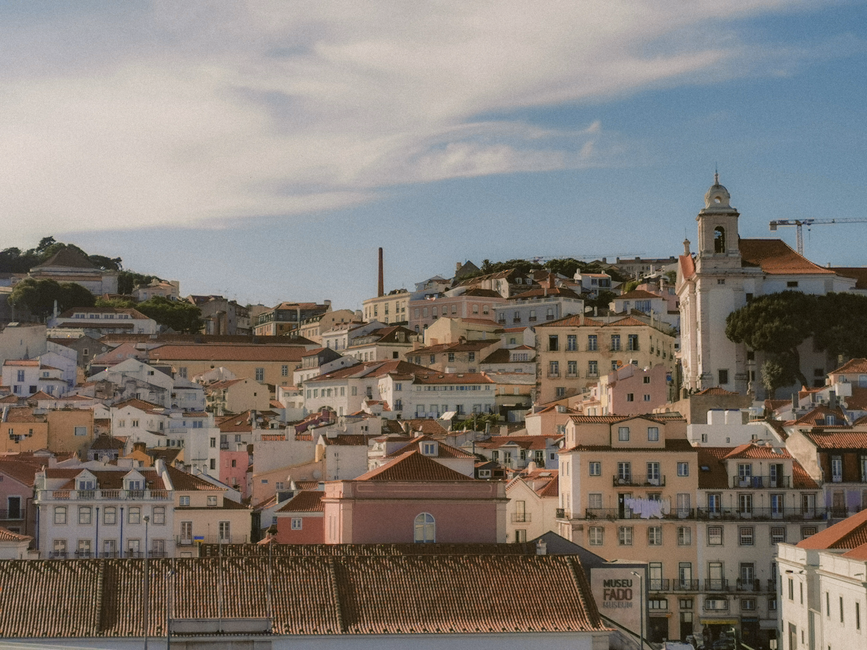
Lisbon is a sunny, hilly capital on the wide Tagus estuary, where old yellow trams climb past tiled houses to viewpoints over red rooftops, and beaches and palaces are a short train ride away. The best months are April to June and September to October: warm, mostly dry and kinder to walk in than midsummer. Three days covers the city; add a fourth for Sintra or Cascais.
Right now in Lisbon
- Wed 17–24°C 63–75°F 1 mm Light showers
- Thu 17–27°C 63–81°F Mostly clear
- Fri 17–25°C 63–77°F Clear
Weather: MET Norway (CC BY 4.0) · Sea temperature: NOAA CoastWatch · Air quality: OpenAQ · Rates: ECB
Top tours in Lisbon
See all tours for Lisbon →
From local operators, with prices and reviews; you check availability and book on Viator, our partner. We may earn a commission at no extra cost to you. How we earn money
Lisbon at a glance
- Best months: April–June and September–October. Average highs run from about 20 °C in April to 23 °C in May and October, with 2–9 rainy days a month (IPMA 1991–2020 normals). July and August average 28–29 °C, with 8–10 days a month above 30 °C.
- Days needed: 3 for the city, 4–5 with Sintra and the coast.
- Airport: Lisbon Humberto Delgado (LIS), inside the city. The Metro red line starts in the terminal.
- Getting around: walking plus Metro, trams and buses on one reloadable navegante card. A 24-hour Carris/Metro ticket is €7.25 (as of October 2026).
- Budget level: mid-range for Western Europe, but rooms are not cheap even off-season. In November 2025, Greater Lisbon had Portugal’s highest average room rate, about €130 a night (INE). See our Portugal guide for daily costs, money and entry rules.
Neighbourhoods to know
Most visitors stay along the river, between Alfama in the east and Belém in the west.
- Baixa and Chiado: the flat, grid-planned downtown, rebuilt after the 1755 earthquake, opens onto the riverside Praça do Comércio. Chiado sits uphill with old cafés, bookshops and theatres. Best for first-timers who want everything within walking distance and easy Metro links.
- Alfama: the oldest quarter, a maze of stairways and alleys below the castle, with laundry lines, small churches and fado houses. It suits travellers who want atmosphere and don’t mind steep climbs. In June it hosts the loudest street parties in town.
- Bairro Alto: quiet by day, packed with small bars and people drinking in the street by night. Great for nightlife; light sleepers should stay elsewhere.
- Príncipe Real: just above Bairro Alto, with a leafy garden, concept stores and relaxed restaurants. It suits couples and repeat visitors who want something calmer but still central.
- Belém: the riverside district of monuments, museums, gardens and the famous custard-tart bakery. Spacious and quieter at night; good for families and for a slower day.
- Alcântara and LX Factory: LX Factory is a former textile mill from 1846, turned into a creative hub of shops, cafés and a big bookshop, under the 25 de Abril bridge. Best for an afternoon of browsing and food.
- Parque das Nações: the modern riverside district built for Expo 98, with the Oceanário, a cable car along the water and a long promenade. Flat and easy with a stroller or wheelchair, and served by Oriente station on the airport’s Metro red line.
Top things to see: landmarks and museums
Prices and hours below come from the official websites, as of October 2026. National monuments close on Mondays; the Gulbenkian and MAAT close on Tuesdays.
Jerónimos Monastery (Belém)
Work started on the monastery in 1502, and its carved stone cloister is the high point of the Manueline style. Together with Belém Tower it has been a UNESCO World Heritage Site since 1983. How to visit: the cloister opens Tuesday to Sunday, 9:30–17:30 (last entry 17:00), and the ticket office closes at 16:30. A standard ticket is €18. It is closed on Mondays, 1 January, Easter Sunday, 1 May, 13 June and 25 December. Buy online to skip the ticket queue. The church has its own, shorter hours.
Belém Tower
The little fortified tower on the river reopened on 26 May 2026 after conservation work. Visits are now staggered, with a maximum of 60 people every half hour and 900 a day, so book ahead. How to visit: Tuesday to Sunday, 9:30–17:30 (last entry 17:00); standard ticket €15. It closes on the same days as Jerónimos. You can buy tickets online or at the Jerónimos ticket office. Lisboa Card holders must book a time slot with their card number.
São Jorge Castle
The castle crowns the hill above Alfama, with shady courtyards, peacocks and the widest view over the city. How to visit: open daily, 9:00–21:00 from March to October (last entry 20:30) and 9:00–18:00 from November to February (last entry 17:30). Closed 1 January, 1 May and 24, 25 and 31 December. Adults pay €17, ages 13–25 €8.50 and over-65s €14; children up to 12 go free. Adult Lisboa Card holders get in free through the “Lisboa Card/Residents” queue.
Tram 28
Route 28E runs from Martim Moniz up through Graça, past the Portas do Sol and Santa Luzia viewpoints, down by the Sé (cathedral), across Baixa and Chiado, and on to Estrela and Campo de Ourique (Prazeres). How to ride: a ticket bought on board costs €3.30 (as of October 2026), and you can pay by contactless card. It is cheaper to tap a prepaid navegante card: €1.90 for 60 minutes on Carris and Metro, or a €7.25 24-hour ticket. To avoid the long queue at Martim Moniz, board early in the morning, start from the Prazeres end, or ride route 12E, which shares the Alfama stretch.
Miradouros (viewpoints)
Lisbon’s free viewpoints fill up at sunset. Santa Luzia and Portas do Sol (both tram 28 stops) look over Alfama’s rooftops to the river. Senhora do Monte, above Graça, is one of the highest and has a wide view over the castle and downtown. São Pedro de Alcântara, a garden terrace with a kiosk, faces the castle across Baixa. Arrive 30–45 minutes before sunset and watch your bag in the crowd.
Calouste Gulbenkian Museum
A superb private collection, from Egyptian and Islamic art to Lalique jewellery, set in a lovely garden, with the Centro de Arte Moderna (CAM) next door. How to visit: 10:00–18:00, and until 21:00 on Saturdays; closed Tuesdays, 1 January, Easter Sunday, 1 May and 24–25 December. The Museum ticket (€16) includes the CAM collection; the All Inclusive ticket is €18. Entry is free on Sundays from 14:00, and the garden is always free.
Oceanário de Lisboa
A huge central tank ringed by smaller habitats, from penguins to sea otters; a good rainy-day plan with kids. How to visit: open daily, 10:00–20:00 (last entry 19:00). Prices depend on the time slot: adults (13–64) pay €29.90 before 11:30, €27.70 from 12:00 and €25.50 from 16:00. Children 3–12 pay €15.50–17.70, over-65s €17.70–19.90, and under-3s go free. The site is fully accessible, with ramps and lifts.
MAAT (Museum of Art, Architecture and Technology)
A wave-shaped building on the Belém riverfront, with a walkable roof and changing contemporary exhibitions. How to visit: Wednesday to Monday, 10:00–19:00; closed Tuesdays. Tickets cost €16 for visitors who live outside Portugal, and children under 12 go free.
Santa Justa Lift and the funiculars: check before you go
After the Glória funicular derailment on 3 September 2025, Lisbon’s historic lifts were stopped. As of October 2026, Carris lists the Santa Justa Lift as temporarily closed, with no reopening date announced. The Glória, Lavra and Bica funiculars are also out of service. The Graça funicular, between Mouraria and Graça, reopened on 30 April 2026 and is a handy shortcut up towards Senhora do Monte. When the lifts run, a ticket bought on board covers up to two trips (€6.20 for Santa Justa, €4.30 for a funicular).
Monuments
- Belém Tower
- Jerónimos Monastery
- Lisbon Cathedral
- Padrão dos Descobrimentos
Castles and forts
Museums
Other sights
- 25 de Abril Bridge
Zoos and aquariums
Things to do and activities
Eat your way around
Start with a pastel de nata, the crisp custard tart, still warm and dusted with cinnamon. Pastéis de Belém has made its version since 1837 and is open daily from 8:00 to 21:00 (22:00 from July to September). For lunch, look for a tasca, a small family-run tavern with a handwritten prato do dia (dish of the day): grilled fish, bacalhau or bifanas (pork sandwiches). Time Out Market, in the Mercado da Ribeira building at Cais do Sodré, puts dozens of food stalls under one roof and is open daily from 10:00 to midnight. Go before 12:30 or later in the evening to find a seat.
Hear fado
Fado, Lisbon’s soulful song of longing, has been on UNESCO’s list of the Intangible Cultural Heritage of Humanity since 2011. Alfama and Bairro Alto have the most fado houses, from candlelit taverns where waiters sing between courses to formal dinner shows. Many places expect you to order dinner or spend a minimum, and everyone stays silent while the singer performs. Book ahead on weekends.
Get out on the Tagus
The cheapest river cruise in town is the commuter ferry from Cais do Sodré to Cacilhas: €2.00 for a single ticket or €1.60 with zapping credit (Transtejo fares, as of October 2026). The ride back gives the classic view of the city’s hills. For something special, private operators run sunset sailboat and catamaran trips from the riverside docks, often passing under the 25 de Abril bridge.
Beaches and surfing near Lisbon
Cascais–Estoril line: the CP train from Cais do Sodré follows the coast, stopping at sandy beaches like Carcavelos, São Pedro do Estoril and Estoril before reaching Cascais in about 40 minutes. Trains run every 20 minutes off-peak on weekdays (CP timetable valid since 6 April 2026). Carcavelos, about 27 minutes from Cais do Sodré, has a long beach a short walk from the station and several surf schools on the sand. It is the easiest place near Lisbon for a first lesson.
Costa da Caparica: south across the river, a long stretch of Atlantic sand with beach bars, surf schools and more space than the Cascais line. Carris Metropolitana buses run to Costa da Caparica from Lisbon (route 3708 from Cais do Sodré, 3709 from Marquês de Pombal and 3710 from Areeiro). You can also take the ferry to Cacilhas, then route 3011 or 3022. The Atlantic stays cool even in summer, so surfers wear wetsuits most of the year. Swim only at beaches with lifeguards and follow the flags.
Activities and best months
- Boat tripsSightseeing and sunset cruises on the Tagus leave from Praça do Comércio and pass the 25 de Abril Bridge, Padrão dos Descobrimentos and Belém Tower. · source
Day trips from Lisbon
- Sintra: palaces and gardens in misty hills, about 40 minutes by CP train from Rossio station. A Lisbon–Sintra return ticket is €5.10. CP’s “Train & Bus” day ticket is temporarily suspended (CP, October 2026), so pay for the 434/435 palace buses separately. Book Pena Palace for a timed slot and go early. Read our Sintra guide for palaces and tickets.
- Cascais: a former fishing village turned seaside town, with small beaches, a marina and the coastal path and bike lane towards Guincho. About 40 minutes by train from Cais do Sodré; a Lisbon–Cascais return is €5.10.
- Arrábida and Setúbal: limestone hills dropping into turquoise coves south of the Tagus. Fertagus trains run from Roma-Areeiro, Entrecampos and Sete Rios to Setúbal in about an hour. In summer, private cars are banned from the beach roads between 7:00 and 20:00 (4 June to 15 September in 2026), and Carris Metropolitana beach buses run from Setúbal instead. Pair it with grilled fish and choco frito (fried cuttlefish) in Setúbal.
- Óbidos: a walled medieval village with whitewashed lanes, about an hour north by Rodoviária do Oeste’s express bus from Campo Grande. The bus stops about 100 metres from the historic centre.
Nearby destinations
Getting there and getting around
From the airport to the city
- Metro (cheapest): Aeroporto station is the end of the red line. It takes about 20 minutes to Alameda or Saldanha. For Baixa, Rossio and Cais do Sodré, change to the green line at Alameda; for Avenida and Restauradores, change to the blue line at São Sebastião. A single Carris/Metro ticket is €1.90 on a €0.50 navegante card, or €1.92 if you tap a contactless bank card at the gates (as of October 2026). The Metro runs from 6:30 to 1:00 every day.
- Aerobus: the old airport shuttle bus is not running as of October 2026, so don’t plan around it.
- Taxi and ride-hailing: taxis wait outside arrivals, and ride-hailing apps also work. They make sense late at night, with heavy luggage, or for hilltop stays in Alfama or Bairro Alto.
Getting around the city
Tickets: buy a navegante occasional card (€0.50, the card formerly called Viva Viagem) from any Metro machine. Load it with one ticket type at a time: single Carris/Metro tickets (€1.90), a 24-hour Carris/Metro ticket (€7.25), a 24-hour ticket that adds the Cacilhas ferry (€10.35) or the CP Sintra and Cascais lines (€11.40), or “zapping” pay-as-you-go credit, which brings a Metro trip down to €1.72. Each person needs their own card. Fares are as of October 2026.
Lisboa Card: the official city pass costs €31, €51 or €62 for 24, 48 or 72 hours (adults), or €21, €28 or €35 for children aged 4–15. Prices are valid until 31 March 2027. It includes Carris, Metro and the CP trains to Sintra and Cascais, plus free entry to more than 50 museums and monuments, including Jerónimos, Belém Tower and the castle. Three days of transport (3 × €7.25) plus Jerónimos, Belém Tower and the castle cost about €72 at full price, so the 72-hour card pays off for busy sightseers. Some included museums, such as the National Tile Museum and the National Museum of Ancient Art, are closed for works as of October 2026.
Metro, trams and buses: the four Metro lines are the fastest way across town. Trams 28E and 12E climb into Alfama and Graça, and tram 15E runs along the river from Praça da Figueira past Cais do Sodré to MAAT, Jerónimos and Belém. The Cascais-line train from Cais do Sodré also stops at Belém.
Walking: central Lisbon is compact but steep. Ride uphill, walk downhill, and wear shoes with real grip.
When to go and how long to stay
Lisbon is mild all year. Average highs never drop below 15 °C in IPMA’s 1991–2020 normals for central Lisbon, and frost is almost unknown. Crowds are spread out more than in beach regions. INE counted about 1.6 million nights in Lisbon’s tourist accommodation in August 2025 and still about 1.2 million in November 2025, so expect company in every season.
| Season | Average high / low | Rainy days a month | What it’s like |
|---|---|---|---|
| Spring (Mar–May) | 19–23 °C / 11–14 °C | 6–8 | Fresh and green, the best walking weather. Easter brings crowds. |
| Summer (Jun–Aug) | 26–29 °C / 17–19 °C | 1–2 | Hot and dry, with 6–10 days a month above 30 °C. Santos Populares street parties in June; busiest in July–August. |
| Autumn (Sep–Nov) | 18–27 °C / 12–18 °C | 4–10 | September is still summery and great for beaches. Rain returns from late October. |
| Winter (Dec–Feb) | 15–16 °C / 9 °C | 8–10 | Mild and green, with sunny days between showers. Fewest visitors, except at Christmas and New Year. |
June festivals: the Festas de Lisboa peak on the night of 12–13 June, when neighbourhood marching groups parade down Avenida da Liberdade, and Alfama, Graça and Mouraria fill with grilled sardines and music. 13 June is a Lisbon holiday, so Jerónimos and Belém Tower are closed that day. Book rooms early for those dates.
2 days in Lisbon
Day 1: Baixa and Praça do Comércio, up to the castle, through Alfama to Portas do Sol, then sunset at Senhora do Monte and fado for dinner. Day 2: Belém by tram 15E (Jerónimos, Belém Tower, MAAT and a pastel de nata), back to LX Factory, then evening drinks in Bairro Alto or Príncipe Real.
3 days in Lisbon
Add a slower day: an early tram 28 ride to Estrela and Campo de Ourique, the Gulbenkian museum and garden, and Time Out Market at Cais do Sodré. Or spend the day in Parque das Nações with the Oceanário and the riverside cable car.
4 days in Lisbon
Take the train to Sintra for the palaces (start early). Or, in warm weather, go to Cascais for the beaches and the coast, with a surf lesson at Carcavelos on the way back. With a fifth day, do both.
Where to stay: areas by budget and style
- First visit, mid to high budget: Baixa, Chiado or Rossio. Everything is walkable, the main Metro lines are close, and the streets are flat downtown. You pay for the location.
- Atmosphere over convenience: Alfama, Graça or Mouraria. There are guesthouses and apartments in old buildings, but expect stairs, few lifts and noise during the June festivals.
- Nightlife: Bairro Alto, Cais do Sodré or Santos. You’re close to the bars, but street noise lasts late into the night.
- Quieter and stylish: Príncipe Real, Estrela or Lapa, with residential streets, gardens and smaller boutique places.
- Value and transport links: Avenida da Liberdade (north end), Marquês de Pombal, Saldanha or Arroios. Business-style hotels and good Metro access, including the red line to the airport.
- Families and step-free stays: Parque das Nações, which is flat, modern, near the airport and the Oceanário, and on the red line. Belém is calmer but further from the centre.
Lisbon adds a municipal tourist tax of €4 per person per night (from age 13, up to 7 nights) to your room bill; see our Portugal guide for details.
Practical tips
- Pickpockets: the UK government’s travel information warns about thieves on public transport and at crowded bus and tram stops. They often work in teams and use distraction. Packed tram 28 carriages and their stops are a well-known hotspot. Wear a zipped crossbody bag in front of you, keep your phone out of back pockets and stay alert when boarding. The PSP police run a Tourism Police station at Palácio Foz on Praça dos Restauradores, where officers help visitors report thefts. The emergency number is 112.
- Shoes for the calçada: the white-and-black stone pavements are beautiful, but they are slippery when wet and even on dry downhill slopes. Leave thin soles and heels at home.
- Accessibility: hills, steps and cobbles make the old quarters hard with a wheelchair or stroller. Metro Lisboa advises checking that both your departure and arrival stations are fully accessible, and calling ahead about lifts. The flat riverside, Belém and Parque das Nações are the easiest areas, and the Oceanário is fully accessible. Carris runs a bookable door-to-door service for people with reduced mobility; request it at least two days ahead.
- Monday and Tuesday closures: Jerónimos and Belém Tower close on Mondays; the Gulbenkian and MAAT close on Tuesdays. The castle and the Oceanário open every day. Free Sunday afternoon at the Gulbenkian (from 14:00) is a good budget tip.
- Tipping: optional; our Portugal guide covers tipping, the couvert, cards and cash.
- Strikes: transport and monument staff sometimes strike at short notice. Check Carris, Metro and the attraction’s website the day before a big plan.
Weather month by month
Averages from IPMA normals 1991–2020, Lisboa / Instituto Geofísico · Last reviewed 3 Oct 2026
What to pack for Lisbon
Pack for hills, wind and sun. Most important: comfortable walking shoes with grippy soles, because you will walk a lot, much of it uphill on polished stone. From June to September, bring sunscreen, sunglasses, a hat and a refillable water bottle; highs average 26–29 °C, and the viewpoints have little shade. Evenings by the river and at the coast are often breezy, so a light jumper or windproof layer is worth carrying even in summer. From November to March, bring a compact umbrella or a light waterproof jacket, plus warm layers: lows average around 9 °C and rain falls on about 8–10 days a month. For the coast, pack a swimsuit and a quick-dry towel; surf schools rent wetsuits. A small zipped crossbody bag or anti-theft daypack makes trams and crowds less stressful.
What to pack
- Dry bags and phone pouchesSpray soaks phones and cameras on open boats to the Algarve caves and on whale-watching trips.
- Fleeces and warm layersIt is cooler at sea than on land, especially on morning whale-watching trips.
- Rain jacketsA windproof, waterproof shell keeps you warm on open boats, where wind and spray cool you quickly.
- Reef-friendly sunscreenSun reflects off the water on cruises and cave tours.
- Water shoesKayak and small-boat trips to the Algarve grottoes land on rock and wet sand.
Lisbon travel FAQ
How many days do you need in Lisbon?
Three days covers the city: Baixa, the castle and Alfama; Belém; and a day for museums, trams and viewpoints. Add a day for Sintra or Cascais.
What is the best time to visit Lisbon?
April to June and September to October. Average highs are about 20–27 °C, and there are fewer rainy days than in winter. Walking the hills is more comfortable than in July and August, when highs average 28–29 °C.
How do I get from Lisbon airport to the city centre?
Take the Metro red line from Aeroporto station and change at Alameda or São Sebastião for the centre. A single ticket is €1.90 on a €0.50 navegante card (as of October 2026).
Is the Aerobus still running?
No. As of October 2026 the Aerobus airport shuttle is not operating, so use the Metro, a taxi or a ride-hailing app.
Is the Lisboa Card worth it?
If you ride a lot and visit the big paid sights, yes: the 72-hour adult card is €62 (as of October 2026), against about €72 for three days of transport plus Jerónimos, Belém Tower and the castle. If you mostly walk, pay as you go.
Is the Santa Justa Lift open?
No. It has been shut since September 2025, and Carris lists it as temporarily closed with no reopening date (as of October 2026). Walk up to Carmo from Chiado instead.
How can I ride Tram 28 without a long wait?
Board early in the morning or in the evening, start from the Campo de Ourique (Prazeres) end instead of Martim Moniz, or take tram 12E through the same Alfama stretch. Use a prepaid ticket or 24-hour pass rather than paying €3.30 on board.
Do I need to book Belém Tower and Jerónimos in advance?
It is wise. Since May 2026, Belém Tower admits a maximum of 60 people every half hour (900 a day), and both sites get long queues. Buy online, and if you have a Lisboa Card, book your slot with the card number.
Which Lisbon sights are closed on Mondays?
The national monuments, including Jerónimos and Belém Tower. On Mondays, visit the castle, the Oceanário, the Gulbenkian or MAAT instead; the last two close on Tuesdays.
Is Lisbon safe for tourists?
Yes, generally. The main problem is pickpocketing on crowded trams, at stops and at busy viewpoints. Keep valuables zipped and in front of you, and call 112 in an emergency.
Can you swim near Lisbon?
Yes: the beaches on the Cascais train line and at Costa da Caparica are closest. The Atlantic is cool even in summer; swim where lifeguards are on duty.
Sintra or Cascais for a day trip?
Choose Sintra for palaces, gardens and history, and Cascais for beaches, seafood and an easy seaside walk. Both are about 40 minutes by train, and a Lisbon return ticket to either costs €5.10.
Sources
- © OpenStreetMap contributors · ODbL · fetched 3 Oct 2026
- Wikidata · CC0 · fetched 3 Oct 2026
Sources and last review
Researched and last reviewed on 3 October 2026. Hours and prices come from the official websites of Museus e Monumentos de Portugal (Jerónimos, Belém Tower), Castelo de São Jorge, the Gulbenkian, the Oceanário and MAAT. Transport fares and service status come from Carris, Metro Lisboa, CP, Transtejo, Carris Metropolitana and Fertagus, and Lisboa Card prices from Turismo de Lisboa’s official shop. Climate figures are IPMA’s 1991–2020 normals, and visitor and room-rate figures come from Statistics Portugal (INE). Prices, timetables and opening hours change, so check the official sites before you travel.
Plan your trip
Partner links: TravelerCenter may earn a commission if you book, at no extra cost to you.
🇵🇹 Useful Portuguese phrases for Lisbon
All 38 Portuguese phrases: restaurant, hotel, emergencies, romance (printable) →
Traveler centers in Lisbon
Tourist information offices, visitor centers and travel agencies in Lisbon, from OpenStreetMap.
- Travel agency
Abreu
- Travel agency
Aerolineas Estelar
- Travel agency
Caravel on Wheels – Lisbon Bus Tour – Ticket Shop
- Travel agency
PBSTravel
- Travel agency
TopAtAtlântico
- Travel agency
Abreu