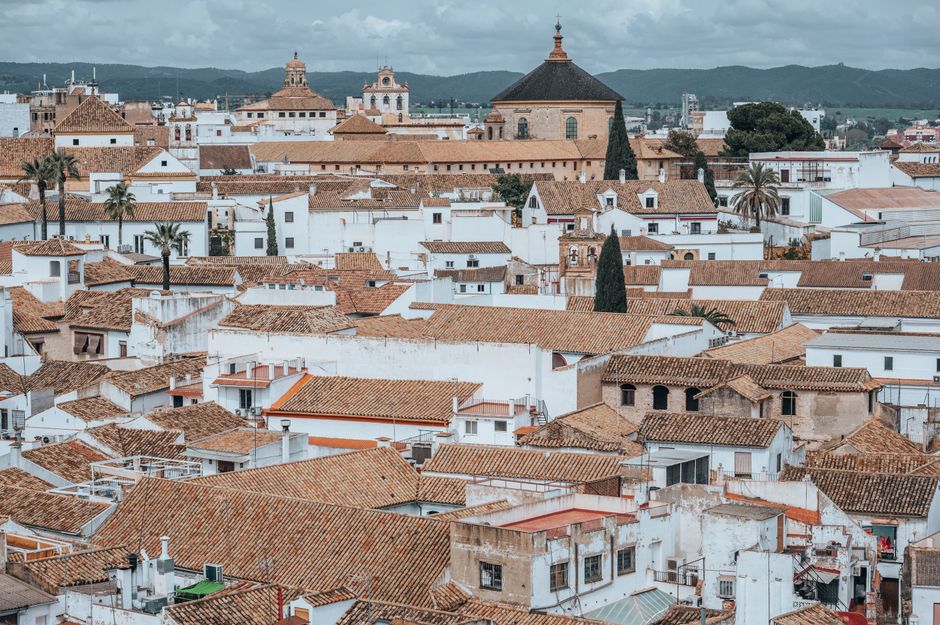
Córdoba was once the capital of Muslim Spain and one of the largest cities in Europe. Today it’s a compact riverside town of whitewashed lanes and flower-filled patios, built around the Mezquita-Catedral, a vast forest of striped arches with a cathedral in the middle. The best months are March to May, when the patios bloom, and late September to November. Summer is fierce: July and August average 37 °C. One full day covers the highlights; two lets you add Medina Azahara and see the lanes at night.
Right now in Córdoba
- Wed 17–25°C 62–78°F 1 mm Partly cloudy
- Thu 15–27°C 59–81°F Clear
- Fri 16–26°C 60–78°F Clear
- Mon 12 Oct National Day of Spain (Fiesta Nacional de España)
Weather: MET Norway (CC BY 4.0) · Rates: ECB · Holidays: Nager.Date
Top tours in Córdoba
See all tours for Córdoba →
From local operators, with prices and reviews; you check availability and book on Viator, our partner. We may earn a commission at no extra cost to you. How we earn money
Córdoba at a glance
- Best months: March–May and late September–November. Average highs are about 21–28 °C in spring and 26 °C in October (AEMET 1991–2020 normals, Córdoba airport). July and August average 37 °C, among the hottest in Europe.
- Days needed: 1 for the Mezquita and the old town, 2 with Medina Azahara, the Alcázar and an evening in the lanes.
- Getting there: high-speed trains from Madrid in under 2 hours, from Seville in about 45 minutes and from Málaga in about an hour. The nearest busy airports are Seville (SVQ) and Málaga (AGP).
- Getting around: on foot. The old town is flat and compact; the station is about a 25-minute walk from the Mezquita.
- Budget level: good value for Spain, with low-cost monuments and tapas. There is no tourist tax in Andalusia as of October 2026. See our Spain guide for money and entry rules.
Córdoba’s neighbourhoods
Córdoba’s historic centre is one of the largest in Europe, and it was added to the UNESCO World Heritage list around the Mezquita in 1984, then extended in 1994. Most visitors stay within it.
- La Judería: the old Jewish quarter around the Mezquita, a maze of narrow white lanes, souvenir shops, small squares and the medieval Synagogue. Beautiful early and late in the day; packed in between. Best for a first, short stay.
- San Basilio (Alcázar Viejo): just beyond the Alcázar, a quieter residential quarter with some of the city’s most famous private patios. Lovely in May.
- Santa Marina and San Lorenzo: northern working-class quarters with medieval “Fernandine” churches, built after the Christian conquest of 1236, plus small tavernas and the Palacio de Viana. Local and less touristy.
- Axerquía: the eastern lower town around the arcaded Plaza de la Corredera and the Plaza del Potro, with bars where locals eat salmorejo and fried aubergines with honey.
- La Ribera and the Roman Bridge: the riverside below the Mezquita, with the bridge, the Calahorra tower on the far bank, and a long walkway beside the Guadalquivir.
- Centro (Las Tendillas): the modern shopping centre around Plaza de las Tendillas, a 10-minute walk north of the Mezquita, with flat streets and bigger hotels.
Top things to see in Córdoba
Prices and hours below come from the official websites, as of October 2026. Ticket offices close earlier than the sites, and summer hours at the municipal monuments are mornings only.
Mezquita-Catedral (Mosque-Cathedral)
Begun in 785 and enlarged over two centuries, the great mosque of Córdoba is a hall of more than 800 columns of jasper, marble and granite, topped with red-and-white double arches. After 1236 it became a cathedral, and in the 16th century a Renaissance cathedral was built right in the middle of it. Don’t miss the mihrab, the prayer niche covered in gold Byzantine mosaics. How to visit: a general ticket is €15 since 1 April 2026; reduced tickets are €12 (over-65s, students aged 15–26) and €8 (children aged 10–14), and under-10s go free. Monday to Saturday, from 8:30 to 9:30, individual visitors can enter free in silence (not on special celebration days, and not in groups). On Sundays and holidays it opens 8:30–11:30 and 15:00–19:00. Normal weekday visiting is roughly 10:00–19:00 from March to October and 10:00–18:00 from November to February; check the official date-by-date calendar before you go. Ticket sales end 30 minutes before closing.
The bell tower: climb the Torre Campanario, the former minaret, for €4, at timed slots between 9:30 and 18:30. Slots are small, so book online when you buy your main ticket.
Night visit: “El Alma de Córdoba” is an evening sound-and-light tour with an audio guide, for €25 (reduced €18). It doesn’t run every night, so check the booking calendar.
Planning your visit: allow 1–1.5 hours inside. You enter through the Patio de los Naranjos, the orange-tree courtyard, which is free to walk through. Go at the free 8:30 hour if you want silence and soft morning light, or buy a ticket for late afternoon, when tour groups have left. Book the bell tower for a slot after your visit, so you can match the view to what you’ve just seen. Photography without flash is allowed for personal use. Mass is celebrated in the cathedral area, and some parts may close during services.
Alcázar de los Reyes Cristianos
The fortress-palace where Isabella and Ferdinand lived during the war against Granada, and where they first received Columbus. Its terraced gardens of pools, fountains, orange trees and clipped cypresses are the highlight, along with Roman mosaics and the views from the towers. How to visit: from 16 September to 15 June, it opens Tuesday to Friday 8:15–20:15, Saturday 9:30–17:30 and Sunday and holidays 8:15–14:15; from 16 June to 15 September, mornings only (check the official site for exact times). It is closed on Mondays. Entry is free on Thursdays in the last part of the day. Restoration work on the main tower and the mosaic hall was expected to finish around November 2026, so some rooms may be closed; check what’s open when you buy.
Roman Bridge and the Calahorra Tower
The bridge over the Guadalquivir, Roman in origin and rebuilt many times, is free to walk at any time and loveliest at sunset with the Mezquita behind it. The Calahorra tower at the far end is a small museum on Al-Andalus culture.
Medina Azahara (Madinat al-Zahra)
The ruins of a 10th-century palace city built by Caliph Abd al-Rahman III, about 8 km west of Córdoba, became a UNESCO World Heritage Site in 2018. How to visit: entry is free for EU citizens and €1.50 for others. From 21 September to 20 March it opens Tuesday to Saturday 9:00–18:00; in spring, Tuesday to Thursday 9:00–18:00 and Friday and Saturday until 21:00; from 21 June to 20 September, Tuesday to Saturday 9:00–14:00 and again 19:00–24:00. Sundays and holidays 9:00–15:00, closed Mondays. From the museum, a shuttle bus (about €3) takes you up to the ruins. Without a car, book the tourist bus from the city centre at the tourist office.
Palacio de Viana
A noble house with 12 patios and a garden, each one different, in the Santa Marina quarter. It’s the best place to see Córdoba’s patios outside May. How to visit: September to June, Tuesday to Saturday 10:00–19:00 and Sunday 10:00–15:00; July and August, Tuesday to Sunday 9:00–15:00; closed Mondays. The patios cost €8.50, a guided palace tour €9, or both for €14.
Synagogue and the Judería
The small, plaster-carved Synagogue on Calle Judíos, from the early 14th century, is one of only three medieval synagogues surviving in Spain. Nearby, the Calleja de las Flores frames the Mezquita’s bell tower between flowerpots: it’s tiny and always crowded, so go early.
Museums
- Museo Arqueológico de Córdoba
- Torre de la Calahorra
Other sights
- Mosque-Cathedral of Córdoba
- Historic Centre of Córdoba
- Roman Bridge of Córdoba
Archaeological sites
- Caliphal Baths of Córdoba
Castles and forts
- Alcázar de los Reyes Cristianos
Things to do in Córdoba
The Patios Festival in May
Every May, residents open their private patios, filled with hundreds of geraniums, jasmine and bougainvillea, for the Fiesta de los Patios, recognised by UNESCO as Intangible Cultural Heritage. In 2026 it ran from 4 to 17 May, with 53 patios open free of charge, from 11:00 to 14:00 and 18:00 to 22:00, along five routes (Santa Marina/San Agustín, San Lorenzo, San Pedro–Santiago, Judería–San Francisco and San Basilio). Queues are long at midday; go at opening time or in the evening. May also brings the Cruces de Mayo, flower-decked crosses in the squares, and the Feria at the end of the month, so book rooms early.
Eat salmorejo and flamenquín
Córdoba’s own dishes are salmorejo, a thick, cold tomato and bread cream topped with egg and ham, and flamenquín, a fried roll of pork and ham. Try them with berenjenas con miel (fried aubergine with cane honey) and a glass of the local Montilla-Moriles wine, a dry, sherry-like fino from the south of the province. See our wine tasting guide for visiting wineries.
Walk the Fernandine churches and the Corredera
North of the Judería, a self-guided walk links the Gothic-Mudéjar parish churches built after 1236, such as San Lorenzo, with its rose window, and Santa Marina, in the bullfighters’ quarter. Finish in the arcaded Plaza de la Corredera, the city’s old market and bullfight square, where bars put tables out under the arches. It’s the side of Córdoba where locals live, and it’s quiet even in May.
Walk the river at sunset
Cross the Roman Bridge at dusk, then follow the riverside walkway east as the Mezquita lights up. Bars along the Ribera and in the Plaza del Potro are good for a late drink when the heat breaks.
Day trips from Córdoba
- Seville: about 45 minutes by high-speed train, for the Alcázar, the cathedral and the Plaza de España. Read our Seville guide.
- Granada: about 1 h 35–1 h 45 by direct train, for the Alhambra (book a named ticket in advance). Read our Granada guide.
- Málaga: about 50 minutes to an hour by train, for the Picasso museum, the Alcazaba and the beach. Read our Málaga guide.
- Montilla and the wine country: the Montilla-Moriles wine area, about 45 km south, has bodegas that offer tastings. A car or a tour is the practical way to go.
- Almodóvar del Río: a restored castle on a hill above the Guadalquivir, about 25 km west, an easy half day by car.
Nearby destinations
- Seville121 km
- Granada131 km
- Ronda133 km
- Málaga134 km
- Costa del Sol153 km
- Marbella154 km
- Sierra Nevada160 km
- Cádiz202 km
Getting there and getting around
By train
Córdoba is on Spain’s main high-speed line to Andalusia, and Renfe (AVE and AVLO), Iryo and Ouigo all stop here. The fastest trains from Madrid take about 1 h 45. On 18 January 2026, a serious train crash at Adamuz, in Córdoba province, closed the line. It reopened on 17 February 2026 with speed restrictions, and as of late summer 2026 some restrictions were still in place, so check current journey times when you book. Trains to Seville take about 45 minutes, to Málaga about 50 minutes to an hour, and to Granada about 1 h 35–1 h 45.
By air
Córdoba’s own airport has very few scheduled flights. Fly into Seville (SVQ) or Málaga (AGP) and continue by train; from Málaga, the C1 train takes you from the airport to María Zambrano station, where high-speed trains leave for Córdoba.
Getting around the city
Walk: the old town is small and mostly flat. From the train station, it’s about 2 km (a 25-minute walk) through the Jardines de la Victoria to the Mezquita; a taxi is a few minutes. AUCORSA city buses cost €1.30 a ride (as of October 2026), paid on board by card or cash. Don’t drive into the historic centre: it’s a low-emission zone with camera-controlled access, and cars need authorisation unless they have a zero or ECO label. You can cross it to reach a public car park, and hotels inside can register your car.
When to go and how long to stay
Córdoba has one of Spain’s hottest summers. In AEMET’s 1991–2020 normals, the average high is 37 °C in July and August; temperatures above 40 °C are common, and the record is 46.9 °C. Winters are mild and sunny by day, with cool nights.
| Season | Average high / low | Rainy days a month | What it’s like |
|---|---|---|---|
| Spring (Mar–May) | 21–28 °C / 7–13 °C | 5–6 | The best time: orange blossom in March and April, patios and festivals in May. Busy and pricey in May. |
| Summer (Jun–Aug) | 33–37 °C / 17–20 °C | 0–1 | Dangerously hot afternoons. Sightsee from 8:30 to noon, rest, and go out again after sunset. |
| Autumn (Sep–Nov) | 19–32 °C / 8–17 °C | 3–7 | September is still very hot; October and November are warm and pleasant. |
| Winter (Dec–Feb) | 15–17 °C / 4–5 °C | 6–7 | Mild, sunny days, chilly nights and the fewest visitors. Good for the Mezquita without crowds. |
1 day in Córdoba
Start with the free early entry to the Mezquita at 8:30, or buy a ticket and climb the bell tower. Walk the Judería and the Calleja de las Flores, then the Alcázar gardens. Lunch on salmorejo, rest through the hottest hours, and cross the Roman Bridge at sunset.
2 days in Córdoba
Add Medina Azahara in the morning (book the bus or drive), then the Palacio de Viana and the tavernas of Santa Marina and San Lorenzo. If it’s running, end with the Mezquita’s night visit.
3 days or as part of a loop
Córdoba sits between Seville, Granada and Málaga, so it fits well into an Andalusia loop by train: two nights here, then Seville or Granada.
Where to stay in Córdoba
- First visit, short stay: La Judería, steps from the Mezquita. Atmospheric, but streets are crowded by day and cars can’t reach most hotels.
- Quieter and local: San Basilio, Santa Marina or San Lorenzo, with patio-house hotels and neighbourhood bars.
- By the river: La Ribera, near the Roman Bridge, with sunset views and easy walking to the Mezquita.
- With a car or on a budget: the Centro around Las Tendillas, or near the station, with larger hotels and garages.
- In summer: a room with good air conditioning and, if possible, a pool, matters more than the view.
Practical tips for Córdoba
- Use the free hour: individual visitors enter the Mezquita free from 8:30 to 9:30, Monday to Saturday. It’s the quietest time inside, but you must keep silent.
- Beat the heat: from June to September, see the sights before noon and after 19:00. Carry water and use shade; heat stroke is a real risk.
- Mondays: the Alcázar, Medina Azahara and the Palacio de Viana close on Mondays. The Mezquita opens daily.
- Dress: the Mezquita-Catedral is an active church; shoulders and knees should be covered, and hats removed.
- Mind your bag in the crowded lanes around the Mezquita and the Calleja de las Flores. The emergency number is 112.
- No tourist tax: Andalusia does not charge one as of October 2026.
Weather month by month
Averages from AEMET normals 1991–2020, Córdoba Aeropuerto · Last reviewed 4 Oct 2026
What to pack for Córdoba
Pack for heat most of the year. From May to September, bring a wide-brimmed hat, sunglasses, high-factor sunscreen, a refillable water bottle and light, loose clothing; afternoons can pass 40 °C. Add a light scarf or shawl to cover shoulders in the Mezquita-Catedral. Comfortable, breathable walking shoes help on cobbled lanes. From November to March, bring a light jacket and layers: days are mild, but nights cool to about 4–5 °C, and old stone houses can be chilly inside.
Córdoba travel FAQ
How much does it cost to visit the Mezquita?
A general ticket is €15 (as of October 2026), with reduced prices of €12 and €8, and free entry for under-10s. The bell tower is €4 extra.
Can you visit the Mezquita for free?
Yes. From Monday to Saturday, individual visitors can enter free from 8:30 to 9:30, in silence and not in groups. It doesn’t apply on special celebration days.
Is one day in Córdoba enough?
One day covers the Mezquita, the Judería, the Alcázar and the Roman Bridge. Stay a second day for Medina Azahara, the Palacio de Viana and the city at night.
What is the best time to visit Córdoba?
March to May, and especially early May for the Patios Festival, or late September to November. July and August average 37 °C.
When is the Córdoba Patios Festival?
In the first half of May. In 2026 it ran from 4 to 17 May, with free entry to 53 patios. The 2027 dates were not yet announced as of October 2026.
How do I get to Medina Azahara without a car?
Take the tourist bus from the city centre, booked at the tourist office, which includes the shuttle from the museum to the ruins. Entry is free for EU citizens and €1.50 for others.
Is Medina Azahara open on Mondays?
No. It closes on Mondays (except some Mondays before a holiday). It opens Tuesday to Saturday and on Sunday mornings.
How long is the train from Madrid to Córdoba?
About 1 h 45 on the fastest high-speed trains. After the January 2026 Adamuz crash, speed restrictions have added time on some services, so check when you book.
Is Córdoba a good day trip from Seville or Málaga?
Yes. It’s about 45 minutes by train from Seville and about an hour from Málaga, so a day trip is easy. Staying a night lets you see the lanes at their best.
Can I drive into Córdoba’s old town?
Only with authorisation or a zero/ECO label car. The historic centre is a camera-controlled low-emission zone; park in a public car park or ask your hotel to register your car.
Do I need to dress modestly in the Mezquita?
It’s an active cathedral, so cover shoulders and knees, remove hats and keep your voice down, especially during the free early-morning entry.
How hot is Córdoba in summer?
Very hot. Average highs are 37 °C in July and August (AEMET 1991–2020), and the record is 46.9 °C. Sightsee early and late, and rest at midday.
Sources
- © OpenStreetMap contributors · ODbL · fetched 3 Oct 2026
- Wikidata · CC0 · fetched 3 Oct 2026
Sources and last review
Researched and last reviewed on 3 October 2026. Mezquita-Catedral prices, free entry and bell-tower times come from its official website; Medina Azahara and the Palacio de Viana from the Junta de Andalucía and the palace’s own site; the Alcázar from the Ayuntamiento de Córdoba and its official ticket site; and the Patios Festival from the city’s official patios website. Climate figures are AEMET’s 1991–2020 normals for Córdoba airport. Train disruption, bus fares and the low-emission zone were checked in Spanish press and transport references where no official page could be read. Prices, timetables and opening hours change, so check the official sites before you travel.
Plan your trip
Partner links: TravelerCenter may earn a commission if you book, at no extra cost to you.
🇪🇸 Useful Spanish phrases for Córdoba
All 38 Spanish phrases: restaurant, hotel, emergencies, romance (printable) →
Traveler centers in Córdoba
Tourist information offices, visitor centers and travel agencies in Córdoba, from OpenStreetMap.
- Tourist information office
Oficina de Turismo
- Travel agency
Córdoba Visión
- Tourist information office
Información Turística
- Travel agency
Oway Tours
- Tourist information office
Punto de Información Turística
- Travel agency
Viajes Robles