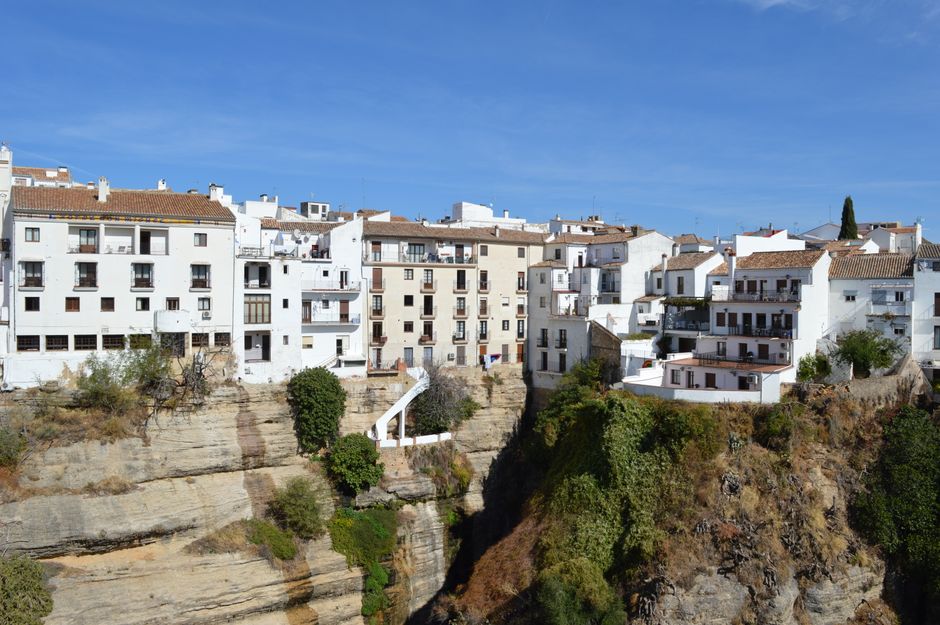
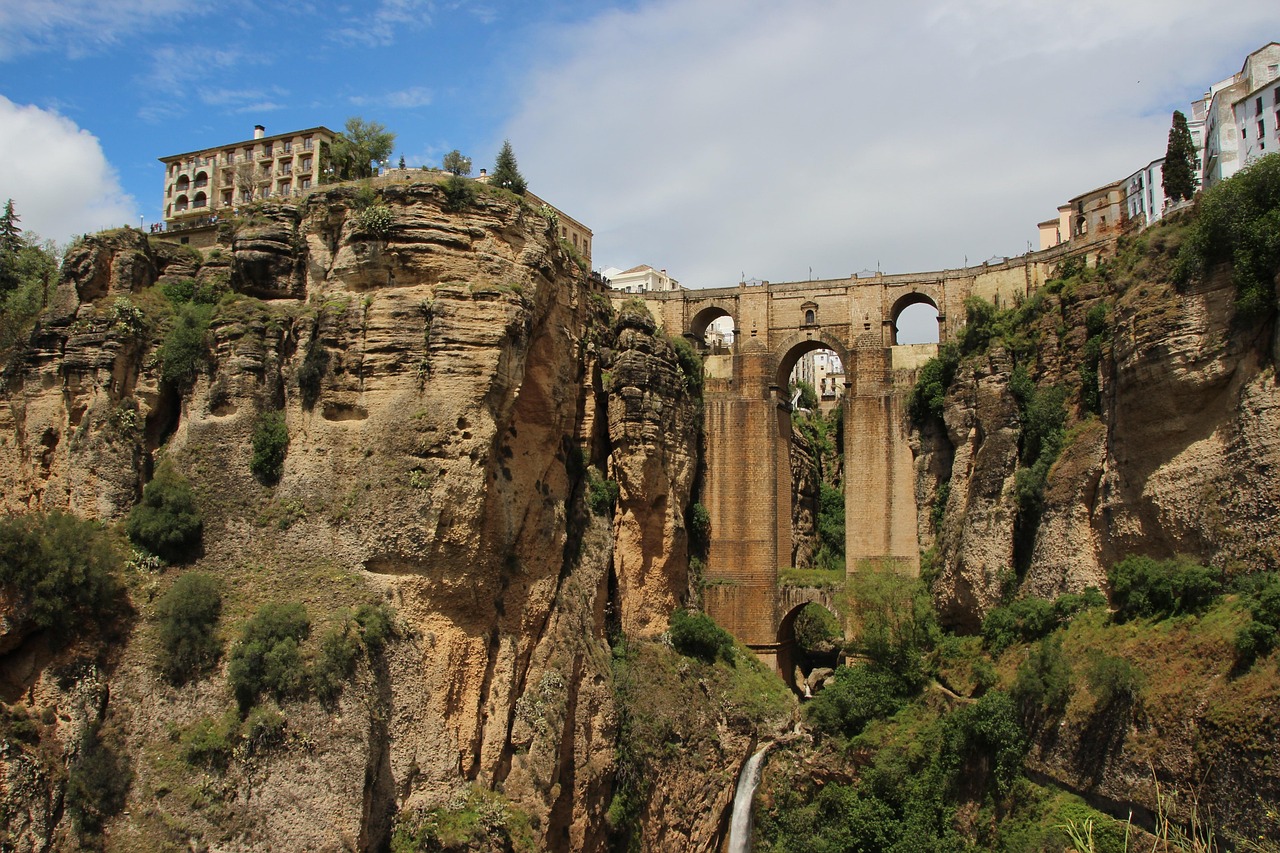
Ronda is one of the most dramatic towns in Spain. It sits on a rocky plateau in the mountains of Málaga province, cut in two by El Tajo, a gorge about 100 metres deep, and joined across it by the 18th-century Puente Nuevo. On one side lies La Ciudad, the old Moorish town of whitewashed lanes, palaces and Arab baths; on the other, El Mercadillo, with one of Spain’s oldest bullrings and cliff-top promenades that look out over olive groves to the Serranía de Ronda. Around it are the white villages of the Sierra de Grazalema, a prehistoric painted cave and a young national park. Ronda is a classic day trip from Málaga, the Costa del Sol and Seville, but it is far more magical once the coaches leave, so stay at least a night. The best months are April to June and September to October.
Right now in Ronda
- Wed 13–22°C 55–71°F Partly cloudy
- Thu 13–25°C 56–77°F Mostly clear
- Fri 14–19°C 57–66°F 7 mm Rain
- Mon 12 Oct National Day of Spain (Fiesta Nacional de España)
Weather: MET Norway (CC BY 4.0) · Rates: ECB · Holidays: Nager.Date
Top tours in Ronda
See all tours for Ronda →
From local operators, with prices and reviews; you check availability and book on Viator, our partner. We may earn a commission at no extra cost to you. How we earn money
Ronda at a glance
- Best for: spectacular views and bridges, Moorish and Renaissance history, the bullring museum, walks into the gorge, white villages, mountain hiking and local wine.
- How long: a day trip covers the bridge, the bullring and La Ciudad; 2–3 days let you add the gorge walks, the white villages and the Cueva de la Pileta.
- Best time: April to June and September to October. Summer afternoons are hot, and winters are cool at 740 m, with frosty nights.
- Getting there: Damas buses from Málaga (about 1 h 45–2 h) and from Seville (about 2 h 20–2 h 45). Trains to Ronda are suspended for works until 2027, with Renfe replacement buses.
- Getting around: on foot; the centre is compact but hilly, with steep paths down into the gorge. A car helps for the villages and caves.
- Before you go: entry rules, money, trains and general safety are on our Spain travel guide.
Ronda’s neighbourhoods and who each one suits
The gorge divides Ronda into two halves linked by three bridges, and most visitors stay within ten minutes’ walk of the Puente Nuevo.
La Ciudad (the old town)
South of the gorge, the walled Moorish town keeps its narrow lanes, mansions and churches: the Palacio de Mondragón, the church of Santa María la Mayor, built over the main mosque, and the Casa del Rey Moro. It is quiet in the evening once day-trippers leave, with small hotels in historic houses. Best for couples and anyone who wants atmosphere and views.
El Mercadillo
The newer town north of the bridge grew up from the 15th century around its market. Here are the Plaza de España, the bullring, the Alameda del Tajo gardens and the main shopping street, Carrera Espinel, with most restaurants, bars and hotels. Practical and lively, and the easiest base for first-timers arriving by bus.
San Francisco and the Barrio de Padre Jesús
Below the old walls, the San Francisco quarter grew up outside the Almocábar gate, while the Barrio de Padre Jesús runs down to the old bridges at the bottom of the gorge. Both are local and residential, with simple restaurants and guesthouses. Good for walkers and for a quieter, cheaper stay, but expect steep streets.
Countryside hotels in the Serranía
The hills around Ronda are dotted with rural hotels, farmhouses and wineries, a few minutes’ drive from town. They suit families and couples with a car who want a pool and silence.
Top things to see in Ronda
Prices and hours below were checked on the official sites in October 2026, unless we say otherwise; check again before you go. The town’s tourist office sells a municipal pass (bono turístico) that covers the Puente Nuevo interpretation centre, the Casa del Gigante, the Arab Baths and the Palacio de Mondragón for €12 (€9 for students, retired people and groups; free for under-8s) as of October 2026.
The Puente Nuevo and El Tajo
The “New Bridge” took about 40 years to build and was finished in 1793. It rises almost 100 metres from the river Guadalevín at the bottom of the gorge, and its stone arches are Ronda’s great image. Walk across it, then look back from the viewpoints on either side: the Mirador de Aldehuela and the Plaza de María Auxiliadora on the old-town side, and the cliff-top Paseo de Blas Infante and Alameda del Tajo in El Mercadillo. Inside the bridge, in the chamber above the central arch, a small interpretation centre tells the story of its construction. It follows the municipal opening hours: Tuesday to Friday 10:00–19:00, Monday and Saturday 10:00–14:00 and 15:00–18:00, and Sundays and holidays 10:00–15:00, with last entry 30 minutes before closing. It is included in the municipal pass.
The bullring and the Real Maestranza museum
The Plaza de Toros of the Real Maestranza de Caballería, an order of horsemen founded in the 16th century, opened in 1785 and is one of the oldest bullrings in Spain. Its double ring of Tuscan stone columns and the sandy arena are open to visitors, along with the museums of bullfighting history, saddlery and antique firearms, and the stables of the riding school. As of October 2026 entry costs €10, or €12 with an audio guide, and it opens every day: 10:00–19:00 in March and October, 10:00–20:00 from April to September and 10:00–18:00 from November to February. The Real Maestranza notes that consolidation works on the bullring are under way, so some areas may be closed.
Casa del Rey Moro and the water mine
Despite its name, this cliff-side estate was never a Moorish king’s house; it is an 18th-century mansion over a 14th-century secret: a water mine, a stairway cut through the rock down to the river, used to carry water up to the town in times of siege. The climb down some 200 rough, damp steps (and back up) is a real adventure, and you reach a small landing at the river deep in the gorge. Above, the terraced garden was designed in 1912 by the French landscape architect Jean-Claude Nicolas Forestier. The house itself is being restored and is closed; the mine and garden are open. As of October 2026 tickets cost €10 (€3 for under-12s), sold at the door, and the site opens daily 10:00–20:00 from October to April and 10:00–21:30 from May to September. Wear shoes with grip; it is not suitable for people with limited mobility.
The Arab Baths
Down by the old bridges, the Baños Árabes, from the 13th and 14th centuries, are among the best-preserved Moorish bathhouses in Spain, with horseshoe arches, brick columns and vaulted rooms lit by star-shaped skylights. As of October 2026 entry costs €4.50 (€3 for students under 26, retired people and groups; free for under-14s). From March to June and in September and October they open Tuesday to Friday 9:30–19:00, Monday and Saturday 10:00–14:00 and 15:00–18:00, and Sundays and holidays 10:00–15:00; from November to February they close at 18:00 on weekdays. They close on 1 and 6 January, 1 May and 24, 25 and 31 December, and numbers inside are limited.
The Palacio de Mondragón and La Ciudad
This Moorish palace, rebuilt after the Christian conquest of 1485, has patios with Mudéjar tiles and a small hanging garden on the edge of the cliff. It houses the Municipal Museum, with displays on the Serranía’s prehistory, the Roman town of Acinipo and Moorish Ronda. As of October 2026 entry costs €5, and it keeps the municipal hours given above for the interpretation centre. From here, wander to the church of Santa María la Mayor, on the main square of the old town, and on to the walls and the Puerta de Almocábar gate.
More to see
- Puente Viejo and Puente de San Miguel: the two older bridges downstream, with fine views of the gorge and the Arab Baths below.
- Alameda del Tajo: a 19th-century park ending in a balcony over the cliff, ideal at sunset.
- Casa del Gigante: a Nasrid house from the 14th century with carved plaster and a pool, included in the municipal pass.
- Iglesia del Espíritu Santo: a fortress-like church built after the conquest, near the Almocábar gate.
- Museo Joaquín Peinado: paintings by the Ronda-born artist, a friend of Picasso, in an 18th-century palace in La Ciudad.
Other things to do in Ronda
Walk down into the gorge
To see the Puente Nuevo from below, take the path from the Plaza de María Auxiliadora, at the edge of La Ciudad. A paved track and then a rough path zigzag down the cliff, past the arch of the old town gate, to viewpoints facing the bridge and its waterfall. It is free and takes about 20 minutes down and longer back up; it is steep, uneven and exposed to the sun, so go early or late in summer and wear proper shoes. For the gorge from the other side, walk down from the Puente Viejo past the Arab Baths. See our hiking guide.
Hiking in the Sierra de las Nieves and Grazalema
Ronda sits between two great mountain areas. To the east, the Sierra de las Nieves became Spain’s 16th national park in 2021, protecting limestone peaks up to the Torrecilla (1,919 m) and forests of the rare Spanish fir (pinsapo), a relic of the Ice Age. To the west, the Sierra de Grazalema natural park, one of the rainiest places in Spain, has gorges, cork oaks and more pinsapos. Some trails in Grazalema’s reserve areas need a free permit from the regional government. Spring and autumn are best. See our hiking guide.
Wine and food
Ronda’s vineyards have revived since the 1990s, and dozens of small wineries in the Serranía, many under the Sierras de Málaga label, make reds and whites at altitude. Several welcome visitors by appointment. In town try rabo de toro (oxtail stew), mountain lamb and local cheeses. See our wine tasting guide.
Day trips and onward travel
The white villages
The Ruta de los Pueblos Blancos winds through the Sierra de Grazalema west of Ronda. Setenil de las Bodegas, about 20 km north, has houses built into the overhanging rock of its river gorge. Zahara de la Sierra climbs a hill crowned by a Moorish tower above a turquoise reservoir, and Grazalema, about 30 km west, is a mountain village known for its walks and wool blankets. Further on lie Arcos de la Frontera and the road to Cádiz. You need a car or a tour; buses are infrequent.
Cueva de la Pileta and Acinipo
The Cueva de la Pileta, near Benaoján about 20 km south-west of Ronda, is a privately run national monument with prehistoric paintings of horses, goats and fish, seen by lamp light on a one-hour guided tour. As of October 2026 tickets cost €15 (€10 for ages 5–10; free under 5), and you must book by phone (reservations taken daily 10:00–13:00). Tours run every day with up to 20 people: on weekdays at 11:30 and 13:00, and at weekends and on holidays at 11:00, 12:00, 13:00 and 16:00. Arrive 20 minutes early or you lose your place; the access path from the car park has 101 uneven steps. North-west of Ronda, the Roman town of Acinipo, “Ronda la Vieja”, has a theatre cut into the rock on a 999-metre plateau. Entry is normally free, but in October 2026 the Junta de Andalucía said the site was closed because a landslide had cut the access road; check before you go.
Nearby destinations
Getting there and getting around
By bus from Málaga and Seville
Damas runs several buses a day from Málaga bus station to Ronda, taking about 1 h 45–2 h on the direct services, and from Seville’s Plaza de Armas and Prado de San Sebastián stations, about 2 h 20–2 h 45. From Málaga airport, take the train or bus into Málaga first. From Marbella and San Pedro, coaches also climb the mountain road to Ronda. Ronda’s bus station is in El Mercadillo, about 10 minutes’ walk from the Puente Nuevo.
By train: suspended until 2027
Ronda is on the Algeciras–Bobadilla railway, but trains have been suspended since February 2026 while Adif, the rail infrastructure company, renews the line and repairs storm damage; reopening is planned for 2027. Meanwhile Renfe runs replacement buses for its trains, linking Ronda with Antequera Santa Ana, the high-speed station for AVE trains to Madrid, Córdoba and Málaga, and with Algeciras via the stations along the line. Book them like train tickets on Renfe’s website and check times there, as they change with the works.
By car and parking
Ronda is about 1 hour 15 minutes from Marbella by the winding A-397 mountain road, and roughly 1 hour 45 minutes from Málaga and 2 hours from Seville. A car is the easiest way to see the white villages and the caves. The old town’s lanes are narrow and partly restricted, so use the public car parks in El Mercadillo and walk across the bridge.
When to go and how long to stay
Ronda has a Mediterranean climate with a mountain edge: hot, dry summers and cool, fairly wet winters. There is no AEMET climate normal for Ronda itself, so the table uses AEMET’s 1991–2020 normals for Morón de la Frontera, the nearest station with published normals, about 60 km north-west at 87 m: average daily highs and lows, and days with at least 1 mm of rain. Ronda stands about 650 m higher, so expect it to be several degrees cooler than these figures, especially at night, with frost on winter nights and, very occasionally, snow. The Serranía also catches more rain from Atlantic storms than the plains.
| Season | Average high / low | Rainy days per month | What it’s like | Good for |
|---|---|---|---|---|
| Winter (Dec–Feb) | 16–18 °C / 5–6 °C at Morón; colder in Ronda | 6–7 | Cool, sunny spells between rainy days; cold nights | Quiet sightseeing, low prices, cosy restaurants |
| Spring (Mar–May) | 21–27 °C / 8–12 °C | 4–7 | Green countryside and wild flowers, changeable in March | Walking, white villages, Sierra de las Nieves |
| Summer (Jun–Aug) | 32–36 °C / 16–19 °C | 0–1 | Hot and dry; evenings are fresher in Ronda than on the plains | Early-morning walks, evening strolls, Grazalema |
| Autumn (Sep–Nov) | 31 °C falling to 20 °C / 16 °C falling to 9 °C | 3 in September, 6 in October and November | Warm in September, rain returns in late autumn | Feria and Goyesca, hiking, wine harvest |
Morón de la Frontera averages about 514 mm of rain a year on 53 days, with November and December the wettest months; Ronda, higher up, gets more. Pack a jumper even in summer for the evenings.
Events worth planning around
- Easter week: processions through the old town and across the bridge.
- May: Ronda Romántica, a weekend of 19th-century costumes and markets recalling the town’s romantic travellers.
- Early September: the Feria de Pedro Romero, the town’s fair, with the Corrida Goyesca in the historic bullring; tickets sell out and hotels fill up.
How long to stay: 1, 2 and 3 days
1 day: cross the Puente Nuevo and visit its interpretation centre, tour the bullring, wander La Ciudad to the Palacio de Mondragón, climb down the Casa del Rey Moro water mine and end at the Alameda del Tajo for sunset.
2 days: add the walk down to the foot of the bridge, the Arab Baths and a winery visit. 3 days: add a drive through Setenil, Zahara and Grazalema, or the Cueva de la Pileta and a hike in the Sierra de las Nieves.
Where to stay in Ronda and the tourist tax
- El Mercadillo: the widest choice and the bus station close by; best for first-timers.
- La Ciudad: boutique hotels in old houses, some with gorge views; quiet at night.
- Rooms on the cliff edge: on both sides, a few hotels look straight over the gorge; book early and pay for the view.
- Countryside: rural hotels and wineries in the Serranía, best with a car.
Rooms are scarce and pricey during Easter week and the September fair. There is no tourist tax in Ronda or anywhere else in Andalusia as of October 2026; check again if you are booking for 2027.
Practical tips for Ronda
- Stay the night: the bridge and the old town are at their best early in the morning and at dusk, when the tour coaches have gone.
- Check train news: trains to Ronda are suspended until 2027; Renfe’s replacement buses and Damas buses are the public transport options.
- Book the Pileta cave: reserve by phone in advance, especially at weekends.
- Buy the municipal pass: at €12 it covers four sights, including the Arab Baths and the Palacio de Mondragón.
- Emergencies: call 112.
What to pack for Ronda
Comfortable shoes with good grip are essential: the streets are steep and cobbled, the water-mine stairs are damp and the paths into the gorge are rough. In summer bring a sun hat, sunglasses, high-factor sunscreen and a water bottle, plus a light layer for the evening. From November to March pack a warm coat and a jumper, as nights at 740 m are cold, and a waterproof jacket for rainy spells. Hikers heading into the Sierra de las Nieves or Grazalema need walking boots, a daypack and plenty of water.
Ronda travel FAQ
Is Ronda worth a day trip from Málaga?
Yes. Damas buses take about 1 h 45–2 h each way, enough time to see the Puente Nuevo, the bullring and the old town. Staying a night is better, to see the bridge lit up.
How do I get from Seville to Ronda?
Take a Damas bus from Seville’s Plaza de Armas or Prado de San Sebastián station, about 2 h 20–2 h 45, with several departures a day, or drive in about two hours. There is no direct train.
Are trains running to Ronda?
No. Trains on the Algeciras–Bobadilla line have been suspended since February 2026 for works, with reopening planned for 2027. Renfe runs replacement buses to Antequera Santa Ana, for high-speed trains, and to Algeciras.
How much is the Ronda bullring?
As of October 2026, €10, or €12 with an audio guide. It opens daily, 10:00–19:00 in October and March, 10:00–20:00 from April to September and 10:00–18:00 from November to February.
Can you walk to the bottom of the Ronda gorge?
Yes. A free path leads down from the Plaza de María Auxiliadora to viewpoints below the Puente Nuevo, about 20 minutes down. It is steep and rough, so wear good shoes and avoid the midday heat. The Casa del Rey Moro’s water mine also reaches the river, for a fee.
Is the Casa del Rey Moro worth it?
For the water mine, yes: some 200 steps cut through the rock lead down to the river at the bottom of the gorge. Entry is €10 as of October 2026 (€3 under 12); the house itself is closed for restoration.
Do I need to book the Cueva de la Pileta?
Yes. Visits are guided, in groups of up to 20, and must be booked by phone in advance; without a booking you can join only if there are free places. Tickets cost €15 for adults as of October 2026.
Is there a tourist tax in Ronda?
No. As of October 2026 Andalusia does not charge a tourist tax.
How many days do you need in Ronda?
One full day covers the main sights; two days let you walk into the gorge and enjoy the evenings, and three let you add the white villages, the Pileta cave or a hike.
Sources and last review
Researched and last reviewed on 4 October 2026. Bullring prices and hours: the Real Maestranza de Caballería de Ronda; Casa del Rey Moro: its official site; municipal pass, Palacio de Mondragón and interpretation centre hours: Ronda’s official tourism office; Arab Baths and Acinipo: the Junta de Andalucía’s cultural sites network; Cueva de la Pileta: the cave’s official site; replacement buses: Renfe; bus timetables: Damas; climate: AEMET’s 1991–2020 normals for Morón de la Frontera, published through the WMO. Journey times, the 2027 reopening date of the railway, the number of steps in the water mine, the gorge path and event timings come from general references and other secondary sources and are flagged for checking. Prices, hours and timetables change, so check the official sites before you go. For entry rules, money and general safety, see our Spain travel guide.
Plan your trip
Partner links: TravelerCenter may earn a commission if you book, at no extra cost to you.
🇪🇸 Useful Spanish phrases for Ronda
All 38 Spanish phrases: restaurant, hotel, emergencies, romance (printable) →