Tenerife is the biggest of the Canary Islands and the one with the most range: a sunny south of beaches and resorts, a green north of old towns and banana farms, wild laurel-forest mountains in Anaga, and Teide, Spain’s highest peak, rising from a volcanic moonscape in the middle. Base yourself in the south for sun or the north for character, rent a car for a few days, and book the Teide summit and Masca gorge before you fly. Give it a week.
Right now in Tenerife (Los Cristianos)
- Wed22–25°C71–76°FPartly cloudy
- Thu21–24°C69–75°F5 mm rain
- Fri21–23°C69–74°F4 mm rain
- Mon 12 Oct National Day of Spain (Fiesta Nacional de España)
Top tours in Tenerife
See all tours for Tenerife →
From local operators, with prices and reviews; you check availability and book on Viator, our partner. We may earn a commission at no extra cost to you. How we earn money
Tenerife at a glance
- What it is: the largest Canary Island (about 2,034 km²), off north-west Africa. The capital is Santa Cruz de Tenerife.
- Highest point: Teide, about 3,715 m (older sources say 3,718 m). Teide National Park (2007) and La Laguna’s old town (1999) are UNESCO World Heritage Sites.
- Climate: the south coast averages highs of about 22 °C in winter and 28 °C in August, with little rain; the north is cooler and greener, and Teide can freeze in winter (AEMET normals).
- Teide summit: a named permit, booked on the Cabildo’s Tenerife ON site, costs €15 for non-Canary visitors in daytime slots since 19 January 2026 (as of October 2026).
- Airports: Tenerife Sur (TFS) for the southern resorts and Tenerife Norte (TFN) near La Laguna.
- Time zone: one hour behind mainland Spain, the same as the UK and Portugal.
- Entry, money and general safety: as for the rest of Spain; see our Spain travel guide.
The island’s areas and who each one suits
Trade-wind clouds keep the north green and mild; the south, in the rain shadow, is dry and sunny.
Costa Adeje, Playa de las Américas and Los Cristianos
The south-west resort strip, where most visitors stay: a long promenade linking Playa del Duque, Fañabé, Las Américas and Los Cristianos, with big hotels, restaurants and nightlife. Costa Adeje is the upmarket end, Las Américas the liveliest, and Los Cristianos a former fishing port with the La Gomera ferries. Best for families, first-timers and travellers without a car.
Los Gigantes and Puerto de Santiago
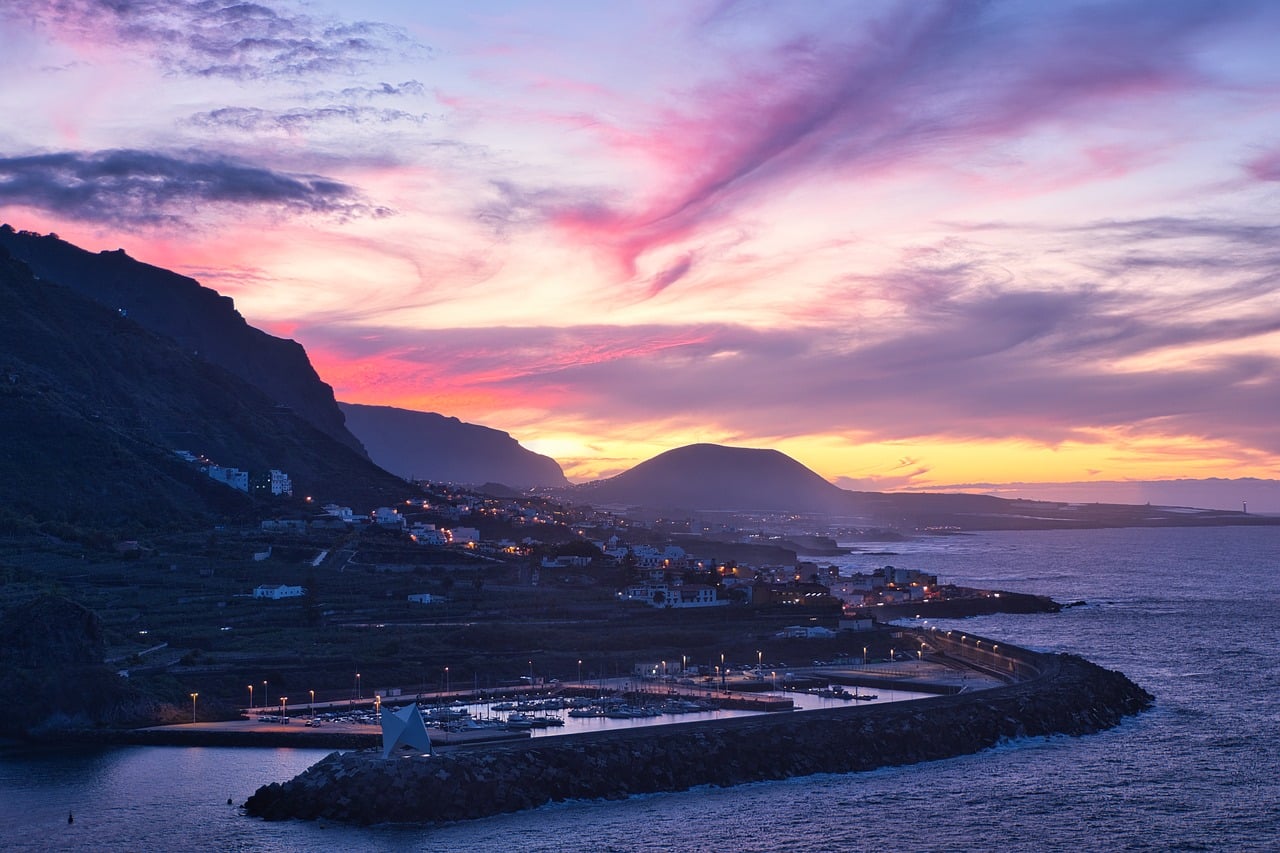
A small marina town on the west coast under sheer sea cliffs, with the black-sand Playa de la Arena next door. Quieter than the big resorts; good for couples, sunsets and boat trips.
El Médano
A relaxed town near the south airport, known for windsurfing, kitesurfing, natural sandy beaches and the red cone of Montaña Roja. Best for water-sports fans.
Puerto de la Cruz and the Orotava valley
The north coast’s old resort town has seawater pools, black-sand beaches, a botanical garden founded in 1788 and Loro Parque. Above it, the valley climbs through banana farms and vineyards to La Orotava, a town of carved wooden balconies and manor houses. Best for walkers and anyone who prefers local life and green views to beach heat; expect more cloud.
San Cristóbal de La Laguna
The old capital, near the north airport. Its late-15th-century street grid became a model for colonial cities in the Americas; today it is a lively university town of painted mansions and churches, and the gateway to Anaga. Best for culture lovers; often cool and damp.
Santa Cruz de Tenerife
A working port city with shopping streets, the white-winged Auditorio, the Nuestra Señora de África market and Carnival. The tram runs to La Laguna and Las Teresitas beach is close. Best for city life.
Garachico and the north-west
Garachico was the main port until a 1706 eruption sent lava into town; today it is quiet and handsome, with lava pools (El Caletón), near Icod’s ancient dragon tree, Teno and Masca. Best for slow travellers.
Anaga
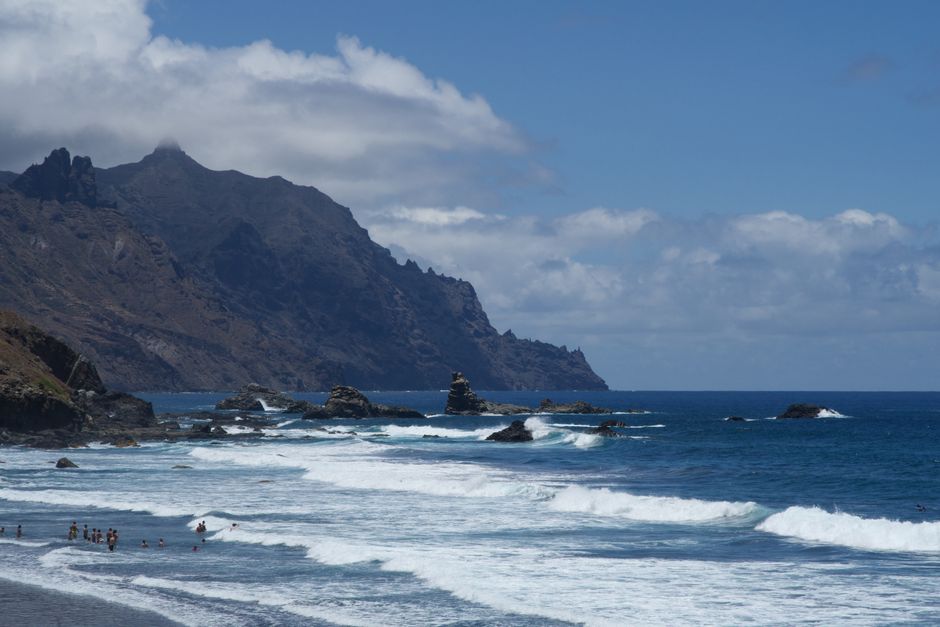
The north-east tip: jagged ridges, laurel forest, deep ravines and hamlets such as Taganana and Chinamada, with wild beaches at Benijo and Almáciga. Anaga Rural Park became a UNESCO Biosphere Reserve in 2015. Most visitors come for the day.
Top things to see in Tenerife
- Teide National Park: the vast crater floor of Las Cañadas, about 2,000 m up, with Teide above it. Worth a day even without the summit.
- Roques de García: twisted lava towers with Teide behind them, the island’s classic photo, on an easy loop walk.
- Los Gigantes cliffs: sea walls hundreds of metres high, best seen from a boat.
- Masca: a hamlet of stone houses and palms on a ridge in the Teno mountains, reached by a spectacular road. The village is free; the gorge walk is booked and paid (see below).
- Anaga: laurel forest and the Cruz del Carmen viewpoint.
- Playa de Las Teresitas: a long, calm beach of pale sand behind a breakwater at San Andrés, near Santa Cruz.
- Siam Park: a big Thai-themed water park in Costa Adeje; a full day out, so buy tickets online for busy dates.
- Loro Parque, honestly: the Puerto de la Cruz zoo is known for parrots, penguins and gardens, and its foundation funds parrot conservation. It also keeps orcas and dolphins in captivity for shows, which many animal-welfare groups oppose. You can see wild whales and dolphins at sea instead.
Protected areas
- Teide National Park
- Macizo de Anaga Biosphere Reserve
Zoos and aquariums
- Loro Parque
Archaeological sites
- Pyramids of Güímar
Monuments
- Cathedral of La Laguna
- Iglesia de la Concepción
Other sights
- Auditorio de Tenerife
Teide National Park and climbing Teide
Teide National Park was created in 1954 and covers about 19,000 hectares of lava fields and craters. Most of it is open to all, with free viewpoints and trails. Permits are needed only for the busiest high paths, above all the summit, booked through the Cabildo de Tenerife (the island government) on tenerifeon.es.
The summit permit: PNT 10 Telesforo Bravo (as of October 2026)
Trail PNT 10, the old “sendero 10”, climbs from La Rambleta, beside the cable car’s top station at 3,555 m, to the crater rim. It is only about 0.69 km and 45 minutes, but steep (up to 60%) and breathless at that altitude.
- Where to book: on the trail’s page on Tenerife ON. Bookings moved there from the national parks’ system (reservasparquesnacionales.es) on 1 September 2025; ignore older guides.
- How far ahead: up to 56 days. A new week is released every Monday at 07:00 Canary time, and high-season slots go fast.
- Time slots: two-hour entry slots within cable car hours (09:00–17:00), valid only for that day and slot; the Cabildo caps them at 50 people per slot and 300 a day.
- Fees since 19 January 2026: €15 for visitors from outside the Canaries, €6 for residents of the other islands, free for Tenerife residents and under-14s.
- ID: carry the permit, printed or on your phone, with the passport or ID card you booked with. Groups of up to 15 can book together.
- Refunds: if the trail closes for weather or the cable car stops, or if you cancel three days ahead. The permit is not a cable car ticket: buy both.
Sold out? Stay at the Altavista refuge (below), or ride the cable car and walk the free trails from La Rambleta to the Pico Viejo viewpoint (about 30 minutes) or La Fortaleza viewpoint, for fine views.
The Teide cable car
The Teleférico del Teide rises from 2,356 m (TF-21, km 43) to 3,555 m in under eight minutes. As of October 2026 a return costs €42 for non-resident adults and €21 for children aged 3 to 13; one way is €23.50. In 2026 it runs 09:00–18:00 from 1 to 13 October, 09:00–17:30 from 14 to 24 October, and 09:00–17:00 from 25 October to year end (last ride up 16:00).
- Wind and ice close it, sometimes for days in winter. Closures are usually announced around 08:30 on the operator’s status page.
- Not for children under 3, pregnant women or people with heart conditions, says the operator. Wear closed shoes.
- One hour at the top is the limit without a summit permit.
A night at the Altavista refuge
Refugio de Altavista, at 3,260 m and refurbished in 2026, has 49 bunks in shared dorms, a kitchen and toilets, but no showers or linen: bring a sleeping bag, food and water. A booking on refugioaltavista.com includes the PNT 07 and PNT 10 permits, and guests can climb to the crater between 06:00 and 09:00 to watch Teide’s shadow fall across the sea at sunrise; the Cabildo keeps most early-morning places for them. Access is on foot only.
Walking up: PNT 07 Montaña Blanca
The classic route starts on the TF-21 and climbs past the refuge to La Rambleta: 8.2 km one way and about 5 hours 30 minutes, with around 1,200 m of ascent at altitude. It needs its own Tenerife ON slot: since 19 January 2026, non-Canary visitors pay €6 on weekdays and €10 at weekends and on holidays (as of October 2026). Add a PNT 10 permit for the summit, and check the last cable car down.
Easy walks and stargazing
The Roques de García loop takes about two hours and needs no permit. Tenerife is a certified Starlight destination with a law limiting light pollution, so join a night tour with telescopes or a daytime visit to the Teide Observatory. Above 3,000 m, go slowly and turn back if you feel dizzy.
Is there a Teide eco-tax?
As of October 2026 the only charges are the PNT 10 and PNT 07 trail fees and the cable car; entering the park, parking and other trails are free. Local press reported in May 2026 that the Cabildo plans access control with pre-booked, paid parking for visitors from late 2026 and shuttle buses from the coast in 2027. Neither had started when we checked, so look at Tenerife ON before you go.
Hiking in Masca and Anaga
The Masca gorge (as of October 2026)
The Barranco de Masca path drops about 5 km from the hamlet at 750 m to a cove on the sea, over steps and slippery boulders: about four hours down, rated high difficulty. It is managed through the official site caminobarrancodemasca.com, with strict rules:
- Named ticket: from €40.66 for an adult who does not live in the Canaries (€20.33 child), €7.49 for Canary residents, refunded for Tenerife residents. It includes a loan helmet, insurance and trail staff.
- Minimum age 8, good fitness and closed hiking boots, or you are turned away.
- No cars to the start: since December 2025 you must ride TITSA line 355 from Santiago del Teide (about 20 minutes), be at the stop an hour before your slot and at the Masca control 30 minutes before.
- Leave by boat: buy a separate boat ticket from the cove to Los Gigantes, within four hours of your slot. If rough seas cancel the boats, you walk back up; TITSA lines 462 and 325 run from Los Gigantes back to Santiago del Teide.
- No swimming (the beach is closed), and carry at least 1.5 litres of water.
The site says Masca has had more rescues in recent years than anywhere else in the Canaries; check its “Masca hoy” page on the morning. Or simply visit the hamlet and the Cherfe and Cruz de Hilda viewpoints.
Anaga hikes
Anaga is the island’s greenest walking: mossy laurel forest, ridge paths and old tracks to hamlets. Most trails are free with no booking:
- Sendero de los Sentidos: a short, accessible forest path at Cruz del Carmen; ideal with children.
- Cruz del Carmen to Chinamada: forest, then ravine views to a hamlet of cave houses, with an optional descent to Punta del Hidalgo.
- Bosque de los Enigmas: a protected corner with limited numbers; it needs a prior permit, so check Tenerife ON.
The Cruz del Carmen visitor centre (TF-12) has maps and was listed as open daily 09:30–16:00. Start early: cloud often rolls in after midday. In an emergency call 112, and check Tenerife ON for trail closures. More ideas in our hiking guide.
Activities and best months
- Beaches and swimmingGolden-sand and black volcanic-sand beaches around the island, from calm resort bays to pebble shores.
- Boat tripsThe south-west coast is the place for whale and dolphin watching; boats leave from Los Cristianos, Puerto Colón and Los Gigantes.
- HikingTeide National Park (UNESCO World Heritage, Spain's highest peak at 3,718 m) has a trail network for self-guided walks or walks with official guides (every day except 1 and 6 January and 25 December). From the cable car's top station (3,555 m) a steep path climbs to the crater in about 40 minutes.
- SurfingWarm all year with waves for every level; the strongest waves break on the north and north-west coasts, the south and south-west are gentler. Conditions vary with the season.
Other things to do in Tenerife
Whale and dolphin watching
The strait between Tenerife and La Gomera has a resident population of short-finned pilot whales and frequent bottlenose dolphins; Turismo de Tenerife counts up to 21 species in these waters. Boats leave Los Cristianos, Puerto Colón and Los Gigantes. Choose a boat flying the “Blue Boat” (Barco Azul) flag, the Canary authorisation for commercial whale watching. The rules: at least 60 metres from the animals, no more than 30 minutes with them, slow speed, and no swimming with, feeding or touching them.
Beaches and natural pools
The calmest beaches are in the south (Playa del Duque, Fañabé, Los Cristianos, El Médano). In the rougher north, locals swim in seawater pools in Puerto de la Cruz, Garachico and Mesa del Mar. Check the flags; see our beaches guide. El Médano is the wind-sports spot, and surf schools work in Las Américas and the north (surfing guide).
Eating and drinking
Try papas arrugadas (wrinkled salt-boiled potatoes) with red and green mojo, grilled cheese with palm honey, fresh fish and gofio, toasted grain flour. In the northern vineyards, guachinches are family places serving their own wine and home cooking. Finish with a barraquito, a layered coffee with condensed milk and liqueur.
Day trips to La Gomera and Gran Canaria
La Gomera is 50 minutes by ferry from Los Cristianos: the Garajonay laurel forest, Valle Gran Rey and the whistled language, silbo. Gran Canaria is 80 minutes from Santa Cruz and deserves more than a day; see our Gran Canaria guide.
Nearby destinations
- La Gomera63 km
- Gran Canaria105 km
- La Palma130 km
- Fuerteventura255 km
Getting there and getting around
Flying in
Tenerife has two AENA airports, about an hour apart: Tenerife Sur (TFS), near El Médano, for most international holiday flights, and Tenerife Norte–Ciudad de La Laguna (TFN), mostly for mainland Spain and the other islands.
Airport buses
All buses (guaguas) are run by TITSA. From Tenerife Sur, AENA lists line 40 to Los Cristianos and Costa Adeje, line 10 to Santa Cruz, night line 711, and line 343 to Tenerife Norte (about 50 minutes, non-stop). From Tenerife Norte, line 20 runs to La Laguna and Santa Cruz (€2.65), line 30 to Puerto de la Cruz (€4.75) and line 104 to both. These numbers are newer than many guides show; check titsa.com for times.
Buses, tram and the Ten+ card
TITSA covers the whole island, including lines 342 and 348 to the Teide cable car, with few departures. The Ten+ system covers buses and the tram (as of October 2026): a rigid Ten+ card costs €2 and takes €5–€100 of credit at kiosks, tram machines and offices, making each trip cheaper; unlimited passes for all TITSA lines and the tram cost €10 for 24 hours or €50 for 7 days, on the Ten+ móvil app or a card from tram and airport machines.
Metrotenerife’s tram runs Line 1 from Santa Cruz to La Laguna and Line 2 from La Cuesta to Tíncer, 06:00–midnight on weekdays and through the night at weekends. A single costs €1.35 on a card or €1.10 on the app.
Driving and the roads to Teide
A car is the easiest way to reach Teide, Anaga, Teno and the northern towns. The TF-1 motorway follows the south and east coasts and the TF-5 the north. Teide is reached on the TF-24 from La Laguna, the TF-21 from La Orotava or Vilaflor, and the TF-38 from Chío; the cable car is 64 km from Santa Cruz and 45 km from Puerto de la Cruz, about an hour.
Ferries
As of October 2026, Fred. Olsen Express sails from Los Cristianos to San Sebastián de La Gomera (about 50 minutes) and Santa Cruz de La Palma (about 2 hours 30 minutes), and from Santa Cruz de Tenerife to Agaete on Gran Canaria (about 80 minutes). Armas Trasmediterránea (formerly Naviera Armas) links Los Cristianos with La Gomera and Tenerife with Gran Canaria, La Palma and El Hierro. Both also sail to mainland Spain. Book ahead if you take a car.
When to go and how long to stay
The table uses AEMET’s normals for Tenerife Sur airport (average daily high and low, days with at least 1 mm of rain); these are AEMET’s published 1981–2010 tables, the most recent we could read for this station.
| Season | South coast high / low | Rainy days a month | What it’s like | Good for |
|---|---|---|---|---|
| Winter (Dec–Feb) | 22–23 °C / 15–17 °C | 1.8–3.5 | Mild, mostly sunny south; wettest season in the north; snow possible on Teide | Winter sun, Christmas, Carnival |
| Spring (Mar–May) | 23–24 °C / 16–17 °C | 0.3–1.9 | Pleasant, flowers in the hills, cool sea | Hiking, Teide, Corpus Christi in La Orotava |
| Summer (Jun–Aug) | 25–28 °C / 19–21 °C | 0–0.2 | Hot and dry in the south; cloud often over the north | Beaches, water parks, dawn hikes on Teide |
| Autumn (Sep–Nov) | 25–28 °C / 18–21 °C | 0.6–1.9 | Warm sea; rain returns to the north from October | Swimming, hiking, guachinche season |
North and mountain: Tenerife Norte airport averages about 16 °C by day in January and 26 °C in August, with 520 mm of rain a year against 132 mm at Tenerife Sur. Izaña (2,369 m) averages highs of 7.5 °C and lows of 1.1 °C in January, with about two snow days a month from December to March. Take a warm layer to Teide in any season.
Events worth planning around
- Carnival of Santa Cruz: one of the world’s biggest street carnivals, in February or early March depending on Easter; book early.
- Corpus Christi in La Orotava: carpets of flowers and coloured volcanic sand in the streets, in late May or June.
How long to stay: 3-, 5- and 7-day plans
3 days: Day 1, Teide: Roques de García, the cable car and the summit if you have a permit, then sunset or stargazing. Day 2, the north: La Orotava, Puerto de la Cruz and Garachico. Day 3, whale watching and the beach.
5 days: add La Laguna with a walk in Anaga, and Masca: the gorge with a boat to Los Gigantes, or the hamlet and Teno viewpoints by car.
7 days: add La Gomera by ferry, a night at Altavista for sunrise on Teide, and beach time in El Médano or Las Teresitas. Keep a spare day for wind closures.
Weather month by month
Where to stay in Tenerife
- Costa Adeje: resort hotels, family pools and the best southern beaches.
- Los Cristianos, Las Américas or El Médano: a ferry town, a nightlife hub, or a laid-back wind-sports base.
- Los Gigantes and Puerto de Santiago: quiet apartments with sunset views, near Teno.
- Puerto de la Cruz: the north’s main base, with buses to La Orotava, Teide and both airports.
- La Laguna and Santa Cruz: city stays for culture, Carnival and Anaga.
- The Parador in the national park or the Altavista refuge: for mountain nights and dark skies.
Tourist tax: as of October 2026 we found no tourist tax in force across the Canary Islands or in Tenerife’s towns; check when you book. Prices include the Canary sales tax, IGIC, not mainland VAT.
Practical tips
- Book the fixed things first: the Teide permit (Mondays, 56 days ahead), Masca, Altavista and Carnival rooms.
- Set your watch back an hour if you come from mainland Spain; bookings use Canary time.
- Go to Teide early or late; 10:00 to 15:00 is the crush.
- What it costs (as of October 2026): Teide permit €15, cable car €42 return, Montaña Blanca €6–€10, Masca from €40.66 plus bus and boat, bus-and-tram pass €10 a day. Rooms are dearest at Christmas, New Year and Carnival.
What to pack for Tenerife
- A warm jacket and fleece for Teide, even in August.
- Closed hiking boots with grip: required for Masca, wise on volcanic gravel.
- High-factor sun cream, hat and sunglasses; altitude sun burns fast.
- A 1.5-litre water bottle and snacks for hikes.
- Your passport or ID and saved permits: Teide and Masca tickets are checked against your ID.
What to pack
- Day packs and anti-theft bagsCarries water, towel and sunscreen down the long stairways to Algarve coves.
- Dry bags and phone pouchesProtects phones and cameras from sand and spray on beaches reached by ferry or steep paths.
- Fleeces and warm layersIt is cooler at sea than on land, especially on morning whale-watching trips.
- HeadlampsLevada routes such as PR1 and PR9 pass through long, dark, wet tunnels.
- Hiking shoes and bootsMadeira's levadas and the Azores' crater rims are wet, rocky and slippery, so grippy shoes matter more than anywhere else in Portugal.
- Quick-dry beach towelsA sand-shedding quick-dry towel packs small for beach days and lido visits.
- Rain jacketsA windproof, waterproof shell keeps you warm on open boats, where wind and spray cool you quickly.
- Reef-friendly sunscreenSummer UV is strong on Portuguese beaches and there is little shade below the cliffs.
- Surf accessories (boots, leashes, wax)Neoprene boots keep feet warm in winter and protect them on rock and reef breaks.
- Trekking polesLong stone staircases and steep descents on Madeira's peaks and the Azores' crater rims are easier on the knees with poles.
- Water bottles and hydration packsAlgarve and Alentejo trails are hot and exposed with few refill points.
- Water shoesRocky coves, lava pools and weever fish in shallow sand make water shoes useful.
- WetsuitsOn the west and north coasts the sea stays around 16–18 °C even in summer, so a thin suit helps for long swims.
Tenerife travel FAQ
Do I need a permit to climb Teide?
Only for the final trail to the crater, PNT 10 Telesforo Bravo, booked on Tenerife ON up to 56 days ahead. Since 19 January 2026 it costs €15 for non-Canary visitors in the 09:00–17:00 slots; under-14s go free (as of October 2026).
Can I still book the Teide permit on reservasparquesnacionales.es?
No. Since 1 September 2025 the Cabildo de Tenerife handles PNT 10 bookings on tenerifeon.es. Bring the passport or ID you booked with.
How can I reach the summit if permits are sold out?
Stay at the Altavista refuge, whose guests climb between 06:00 and 09:00, or take the cable car and walk to the free Pico Viejo or La Fortaleza viewpoints.
How much is the Teide cable car?
€42 return for non-resident adults and €21 for children aged 3 to 13, as of October 2026. It does not include the summit permit and closes in strong wind or ice.
Do I have to pay to hike the Masca gorge?
Yes: from €40.66 for non-Canary adults on caminobarrancodemasca.com (as of October 2026), plus TITSA bus 355 to the start and a boat from the bottom to Los Gigantes. The village itself is free.
Is there a tourist tax in Tenerife?
Not that we could find as of October 2026, either regional or municipal. You pay instead for specific places, such as the Teide summit trail and the Masca gorge.
Is Tenerife on the same time as mainland Spain?
No. The Canary Islands are one hour behind Madrid, on the same time as London and Lisbon.
Do I need a car in Tenerife?
Not for a resort holiday: buses and tours cover the main sights. For Teide at sunrise, Anaga and Teno, a car helps a lot.
When is the best time to visit Tenerife?
Any time. Spring and autumn suit hiking and Teide, June to October has the warmest sea, and the south still reaches about 22 °C in winter. Snow can close the summit in winter.
Is Tenerife or Madeira better for hiking?
Tenerife has drier, high-altitude volcano walks; Madeira has gentler levada paths through laurel forest. Both charge for some trails. Compare with our Madeira guide.
Plan your trip
Partner links: TravelerCenter may earn a commission if you book, at no extra cost to you.
🇪🇸 Useful Spanish phrases for Tenerife
All 38 Spanish phrases: restaurant, hotel, emergencies, romance (printable) →
Traveler centers in Tenerife
Tourist information offices, visitor centers and travel agencies in Tenerife, from OpenStreetMap.
- Tourist information office
Centro de Iniciativas y Turismo - CIT Güímar
- Travel agency
Marítima Acantilados Los Gigantes
- Travel agency
Excursiones Jesus
- Travel agency
Tenerife Whale Watching I Atlantic Eco Experience
- Travel agency
Barranco del Infierno
- Travel agency
Bonadea II
Sources · last reviewed 3 October 2026
Researched and last reviewed on 3 October 2026. Teide permits: Cabildo de Tenerife and Tenerife ON; cable car and Altavista: their operators; Masca: caminobarrancodemasca.com; Anaga and whale-watching rules: Turismo de Tenerife; climate: AEMET; airports: AENA; tram and Ten+ fares: Metrotenerife; ferries: Fred. Olsen Express and Armas Trasmediterránea. Fees, timetables and trail rules change often, so check the official links before you travel. For entry rules, money and general safety, see our Spain travel guide.
Also: webtenerife.com · AEMET normals 1991–2020, Tenerife Sur Aeropuerto (climate)
Data: Weather: MET Norway (CC BY 4.0) · Sea temperature: NOAA CoastWatch · Rates: ECB · Holidays: Nager.Date · Costs: World Bank ICP and price levels · © OpenStreetMap contributors (ODBL) · Wikidata (CC0)