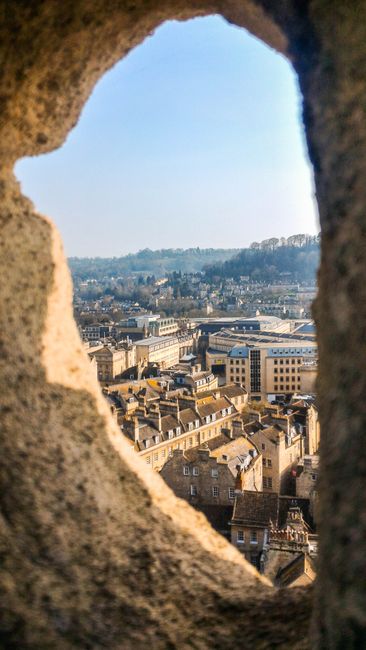
Bath is England’s most elegant small city: a honey-coloured spa town in a green valley in Somerset, built over hot springs that the Romans turned into a great bathing complex, and rebuilt in the 18th century as a stage set of Georgian crescents, terraces and assembly rooms. The whole city is a UNESCO World Heritage Site. You come to walk through the Roman Baths, sit under the fan vaulting of Bath Abbey, stroll the Royal Crescent and the Circus, bathe in the warm rooftop pool of Thermae Bath Spa, follow Jane Austen through the streets she wrote about, and eat a Bath bun in a tea room. It is about an hour and a half from London by train and small enough to explore on foot. Give it one full day for the highlights, or two or three to add the spa, the museums and a day trip to Stonehenge or the Cotswolds.
Right now in Bath
- Wed 9–15°C 48–58°F 6 mm Partly cloudy
- Thu 7–14°C 45–57°F 1 mm Partly cloudy
- Fri 11–16°C 51–60°F 8 mm Heavy rain
Weather: MET Norway (CC BY 4.0) · Air quality: OpenAQ · Rates: ECB
Top tours in Bath
See all tours for Bath →
From local operators, with prices and reviews; you check availability and book on Viator, our partner. We may earn a commission at no extra cost to you. How we earn money
Bath at a glance
- Best for: Roman history, Georgian architecture, thermal spa days, Jane Austen, museums, afternoon tea, shopping and romantic weekends.
- How long: 1 day for the Roman Baths, the Abbey and the Royal Crescent; 2–3 days to add the spa, museums, a walk in the hills and a day trip.
- Best time: May to September for long, mild days; late November to mid-December for the Christmas market; weekdays are calmer and cheaper at the Roman Baths.
- Getting in: trains from London Paddington reach Bath Spa in about 1 hour 20 minutes to 1 hour 30 minutes; Bristol Airport is the nearest airport.
- Getting around: on foot; the centre is compact but hilly. As of October 2026, an advance adult ticket to the Roman Baths cost £26.50 on weekdays and £29 at weekends.
- Before you go: entry rules, money and general safety are in our United Kingdom travel guide.
Bath, area by area
Bath sits in a loop of the River Avon, with the old centre on the flat valley floor and the Georgian city climbing the hills to the north. Everything in the centre is within a 20-minute walk, but the streets up to the Royal Crescent and Lansdown are steep.
The old centre: Abbey, Baths and Pump Room
The heart of Bath is the paved Abbey Churchyard, where buskers play between Bath Abbey, the Roman Baths and the Georgian Pump Room. Around it are narrow lanes of shops and tea rooms, the Guildhall Market and Pulteney Bridge, lined with tiny shops like the Ponte Vecchio in Florence, over a horseshoe weir. Best for: first visits and short stays.
The Upper Town: the Circus, Royal Crescent and Assembly Rooms
Uphill from the centre, the architects John Wood the Elder and his son laid out the Georgian showpieces: the Circus, a ring of three curved terraces, and the Royal Crescent, a sweeping half-moon of 30 houses facing a lawn and Royal Victoria Park. The Assembly Rooms, where Georgian society danced and gossiped, stand nearby. Best for: architecture lovers and quiet, elegant stays.
Bathwick and the canal
Across Pulteney Bridge, Great Pulteney Street leads to the Holburne Museum and Sydney Gardens, and the Kennet and Avon Canal runs past locks and narrowboats towards the countryside. Best for: walkers, cyclists and travellers who want to be a short stroll from the centre without the crowds.
Widcombe and the southern slopes
South of the station, Widcombe is a village-like corner of pubs and cafés below the hills, with the walk up to Prior Park’s landscape garden and its Palladian bridge, and views back over the city. Best for: good-value stays and local pubs.
Top things to see in Bath
Prices and hours below were checked on the official sites in October 2026. They change, so check before you go.
The Roman Baths
Hot water rises at about 46 °C from deep underground and has filled the bathing pools since the Romans built a temple to the goddess Sulis Minerva and a great bath complex here almost 2,000 years ago. You walk around the green Great Bath on its Victorian terrace, then down through the museum of the temple, the curse tablets, the gilded head of Minerva and the remains of the bath houses, with costumed characters and an audio guide. Allow two hours.
Tickets and timed entry. Tickets are sold for a time slot and cost less online in advance; on the day they cost £2 more, and slots sell out at weekends and in the holidays. Prices change by season and between weekdays and weekends. For visits from 1 September to 31 October 2026, an advance adult ticket (19+) cost £26.50 on weekdays and £29 at weekends and bank holidays; students and over-65s paid £25.50 and £28, children aged 6–18 £19.50 and £22, and a family of two adults and two to four children £69 and £77. From 1 November to 18 December 2026, prices drop to £23.50 (weekdays) and £26.50 (weekends) for an adult. Shared guided tours cost £8 per person on top, hourly from 10:00 to 15:00. The Baths open daily, usually from 09:00 to 18:00 with last entry an hour before closing, and stay open until 22:00 on summer evenings in late July and August; they close on 25 and 26 December. Look but do not touch: the water in the Roman Baths is not safe to bathe in. To bathe in the hot springs, go to Thermae Bath Spa.
Bath Abbey
Bath Abbey, rebuilt from 1499 on the site of a Saxon abbey where Edgar, the first king of all England, was crowned in 973, is famous for its fan-vaulted ceiling, its walls of memorial tablets and the stone angels climbing ladders to heaven on the west front. As of October 2026, admission cost £9 for adults, £7.50 for students and £5 for children aged 5–15, with an audio guide for £3.50. It is usually open Monday to Friday 10:00–17:30, Saturday 10:00–18:00 and Sunday 13:00–15:30, with last entry 30 minutes before closing, and closes for services and events. Tower tours climb 212 steps in two spiral stairs to the bells, the back of the clock face and the roof over the vaulting, with views over the whole city; they run Monday to Saturday, last about an hour and include Abbey entry. Book online or at the welcome desk.
The Royal Crescent and No. 1 Royal Crescent
Walk the length of the Royal Crescent, finished in 1774, and look out over the lawn and the park. Most of the houses are private homes and a hotel, but No. 1 Royal Crescent is a museum furnished as a wealthy Georgian townhouse, from the parlours to the servants’ kitchen. As of October 2026, entry cost £16 for adults and £14.50 for concessions, with under-18s free with an adult (up to four children per adult), and tickets can be reused for 12 months. It opens Tuesday to Sunday 10:00–17:30 (last entry 16:30) and on Monday bank holidays and in school holidays; in 2026 it closes from 16 to 28 November and on 25 and 26 December, and the season runs until 3 January 2027.
Thermae Bath Spa
Thermae Bath Spa is the only place in Britain where you can bathe in natural hot spring water: a modern glass-and-stone building with an indoor mineral pool, steam rooms and, best of all, an open-air rooftop pool looking over the Abbey and the hills, magical at dusk. As of October 2026, the “Thermae Welcome” two-hour session cost £44 Monday to Friday and £49 at weekends, including towels and robes. The minimum age is 16 (18 for treatments). A limited number of slots can be booked ahead; on the day, entry runs through a virtual queue until the spa is full, so book or arrive early. The spa is open 09:00–21:30, with the pools closing at 21:00, and it closes on 25 and 26 December and 1 January. Opposite, the small open-air Cross Bath is fed by its own spring and can be booked for private sessions.
Jane Austen’s Bath
Jane Austen lived in Bath from 1801 to 1806 and set much of Northanger Abbey and Persuasion here. The Jane Austen Centre in Gay Street tells her Bath story with costumed guides, dressing up and a Regency tea room; as of October 2026 an adult ticket cost £18 online, a child £9.95 and a family of two adults and up to three children £40.95. In autumn (22 September to 2 November) it opens daily 10:00–17:30; from 3 November, Sunday to Friday 10:00–16:30 and Saturday 10:00–17:30. Then walk in her footsteps to the Pump Room, the Assembly Rooms, Milsom Street and Sydney Place, where she lived. Every September, the Jane Austen Festival fills the streets with a costumed Regency promenade.
Pulteney Bridge, the Pump Room and the museums
The Pump Room, the Georgian meeting place above the Roman Baths, serves afternoon tea, and you can taste the warm spa water from the fountain. Pulteney Bridge, designed by Robert Adam, is one of only a handful of bridges in the world lined with shops. The Holburne Museum has fine art in a garden setting; the Victoria Art Gallery and the Museum of Bath Architecture are good small museums. See our city sightseeing guide for more.
Archaeological sites
Monuments
- Bath Abbey
- Pulteney Bridge
- Royal Crescent
- The Circus
Other sights
- Thermae Bath Spa
Museums
- Herschel Museum of Astronomy
- Jane Austen Centre
Driving into Bath and the Clean Air Zone
Bath has a Clean Air Zone covering the city centre. Private cars and motorbikes are not charged, whatever their emissions. Older, more polluting taxis and private hire cars, vans, minibuses, buses, coaches and lorries are charged a daily fee; check a vehicle and pay online on the GOV.UK Clean Air Zones service. Even so, driving into the centre is slow and parking is expensive and scarce; the city’s Park and Ride sites on the edge of town (Lansdown, Newbridge and Odd Down) are the easier choice for day visitors with a car. Many hotels in the centre have no parking.
Things to do in Bath
Walk the Bath Skyline and the canal
The Bath Skyline is a 6-mile (10 km) circular walk through meadows and woods above the city, with views across the rooftops; the towpath of the Kennet and Avon Canal leads east past locks to Bathampton and the Dundas Aqueduct. Bath is also the end (or start) of the 102-mile Cotswold Way, which finishes at Bath Abbey. See our hiking guide.
Cycle the Two Tunnels and the railway path
The Two Tunnels Greenway takes cyclists and walkers through two old railway tunnels, one of them more than a kilometre long, south of the city; the Bristol and Bath Railway Path is a flat, traffic-free route of about 13 miles to Bristol. Bikes and e-bikes can be hired in the city. See our cycling guide.
Eat and drink like a local
Try a Sally Lunn bun (a light, brioche-like bun served in one of Bath’s oldest houses), a Bath bun, a Bath Oliver biscuit, afternoon tea in the Pump Room, Somerset cider and cheeses, and a pint in a Georgian pub. The Guildhall Market and the Saturday farmers’ market at Green Park Station are good for picnics.
The Christmas market
From 26 November to 13 December 2026, Bath’s Christmas Market fills the streets around the Abbey with more than 200 traders in wooden chalets selling crafts, food and drink. Entry is free. It is very busy at weekends: come by train or Park and Ride, and book hotels early.
Activities and best months
- City sightseeingVisit Bath highlights the Roman Baths (from AD 43), Bath Abbey, the Royal Crescent and the Circus, and Pulteney Bridge and Weir, plus the Jane Austen Centre, the Holburne Museum and Thermae Bath Spa with its rooftop views; the compact UNESCO city can be toured on foot or by bus, boat or bike. · source
Day trips from Bath
Stonehenge
The world’s most famous stone circle, built and rebuilt from about 5,000 years ago, stands on Salisbury Plain about an hour’s drive (roughly 60 km) east of Bath. English Heritage runs the site: you buy a ticket for the day, see the exhibition and the reconstructed Neolithic houses at the visitor centre, then take the shuttle bus or walk the 1.5 miles (2.4 km) to the stones, which you view from a path around the circle. Tickets are now valid all day, so you can arrive at any time within opening hours, but book online by midnight the day before to save up to 15%. Prices change by date; for the 2026/27 season, adult tickets are roughly £25–£29. Members of English Heritage and of the National Trust (England) enter free with a booking. From 7 September 2026 to 16 March 2027 it opens daily 9:30–17:00 (last entry 15:00) and closes on 25 December; summer hours are longer. There is no simple public transport from Bath: take a coach tour from Bath, or the train to Salisbury and the Stonehenge Tour bus.
Lacock, Castle Combe and the Cotswolds
The National Trust village of Lacock, with its abbey and old stone streets used in many films, is 30 minutes away by car; Castle Combe, often called the prettiest village in England, is a little further. Both are a good start to the southern Cotswolds; see our Cotswolds guide.
Wells, Cheddar and Bristol
Wells, England’s smallest city, has a glorious cathedral and the moated Bishop’s Palace; nearby Cheddar Gorge has cliffs and show caves. Bristol, 15 minutes by train, has a lively harbourside, Brunel’s SS Great Britain and the Clifton Suspension Bridge.
Getting to Bath
By train. Great Western Railway trains from London Paddington reach Bath Spa in about 1 hour 20 minutes to 1 hour 30 minutes, with trains around every half hour; book advance tickets for the best fares. Trains also run from Bristol Temple Meads (about 15 minutes), Cardiff, Salisbury and the south coast. Bath Spa station is a five-minute walk from the Abbey.
By air. Bristol Airport is the closest, about 45 minutes away by road, with an airport bus to Bath. From London Heathrow, take the Elizabeth line or Heathrow Express into London, or the coach direct.
By coach. National Express coaches from London Victoria take about three hours and stop at the bus station next to the train station.
By car. Bath is about 20 minutes from junction 18 of the M4. Use the Park and Ride rather than driving into the centre.
Getting around Bath
The centre is best on foot; the walk from the Abbey to the Royal Crescent takes about 15 minutes, uphill. Local buses reach Prior Park, Lansdown and the Park and Ride sites, and open-top sightseeing buses loop around the city. Free walking tours by the Mayor of Bath’s Honorary Guides leave from outside the Pump Room most days, a great introduction.
When to go and how long to stay
Bath has a mild, fairly damp climate: warm but rarely hot summers, cool winters with occasional frost and little snow. The table uses the WMO 1991–2020 normals for Lyneham (145 m), the nearest station in the collection, on the Wiltshire downs about 30 km east of Bath; the city in its valley is a little warmer.
| Season | Average high / low | Rainy days per month | What it’s like |
|---|---|---|---|
| Spring (Mar–May) | 10–16 °C / 3–8 °C | about 10 | Blossom in the parks, quieter weekdays, showers |
| Summer (Jun–Aug) | 19–22 °C / 10–12 °C | 9–10 | Warmest and sunniest, longest hours, busiest at the Roman Baths, late openings |
| Autumn (Sep–Nov) | 18 °C falling to 10 °C / 10 °C falling to 4 °C | 10–13 | Golden September and the Jane Austen Festival; lower Roman Baths prices from November |
| Winter (Dec–Feb) | 7–8 °C / about 2 °C | 11–13 | Christmas market and lights, steaming rooftop pool on cold nights, short days |
Lyneham records about 770 mm of rain a year and about 1,650 hours of sunshine; May to August are the sunniest months, and October to January the wettest. Late spring and September are the sweet spot, while late November and early December bring the Christmas market.
Bath in 1 day
Morning at the Roman Baths (book the first slot), then Bath Abbey and a tower tour. Lunch near the Guildhall Market, then Pulteney Bridge, the Circus, the Royal Crescent and No. 1 Royal Crescent. End with an evening session in the Thermae rooftop pool.
Bath in 3 days
Add a free walking tour, the Jane Austen Centre and afternoon tea in the Pump Room, the Holburne Museum and Sydney Gardens, the Bath Skyline walk or a canal walk, and a day trip to Stonehenge, Lacock and Castle Combe, or Wells and Cheddar.
Weather month by month
Averages from Met Office normals 1991–2020, Lyneham (Wiltshire) · Last reviewed 4 Oct 2026
Where to stay in Bath
- The centre: boutique hotels and apartments near the Abbey and Baths, close to everything but noisier at night.
- The Upper Town: elegant Georgian townhouse hotels around the Circus and Royal Crescent, quiet and grand.
- Bathwick and Great Pulteney Street: handsome guesthouses a short walk over the bridge.
- Widcombe and near the station: good-value B&Bs and easy arrivals by train.
- Outside the city: country house hotels and village inns, best with a car.
Book well ahead for summer weekends, the Christmas market and the Jane Austen Festival in September. Hotels in the centre rarely have parking.
Practical tips for Bath
- Book the Roman Baths: time slots sell out at weekends and holidays, and booking ahead costs £2 less than on the day.
- Go on a weekday: Roman Baths tickets are cheaper and the spa and streets calmer from Monday to Friday.
- Bring good shoes: the walk up to the Royal Crescent and Lansdown is steep, and the pavements are old stone.
- Leave the car: use the train or Park and Ride; central parking is limited and expensive.
- Check the spa age rule: Thermae Bath Spa is for over-16s only, so plan another treat for children.
- Look up: street names carved in stone, Georgian fanlights and the Abbey’s angels reward slow walking.
What to pack for Bath
Comfortable walking shoes for hills and cobbles, a light waterproof jacket and umbrella, layers for changeable weather, swimwear and flip-flops for Thermae Bath Spa (robes and towels are included), a smart-casual outfit for afternoon tea or dinner, and a small day bag. If you are coming for the Jane Austen Festival, a Regency outfit is welcome.
What to pack
- City walking shoesLisbon and Porto are steep, with polished limestone cobbles that get slippery, so grippy soles matter.
- Day packs and anti-theft bagsA small zipped or anti-theft bag makes crowded trams and viewpoints less stressful.
- Rain jacketsFrom October to April Porto and Lisbon see rain on roughly a third of days.
- Travel adapters and convertersPortugal uses Type C and F sockets at 230 V, so most visitors from outside Europe need an adapter.
Bath travel FAQ
How much are tickets for the Roman Baths?
As of October 2026, advance adult tickets cost £26.50 on weekdays and £29 at weekends until 31 October, then £23.50 and £26.50 from 1 November to 18 December. Tickets on the day cost £2 more; children aged 6–18 and families pay less.
Do I need to book the Roman Baths in advance?
It is strongly recommended. Tickets are sold for timed slots, which sell out at weekends and in school holidays, and booking online is £2 cheaper than buying on the day.
Can you swim in the Roman Baths?
No. The water in the Roman Baths is untreated and not safe to touch or bathe in. To bathe in Bath’s hot springs, book a session at Thermae Bath Spa.
How much is Thermae Bath Spa?
As of October 2026, the two-hour “Thermae Welcome” session cost £44 on weekdays and £49 at weekends, including towels and robes. You must be 16 or over.
Is Bath Abbey free?
No. As of October 2026, admission cost £9 for adults, £7.50 for students and £5 for children aged 5–15. Services are free to attend for worship. Tower tours cost extra and include Abbey entry.
Do I have to pay the Bath Clean Air Zone charge in my car?
No. Private cars and motorbikes are not charged in Bath’s Clean Air Zone. Older taxis, vans, minibuses, buses, coaches and lorries can be; check your vehicle on GOV.UK.
How do I get from London to Bath?
By Great Western Railway train from London Paddington to Bath Spa, in about 1 hour 20 minutes to 1 hour 30 minutes. National Express coaches from Victoria take about three hours and are cheaper.
Can I visit Stonehenge from Bath?
Yes. Stonehenge is about an hour’s drive east. Join a coach tour from Bath, drive, or take the train to Salisbury and the Stonehenge Tour bus. Book tickets online by midnight the day before to save up to 15%; tickets are valid all day.
How many days do you need in Bath?
One full day covers the Roman Baths, the Abbey and the Royal Crescent. Two or three days let you add the spa, the museums, a walk on the Bath Skyline and a day trip to Stonehenge or the Cotswolds.
When is the Bath Christmas Market?
In 2026 it runs from 26 November to 13 December, around the Abbey and the city centre streets. Entry is free.
Is Bath worth visiting for Jane Austen fans?
Yes. She lived here from 1801 to 1806 and set two novels in the city. Visit the Jane Austen Centre, the Pump Room and the Assembly Rooms, and come in September for the Jane Austen Festival.
When is the best time to visit Bath?
May, June and September for mild weather and long days, or late November to mid-December for the Christmas market. Weekdays are quieter and cheaper at the Roman Baths.
Nearby destinations
- Cotswolds52 km
- Cardiff58 km
- Oxford87 km
- Jurassic Coast87 km
- Stratford-upon-Avon101 km
- Birmingham126 km
- London155 km
- Brighton167 km
Sources
- © OpenStreetMap contributors · ODbL · fetched 4 Oct 2026
- Wikidata · CC0 · fetched 4 Oct 2026
Sources and last review
Researched and last reviewed on 4 October 2026. Roman Baths prices and tours: romanbaths.co.uk ticket pages for September–October and November–December 2026; Bath Abbey admission and tower tours: Bath Abbey; No. 1 Royal Crescent: Bath Preservation Trust; Thermae Bath Spa sessions and hours: Thermae Bath Spa; Jane Austen Centre: the centre’s official site; Clean Air Zone and Christmas market dates: Bath & North East Somerset Council; Stonehenge: English Heritage; climate: Met Office normals for Lyneham from the WMO 1991–2020 climate normals collection. Prices, timetables and rules change, so check the official links before you go. For entry rules, money and general safety, see our United Kingdom travel guide; for the capital, our London guide; and for nearby countryside, our guides to the Cotswolds and Cornwall.
Plan your trip
Partner links: TravelerCenter may earn a commission if you book, at no extra cost to you.