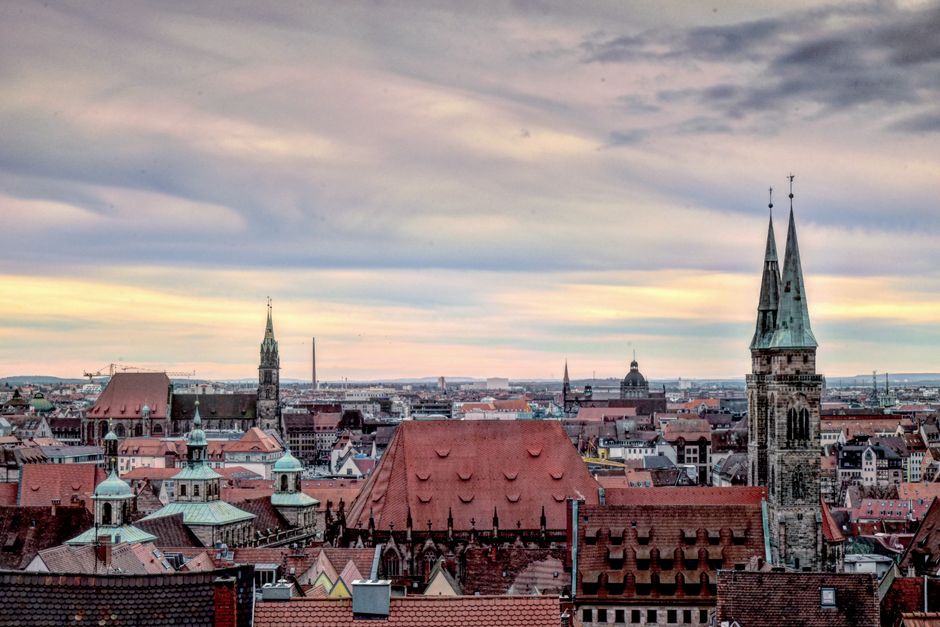
Nuremberg is two cities in one. Inside its massive red sandstone walls is the old imperial city of Albrecht Dürer: a castle on a rock, Gothic churches, half-timbered lanes along the river Pegnitz and the most famous Christmas market in the world. Outside, on the south-east edge of town, are the vast unfinished buildings of the Nazi Party Rally Grounds, and in the west the courtroom where the leading Nazis were tried after the war. You come to climb to the Imperial Castle, see Dürer’s house, eat little grilled sausages and gingerbread, and face the 20th century honestly at the Documentation Center and Courtroom 600. It is about an hour from Munich by ICE train. Give it two days for the old town and the history sites, or three to add Bamberg or Rothenburg.
Right now in Nuremberg
- Wed 9–22°C 49–72°F Clear
- Thu 11–20°C 52–67°F 7 mm Heavy rain
- Fri 5–13°C 41–55°F 1 mm Partly cloudy
Weather: MET Norway (CC BY 4.0) · Air quality: OpenAQ · Rates: ECB
Top tours in Nuremberg
See all tours for Nuremberg →
From local operators, with prices and reviews; you check availability and book on Viator, our partner. We may earn a commission at no extra cost to you. How we earn money
Nuremberg at a glance
- Best for: medieval and Renaissance history, the Holy Roman Empire, 20th-century history, Albrecht Dürer, Franconian food and beer, and Christmas markets.
- How long: 1 day for the old town and the castle; 2–3 days to add the Documentation Center, the Nuremberg Trials Memorial, the museums and a day trip.
- Best time: May to September for the beer gardens and the walls; 27 November to 24 December 2026 for the Christkindlesmarkt.
- Getting in: ICE trains from Munich take about 1 hour to 1 hour 15 minutes; the U2 metro links the airport with the main station in about 12 minutes.
- Getting around: on foot inside the walls; trams, buses and the metro to the history sites outside. As of October 2026, the Imperial Castle full ticket cost €10, and under-18s went free.
- Before you go: entry rules, money and general safety are in our Germany travel guide.
Nuremberg, area by area
The old town (Altstadt) is ringed by about 4 km of medieval walls, towers and gates, and split in two by the Pegnitz. Most of it was destroyed by bombing in January 1945 and rebuilt in the following decades, largely on the old street plan and with the great churches restored.
Sebalder Altstadt: the castle quarter
North of the river, the old town climbs to the Imperial Castle. Around it are the Tiergärtnertor square with Dürer’s house, the half-timbered Weinmarkt, St Sebaldus Church and the Hauptmarkt, the main market square. Best for: first visits, views and atmospheric stays.
Lorenzer Altstadt: the shopping side
South of the river, the old town is busier and more commercial, with St Lorenz Church, the Königstraße running down to the main station, the Germanisches Nationalmuseum and the craft courtyard of the Handwerkerhof by the Königstor gate. Best for: shopping, arrivals by train and museums.
Along the Pegnitz
The river runs through the middle of the old town, crossed by bridges and the covered Hangman’s Bridge (Henkersteg), past the Holy Spirit Hospital built over the water and the Weißgerbergasse, the best-preserved street of half-timbered houses in the city. Best for: walks and photos.
Gostenhof and Südstadt
Just outside the walls to the west, Gostenhof is a multicultural district of cafés, bars and small restaurants on the way to the Nuremberg Trials Memorial. Best for: eating out and nightlife away from the crowds.
Top things to see in Nuremberg
Prices and hours below were checked on the official sites in October 2026. They change, so check before you go.
The Imperial Castle (Kaiserburg)
Every Holy Roman Emperor from the 11th to the 16th century stayed in the castle on its sandstone ridge above the old town, and the imperial regalia were kept in Nuremberg for almost 400 years. Visit the residential palace (Palas), the two-storey Romanesque Double Chapel, the Imperial Castle Museum with its armour and weapons, the Sinwell Tower for the best view over the roofs, and the Deep Well, cut about 50 m through the rock, which you see on a short guided demonstration. The castle gardens and the terrace below the walls are free and have fine views.
Tickets and hours. As of October 2026, the full ticket (palace, chapel, museum, Deep Well and Sinwell Tower) costs €10 for adults and €9 reduced; the palace and museum alone cost €7, and the well and tower alone €4. Children and young people under 18 go free. The castle opens daily 9:00–18:00 from April to September and 10:00–16:00 from October to March, with last entry about an hour before closing; it is closed on 1 January, Shrove Tuesday and 24, 25 and 31 December.
Albrecht Dürer’s House
The great Renaissance painter and printmaker lived and worked from 1509 until his death in 1528 in this tall half-timbered house below the castle, on the Tiergärtnertor square. It shows the rooms of a wealthy 16th-century household, a reconstructed workshop where printing techniques are demonstrated, and changing exhibitions of Dürer’s prints. On some days, an actress playing his wife, Agnes, leads costumed tours (extra charge).
As of October 2026, entry cost €7.50 for adults and €2.50 reduced (including ages 4 to 17 and students). It is open Tuesday to Sunday 10:00–18:00, and on Mondays too from July to September and during the Christkindlesmarkt. For €4 more, your ticket becomes a day ticket valid at the other city museums, including the Documentation Center and the Nuremberg Trials Memorial.
The Hauptmarkt and the old town churches
The Hauptmarkt holds a market every day and is the stage for the Christkindlesmarkt. On one side, the 19-m Gothic spire of the Schöner Brunnen (Beautiful Fountain) has a brass ring set into its railings: turn it for luck. On the other, the Frauenkirche’s clock performs the Männleinlaufen at noon, when the seven electors parade around Emperor Charles IV. St Sebaldus and St Lorenz, the two great Gothic parish churches, hold masterpieces by the city’s sculptors, including Veit Stoss’s Angelic Salutation, which hangs in the choir of St Lorenz.
Germanisches Nationalmuseum
The largest museum of German art and culture covers everything from prehistoric gold to Dürer’s paintings, medieval sculpture, musical instruments, toys and the first globe (the Behaim globe of 1492). It is closed on Mondays; allow at least half a day.
Under the old town
Nuremberg is hollowed out underneath. Guided tours visit the rock-cut cellars (Felsengänge) where beer was once stored, the Historic Art Bunker where the city’s treasures survived the war, and the Medieval Dungeons beneath the old town hall (separate tickets).
Churches and cathedrals
- Frauenkirche (Nuremberg)
- St. Lawrence
- St. Sebaldus
Museums
- Albrecht Dürer's House
- Germanisches Nationalmuseum
Castles and forts
- Nuremberg Castle
Other sights
- Palace of Justice (Memorium Nuremberg Trials)
Nuremberg and the 20th century
Nuremberg was the city of the Nazi Party rallies from 1933 to 1938 and the place where the “Nuremberg Laws” were announced in 1935; after the war, it was chosen for the international trials of the leading Nazis. Visiting both sites, with care and time, is one of the most important things you can do here. The Documentation Center is not suitable for children under 14.
Documentation Center Nazi Party Rally Grounds
In the north wing of the unfinished Congress Hall, a horseshoe-shaped building meant to seat 50,000 party members, the Documentation Center explains how the rallies worked as propaganda and how they connect to the violence of the regime. After renovation and extension work that began in 2020, the new permanent exhibition, “Nuremberg and the Nazi Party Rallies”, opened in a trial phase on 22 May 2026, making the whole building open to the public for the first time since 2020; the official opening is planned for 4 November 2026, 25 years after the centre first opened. The centre is closed on 3 and 4 November 2026. Building work continues around the Congress Hall, so expect some noise and restricted access.
As of October 2026, the centre opens Monday to Friday 9:00–18:00 and at weekends 10:00–18:00, and entry costs €7.50 for adults and €2.50 reduced. Public guided tours run at weekends, with an English tour on Sundays at 13:30. Take tram 6 or 8 or buses 36, 45, 55 or 65 to Doku-Zentrum, or the S2 to Dutzendteich; as of October 2026, roadworks meant the trams did not run all the way, with replacement buses.
The rally grounds. From the centre, a walk of about an hour around the Dutzendteich lake takes you to the Great Road, built for parades, and the Zeppelin Field with its stone tribune, from which Hitler addressed the crowds; information boards explain the site. The grounds are open and free, but parts of the tribune may be fenced off for conservation work.
Nuremberg Trials Memorial and Courtroom 600
In the Palace of Justice in the west of the city, Courtroom 600 is where the International Military Tribunal tried 22 leading Nazis, 21 of them in the dock, including Hermann Göring, from November 1945 to October 1946, laying foundations for international criminal law. The Memorium Nuremberg Trials, on the floor above, tells the story of the trials and their legacy. The courtroom stopped hosting court hearings in 2020 and is now part of the memorial, though events still close it on some days: in October 2026, Courtroom 600 is closed from 7 to 9 October and partly closed on 19 October. The exhibition stays open when the courtroom is closed.
As of October 2026, entry cost €7.50 for adults and €2.50 reduced. From April to October, the memorial opens Monday and Wednesday to Friday 9:00–18:00 and at weekends 10:00–18:00; from 1 November 2026 to 31 March 2027, Wednesday to Monday 10:00–18:00. It is always closed on Tuesdays. Take the U1 metro to Bärenschanze. A free media guide is part of the museum’s app.
Things to do in Nuremberg
Walk the walls and the river
Follow the walls around the old town, past towers and gates, then the Pegnitz from the Hangman’s Bridge to the Holy Spirit Hospital and the Weißgerbergasse. The castle terrace at sunset is unbeatable. See our city sightseeing guide.
Eat Franconian food
Order Nürnberger Rostbratwürste, small sausages grilled over beechwood, by the six, ten or twelve on a pewter plate with sauerkraut and horseradish, or “drei im Weggla”, three in a bread roll, from a stall. Try Schäufele (roast pork shoulder) with dumplings, Lebkuchen (Nuremberg gingerbread), and the local beers from the many small breweries of Franconia.
Museums for families
The Toy Museum, the DB Museum, on the history of German railways, which began here in 1835 with the line to Fürth, and the Museum of Industrial Culture are good choices with children.
Cycle out of the city
The Pegnitz valley path leads out to green meadows west of the city, and the Ludwig Canal path heads south. See our cycling guide.
The Nuremberg Christkindlesmarkt
The Christkindlesmarkt on the Hauptmarkt is one of the oldest and the best-known Christmas markets in the world, a “little town of wood and cloth” of red-and-white-striped stalls selling Lebkuchen, fruit loaf, gold-foil angels, cribs, candles, toys and plum figures. In 2026 it runs from 27 November to 24 December, daily from 10:00 to 21:00 and on 24 December from 10:00 to 14:00. It opens on 27 November at 17:30, when the Nuremberg Christkind, a young woman chosen every two years, recites the prologue from the gallery of the Frauenkirche. Around it are the Children’s Christmas market on Hans-Sachs-Platz and the Market of the Sister Cities on the Rathausplatz. It gets extremely busy at weekends; come on a weekday morning for the stalls and after dark for the lights. (In 2027 it will run from 26 November to 24 December.)
Activities and best months
- City sightseeingNuremberg's landmark is the Imperial Castle on its rock above the Old Town, one of the most important imperial palaces. Nearby are the 19 m Gothic Beautiful Fountain (1385-1396), St. Lawrence and St. Sebald churches, half-timbered houses, the medieval walls, the rock-cut beer cellars and the Germanisches Nationalmuseum. The Christkindlesmarkt is one of Germany's oldest and best-known Christmas markets. · source
Getting to Nuremberg
By train. Nürnberg Hauptbahnhof, just outside the old town walls, is a major rail hub. ICE trains from Munich take about 1 hour to 1 hour 15 minutes; from Berlin, about 3 hours; from Frankfurt, about 2 hours. Book on bahn.de for advance fares.
By air. Nuremberg Airport has flights from around Europe; the driverless U2 metro reaches the main station in about 12 minutes. Munich Airport is about 1 hour 30 minutes away by train.
By car. Nuremberg is a junction of the A3, A6, A9 and A73 motorways. Driving in the old town is slow and parking is expensive; use a car park by the walls.
Getting around Nuremberg
Inside the walls, walk: from the main station to the castle is about 20 minutes uphill. The VGN network of metro lines, trams and buses reaches the Documentation Center (tram, bus or S-Bahn) and the Trials Memorial (U1). Day tickets are good value if you visit both history sites on one day.
When to go and how long to stay
Nuremberg has a moderate continental climate, drier than most of Germany: warm summers, cold winters and fairly little rain. The table uses the Deutscher Wetterdienst (DWD) 1991–2020 averages for the Nuremberg weather station at the airport: average temperature over day and night, rainfall and hours of sunshine per month.
| Season | Average temperature | Rain per month | Sunshine per month | What it’s like |
|---|---|---|---|---|
| Winter (Dec–Feb) | 0.7–1.6 °C | 33–49 mm | 44–85 hours | Cold, frosty nights, some snow; the Christkindlesmarkt until 24 December |
| Spring (Mar–May) | 5.2 °C rising to 14.2 °C | 33–61 mm | 130–219 hours | Cool and bright, beer gardens open in May |
| Summer (Jun–Aug) | 17.6–19.5 °C | 60–77 mm | 226–239 hours | Warm, with thunderstorms; open-air concerts and festivals |
| Autumn (Sep–Nov) | 14.3 °C falling to 4.7 °C | 47–49 mm | 165 falling to 58 hours | Mild September, the autumn fair, grey November |
Nuremberg averages only about 600 mm of rain a year, with about 1,750 hours of sunshine and an annual average temperature of about 9.8 °C. July is the warmest and wettest month, mostly from short summer storms.
Nuremberg in 1 day
Start at the Imperial Castle when it opens, walk down past Dürer’s House and the Weinmarkt to the Hauptmarkt for the Männleinlaufen at noon, and have a bratwurst lunch. In the afternoon, take the tram to the Documentation Center and walk to the Zeppelin Field.
Nuremberg in 3 days
Add Courtroom 600 and the Trials Memorial, the Germanisches Nationalmuseum, a tour of the rock-cut cellars and a walk along the walls. On the third day, take a trip to Bamberg or Rothenburg.
Weather month by month
Averages from DWD normals 1991–2020, Nürnberg (airport) · Last reviewed 4 Oct 2026
Day trips from Nuremberg
Bamberg, a UNESCO-listed old town on seven hills with a cathedral and a town hall built in the river, is under an hour by train; try its smoked beer. Rothenburg ob der Tauber, the walled medieval town on the Romantic Road, is about 1 hour 15 minutes to 1 hour 30 minutes by train with changes in Ansbach and Steinach; see our Rothenburg guide. Regensburg, with its stone bridge and Roman and medieval old town on the Danube, is about an hour away, and Würzburg, with its baroque Residence, about an hour. The Franconian Switzerland hills to the north have caves, castles and hundreds of small breweries. For Bavaria’s capital, see our Munich guide.
Nearby destinations
- Rothenburg ob der Tauber66 km
- Munich151 km
- Karlovy Vary155 km
- Stuttgart157 km
- Heidelberg172 km
- Frankfurt187 km
- Bavarian Alps208 km
- Leipzig229 km
Where to stay in Nuremberg
- Sebalder Altstadt: quiet lanes below the castle and the most atmospheric hotels.
- Lorenzer Altstadt and Königstraße: central, close to the main station and the shops.
- Near the main station: large chain hotels, good value and handy for day trips.
- Gostenhof: small hotels and apartments, near the Trials Memorial.
Prices rise sharply during the Christkindlesmarkt and the big trade fairs, such as the toy fair in winter, so book months ahead for Advent weekends.
Practical tips for Nuremberg
- Check Courtroom 600 closures: the memorial publishes the days when the courtroom is shut for events.
- Mind the closing days: the Trials Memorial closes on Tuesdays, the Germanisches Nationalmuseum on Mondays and Dürer’s House on Mondays outside summer and the Christmas market.
- Note the Documentation Center closure: it is shut on 3 and 4 November 2026 for the reopening.
- Buy a day ticket: €4 extra turns any city museum ticket into a pass for the other city museums that day.
- Teenagers go free at the castle: under-18s pay nothing.
- Visit the market on a weekday: Christkindlesmarkt weekends are packed.
What to pack for Nuremberg
Comfortable shoes for cobbles and the climb to the castle, a light waterproof, layers for cool evenings and, in winter, a warm coat, hat and gloves for the Christmas market, where the evenings are often below freezing. A small day bag is easiest in museums and on the narrow castle stairs.
What to pack
- City walking shoesLisbon and Porto are steep, with polished limestone cobbles that get slippery, so grippy soles matter.
- Day packs and anti-theft bagsA small zipped or anti-theft bag makes crowded trams and viewpoints less stressful.
- Rain jacketsFrom October to April Porto and Lisbon see rain on roughly a third of days.
- Travel adapters and convertersPortugal uses Type C and F sockets at 230 V, so most visitors from outside Europe need an adapter.
Nuremberg travel FAQ
Is the Documentation Center Nazi Party Rally Grounds open?
Yes. After renovation since 2020, the new permanent exhibition opened in a trial phase on 22 May 2026, and the official opening is planned for 4 November 2026. The centre is closed on 3 and 4 November 2026.
How much does the Documentation Center cost?
As of October 2026, €7.50 for adults and €2.50 reduced. It opens Monday to Friday 9:00–18:00 and at weekends 10:00–18:00. It is not suitable for children under 14.
Can you visit Courtroom 600 in Nuremberg?
Yes, as part of the Memorium Nuremberg Trials (€7.50 for adults as of October 2026). The courtroom sometimes closes for events, such as 7 to 9 October 2026; the memorial is closed every Tuesday.
How much does Nuremberg Castle cost?
As of October 2026, the full ticket costs €10 for adults and €9 reduced, and under-18s go free. It opens 9:00–18:00 from April to September and 10:00–16:00 from October to March.
When is the Nuremberg Christmas market in 2026?
From 27 November to 24 December 2026, daily 10:00–21:00 (until 14:00 on 24 December). The Christkind opens it with the prologue on 27 November at 17:30.
Is Albrecht Dürer’s House worth visiting?
Yes, for the 16th-century rooms, the printing workshop and his prints. As of October 2026 it cost €7.50 for adults and opened Tuesday to Sunday 10:00–18:00, plus Mondays in summer and during the Christmas market.
How many days do you need in Nuremberg?
One day covers the old town and the castle; two lets you add the Documentation Center and Courtroom 600 properly; three adds a day trip to Bamberg or Rothenburg.
How do I get from Munich to Nuremberg?
By ICE train, which takes about 1 hour to 1 hour 15 minutes, with several trains an hour.
What food is Nuremberg famous for?
Nürnberger Rostbratwürste, the small grilled sausages, and Lebkuchen, Nuremberg gingerbread, both protected by name. Try Schäufele and a local Franconian beer too.
How do I get from Nuremberg to Rothenburg ob der Tauber?
By regional trains with changes in Ansbach and Steinach, taking about 1 hour 15 minutes to 1 hour 30 minutes, or about 1 hour 15 minutes by car.
When is the best time to visit Nuremberg?
May to September for warm weather and beer gardens, or late November and December for the Christkindlesmarkt.
Sources
- © OpenStreetMap contributors · ODbL · fetched 4 Oct 2026
- Wikidata · CC0 · fetched 4 Oct 2026
Sources and last review
Researched and last reviewed on 4 October 2026. Imperial Castle prices and hours: the Bavarian Palace Administration; Documentation Center, Memorium Nuremberg Trials, Courtroom 600 closures and Albrecht Dürer’s House: the Museums of the City of Nuremberg; Christkindlesmarkt dates and hours: the official Christkindlesmarkt site (City of Nuremberg); climate: Deutscher Wetterdienst 1991–2020 averages for Nuremberg. The official opening date of the Documentation Center, train times and the Germanisches Nationalmuseum’s closing day come partly from secondary sources and are flagged for checking. Prices, timetables and rules change, so check the official links before you go. For entry rules, money and general safety, see our Germany travel guide; and for the next stops, our Munich guide and Rothenburg ob der Tauber guide.
Plan your trip
Partner links: TravelerCenter may earn a commission if you book, at no extra cost to you.
🇩🇪 Useful German phrases for Nuremberg
All 38 German phrases: restaurant, hotel, emergencies, romance (printable) →