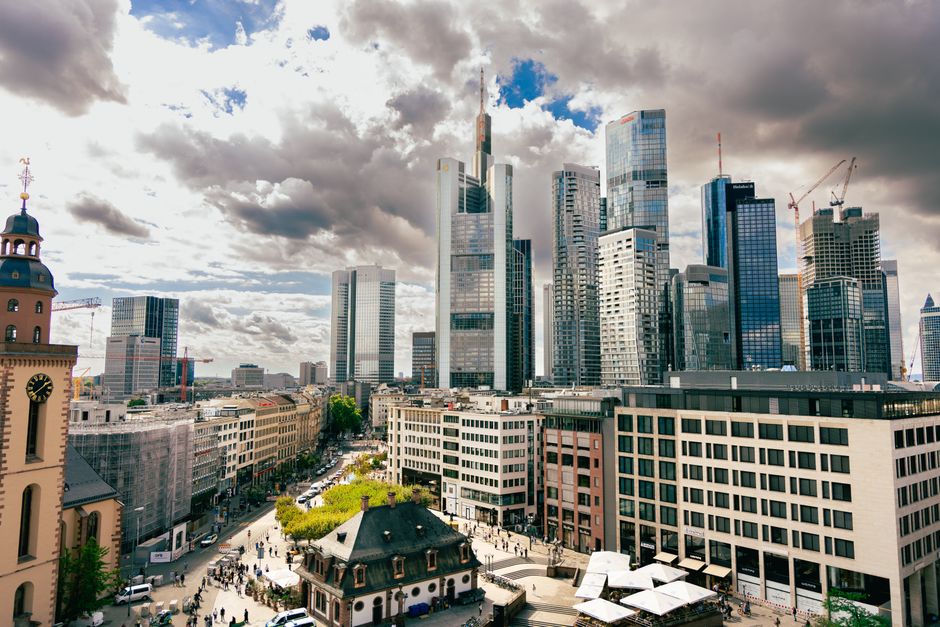
Frankfurt am Main is Germany’s banking capital and its busiest air hub, a compact city where glass towers rise behind a rebuilt medieval square and a riverbank lined with museums. Most visitors pass through the airport; those who stay find a friendly, walkable place with a lot to see: the Römerberg and the emperors’ cathedral, a dozen museums along the Main, Goethe’s birthplace, a skyline view from 200 m up, and cider taverns in Sachsenhausen where strangers share long tables over jugs of apple wine. Two days cover the highlights; add a third for the Rhine gorge or Heidelberg, each about an hour away by train.
Right now in Frankfurt
- Wed 8–22°C 47–72°F Partly cloudy
- Thu 11–16°C 52–60°F 5 mm Light showers
- Fri 6–12°C 43–54°F 1 mm Cloudy
Weather: MET Norway (CC BY 4.0) · Air quality: OpenAQ · Rates: ECB
Top tours in Frankfurt
See all tours for Frankfurt →
From local operators, with prices and reviews; you check availability and book on Viator, our partner. We may earn a commission at no extra cost to you. How we earn money
Frankfurt at a glance
- Best for: art museums, skyline views, apple-wine taverns, short city breaks, stopovers and Christmas markets.
- How long: 1–2 days for the Old Town, the Städel and the river; 3 days to add the Rhine Valley or Heidelberg.
- Best time: May to September for riverbank life and beer and cider gardens; late November to 22 December for the Christmas market.
- Getting in: Frankfurt Airport is Germany’s biggest; S-Bahn trains reach the main station in about 15 minutes. ICE trains reach Cologne in about an hour.
- Getting around: on foot in the centre, by U-Bahn, S-Bahn and tram beyond. As of October 2026, a Städel ticket cost €19 and the Main Tower platform €9.
- Before you go: entry rules, money and general safety are in our Germany travel guide.
Frankfurt, area by area
The Main river runs west to east through the city. The old centre and the business district sit on the north bank; Sachsenhausen, with the museums and the cider taverns, faces them on the south bank. Nearly everything a first-time visitor wants is within a 30-minute walk.
The Altstadt and the Römerberg
The historic heart, bombed in 1944 and rebuilt in stages: the Römerberg square with the stepped gables of the Römer city hall, the half-timbered houses opposite, the cathedral, St Paul’s Church and the New Old Town, a quarter of reconstructed and new narrow houses between the cathedral and the Römer, finished in 2018. Best for: first visits, sightseeing on foot and the Christmas market.
The Innenstadt and the banking district
North and west of the Old Town: the Zeil shopping street, the Hauptwache square, the Fressgass (“guzzle lane”) of delis and restaurants leading to the Alte Oper concert hall, and the skyscrapers of the banking district, including the Main Tower. Best for: shopping, business stays and evening concerts.
Sachsenhausen
Across the river, the Schaumainkai embankment holds the Museumsufer (Museum Embankment), and behind it Alt-Sachsenhausen’s cobbled lanes and the Schweizer Straße are lined with apple-wine taverns. Best for: museums by day, cider and Frankfurt food by night.
The Bahnhofsviertel
The station district between the Hauptbahnhof and the banks is a mix of grand 19th-century buildings, cheap hotels, bars and some of the city’s most varied food. It also has a red-light area and a visible drug scene, so stay alert here late at night. Best for: train travellers, budget stays and food.
Nordend, Bornheim and the Westend
Residential districts of tree-lined streets. Bornheim’s Berger Straße has cafés, shops and a weekly market; the leafy Westend leads to the Palmengarten. Best for: apartment stays and a local feel.
Top things to see in Frankfurt
Prices and hours below were checked on the official sites in October 2026. They change, so check before you go.
The Römerberg and the Römer
Frankfurt’s main square has been its market place and stage for centuries. On the west side, the Römer, three gabled merchants’ houses joined together, has served as the city hall since 1405; its Kaisersaal (Imperial Hall), lined with portraits of the Holy Roman emperors, is where coronation banquets were held. Opposite stands the row of half-timbered houses known as the Ostzeile, rebuilt in the 1980s, with the Justice Fountain in the middle and the small Old St Nicholas Church at the south end. It is free and at its best early in the morning.
Walk through the New Old Town to the cathedral along the old coronation route, and look in at St Paul’s Church (Paulskirche), where Germany’s first freely elected parliament met in 1848–1849.
The Kaiserdom and its tower
St Bartholomew’s Cathedral is called the Kaiserdom (Imperial Cathedral) because the kings of the Holy Roman Empire were elected here from the 14th century and crowned here from 1562 to 1792. The Gothic tower, begun in 1415, is 95 m high. Entry to the church is free.
The tower climb. A narrow spiral staircase of 328 steps leads to a viewing platform 66 m up, with views over the river and the skyline; there is no lift, and backpacks must be left at the desk. As of October 2026, entry cost €3 (€2 reduced), or €5 (€3 reduced) on weekend and holiday afternoons, when a small exhibition in the old watchman’s room is also open. From April to October the tower opens Monday 12:00–18:00, Tuesday to Saturday 10:00–18:00 and Sunday 11:00–18:00; from November to March it is closed on Mondays and opens Tuesday to Friday 10:00–17:00 and weekends 11:00–17:00. The last climb is 30 minutes before closing; expect a wait at weekends, and the tower stays shut in bad weather.
The Städel and the Museum Embankment
The Museumsufer on the south bank is one of Europe’s densest clusters of museums: painting, sculpture, film, architecture, applied arts and world cultures, in villas and modern buildings along the river. Its star is the Städel Museum, founded in 1815 by a Frankfurt banker, which covers 700 years of European art, from Dürer and Rembrandt to Monet, the German Expressionists and contemporary work in the underground garden halls lit by round skylights. Look for Vermeer’s The Geographer and Tischbein’s portrait of Goethe.
Visiting the Städel. As of October 2026, a ticket cost €19 for adults and €17 reduced, €30 for families, and was free for children under 12; on Tuesdays from 15:00 a ticket costs €10. The museum opens Tuesday to Sunday 10:00–18:00, to 21:00 on Thursdays, and is closed on Mondays and on 24 and 31 December. The restaurant is closed for renovation; the café is open. Next door, the Liebieghaus shows sculpture from ancient Egypt to neoclassicism in a riverside villa.
The MuseumsuferTicket. If you plan several museums, this pass gives entry to 39 museums in and around Frankfurt, including their special exhibitions, on two consecutive days. As of October 2026 it cost €21 for one adult, €32 for a family and €12 reduced.
The Main Tower viewing platform
Frankfurt’s skyline, nicknamed “Mainhattan”, is the only one of its kind in Germany, and the best place to see it is the open-air platform of the Main Tower, 200 m above the street. On a clear day you can see the Taunus hills. As of October 2026, tickets cost €9 for adults, €6 reduced and €20 for a family of two adults with up to three children, with a cheaper ticket when bad weather limits the view. In summer the platform opens Sunday to Thursday 10:00–21:00 and Friday and Saturday 10:00–23:00. When the clocks go back (25 October 2026), winter hours start: Sunday to Thursday 10:00–19:00 and Friday and Saturday 10:00–21:00. The last lift goes up 45 minutes before closing. Online tickets (adults only) do not skip the queue.
Goethe House
Johann Wolfgang von Goethe, Germany’s greatest writer, was born in 1749 in this tall townhouse on the Großer Hirschgraben, a short walk from the Römerberg. Rebuilt after the war with its original furniture, it shows how a wealthy Frankfurt family lived. It shares a ticket with the modern German Romantic Museum (Deutsches Romantik-Museum) next door. As of October 2026, entry cost €12 for adults, €7 for students and €18 for families, with children aged 6 and under free; both open daily 10:00–18:00 and to 21:00 on Thursdays.
The Palmengarten
Frankfurt’s botanical garden on the edge of the Westend has glasshouses of tropical and desert plants, rose and rock gardens and a playground. From October to around mid-April, butterflies fly free in the Blossom and Butterfly House, included in the ticket. As of October 2026, entry cost €9 for adults and €5 reduced, with everyone up to 17 free. It opens 09:00–19:00 from March to October and 09:00–16:00 from November to February.
The Kleinmarkthalle
Frankfurt’s covered market hall, between the Zeil and the Liebfrauenberg, has more than 60 stalls selling sausages, cheese, fruit, spices, fish and flowers from around the world. It is the best place in town for a stand-up lunch of Frankfurter sausages. It opens Monday to Friday 08:00–18:00 and Saturday 08:00–16:00, and is closed on Sundays and public holidays.
Sachsenhausen and apple wine
Frankfurt’s own drink is not beer but apple wine: Apfelwein, called Ebbelwoi or Stöffche in the local dialect, a dry, tart cider poured from a grey-and-blue stoneware jug (the Bembel) into a ribbed glass (the Gerippte). Order it plain or “sauergespritzt”, topped up with sparkling water. Traditional taverns have long shared tables and hang a pine wreath over the door when the new cider is in.
With it, try the local dishes: Handkäs mit Musik, a tangy sour-milk cheese marinated with onions in oil and vinegar (the “music” is said to come later); Grüne Soße, a cold sauce of seven herbs served with boiled eggs and potatoes, a Frankfurt favourite in spring; and Frankfurter Rippchen, cured pork chop with sauerkraut. The cobbled lanes of Alt-Sachsenhausen, around the Kleine and Große Rittergasse, are the old tavern quarter, while the Schweizer Straße and the streets around it have some of the most traditional houses. Book a table on Friday and Saturday nights.
Things to do in Frankfurt
Walk the river
The riverbanks are Frankfurt’s living room: paths, lawns and plane trees on both sides from the Friedensbrücke to the European Central Bank’s tower in the Ostend. Cross the Eiserner Steg footbridge for the classic skyline photo, and on summer evenings join locals with a drink on the steps of the Mainkai. Sightseeing boats leave from the north bank near the Eiserner Steg for river cruises past the skyline. See our city sightseeing guide and our boat trips guide.
Day trip: the Middle Rhine Valley
The castle-lined gorge of the Rhine begins at Rüdesheim and Bingen, about an hour west by regional train via Wiesbaden or Mainz. Take a boat downstream past the Loreley rock, or ride the train along the bank to Bacharach or St Goar and walk among the vineyards. Read our Middle Rhine Valley guide for boats, castles and where to stay, and our wine tasting guide for the Rheingau’s Rieslings.
Day trip: Heidelberg
Germany’s most famous university town, with its red sandstone castle ruin above the Neckar, is about 50 minutes to 1 hour 20 minutes away by direct train. See our Heidelberg guide.
Christmas in Frankfurt
Frankfurt’s Christmas market is one of the oldest and largest in Germany, spreading from the Römerberg across the Paulsplatz to the Mainkai by the river and the Hauptwache and Roßmarkt squares. In 2026 it runs from Monday 23 November to Tuesday 22 December, Monday to Saturday 10:00–21:00 and Sunday 11:00–21:00. On Wednesday and Saturday evenings from 18:00, brass players perform carols from the gallery of the Old St Nicholas Church, and on Saturday 28 November, from 16:30 to 17:00, the city’s church bells ring together. Look for Bethmännchen, marzipan sweets with almonds, and Quetschemännchen, little lucky figures made from dried plums and nuts.
Getting to Frankfurt
By air. Frankfurt Airport (FRA) is Germany’s largest and one of Europe’s main hubs. S-Bahn lines S8 and S9 leave from the regional station under Terminal 1 (from Terminal 2, take the SkyLine train or the shuttle bus) and reach the Hauptbahnhof in about 15 minutes and the Hauptwache in 15 to 20 minutes. A single ticket to the city costs about €6.90. As of October 2026, RMV’s Airport-to-City day ticket, bought online, cost €13.50 for one adult or €22.50 for a group of up to five, valid all day in Frankfurt. The airport also has its own long-distance station with ICE trains across Germany.
By train. Frankfurt Hauptbahnhof is the heart of the German rail network: ICE trains reach Cologne in about an hour, and Munich, Berlin and Hamburg in about four hours, with direct high-speed trains to Paris, Brussels and Amsterdam. Book on bahn.de for advance fares.
By car. The city sits at the junction of the A3 and A5 motorways. You won’t need a car in town.
Getting around Frankfurt
The centre is easy on foot. For longer hops, U-Bahn, S-Bahn, trams and buses run by the RMV transport association share one ticket system: buy single or day tickets from machines or the RMVgo app, and if you’re staying longer, the Deutschlandticket covers all local transport (see our Germany guide). The Frankfurt Card adds transport and discounts. Cycling along the river is a pleasure.
When to go and how long to stay
Frankfurt lies in the sheltered, fairly dry Rhine-Main lowland, one of the warmer parts of Germany: summers are warm and sometimes hot, winters cool and grey rather than very cold. The table uses the Deutscher Wetterdienst (DWD) 1991–2020 averages for the Frankfurt/Main weather station at the airport: average temperature over day and night, rainfall and hours of sunshine per month.
| Season | Average temperature | Rain per month | Sunshine per month | What it’s like |
|---|---|---|---|---|
| Winter (Dec–Feb) | 2.3–3.1 °C | 39–55 mm | 40–79 hours | Grey and cool with occasional frost; Christmas market until 22 December, then quiet |
| Spring (Mar–May) | 6.8 °C rising to 15.1 °C | 37–60 mm | 136–219 hours | Blossom in the Palmengarten, Grüne Soße season, the first evenings on the riverbank |
| Summer (Jun–Aug) | 18.5–20.5 °C | 55–64 mm | 225–235 hours | Warm to hot, with thunderstorms; cider gardens, river life and the Museum Embankment festival in late August |
| Autumn (Sep–Nov) | 15.5 °C falling to 6.1 °C | 47–50 mm | 165 falling to 52 hours | Mild September, the new apple wine, trade fairs and foggy November |
Frankfurt averages about 600 mm of rain and 1,720 hours of sunshine a year; July is the warmest month. Watch the trade fair calendar: during big fairs, such as the Frankfurt Book Fair (7–11 October 2026), hotel prices can double.
Frankfurt in 1 day
The Römerberg, the New Old Town and the cathedral tower in the morning, lunch in the Kleinmarkthalle, Goethe House, then across the Eiserner Steg to the Städel, and dinner with apple wine in Sachsenhausen. Finish on the Main Tower for the lights.
Frankfurt in 3 days
Add a day for more museums, the Palmengarten and an evening in Bornheim, and a day trip to the Rhine gorge or Heidelberg.
Where to stay in Frankfurt
- Altstadt and Innenstadt: central and walkable, close to the Römerberg, the Zeil and the river.
- Around the Hauptbahnhof: the most hotels and the best value, handy for the airport and day trips; choose a street on the quieter side towards the river.
- Sachsenhausen: by the museums and the cider taverns, a short walk across the river to the Old Town.
- Westend and the trade fair grounds: business hotels near the Messe and the Palmengarten.
- Nordend and Bornheim: apartments and small hotels in lively residential streets.
Frankfurt charges a per-night tourism fee on overnight stays, added to the hotel bill. Weekends are often cheaper than weekdays in this business city, except during big fairs.
Practical tips for Frankfurt
- Check the fair calendar: book early or avoid trade fair dates, when hotels fill and prices jump.
- Know the closing days: the Städel and most museums close on Mondays; the Kleinmarkthalle closes on Sundays.
- Save on the Städel: Tuesday tickets from 15:00 cost €10, and Thursdays it stays open until 21:00.
- Time the Main Tower: go at sunset on a clear day, and check the weather first; the platform closes in storms.
- Carry some cash: traditional cider taverns and market stalls may not take cards.
What to pack for Frankfurt
Comfortable shoes for cobbles and the 328 steps of the cathedral tower, a light waterproof and a layer for evenings by the river. A small bag works best: the cathedral tower and many museums ask you to leave backpacks at the desk or in lockers. In winter, a warm coat, hat and gloves for the Christmas market, and in summer a refillable water bottle and sun protection.
Frankfurt travel FAQ
Is Frankfurt worth visiting?
Yes, for a day or two. Behind the business image are a rebuilt Old Town, the emperors’ cathedral, a riverbank of museums led by the Städel, the Main Tower view and the apple-wine taverns of Sachsenhausen.
How do I get from Frankfurt Airport to the city centre?
Take S-Bahn line S8 or S9 from the regional station under Terminal 1. Trains reach the Hauptbahnhof in about 15 minutes and the Hauptwache in 15 to 20 minutes. A single ticket costs about €6.90, or buy RMV’s Airport-to-City day ticket online for €13.50 (as of October 2026).
How much does the Main Tower cost?
As of October 2026, €9 for adults, €6 reduced and €20 for a family. The open-air platform is 200 m up and, in summer, opens until 21:00 from Sunday to Thursday and until 23:00 on Friday and Saturday; winter hours, from 25 October 2026, are two hours shorter.
How much is the Städel Museum and when is it open?
As of October 2026, €19 for adults, €17 reduced and free for children under 12, or €10 on Tuesdays from 15:00. It opens Tuesday to Sunday 10:00–18:00, to 21:00 on Thursdays, and is closed on Mondays.
Can you climb Frankfurt Cathedral?
Yes. 328 steps lead to a platform 66 m up. As of October 2026 it cost €3 (€5 on weekend and holiday afternoons, when an exhibition is open too). From November to March the tower is closed on Mondays.
When is the Frankfurt Christmas market in 2026?
From 23 November to 22 December 2026 on the Römerberg, Paulsplatz, Mainkai, Hauptwache and Roßmarkt, open Monday to Saturday 10:00–21:00 and Sunday 11:00–21:00.
Where can I drink apple wine in Frankfurt?
In Sachsenhausen, across the river from the Old Town: the traditional taverns around the Schweizer Straße and the lanes of Alt-Sachsenhausen serve it by the jug, with Handkäs mit Musik and Grüne Soße. Bornheim has more.
Can you visit Goethe’s house in Frankfurt?
Yes. Goethe House, where he was born in 1749, shares a ticket with the German Romantic Museum: €12 for adults as of October 2026, open daily 10:00–18:00 and to 21:00 on Thursdays.
Is Frankfurt a good base for the Rhine Valley and Heidelberg?
Yes. Rüdesheim, at the start of the Rhine gorge, is about an hour away by regional train, and direct trains reach Heidelberg in 50 minutes to 1 hour 20 minutes. For the Rhine, a night or two in a riverside village is even better.
How many days do you need in Frankfurt?
One full day covers the Old Town, the Städel and an evening in Sachsenhausen; two add more museums and the Palmengarten, and three a day trip to the Rhine or Heidelberg.
Nearby destinations
- Heidelberg78 km
- Middle Rhine Valley82 km
- Rothenburg ob der Tauber135 km
- Stuttgart153 km
- Cologne153 km
- Düsseldorf183 km
- Strasbourg184 km
- Nuremberg187 km
Sources and last review
Researched and last reviewed on 4 October 2026. Städel prices and hours: the Städel Museum; Kaiserdom tower: the Dommuseum Frankfurt; Main Tower: the Main Tower’s own site; Goethe House: the Freies Deutsches Hochstift; Palmengarten: the Palmengarten; Kleinmarkthalle hours: the market hall; MuseumsuferTicket: Museumsufer Frankfurt (City of Frankfurt); Christmas market dates and hours: Visit Frankfurt (the city’s tourist board); airport trains and day tickets: RMV, with the single fare from the 2026 RMV price list; Frankfurt Book Fair dates: Frankfurter Buchmesse; climate: Deutscher Wetterdienst 1991–2020 averages for Frankfurt/Main. Train times are approximate and flagged for checking. Prices, timetables and rules change, so check the official links before you go. For entry rules, money and general safety, see our Germany travel guide; for nearby trips, our Middle Rhine Valley guide and Heidelberg guide; and for the Rhineland’s other big city, our Cologne guide.
Plan your trip
Partner links: TravelerCenter may earn a commission if you book, at no extra cost to you.
🇩🇪 Useful German phrases for Frankfurt
All 38 German phrases: restaurant, hotel, emergencies, romance (printable) →