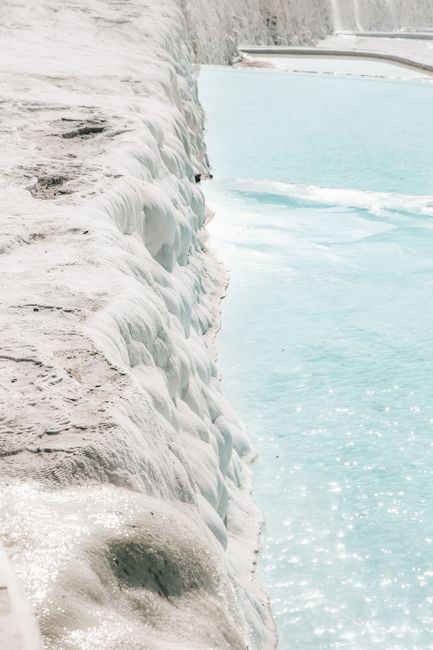
Pamukkale, the “cotton castle”, is a hillside of brilliant white travertine terraces and turquoise pools above a small village in the Aegean interior. Hot, calcium-rich spring water has been flowing down the slope for thousands of years, leaving layer after layer of white limestone that looks like snow or a frozen waterfall. On the plateau at the top, the Romans built Hierapolis, a spa city with a great theatre, a vast necropolis and the warm Antique Pool, where you can still swim among sunken marble columns. Together they have been a UNESCO World Heritage Site since 1988. You walk barefoot up the terraces, explore the ruins, and watch the sun set over the plain. Most people come on a long day trip, but a night in Pamukkale village lets you see the travertines at their emptiest and most beautiful, early and late.
Right now in Pamukkale (Pamukkale village)
- Wed15–27°C59–80°FPartly cloudy
- Thu15–26°C59–79°FMostly clear
- Fri16–27°C61–81°FClear
Top tours in Pamukkale
See all tours for Pamukkale →
From local operators, with prices and reviews; you check availability and book on Viator, our partner. We may earn a commission at no extra cost to you. How we earn money
Pamukkale at a glance
- Best for: a natural wonder, Roman ruins, a swim in a thermal pool, sunset photography.
- How long: half a day for the travertines and the main ruins; a full day with the Antique Pool, the museum and the necropolis; 1 night to see both sunrise and sunset light.
- Best time: April to June and September to October. July and August are very hot (average highs near 35 °C), and the white rock reflects the sun.
- Getting in: fly to Denizli Çardak (DNZ), take a train or bus to Denizli, then a minibus (about 30 minutes) to Pamukkale village.
- Tickets (October 2026): Hierapolis and the Pamukkale travertines €30 in one ticket for foreign visitors; the Antique Pool is a separate paid swim.
- Before you go: visas, money and transport around the country are in our Türkiye travel guide.
Tickets, gates and opening hours
The ticket
One ticket covers the travertine terraces and the whole archaeological site of Hierapolis, including its museum. As of October 2026 it costs €30 for foreign visitors, according to the Ministry of Culture and Tourism’s official ticketing site; prices are fixed in euros and can be paid by card. It is also covered by MuseumPass The Aegean (€95, 7 days), MuseumPass The Mediterranean (€90, 7 days) and MuseumPass Türkiye (€165, 15 days). The nearby ancient city of Laodikeia has its own ticket (€12).
The Antique Pool (also called Cleopatra’s Pool), a thermal pool on the plateau, is run separately and charges its own entry for swimming, paid at the pool. It is not included in the main ticket or in any MuseumPass. Its price is reported at around €13 per adult in 2026; check at the pool before you go. You can look at the pool from the terrace for free.
Opening hours
As of October 2026 the official site lists opening hours of 08:00 to 18:00, with the ticket offices closing earlier. The South Gate and the North Gate close at 18:00, but the pedestrian entrance from Pamukkale village (the travertine entrance at the bottom of the terraces) closes at 17:00. Hours are longer in summer and some evenings have night openings; check the official page before you go if you plan a sunset visit.
Which entrance?
- Town (travertine) entrance: at the foot of the terraces in Pamukkale village. You take off your shoes and walk up the white slope to Hierapolis, about 30–45 minutes. Best if you are staying in the village.
- South Gate: on the plateau near the Antique Pool and the main ruins, where most tour buses stop. The easiest start for people who don’t want to climb.
- North Gate: near Karahayıt, past the huge Northern Necropolis; enter here to walk through the necropolis and Frontinus Street to the centre of Hierapolis, then walk down the terraces to the village.
A good plan for independent travellers is to take a taxi or minibus to the North Gate, walk south through Hierapolis, swim in the Antique Pool, then walk down the travertines at sunset to the village. Shuttle carts sometimes run along the plateau.
How the terraces formed, and how they are protected
The water of Pamukkale’s springs, heated deep underground, emerges at about 35 °C and carries dissolved calcium carbonate. As it flows over the edge of the plateau and loses carbon dioxide, the carbonate precipitates as soft gel that hardens into travertine, building up the terraces at a rate of millimetres a year. The site has been a spa since antiquity: the Romans came for cures for rheumatism and skin and heart complaints, and the name Hierapolis means “holy city”.
In the 1960s–80s, hotels were built right on top of the terraces, a road ran across them, and visitors walked and washed all over them, so the white surface turned grey and dry. After the site’s UNESCO listing in 1988, the hotels were demolished, the road removed and the water flow controlled. Today the springs are channelled in rotation onto different parts of the slope to keep the travertine white and growing, and only a set path is open to visitors. That is why the rule about bare feet and staying on the path is enforced so strictly.
The travertine terraces
The terraces are the reason you came. Warm water at about 35 °C emerges on the plateau and flows over the edge; as it cools, calcium carbonate is deposited as travertine. In the 20th century hotels built on top and the terraces were damaged and discoloured; since the hotels were demolished and the water flow managed, parts have recovered. Today water is rotated between sections to protect them, so some pools are dry on any given day, while a marked path with shallow, man-made pools is open to visitors.
The barefoot rule
To protect the fragile surface, shoes are not allowed on the travertines: guards at the entrances make everyone take them off, and you carry them in a bag. You can only walk on the marked path, not on the natural terraces around it. Walking barefoot is pleasant on the smooth, warm sections, but some parts are ridged and rough under the feet, and the wet rock can be slippery. Bring a bag for your shoes, and take your time. In summer at midday the white surface becomes dazzling and hot, and sunglasses and sunscreen are essential.
Swimming and wading
You can paddle and wade in the pools along the path; swimming costumes are fine, but shoes, glass bottles and soap are not. For real swimming, use the Antique Pool on the plateau.
Hierapolis
Hierapolis was founded by the kings of Pergamon in the second century BC and flourished under Rome as a spa town and religious centre, with its sacred cave of Pluto (the Plutonion), whose deadly volcanic gases killed animals sacrificed to the god of the underworld. St Philip the Apostle is said to have been martyred here.
- The theatre: a beautifully restored Roman theatre on the hillside for about 12,000 people, with carved reliefs on its stage building and great views over the plain. A steep 15–20 minute walk uphill.
- The Martyrium of St Philip: an octagonal fifth-century pilgrimage church on the hill above the theatre, and nearby the newly excavated tomb attributed to the saint.
- The Northern Necropolis: one of the largest and best-preserved ancient cemeteries in Türkiye, with hundreds of tombs, sarcophagi and burial houses along the road to the North Gate.
- Frontinus Street and the Domitian Gate: the colonnaded main street with its triple-arched gateway.
- The Plutonion: the “gate to hell”, rediscovered in 2013; you can see it from outside.
- Hierapolis Archaeology Museum: in the old Roman baths, with fine sarcophagi and sculpture from the theatre and from Laodikeia, included in the ticket.
The Antique Pool
The thermal pool around the ancient sacred spring, with fallen marble columns lying on the bottom, is said to have been a gift from Mark Antony to Cleopatra, which is a story rather than history. The water stays at about 35–36 °C all year. There are changing rooms and lockers. It is very busy at midday with tour groups: go early or late.
Museums
- Hierapolis Archaeology Museum
Archaeological sites
- Laodicea on the Lycus
- Ploutonion at Hierapolis
- Theatre of Hierapolis
Monuments
- Hierapolis
Photography and visiting with children
The best light on the terraces is the last hour before sunset, when the white rock turns pink and gold and the pools reflect the sky; early morning is quieter but flatter. Drones need permission, and tripods may be questioned in busy spots. Children usually love paddling in the shallow pools, but hold small hands on the slippery sections and bring a towel and a change of clothes. The walk up the travertines from the village is steep but short; families with pushchairs should enter by the South Gate, where the plateau paths are flatter. There is little shade in Hierapolis, so in summer plan the theatre climb for early or late in the day.
Nearby: Laodikeia, Karahayıt and Aphrodisias
- Laodikeia: a large Roman city about 10 km away, excavated and partly reconstructed in the last twenty years, with two theatres, colonnaded streets and one of the Seven Churches of Revelation (€12).
- Karahayıt: a spa village 5 km north with red-coloured iron-rich springs and thermal hotels.
- Aphrodisias: about 1½ hours away, a marble city dedicated to Aphrodite, with one of the best-preserved stadiums of the ancient world and a superb museum (€12). Many people combine it with Pamukkale.
- Kaklık Cave: a small cave near Denizli with travertine formations inside, nicknamed the “underground Pamukkale”.
- Further afield: Selçuk and Ephesus are about 3 hours west, and Fethiye and the Turquoise Coast about 3 hours south.
Activities and best months
- City sightseeingWalk on the white travertines (most are protected; visitors use set areas), swim in the Antique Pool (Cleopatra Pool) and tour Hierapolis, the Roman and Byzantine spa city; both are on the UNESCO World Heritage List. Paragliding and balloon flights go over the travertines.
Getting to Pamukkale
To Denizli. Denizli, the provincial capital, is about 20 km south of Pamukkale. Denizli Çardak airport (DNZ), about 65 km away, has flights from Istanbul in about 1 hour 10 minutes; airport shuttle buses meet the flights. TCDD regional trains run from İzmir Basmane via Selçuk to Denizli (about 4½–5 hours from İzmir). Long-distance buses connect Denizli with İzmir, Selçuk, Antalya, Fethiye, Bodrum, Istanbul and Cappadocia.
Denizli to Pamukkale. Minibuses (dolmuş) and local buses leave from the lower level of Denizli’s bus station (otogar), next to the train station, every 15–30 minutes during the day and take about 30 minutes to Pamukkale village. Some long-distance bus companies include a free transfer; check when you book. Taxis are quicker but much dearer.
Day trips. Tours run daily from Antalya, Kuşadası, Marmaris, Bodrum and Fethiye, but they mean 3–4 hours on the road each way and a few hours on site at the busiest time of day. If you can, stay overnight instead.
By car. About 190 km from Selçuk and about 240 km from Antalya. There is parking at the South Gate, the North Gate and in the village.
When to go and how long to stay
Pamukkale has hot, dry summers and cool winters: average highs are about 35 °C in July and August and about 11 °C in January. Spring and autumn are the most comfortable times to walk the terraces and the ruins. Winter is quiet and atmospheric, with steam rising off the warm water on cold mornings, but walking barefoot on a cold, wet surface is not for everyone. The terraces face west, so the late afternoon and sunset are the most beautiful times; early morning is the quietest, before the tour buses arrive at around 10:00.
Pamukkale in half a day
Enter by the South Gate, walk to the theatre, visit the Antique Pool and the museum, then walk down the travertines to the village.
Pamukkale in a full day or overnight
Start at the North Gate and the necropolis, walk Frontinus Street, climb to the theatre and the Martyrium of St Philip, swim in the Antique Pool in the afternoon, and walk down the travertines at sunset. Next morning, visit Laodikeia or drive to Aphrodisias.
Weather month by month
Where to stay and eat
Pamukkale village has small family hotels and guesthouses, many with pools and views of the travertines, at good prices. Karahayıt has bigger thermal spa hotels. Denizli has city hotels but is less atmospheric. Village restaurants serve simple Turkish food: grills, gözleme, pide and home cooking; Denizli is known for its kebabs and its textiles. Hotel bills include Türkiye’s accommodation tax (cut to 1% until the end of 2026).
Practical tips for Pamukkale
- Bring a bag for your shoes: the barefoot rule applies on all the travertines.
- Avoid midday in summer: the white rock is dazzling and hot, and the tours arrive.
- Check the gate times: the village entrance closes earlier than the upper gates.
- Budget for the Antique Pool: it is a separate fee and not in any pass.
- Stay on the marked path: walking on the protected terraces can bring a fine.
- Pack swimwear: wear it under your clothes to wade in the pools.
What to pack for Pamukkale
A swimsuit and a small towel, a bag for your shoes, sunglasses, a sun hat and sunscreen, water, light clothing, comfortable shoes for the ruins, and a warm layer for winter or for evening visits.
What to pack
- City walking shoesLisbon and Porto are steep, with polished limestone cobbles that get slippery, so grippy soles matter.
- Day packs and anti-theft bagsA small zipped or anti-theft bag makes crowded trams and viewpoints less stressful.
- Rain jacketsFrom October to April Porto and Lisbon see rain on roughly a third of days.
- Travel adapters and convertersPortugal uses Type C and F sockets at 230 V, so most visitors from outside Europe need an adapter.
Pamukkale travel FAQ
How much is the Pamukkale ticket in 2026?
As of October 2026 foreign visitors pay €30 for one ticket that covers the travertines, the Hierapolis archaeological site and its museum. The Antique Pool costs extra.
Is the Antique Pool (Cleopatra’s Pool) included?
No. Swimming in the Antique Pool is paid separately at the pool, and MuseumPass cards are not valid there. You can look at it for free.
Do you have to take your shoes off at Pamukkale?
Yes. Shoes are not allowed on the travertines, to protect them. You walk barefoot along the marked path and carry your shoes; the surface can be rough or slippery.
Can you swim in the Pamukkale pools?
You can wade and sit in the shallow pools along the visitors’ path. For proper swimming, use the Antique Pool on the plateau, which has warm thermal water all year.
What are the Pamukkale opening hours?
As of October 2026 the site opens at 08:00. The South and North Gates close at 18:00 and the village (travertine) entrance at 17:00. Hours change with the season, so check before a sunset visit.
Which gate should I use at Pamukkale?
Use the village entrance to climb the travertines from the bottom, the South Gate for the easiest access to the main ruins and the Antique Pool, and the North Gate to walk through the necropolis.
How do I get from Denizli to Pamukkale?
Take a minibus or local bus from the lower level of Denizli bus station; they run every 15–30 minutes by day and take about 30 minutes.
Can I visit Pamukkale at night?
The site has evening openings on some days in season; check the official ministry page for the current night-opening schedule before you plan a visit after dark. MuseumPass cards are not valid at night openings.
Is Pamukkale worth visiting?
Yes, especially if you stay overnight or come early or late. The terraces are smaller and more managed than many photos suggest, but Hierapolis, the theatre and the Antique Pool make it a full and memorable day.
When is the best time to visit Pamukkale?
From April to June and from September to October, at opening time or in the late afternoon for the sunset over the terraces.
Can I visit Pamukkale as a day trip?
Yes, from Denizli easily, or on long tours from Antalya, Kuşadası, Bodrum or Fethiye. Staying a night lets you avoid the midday crowds and heat.
Nearby destinations
Plan your trip
Partner links: TravelerCenter may earn a commission if you book, at no extra cost to you.
🇹🇷 Useful Turkish phrases for Pamukkale
All 38 Turkish phrases: restaurant, hotel, emergencies, romance (printable) →
Sources · last reviewed 4 October 2026
Researched and last reviewed on 4 October 2026. Ticket prices, opening hours, gate times and MuseumPass terms (including that MuseumPass The Mediterranean is not valid at the Antique Pool): the Ministry of Culture and Tourism’s official ticketing site (muze.gov.tr). UNESCO listing: Hierapolis-Pamukkale (1988). The Antique Pool price comes from secondary sources and varies, so it is flagged for checking; transport times are approximate. For visas, money and safety, see our Türkiye travel guide.
Also: goturkiye.com · MGM normals 1991–2020, Denizli (climate)
Data: Weather: MET Norway (CC BY 4.0) · Rates: ECB · Costs: World Bank ICP and price levels · © OpenStreetMap contributors (ODBL) · Wikidata (CC0)