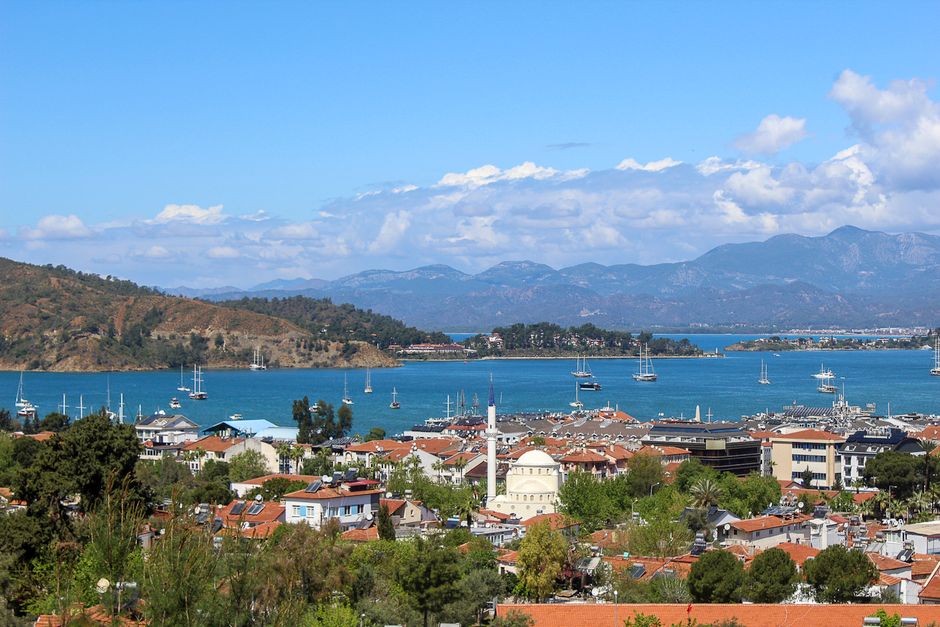
Fethiye is a working harbour town on a wide, island-studded bay in south-west Türkiye, and the base for some of the most famous scenery on the Turquoise Coast. Fifteen minutes away, the Blue Lagoon of Ölüdeniz curls behind a white sand spit under the 1,969 m peak of Babadağ, from which paragliders spiral down to the beach all day. Around them are Butterfly Valley, reachable only by boat; the ghost village of Kayaköy; the icy gorge of Saklıkent; Lycian tombs cut into the cliffs above town; and the start of the Lycian Way. Fethiye itself is a real town with a fish market, a marina and a bay full of gulets that take you island-hopping. The best months are May, June, September and October. Give it five days to a week.
Right now in Fethiye
- Wed14–23°C57–74°F1 mm rain
- Thu14–23°C57–73°FClear
- Fri14–22°C57–72°FClear
Top tours in Fethiye
See all tours for Fethiye →
From local operators, with prices and reviews; you check availability and book on Viator, our partner. We may earn a commission at no extra cost to you. How we earn money
Fethiye at a glance
- Best months: May–June and September–October. Average highs run from about 27 °C in May to 35 °C in July and August, and it barely rains from June to September (WMO 1991–2020 normals, Fethiye station). The sea is about 27–28 °C in August and September.
- Days needed: 3 for Ölüdeniz, a paragliding flight or boat trip and Kayaköy; 5–7 to add Saklıkent, Butterfly Valley, the 12-island tour and the Lycian sites.
- Getting there: fly into Dalaman (DLM), about 50 km and an hour away, with a Havaş shuttle to Fethiye bus station.
- Getting around: frequent dolmuş minibuses link Fethiye, Hisarönü, Ovacık and Ölüdeniz; boats reach the coves; a car helps for Saklıkent and the ruins.
- Budget level: mid-range; Ölüdeniz and Hisarönü are package-holiday prices, Fethiye town is cheaper. See our Türkiye guide for money, visas and costs.
Fethiye’s areas and who each one suits
- Fethiye town: the harbour, the old Paspatur bazaar, the fish market and the marina, with hotels on the hillsides. For travellers who like real town life, food and boat trips; the beaches are a dolmuş ride away.
- Çalış: a long, breezy pebble-and-sand beach north of town, known for its sunsets, with mid-range hotels and a water taxi to the centre. For families and long stays.
- Ölüdeniz: the resort at the foot of Babadağ, on Belcekız beach next to the lagoon. For beach days, paragliding and boat trips; busy and lively in summer.
- Hisarönü and Ovacık: resort villages on the hill above Ölüdeniz, full of bars, restaurants and holiday flats. For nightlife and value; the Lycian Way starts here.
- Kayaköy and Faralya: stone guesthouses in the ghost-village valley or on the cliffs above Butterfly Valley. For peace, walking and views.
- Göcek: a yachting village 30 km west, with a marina and a sheltered bay of islands. For sailors and a quieter, upmarket stay.
Top things to see in Fethiye
Türkiye’s state museums and ancient sites charge foreign visitors in euros; Turkish citizens pay in lira and can use the MüzeKart. Nature parks such as Ölüdeniz and Saklıkent have their own fees in lira. Prices below are as of October 2026 and change every year, so check muze.gov.tr and the park offices before you go.
Ölüdeniz and the Blue Lagoon
Ölüdeniz (“dead sea”, for its stillness) is one of the most photographed beaches in the Mediterranean: a sheltered lagoon of pale turquoise water behind a curving sand spit, surrounded by pine-covered hills. The lagoon and the spit form the Ölüdeniz Nature Park, protected since 1983. In 2026 the park charges 150 TL per person on foot and 750 TL per car, which covers entry and parking; there are sunbeds, showers and cafés inside. The water is shallow and calm, ideal for children and paddleboards. Next to the park, the long public Belcekız beach, where the paragliders land, holds a Blue Flag for 2026 and is free. Come early in July and August, when the lagoon gets crowded by late morning.
Paragliding from Babadağ
Babadağ is one of the world’s best-known paragliding sites: tandem flights launch from the mountain at 1,200 to almost 2,000 m and glide for 25–35 minutes over the lagoon before landing on Belcekız beach. You need no experience; a pilot flies, and you sit in front. Prices in 2026 run roughly from €75 for a standard flight to €110–130 for longer or acrobatic flights with video (about 4,900 TL plus about 1,750 TL for photos and video at one local operator), including the transfer to the take-off. Most operators set a weight limit of about 100–110 kg.
- How it is regulated: Babadağ is a designated flight area defined by Türkiye’s civil aviation authority (SHGM), with a slot centre that controls the take-offs and flies a red or green flag for each one; no one takes off under a red flag. Since August 2025, the Turkish Air Sports Federation (THSF) issues the pilot certificates, and only THSF-issued or converted tandem certificates are valid for tourist flights.
- Choosing an operator: book through a licensed travel agency (TÜRSAB-registered) or an established flight company in Ölüdeniz, and ask to see the pilot’s THSF tandem certificate and insurance. Avoid touts on the beach offering cheap deals.
- When: flights run from spring to autumn, mostly in the morning and early afternoon; the weather and wind decide on the day. The flight can be bumpy; tell your pilot if you suffer from motion sickness.
Non-flyers can ride the Babadağ cable car from the lower station at 1,200 m to the take-off area at 1,700 m, about 15 minutes, with a glass viewing bridge and restaurants at the top; a chairlift continues to 1,800 m from July to October. The upper station closes from November to May. A return ticket was reported at 950 TL from July 2026, sold only at the base station.
Butterfly Valley
Butterfly Valley (Kelebekler Vadisi) is a narrow gorge ending in a small beach, closed in by cliffs about 350 m high, south of Ölüdeniz. It has been a protected area since 1995 and is home to around 100 species of butterflies, most visible from June to September, including the Jersey tiger. A path leads up the valley to a waterfall. There is no road: shuttle boats run from Ölüdeniz several times a day in season, and the 12-island and Ölüdeniz boat tours stop here. Simple camping and bungalows on the beach let you stay overnight. The steep path down from Faralya is dangerous and not recommended.
Kayaköy, the ghost village
Eight kilometres south of Fethiye, the hillside village of Kayaköy, once the Greek town of Levissi, holds about 500 roofless stone houses and two churches, abandoned after its Orthodox Christian population left in the population exchange between Greece and Türkiye in the early 1920s. Walk up through the lanes to the churches and the chapel at the top for views over the valley. The site ticket is about €3. A waymarked path (about 2 hours) leads from Kayaköy over the hill to Ölüdeniz, best in spring and autumn.
Saklıkent gorge
Saklıkent, about 45 km south-east of Fethiye, is a national park around a canyon up to about 300 m deep and some 18 km long, carved by a river of snowmelt. From a wooden walkway, you wade through ice-cold water and mud into the gorge; about 4 km is walkable when the water is low, usually from late spring to autumn, and the deeper parts close when the river is high in winter and spring. Water shoes are essential (they are rented at the entrance), and restaurants on platforms over the river serve trout. There is a small national park fee. Combine it with the Lycian city of Tlos, on a hill nearby.
The Lycian tombs and ancient sites
Above Fethiye town, the Tomb of Amyntas (4th century BC) is carved into the cliff like the front of an Ionic temple; climb the steps at sunset for the view over the bay. The small Fethiye Museum has finds from the region, including a famous trilingual inscription from Letoon. Within an hour’s drive are Xanthos and Letoon, together a UNESCO World Heritage Site (Xanthos about €3), and Patara, with its Lycian League parliament and 18 km beach (about €15).
Archaeological sites
- Kadyanda
- Tomb of Amyntas
Nature
- Lycian Way
Historic centres
- Kayaköy (abandoned village)
Beaches
- Ölüdeniz (Blue Lagoon)
Protected areas
- Saklıkent Canyon
Beaches in Fethiye
Muğla province, which includes Fethiye, had more than 110 Blue Flag beaches in 2026, second only to Antalya; Türkiye had 580 in all, third in the world. For more ideas, see our beach guide.
| Beach | Area | Type | Good for |
|---|---|---|---|
| Ölüdeniz lagoon | Ölüdeniz, 15 km south | Calm, shallow lagoon; sand and pebbles; paid nature park | Children, paddleboarding, the view |
| Belcekız | Ölüdeniz | Long free public beach, Blue Flag | Swimming, watching the paragliders land |
| Butterfly Valley | South of Ölüdeniz, by boat | Small beach under cliffs | A day or a night away from roads |
| Kabak | 25 km south | Pebble cove at the foot of a steep valley | Camping, yoga retreats, quiet |
| Çalış | North of town | Long pebble-and-sand beach | Sunsets, families, kitesurfing |
| Kıdrak | East of Ölüdeniz | Sandy bay in a pine forest | Families, calm water |
The lagoon is calmest, but the open sea at Belcekız is clearer for swimming. Wear water shoes on the pebbles, and swim inside the buoyed zones: boats, paddleboards and the paragliding landing strip all share the shore.
Wildfire season rules (as of October 2026)
Muğla province, with its pine-covered hills, is one of the most fire-prone parts of Türkiye. In late July 2026, a large fire in Seydikemer, next to Fethiye, forced evacuations before it was contained, and in June 2025 a fire near Marmaris burned about 4,500 hectares. The Muğla Governorate’s 2026 order sets the rules:
- Forest entry ban: entering 50 designated forest areas across the province, including in Fethiye district, is banned from 1 June to 31 October 2026. Some Lycian Way sections and forest roads may be closed; ask locally.
- No picnics, camping or fires in the banned areas; elsewhere, never light barbecues or campfires in the countryside and never throw cigarette ends.
- Penalties: fines for breaking the ban, and prosecution and prison for starting a fire.
- If you see smoke or fire: call 112 straight away.
Activities and best months
- Boat tripsFethiye is a well-known yacht charter stop: set out from the marinas of Fethiye and Göcek to the Gulf of Fethiye and the many bays around Ölüdeniz.
- HikingThe Lycian Way starts at Fethiye and runs by Ölüdeniz and Kayaköy towards Kaş, Patara, Olympos and Antalya; Kabak Cove, on the trail, is good for trekking between forest and sea. Saklıkent Canyon (18 km long, 200-600 m walls), reached from Fethiye, can be walked and swum.
Other things to do in Fethiye
The 12-island boat tour
The classic day out from Fethiye harbour is the “12 islands” tour of the Gulf of Fethiye: a wooden boat cruises between the islands and bays, stopping four to six times to swim and snorkel, at places such as the Red Island, the Aquarium Bay and the ruined Byzantine buildings on Gemiler Island, with lunch on board. Tours leave at about 10:00 and return around 17:30–18:00. Compare boats in the harbour: check the number of passengers, the route and what lunch includes. Other boats run from Ölüdeniz to Butterfly Valley, the Blue Cave and St Nicholas Island. See our boat trips guide.
Walking the Lycian Way
The Lycian Way, created in 1999 as Türkiye’s first long-distance trail, starts at Ovacık above Ölüdeniz and follows the coast and mountains east towards Antalya. According to the Culture Routes Society, which maintains it, the full route is now about 760 km and takes around 35 days, ending at Geyikbayırı near Antalya; the often-quoted 540 km is its older length. It is waymarked with red-and-white stripes and signposts. The first stages, via Faralya above Butterfly Valley and on to Kabak, are among the most spectacular, with views down to the sea. Walk from February to May or from September to November; summer is too hot, and forest areas may be closed. See our hiking guide.
Gulet cruises, diving and Göcek
Fethiye is a base for the Blue Cruise: week-long cabin charters on wooden gulets sail east to Kekova and back, with prices in 2026 ranging from about €600 to €1,100 a person depending on the season and the boat. Dive centres in Fethiye and Ölüdeniz run trips to reefs and caves in the gulf; choose one authorised by the Turkish Underwater Sports Federation (TSSF). Göcek’s twelve bays are a sailing paradise. See our diving guide.
Food and markets
At the Fethiye fish market, choose your fish at the central stalls and the restaurants around them cook it for a small fee, with meze and salad. The big Tuesday market by the canal sells fruit, spices, cheese and textiles. In the Paspatur bazaar, try gözleme, Turkish coffee and fresh pomegranate juice.
Day trips from Fethiye
- Dalyan: river boats to the rock tombs of Kaunos, mud baths and İztuzu turtle beach, about 1½ hours west. See our Marmaris guide for details.
- Kaş and Kalkan: about 2 hours east, with diving, Kekova and the Greek island of Kastellorizo. See our Kaş guide.
- Pamukkale: the white travertine terraces, about 3½ hours inland; better with a night. See our Pamukkale guide.
- Xanthos, Letoon and Patara: Lycian ruins and a long sandy beach, an easy day by car.
Nearby destinations
Getting there and getting around
Dalaman airport (DLM)
Dalaman airport, about 50 km west of Fethiye (55 km from Ölüdeniz), has direct flights from much of Europe in summer and from Istanbul and Ankara all year. The Havaş shuttle runs from the airport to Fethiye bus station via Göcek for 300 TL, in about an hour, timed to domestic arrivals (international passengers walk to the domestic terminal). Back to the airport, buses leave Fethiye at 01:30, 05:45, 08:00, 09:30, 12:00, 14:45, 18:00, 19:30 and 21:00. Muğla’s municipal bus company, Muttaş, also runs a line between Fethiye bus station and the airport. From the bus station, dolmuş go on to Ölüdeniz and Hisarönü. Taxis and pre-booked transfers are quicker with luggage.
Dolmuş, cars and boats
- Dolmuş: minibuses run every few minutes in summer from Fethiye to Ovacık, Hisarönü and Ölüdeniz, and less often to Kayaköy, Faralya, Kabak, Çalış and Saklıkent. Pay in lira, in cash or by card where accepted.
- Coaches: from Fethiye bus station to Kaş (about 2 hours), Antalya, Dalyan via Ortaca, Marmaris and Pamukkale.
- Hire car: best for Saklıkent, Tlos, Xanthos and Patara. The road to Babadağ is steep; leave it to the transfer vans.
- Water taxis: link Fethiye harbour with Çalış beach. See our city sightseeing guide.
When to go and how long to stay
Fethiye has hot, dry summers and mild, wet winters. July and August are very hot, often over 35 °C, but fine on the water; May, June, September and October are best for walking, ruins and paragliding, with the sea still warm. In winter, much of Ölüdeniz and Hisarönü closes, but Fethiye town carries on.
| Season | Average high / low | Sea temperature | What it’s like |
|---|---|---|---|
| Spring (Mar–May) | 20–27 °C / 8–15 °C | 17–21 °C | Green and flowery; perfect for the Lycian Way and the ruins; the sea is fresh until late May. |
| Summer (Jun–Aug) | 32–35 °C / 20–23 °C | 24–28 °C | Hot, dry and sunny; peak season for boats, beaches and paragliding. |
| Autumn (Sep–Nov) | 22–32 °C / 10–19 °C | 21–27 °C | Warm sea and calmer resorts in September and October; rain returns in November. |
| Winter (Dec–Feb) | 16–18 °C / 6–7 °C | 16–18 °C | Mild, with heavy rain on some days; many resort hotels closed. |
Air temperatures are the WMO 1991–2020 climate normals for the Fethiye station, supplied by Türkiye’s State Meteorological Service (MGM); Fethiye gets about 840 mm of rain a year on about 61 rainy days, almost all from November to March. Sea temperatures are MGM’s long-term (1970–2025) monthly averages for the Turkish Mediterranean.
3 days in Fethiye
Day one: Ölüdeniz lagoon and Belcekız beach, with a paragliding flight or the Babadağ cable car. Day two: the 12-island boat tour from Fethiye harbour. Day three: Kayaköy in the morning, the walk over to Ölüdeniz, and dinner at the fish market.
5–7 days in Fethiye
Add Saklıkent gorge and Tlos, a boat to Butterfly Valley (stay the night if you can), a day of walking on the Lycian Way to Faralya, and a day at Xanthos and Patara. With more time, continue to Kaş, or west to Dalyan and Marmaris.
Where to stay in Fethiye
- Beach and paragliding: Ölüdeniz, close to Belcekız and the lagoon.
- Nightlife and value: Hisarönü or Ovacık.
- Town life and boat trips: Fethiye centre or the marina.
- Families: Çalış or Ölüdeniz.
- Peace and nature: Kayaköy, Faralya or Kabak.
Türkiye adds an accommodation tax (cut from 2% to 1% from 1 May to 31 December 2026) to room prices, normally already included in the rate shown.
Practical tips for Fethiye
- Money: the currency is the Turkish lira, about 55 TL to the euro in early October 2026. Paragliding, boat tours and hotels often quote euros; markets, dolmuş and park fees are in lira. Pay by card in lira when you can, and refuse charges in your home currency.
- Paragliding: book with a licensed company and check the pilot’s THSF certificate and insurance.
- Saklıkent: wear water shoes and clothes that can get muddy; leave valuables in the car.
- Butterfly Valley: go by boat; do not try the cliff path from Faralya.
- Fire risk: in summer, respect forest closures and never light a fire outdoors.
- Emergencies: call 112.
Weather month by month
What to pack for Fethiye
Pack light clothes, a sun hat, sunglasses, high-factor reef-safe sunscreen and a refillable water bottle. Water shoes are a must for Saklıkent and the pebble beaches, and a snorkel mask makes the island tour better. For the Lycian Way, bring broken-in hiking shoes, a small daypack and plenty of water. A light jacket helps at the top of Babadağ, which is often 10 °C cooler than the beach. Add a rain jacket from November to March.
What to pack
- Day packs and anti-theft bagsA 20–30 litre pack carries layers, water, a head torch and snacks on full-day levada walks.
- Dry bags and phone pouchesSpray soaks phones and cameras on open boats to the Algarve caves and on whale-watching trips.
- Fleeces and warm layersIt is cooler at sea than on land, especially on morning whale-watching trips.
- HeadlampsLevada routes such as PR1 and PR9 pass through long, dark, wet tunnels.
- Hiking shoes and bootsMadeira's levadas and the Azores' crater rims are wet, rocky and slippery, so grippy shoes matter more than anywhere else in Portugal.
- Rain jacketsA windproof, waterproof shell keeps you warm on open boats, where wind and spray cool you quickly.
- Reef-friendly sunscreenSun reflects off the water on cruises and cave tours.
- Trekking polesLong stone staircases and steep descents on Madeira's peaks and the Azores' crater rims are easier on the knees with poles.
- Water bottles and hydration packsAlgarve and Alentejo trails are hot and exposed with few refill points.
- Water shoesKayak and small-boat trips to the Algarve grottoes land on rock and wet sand.
Fethiye travel FAQ
How many days do you need in Fethiye?
Three days covers Ölüdeniz, a boat trip and Kayaköy. Five to seven days lets you add Saklıkent, Butterfly Valley, the Lycian Way and the ancient sites.
How much does it cost to enter Ölüdeniz Blue Lagoon?
In 2026, the nature park charges 150 TL per person on foot and 750 TL per car, including parking. Belcekız beach next to it is free.
How much is paragliding in Ölüdeniz?
Roughly €75 to €130 in 2026, depending on the flight and whether you add photos and video. The transfer up Babadağ is usually included.
Is paragliding in Ölüdeniz safe?
Babadağ is a controlled flight area, with a slot centre that closes take-offs in bad conditions, and tandem pilots must hold a certificate from the Turkish Air Sports Federation. Accidents are rare but do happen; choose an established, licensed company and check the pilot’s certificate and insurance.
How do I get to Butterfly Valley?
By shuttle boat from Ölüdeniz beach, several times a day in season, or on a boat tour. The steep cliff path from Faralya is dangerous and not recommended.
When is Saklıkent gorge open?
The park is open all year, but the gorge itself can only be walked when the river is low, usually from late spring to autumn. Expect ice-cold water.
Where does the Lycian Way start?
At Ovacık, above Ölüdeniz. The full trail, maintained by the Culture Routes Society, is now about 760 km and ends at Geyikbayırı near Antalya.
How do I get from Dalaman airport to Fethiye?
The Havaş shuttle runs to Fethiye bus station for 300 TL in about an hour. Then take a dolmuş to Ölüdeniz or Hisarönü, or book a private transfer.
How warm is the sea in Fethiye?
About 21 °C in May, 27–28 °C in August and September and about 25 °C in October, by MGM’s long-term averages for the Turkish Mediterranean.
Can I hike near Fethiye in summer?
It is very hot, and in 2026 Muğla province banned entry to 50 designated forest areas from 1 June to 31 October. Walk early, on open routes, and save long hikes for spring and autumn.
Plan your trip
Partner links: TravelerCenter may earn a commission if you book, at no extra cost to you.
🇹🇷 Useful Turkish phrases for Fethiye
All 38 Turkish phrases: restaurant, hotel, emergencies, romance (printable) →
Sources · last reviewed 4 October 2026
Researched and last reviewed on 4 October 2026. Blue Flag details come from TÜRÇEV; Ölüdeniz park fees from local press; the Babadağ flight area and slot rules from the Fethiye slot centre, and pilot certification from the Turkish Air Sports Federation (THSF); paragliding and cable car prices from local operators and press; the Lycian Way from the Culture Routes Society; ticket prices from the Ministry of Culture and Tourism’s 2026 tariff as published by Turkish sources; airport bus fares and times from Havaş; forest-fire rules from the Muğla Governorate’s 2026 order; climate from the WMO 1991–2020 normals (MGM data) and sea temperatures from MGM. Prices change, so check the official sites before you travel.
Also: goturkiye.com · MGM normals 1991–2020, Fethiye (climate)
Data: Weather: MET Norway (CC BY 4.0) · Sea temperature: NOAA CoastWatch · Rates: ECB · Costs: World Bank ICP and price levels · © OpenStreetMap contributors (ODBL) · Wikidata (CC0)