Skagen sits at the very top of Denmark, where the land narrows to a hook of sand and two seas, the Skagerrak and the Kattegat, meet in a line of colliding waves at Grenen. It is a small fishing town of yellow houses with red-tiled roofs and white-trimmed eaves, framed by dunes, heather and pine plantations, and lit by a soft, bright light that drew a colony of painters here in the late 19th century. You come to stand with one foot in each sea at Grenen, see the Skagen Painters’ sunlit beach scenes in the museum where they were made, climb the moving sand of Råbjerg Mile, look at the church tower that sticks out of the dunes, eat prawns and fish at the harbour, and cycle out to Gammel Skagen for the sunset. Summer is busy and joyful; spring and autumn are calm and wild. Give it a full day, or two or three to slow down.
Right now in Skagen
- Wed 11–14°C 52–57°F 8 mm Cloudy
- Thu 11–14°C 52–56°F 2 mm Light rain
- Fri 10–12°C 49–54°F 4 mm Rain
Weather: MET Norway (CC BY 4.0) · Sea temperature: NOAA CoastWatch · Rates: ECB
Top tours in Skagen
See all tours for Skagen →
From local operators, with prices and reviews; you check availability and book on Viator, our partner. We may earn a commission at no extra cost to you. How we earn money
Skagen at a glance
- Best for: wild coastal scenery, the meeting of two seas, art and the famous Skagen light, beaches, cycling, birdwatching and fresh seafood.
- How long: one full day for Grenen, the museum and the harbour; 2–3 days to add Råbjerg Mile, the buried church, Gammel Skagen and a beach day.
- Best time: late May to early September for long, light evenings and beach weather; May, June and September for fewer people. Many places close or shorten hours from late October to Easter.
- Getting in: by train from Aalborg (about 1 hour 45 minutes) via Frederikshavn; from Copenhagen allow about 6 hours by train in all. Aalborg Airport is the nearest airport.
- Getting around: the town is walkable and the area is flat and made for bikes; Grenen is 3 km from the centre.
- Money: Denmark uses the Danish krone (DKK); cards and phone payments work almost everywhere, but bring a little cash for the Sandormen tractor bus to Grenen.
Skagen, area by area
Skagen lies on Skagen Odde, the long sandy spit at the northern tip of Jutland, in the municipality of Frederikshavn. The town runs along the Kattegat side, with the harbour at its heart; the open North Sea coast (strictly the Skagerrak) is on the other side of the dunes, a few kilometres west. Around it lies protected heath, dune and plantation land, much of it managed by the Danish Nature Agency (Naturstyrelsen).
Skagen town and the harbour
The main street, Havnevej and Sct. Laurentii Vej, leads from the station to the harbour, lined with shops, ice-cream kiosks and cafés. The harbour is still one of Denmark’s biggest fishing ports, with red fish-warehouse buildings now turned into seafood restaurants, and the Old Town (Østerby and Vesterby) has quiet lanes of single-storey yellow houses. The Skagens Museum, Brøndums Hotel and Anchers Hus are all a few minutes’ walk apart. Best for: first visits, restaurants and staying car-free.
Gammel Skagen (Højen)
About 4 km west of town, on the Skagerrak coast, Gammel Skagen is the original fishing village, now a scattering of elegant white and yellow summer houses, two grand old seaside hotels and a wide sandy beach. It faces west, so locals and visitors gather on the dunes and the beach each summer evening to watch the sun go down over the sea. Best for: sunsets, beach walks and a quieter, more upmarket stay.
Grenen and the Odde
North-east of town, past the Grey Lighthouse and wartime bunkers, the land narrows to the sandbar of Grenen. South of Skagen, the plantations of Skagen Klitplantage and Bunken, the heath at Hulsig and the great dune of Råbjerg Mile are best explored by bike or on foot. Best for: nature, birdwatching and long walks.
Top things to see in Skagen
Prices and hours below were checked on the official sites in October 2026. They change from season to season, so check before you go.
Grenen, where two seas meet
Grenen (“the branch”) is Denmark’s northernmost point: a narrow, ever-shifting finger of sand where the waves of the Skagerrak, coming from the west, run into those of the Kattegat, coming from the east. On a breezy day you see the two sets of waves crash together in a line, and you can stand at the water’s edge with a foot in each sea. Seals often lie on the sand nearby, and in spring the Odde is one of the best places in northern Europe to watch migrating birds of prey. The tip moves and grows every year, so the walk from the car park is about 1.5–2 km along the beach, roughly 30 minutes each way.
Do not swim at Grenen. Bathing at the tip is forbidden and genuinely dangerous: strong currents, crossing waves and sudden holes in the seabed have caused drownings. Paddling at the very edge is fine; going in is not. The Sandormen tractor bus: if you don’t want to walk, the Sandormen (“sandworm”), a tractor pulling an open passenger wagon, runs along the beach from the Grenen car park to near the tip. As of October 2026, a return trip costs DKK 40 for adults and DKK 20 for children under 12. Its 2026 season runs daily from 28 March to 24 October, with no fixed timetable; it leaves regularly through the day. Pay cash on board, or by card at the ticket machine at the stop before you board: there is no mobile coverage on the beach, so cards and MobilePay don’t work in the wagon.
Skagens Museum and the Skagen Painters
From the 1870s, a group of Scandinavian artists came to paint the fishermen, the beaches and above all the light of Skagen: P.S. Krøyer, Michael and Anna Ancher (who was born here), Holger Drachmann, Viggo Johansen, Laurits Tuxen and others. Their meeting place was Brøndums Hotel, and the museum founded in 1908 stands in its old garden. Skagens Museum holds the finest collection of their work, including Krøyer’s shimmering blue-hour beach scenes and the big group portraits of the painters at dinner, with a special exhibition alongside.
Tickets and hours. Under-18s go free (they still need a ticket), and a combined ticket covers the museum, Anchers Hus and Drachmanns Hus; buy at the door or online. Adult entry to the main museum is about DKK 140 (as of October 2026; check the museum’s web shop for the current price). The museum is open Tuesday to Sunday 10:00–16:00 from September to December and in March, 10:00–17:00 in April and May, and daily 10:00–17:00 from June to August. It closes on 23–26 and 31 December.
Anchers Hus and Drachmanns Hus
Anchers Hus is the home of Anna and Michael Ancher and their daughter Helga, left much as it was, with their paintings, furniture and studio; the light through its windows is the light you see in Anna’s pictures. Drachmanns Hus, a short walk away, was the summer home of the poet and painter Holger Drachmann, with his studio and desk. Both belong to Skagens Museum and are seasonal: in 2026 they open Tuesday to Sunday from April to 18 October (Anchers Hus 10:00–16:00, Drachmanns Hus 11:00–16:00) and are closed from late October to March.
Råbjerg Mile, the wandering dune
About 15 km south of Skagen, Råbjerg Mile is Denmark’s largest moving dune: a pale, desert-like hill of sand, around 1 km across and up to about 40 m high, that drifts north-east with the wind by several metres a year. The state bought it in 1900 so that it could keep wandering, and it is expected to reach the Kattegat in a couple of centuries. Climb barefoot to the top for views to both seas, and roll down. It is free and always open, with a car park, toilets and a summer kiosk; the dune gets very hot on summer afternoons, so bring water.
Den Tilsandede Kirke, the buried church
Just south of town, a whitewashed church tower with a stepped gable rises out of the dunes and pines. It belonged to St Lawrence’s Church (Sct. Laurentii Kirke), built in the 14th century and once the largest church in the region. Drifting sand blocked its road and churchyard so badly that it was closed in 1795; the nave was pulled down, and only the tower was kept, as a landmark for sailors. The surroundings are free and open at all times, and the car park is about 400 m away along a path. In summer, a kiosk at the car park sells tickets for a small fee to climb the tower; out of season the tower is usually closed.
The Grey Lighthouse and the bunkers
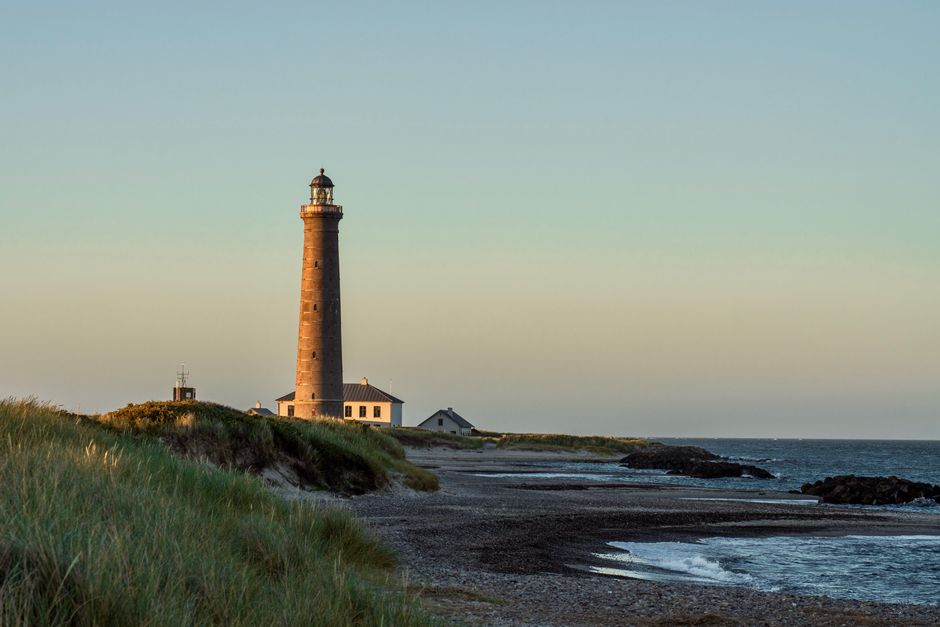
On the road to Grenen, the Grey Lighthouse (Det Grå Fyr), lit in 1858, is about 46 m tall and Denmark’s second-tallest lighthouse. It now holds an exhibition on migratory birds and has 210 steps to a viewing platform over both seas and the Odde. As of October 2026, entry costs DKK 95 for adults, DKK 35 for children aged 4 to 15 and DKK 225 for a family; it is staffed daily 10:00–16:00 from 14 September to 25 October 2026, and from 26 October to 26 March you can climb the tower on a self-service ticket (DKK 50) daily 06:00–22:00, without the exhibition. Around it, German bunkers from the Second World War lie half sunk in the sand.
Museums
- Anchers Hus
- Drachmanns Hus
- Skagens Museum
Other sights
- Den Tilsandede Kirke (The Buried Church)
- Skagen Grey Lighthouse
Nature
- Grenen
- Råbjerg Mile
The Skagen light and the midsummer bonfire
Why did painters come here? Skagen is almost surrounded by sea, and on clear days the light reflects off the water and pale sand from all sides, sharp and silvery by day and softly blue in the long summer dusk, the “blue hour” that Krøyer loved. Skagen is also one of the sunniest corners of Denmark. On Sankt Hans Eve (23 June), the evening before midsummer, Skagen celebrates the way Krøyer painted it: crowds gather on the Sønderstrand beach south of the harbour, sing Holger Drachmann’s midsummer song (“Vi elsker vort land”), and a bonfire with a witch on top is lit at sunset. It is a lovely, local evening and well worth planning a trip around.
Beaches, cycling and food
Beaches
Skagen has two kinds of beaches. On the Kattegat side, Sønderstrand and Østerby beach have calmer, shallower water, better for families. On the Skagerrak side, Gammel Skagen and the long beaches south-west towards Kandestederne face the open sea, with bigger waves, wind and space; swim only in calm conditions and near other people, and never at Grenen. The water is cool even in summer, typically around 16–18 °C in July and August. Several beaches have Blue Flag status and summer lifeguards; check the flags.
Cycling and walking
The Odde is flat and criss-crossed with paved bike paths, which makes cycling the best way to get around: from the harbour to Grenen (3 km), to Gammel Skagen (4 km), to the buried church (2–3 km) and through the plantations towards Råbjerg Mile (about 15 km). Several shops in town rent bikes and e-bikes by the day. For walking, follow the marked trails through Skagen Klitplantage, the heath at Hulsig, the beach from Grenen to town, or the North Sea coast from Gammel Skagen. Wind is the only climb; plan rides so the wind is behind you on the way home.
Seafood at the harbour
Skagen is famous for its prawns (rejer), sold freshly cooked by the half kilo at the harbour fish shops to peel yourself and eat with bread, mayonnaise and lemon. The red fish sheds along the harbour are now restaurants serving fish soup, plaice, mussels and smoked fish; book a table on summer evenings. Try stjerneskud (“shooting star”), an open sandwich of fried and steamed fish, prawns and dressing, and a Skagen-style prawn salad (skagenröra to Swedish visitors). Brøndums Hotel, where the painters ate, still serves classic Danish dishes.
Activities and best months
- Beaches and swimmingSkagen has beaches on two seas: Sønderstrand and Damstederne on the calm Kattegat side are Blue Flag family beaches with fine sand, while Gammel Skagen on the west coast has bigger waves and is the place to watch the sunset. At Grenen, where the Skagerrak and Kattegat meet, swimming is strictly prohibited because of dangerous currents. · source
- CultureSkagens Museum, founded in 1908 by the artists themselves, has the world's largest collection of the Skagen Painters, including P.S. Krøyer's 'Hip, hip, hurra!'; the painters' homes, Anchers Hus and Drachmanns Hus, are open April to mid-October. The sand-buried church from the 14th century, the Grey Lighthouse with its migratory-bird exhibition and the Bunker Museum add to a day of culture. · source
- CyclingThe 560 km West Coast Cycle Route runs from the German border to Skagen and ends at Grenen, Jutland's northernmost point. Grenen is about 3 km from the town centre and can be reached on foot, by rented bike or on the Sandormen tractor bus (Easter to week 43). · source
Festivals and events
- Skagen Festival: Denmark’s oldest folk and roots music festival takes over the town in early summer; the 2027 festival runs from 30 June to 3 July 2027. Rooms sell out early.
- Sankt Hans Eve, 23 June: the midsummer bonfire and singing on Sønderstrand.
- Spring bird migration: from about March to May, thousands of birds of prey and other migrants pass over the Odde; Grenen and the Grey Lighthouse are the places to watch.
- Autumn and winter: storm watching at Grenen, food events and a quieter, local Skagen; the town is decorated for Christmas in December.
Day trips from Skagen
- Rubjerg Knude Lighthouse: a lighthouse half swallowed by a huge coastal dune on the cliffs near Lønstrup, about an hour’s drive south-west. In 2019 the whole tower was rolled about 70 m inland on rails to save it from falling into the sea.
- Hirtshals: North Sea fishing port with a big public aquarium (Nordsøen Oceanarium), and ferries to Norway; about 45 minutes by car.
- Frederikshavn and Sæby: the ferry port 40 km south, and the pretty small harbour town of Sæby beyond it; both on the train or bus line.
- Læsø: a quiet island in the Kattegat, with seaweed-thatched houses and salt meadows, reached by ferry from Frederikshavn (about 1 hour 30 minutes).
- Aalborg: North Jutland’s lively main city, with the Utzon Center, the Kunsten art museum and the harbourfront, about 1 hour 45 minutes by train.
Nearby destinations
- Gothenburg82 km
- Aarhus176 km
- Oslo244 km
- Copenhagen258 km
- Malmö280 km
Getting to Skagen
- By train: Skagen is the end of the line. The local Skagensbanen runs from Frederikshavn in about 35 minutes, with new battery-electric trains introduced in 2026. Since 17 January 2026, regional trains from Skagen run through Frederikshavn to Aalborg and on to Hobro, so many journeys to Aalborg (about 1 hour 45 minutes) need no change. From Copenhagen, take an intercity train to Aalborg (about 4 hours 15 minutes to 4 hours 30 minutes) and change; plan on about 6 hours door to door. In holiday periods, the regional trains run hourly instead of every half hour. Plan and buy tickets with DSB or Rejseplanen.
- By air: Aalborg Airport (AAL) has frequent flights from Copenhagen (about 45 minutes) and some international routes. From Aalborg, continue by train (about 2 hours from the airport, with a change in Aalborg) or by hire car (about 1 hour 15 minutes).
- By car: the E45 motorway runs north through Jutland to Frederikshavn, then route 40 continues to Skagen, about 5 hours from Copenhagen via the Great Belt Bridge (toll payable) and about 5 hours from Hamburg. Parking in central Skagen and at Grenen is limited and often paid in summer.
- By ferry: Frederikshavn has car ferries to Gothenburg in Sweden, Oslo in Norway and the island of Læsø, so Skagen fits neatly into a Scandinavian road trip.
Getting around Skagen
The centre, the harbour and the museum are all within a 15-minute walk of the station. For everything else, rent a bike: Grenen, the Grey Lighthouse, Gammel Skagen and the buried church are all an easy ride on flat bike paths, and Råbjerg Mile is a longer but rewarding trip. Local buses run by the regional transport company NT connect the town with Gammel Skagen and the surrounding area, with more services in summer; check times in the Rejseplanen app. A car is useful mainly for Råbjerg Mile and day trips further afield.
When to go and how long to stay
Skagen has a mild, windy maritime climate, cooler in summer and milder in winter than inland Denmark, and it is drier than most of the country. The table shows averages we calculated from the Danish Meteorological Institute’s (DMI) monthly records for its Skagen Fyr (lighthouse) station over the 15 years 2011–2025, the most recent DMI station data published; they are close to, but not the same as, official 30-year normals.
| Season | Average daily high | Average nightly low | Rain per month | What it’s like |
|---|---|---|---|---|
| Winter (Dec–Feb) | 4–6 °C | 0–3 °C | 46–63 mm | Raw, windy and dark by about 15:45 in December; storm watching at Grenen, many places closed |
| Spring (Mar–May) | 6 °C rising to 14 °C | 1–8 °C | 36–46 mm | The driest time of year; bird migration, bright days, cool winds |
| Summer (Jun–Aug) | 18–20 °C | 12–14 °C | 54–66 mm | Long light evenings (sunset after 22:00 in June), beaches, festivals and crowds |
| Autumn (Sep–Nov) | 17 °C falling to 9 °C | 12 °C falling to 5 °C | 58–78 mm | Mild September, then wetter and stormier; seasonal sights close in late October |
Skagen gets about 680 mm of rain a year, and the wind is almost constant, so it feels cooler than the thermometer says. July and the first half of August, the Danish school holidays, are the busiest and priciest weeks; June and late August to mid-September have long days, warm-enough weather and far more space.
Skagen in 1 day
Morning at Skagens Museum and Anchers Hus (in season), lunch on prawns at the harbour, then bike or bus out to Grenen to stand in two seas, with a climb of the Grey Lighthouse on the way back. Finish with sunset on the beach at Gammel Skagen.
Skagen in 3 days
Day 1 as above. Day 2: cycle to the buried church and on through the plantations to Råbjerg Mile, with a picnic on the dune, then a beach afternoon. Day 3: a slow morning in the old town and Drachmanns Hus, then a day trip to Rubjerg Knude Lighthouse or Hirtshals, or a walk along the North Sea beach from Gammel Skagen.
Weather month by month
Averages from DMI station values 2011–2020 (10-year average), Skagen Fyr · Last reviewed 4 Oct 2026
Where to stay in Skagen
- Skagen town: historic hotels such as Brøndums, small guesthouses and holiday flats near the harbour; best without a car.
- Gammel Skagen: classic seaside hotels and summer houses close to the sunset beach; quieter and more expensive.
- Holiday houses and campsites: Danes mostly rent summer houses (sommerhuse) by the week around Skagen, Kandestederne and Ålbæk, and there are several campsites near the beaches; book months ahead for July.
Practical tips for Skagen
- Respect the swimming ban at Grenen: it is there because people drown; paddle, don’t swim.
- Carry a little cash: the Sandormen wagon takes cash on board, and there is no mobile signal on the beach; otherwise cards work almost everywhere.
- Check seasons: Anchers Hus, Drachmanns Hus, the Sandormen and many restaurants close from late October to Easter, and the main museum is closed on Mondays outside summer.
- Book summer early: July rooms and festival weekends sell out months ahead.
- Protect the dunes: stay on paths in the plantations and heath, and don’t climb fragile dunes that are fenced or planted with marram grass.
What to pack for Skagen
Windproof layers in every season: even on sunny July days the wind off the sea is cool, and evenings on the beach get chilly. Bring a light waterproof jacket, a warm sweater, sunglasses and sun cream (the bright light reflects off sand and water), comfortable shoes for the sandy walk to Grenen, and sandals or bare feet for Råbjerg Mile. Swimwear and a towel in summer, binoculars for seals and birds, and in winter a hat, gloves and a proper coat.
What to pack
- Day packs and anti-theft bagsCarries water, towel and sunscreen down the long stairways to Algarve coves.
- Dry bags and phone pouchesProtects phones and cameras from sand and spray on beaches reached by ferry or steep paths.
- Quick-dry beach towelsA sand-shedding quick-dry towel packs small for beach days and lido visits.
- Rain jacketsA packable shell covers showers and wind on coastal routes outside summer.
- Reef-friendly sunscreenSummer UV is strong on Portuguese beaches and there is little shade below the cliffs.
- Water bottles and hydration packsRiding in the Algarve and Alentejo heat needs more water than you expect.
- Water shoesRocky coves, lava pools and weever fish in shallow sand make water shoes useful.
- WetsuitsOn the west and north coasts the sea stays around 16–18 °C even in summer, so a thin suit helps for long swims.
Skagen travel FAQ
Can you swim at Grenen?
No. Swimming at Grenen is forbidden and life-threatening because of strong currents and crossing waves. You can safely paddle at the water’s edge and stand with one foot in each sea. Swim instead at Sønderstrand or Gammel Skagen in calm weather.
How much does the Sandormen to Grenen cost?
As of October 2026, a return trip costs DKK 40 for adults and DKK 20 for children under 12. It runs daily from late March to late October (28 March to 24 October in 2026), leaving regularly from the Grenen car park. Pay cash on board or by card at the ticket machine before boarding.
How far is Grenen from Skagen?
The Grenen car park is about 3 km from the town centre, an easy bike ride or a 40-minute walk. From the car park it is another 1.5–2 km along the beach to the tip, about 30 minutes on foot.
Is Skagens Museum worth visiting?
Yes, even if you are not an art lover. The Skagen Painters’ pictures of the beaches, the light and the people you will see around you are some of the best-loved paintings in Scandinavia. Under-18s go free, and a combined ticket adds Anchers Hus and Drachmanns Hus in season.
How do I get to Skagen from Copenhagen?
Take the intercity train to Aalborg (about 4 hours 15 minutes to 4 hours 30 minutes), then a regional train to Skagen (about 1 hour 45 minutes); allow about 6 hours in all. Or fly to Aalborg in about 45 minutes and continue by train or car.
Can you climb the buried church tower?
In summer, yes, for a small fee paid at the kiosk by the car park. Outside the season the tower is usually closed, but you can walk around it freely at any time.
Is Råbjerg Mile free?
Yes. Råbjerg Mile is state-owned nature land, open at all times and free to visit, with a car park about 15 km south of Skagen. Go early or late on hot summer days, when the sand burns.
When is the best time to visit Skagen?
June and late August to mid-September are ideal: long days, mild weather and fewer people than in July. Come on 23 June for the midsummer bonfire, or in spring for bird migration. From late October to Easter, Skagen is quiet and many sights close.
When is Skagen Festival in 2027?
Skagen Festival, Denmark’s oldest folk music festival, runs from 30 June to 3 July 2027. Book your room as soon as you can.
Do I need a car in Skagen?
No. The train runs right into town, and a rented bike gets you to Grenen, the lighthouse, Gammel Skagen and the buried church on flat bike paths. A car only helps for Råbjerg Mile on a short visit and for day trips such as Rubjerg Knude.
Sources
- © OpenStreetMap contributors · ODbL · fetched 4 Oct 2026
- Wikidata · CC0 · fetched 4 Oct 2026
Sources and last review
Researched and last reviewed on 4 October 2026. Sandormen season, prices and payment: sandormen.dk; Skagens Museum, Anchers Hus and Drachmanns Hus hours and the under-18 rule: skagensmuseum.dk; the Grey Lighthouse: detgraafyr.dk; Skagen Festival 2027: skagenfestival.dk; the through trains to Aalborg and Hobro: NT (ntrejse.dk); the Skagensbanen trains: Nordjyske Jernbaner; Grenen, the buried church and Råbjerg Mile: VisitNordjylland and the Danish Nature Agency; climate: our calculation from DMI station records for Skagen Fyr, 2011–2025. The adult museum price, train and driving times, the buried church tower fee and local bus details come partly from secondary sources or general knowledge and are flagged for checking. Prices, timetables and seasons change, so check the official links before you go.
Plan your trip
Partner links: TravelerCenter may earn a commission if you book, at no extra cost to you.
🇩🇰 Useful Danish phrases for Skagen
All 38 Danish phrases: restaurant, hotel, emergencies, romance (printable) →