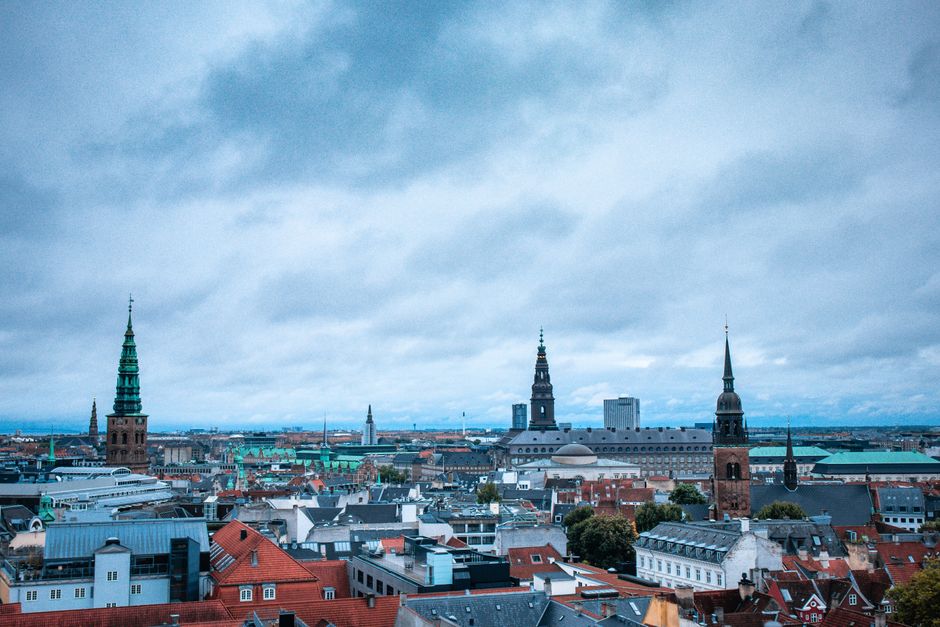
Copenhagen is a harbour city that lives on the water and on two wheels: painted gabled houses along the Nyhavn canal, green copper spires and palace domes, clean harbour water you can swim in, and more bikes than cars in the centre. You come to walk the lamplit paths of Tivoli Gardens, take a canal boat past the Opera and the Little Mermaid, see the crown jewels at Rosenborg and the changing of the guard at Amalienborg, climb the Round Tower, wander free-spirited Christiania, and eat your way from open sandwiches to new Nordic tasting menus. It is also the gateway to Hamlet’s castle at Helsingør, the Louisiana art museum on the coast and, across the Øresund Bridge, Malmö in Sweden. Give it three days for the city, four or five to add the coast and the castles.
Right now in Copenhagen
- Wed 13–15°C 55–59°F Cloudy
- Thu 11–15°C 52–58°F 10 mm Rain
- Fri 10–13°C 49–55°F 4 mm Rain
Weather: MET Norway (CC BY 4.0) · Sea temperature: NOAA CoastWatch · Air quality: OpenAQ · Rates: ECB
Top tours in Copenhagen
See all tours for Copenhagen →
From local operators, with prices and reviews; you check availability and book on Viator, our partner. We may earn a commission at no extra cost to you. How we earn money
Copenhagen at a glance
- Best for: Tivoli Gardens, royal palaces, design and architecture, canal tours, cycling, harbour swimming, food from street stalls to Michelin stars, and Christmas lights.
- How long: 3 days for Tivoli, the palaces, Nyhavn, a canal tour and the museums; 4–5 days to add Louisiana, Kronborg, Roskilde or Malmö.
- Best time: May to September for long light evenings, harbour baths and outdoor cafés; mid-November to early January for Tivoli’s Christmas season and the markets.
- Getting in: the metro runs from Copenhagen Airport to the centre in about 14 minutes, around the clock; as of October 2026 a single ticket costs DKK 30.
- Getting around: on foot, by bike, by metro and by harbour bus. As of October 2026, a City Pass Small for 24 hours of unlimited travel, including the airport, costs DKK 100; the Copenhagen Card DISCOVER (DKK 589 for 24 hours) adds 80+ attractions.
- Money: Denmark uses the Danish krone (DKK), not the euro; cards are accepted almost everywhere, even for a coffee.
Copenhagen, area by area
The compact old centre, Indre By, sits on the west side of the harbour, ringed by the city lakes and the old ramparts. Across the water lie Christianshavn and the former naval and industrial islands; west and north are the 19th-century districts of Vesterbro, Nørrebro and Østerbro, with Frederiksberg, a separate town, in the middle. Almost everything is within a 30-minute bike ride.
Indre By and Nyhavn
The historic core: City Hall Square and Tivoli at one end, the pedestrian shopping street Strøget running to Kongens Nytorv, Nyhavn’s canal, the royal quarter of Frederiksstaden with Amalienborg, the Latin Quarter around the university and the Round Tower, and Slotsholmen island with Christiansborg. Best for: first visits and short stays.
Christianshavn and Christiania
Built on reclaimed land in the 17th century on a Dutch model, Christianshavn has canals with houseboats, the corkscrew spire of Our Saviour’s Church, harbourside restaurants and the self-governing community of Christiania. Best for: atmosphere and waterside walks, a short stroll from the centre.
Vesterbro and the Meatpacking District
Behind the Central Station, the old working-class district has become the city’s most lively: Istedgade and Værnedamsvej for cafés and small shops, and Kødbyen, the former Meatpacking District, for restaurants, bars and clubs in white-tiled butchers’ halls. Best for: nightlife and good-value hotels near the trains.
Nørrebro, Østerbro and Frederiksberg
Multicultural Nørrebro has Jægersborggade’s small shops, the Superkilen urban park and Assistens Cemetery, where Hans Christian Andersen and Søren Kierkegaard are buried. Leafy Østerbro is quieter, with the Fælledparken park and the walk to the Little Mermaid. Frederiksberg has elegant avenues, Frederiksberg Gardens and Copenhagen Zoo. Best for: living like a local.
Refshaleøen, Nordhavn and the new harbour
Former shipyards and docks are now the city’s laboratory: Refshaleøen has food halls, galleries and restaurants in old industrial sheds, Nordhavn has new waterside housing and a harbour bath, and Amager has the CopenHill ski slope on a waste-to-energy plant. The harbour buses link them. Best for: modern architecture and evenings by the water.
Top things to see in Copenhagen
Prices and hours below were checked on the official sites in October 2026. They change, so check before you go. Children under 18 get into most state museums and the royal palaces free.
Tivoli Gardens
Opened in 1843, Tivoli is the third-oldest amusement park in the world and still the heart of the city, right by the Central Station: flower gardens, a lake, the Chinese-style Pantomime Theatre, wooden roller coasters next to modern thrill rides, concert stages, and more than 60 restaurants and food stalls. At dusk thousands of coloured lights come on, and that is the time to be there. Its newest area, Hikari, is inspired by Japan.
Seasons 2026–27. Tivoli is not open all year. Halloween in Tivoli runs from 2 October to 1 November 2026, with more than 20,000 pumpkins and two haunted houses. Christmas in Tivoli runs from 13 November 2026 to 3 January 2027 (closed on 24 December), with Christmas stalls, Santa’s house and fireworks on New Year’s Eve. Then come Easter (19–29 March 2027) and the summer season (30 March to 26 September 2027). Tickets: as of October 2026, entrance for ages 8 and over costs DKK 150 to 210 depending on the day (busier days cost more), children aged 3 to 7 pay half and under-3s go free. Rides cost extra: an Entrance and Ride Pass package costs about DKK 409 to 509, and a Ride Pass alone about DKK 199 to 319. Tickets are for a fixed date, so buy online once your plans are set. The Copenhagen Card covers one entry, but not rides.
Nyhavn and a canal tour
Dug in the 1670s to bring ships to Kongens Nytorv, Nyhavn (“New Harbour”) is the city’s postcard: a quay of red, yellow and blue 17th- and 18th-century houses, wooden sailing ships and outdoor tables. Hans Christian Andersen lived at numbers 20, 67 and 18. Come for the view, early or at golden hour; the quayside restaurants are pricey.
The best way to understand Copenhagen is from a boat. Stromma’s Classic Canal Tour, sailing since 1904, leaves from Nyhavn, Ved Stranden and Ofelia Plads and loops round the harbour, the Christianshavn canals, the Opera House, Amalienborg and the Little Mermaid in about an hour, with a live or audio guide. As of October 2026 it costs from DKK 199 (less online), runs all year in covered, heated boats in winter, and is included in the Copenhagen Card from Ved Stranden. The yellow harbour buses (lines 991, 992 and 993) are a cheaper way to see the waterfront on an ordinary transport ticket.
Rosenborg Castle and the King’s Garden
Christian IV built this small red-brick Renaissance castle in the early 17th century as his favourite residence. Its rooms keep their original painted ceilings and tapestries, the Knights’ Hall has the coronation thrones guarded by three life-size silver lions, and the basement treasury holds the Danish crown jewels and regalia. The King’s Garden (Kongens Have) around it is the city’s oldest park and free. Visiting: as of October 2026 Rosenborg opens daily 10:00–17:00 until 1 November, then Tuesday to Sunday 10:00–16:00 from 2 November to 23 December; it is closed on 24 and 25 December. Entry is by timed ticket and the castle can sell out on busy days, so book ahead.
Amalienborg and the Marble Church
Four identical rococo palaces around an octagonal square form Amalienborg, the royal family’s Copenhagen home. The Royal Life Guards in bearskin hats change guard in the square daily at noon, after marching from Rosenborg. The Amalienborg Museum in Christian VIII’s Palace shows the private rooms of recent kings and queens and a Fabergé chamber; as of October 2026 it opens daily 10:00–16:00 until 1 November, then Tuesday to Sunday. Behind the square rises the great green dome of Frederik’s Church, the Marble Church; in front, the Amalie Garden runs down to the harbour and the Opera House across the water.
Christiansborg Palace
On the island of Slotsholmen, where Bishop Absalon built the first castle in 1167, Christiansborg houses the Danish parliament, the Prime Minister’s office and the Supreme Court, and is still used by the monarch for state occasions. Visitors can see the Royal Reception Rooms with their tapestries of Danish history, the ruins of the earlier castles underneath, the Royal Kitchen and the Royal Stables, and climb the palace tower for a free view. As of October 2026, the Reception Rooms, ruins and kitchen open 10:00–17:00 daily until 1 November and the stables 13:30–16:00; the Reception Rooms close from 14 to 21 October 2026 and the whole palace on 19 October. It is a working palace, so check the week’s hours before you go.
Royal Palace Pass: as of October 2026, one ticket covering Rosenborg, the Amalienborg Museum and Christiansborg costs DKK 255 (DKK 245 online) and is valid for 72 hours from your first visit; you book a time slot only for Rosenborg. Under-18s go free to all three but still need a ticket. All three are also included in the Copenhagen Card.
The Round Tower
Christian IV built the Rundetaarn in 1642 as an observatory for the university. Instead of stairs, a wide spiral ramp winds up past the Library Hall to a platform with a 360-degree view over the rooftops of the old town; at the top, Europe’s oldest functioning observatory opens its telescope on winter evenings. As of October 2026, it costs DKK 60 for adults and is free for under-18s. It is not included in the Copenhagen Card. From October to March it opens 10:00–21:00 on Mondays and Tuesdays and 10:00–18:00 from Wednesday to Sunday; from April to September, 10:00–20:00 daily.
The Little Mermaid and Kastellet
Edvard Eriksen’s bronze statue of Andersen’s heroine has sat on a rock at Langelinie since 1913. She is famously small (about 1.25 m), often surrounded by tour groups, and free. Combine her with a walk through Kastellet, a star-shaped 17th-century fortress with grassy ramparts.
Christiania
In 1971, squatters took over an abandoned army barracks in Christianshavn and declared the “Freetown” of Christiania. Today it is a legally recognised community of about 900 people with handmade houses, workshops, cafés, music venues such as Loppen, and lakeside paths along the old ramparts. After years of gang crime around the cannabis stalls on Pusher Street, residents dug up the street in 2024 and the area is being redeveloped. Visitors are welcome, but residents ask you not to run and not to take photos where signs say so, and to respect that people live here. Guided tours by residents explain its story.
The National Museum
Denmark’s history from reindeer hunters to the present: Bronze Age treasures such as the Sun Chariot and the Egtved Girl, lurs and gold horns, a large Viking exhibition, and rooms on Danish life through the centuries. As of October 2026 it opens daily 10:00–17:00 and costs DKK 150 (DKK 135 online); under-18s are free. The hands-on Children’s Museum closes on 18 October 2026 and will reopen in a new form in summer 2027.
SMK and the Glyptotek
SMK, the National Gallery of Denmark, has Danish Golden Age painting, Hammershøi, Matisse and old masters in a 19th-century palace joined to a white modern wing by the park. As of October 2026 it costs DKK 140 (DKK 95 under 27, free under 18) and opens Tuesday to Sunday 10:00–18:00, until 20:00 on Wednesdays. The galleries are being rehung in stages from 2027 to 2029: the European Art 1300–1800 display closes on 1 November 2026 and reopens in autumn 2027, but the museum stays open. The Ny Carlsberg Glyptotek, founded by the Carlsberg brewer Carl Jacobsen, has Roman portraits, Egyptian art, French Impressionists and a palm-filled Winter Garden under a glass dome. As of October 2026 it costs DKK 150 (DKK 135 online; free under 18, and for everyone on the last Wednesday of the month) and opens Tuesday to Sunday 10:00–17:00, until 21:00 on Thursdays. It plans a major restoration that will close it for part of a four- to six-year project; no closing date had been announced in October 2026.
CopenHill and the modern waterfront
Bjarke Ingels’ CopenHill is a waste-to-energy plant with an all-year artificial ski slope, a hiking trail, a climbing wall and a rooftop bar on top. The rooftop, the hiking path and the lift to the top are free during opening hours; skiing is booked separately.
Theme parks
- Tivoli Gardens
Palaces
- Amalienborg
- Christiansborg Palace
- Rosenborg Castle
Monuments
- The Little Mermaid
- The Round Tower (Rundetårn)
Historic centres
- Nyhavn
Copenhagen on the water and by bike
The harbour is so clean that the city has built free harbour baths into it: Islands Brygge, Fisketorvet (Kalvebod Bølge), Sluseholmen and Sandkaj in Nordhavn are the best known, with lifeguards in the summer season. Locals swim from June to September, and winter bathers keep going with a sauna. For a sandy beach, Amager Strandpark is 15 minutes from the centre by metro.
About half of Copenhageners cycle to work or school, on wide, separate bike lanes with their own traffic lights. Hotels and rental shops rent bikes by the day, and app-based bike and e-bike share schemes are available; the old white Bycyklen city bikes are no longer running. Ride on the right, signal with your hand before stopping or turning, use lights after dark, and never stop in the bike lane. See our cycling guide for more.
Festivals, Christmas and events
- Culture Night: on Kulturnatten, 9 October 2026, museums, churches and the parliament open into the evening with special programmes.
- Christmas 2026: Tivoli’s Christmas season (13 November to 3 January), stalls at Nyhavn and Højbro Plads, Christmas canal tours from November, and the floating Lucia parade on the canals on 13 December.
- Winter Jazz: Vinterjazz, a nationwide jazz festival with many Copenhagen concerts, runs from 29 January to 28 February 2027.
- Copenhagen Jazz Festival: about 1,000 concerts in clubs, squares and parks over ten days in early July (3–12 July in 2026); the 2027 dates had not been announced in October 2026.
Eat local: try smørrebrød (open sandwiches on rye) at lunch, a hot dog from a pølsevogn stand, a cinnamon kanelsnegl or other “Danish” pastry from a bakery, and æbleskiver with mulled gløgg at Christmas. Copenhagen has one of Europe’s highest concentrations of Michelin-starred restaurants; book the famous ones weeks ahead.
Activities and best months
- Beaches and swimmingAmager Beach Park (Amager Strandpark), 5 km from the centre and easy to reach by metro or bike, has 4.6 km of beaches: a lagoon with toddlers' pools on one side and a big sandy beach with dunes on the other. In summer there are kayaking and windsurfing, with views of the wind farm and the Øresund Bridge. · source
- Boat tripsThe classic canal tour takes an hour from Nyhavn or Ved Stranden, passing the Opera House, Amalienborg, Christiansborg, the Black Diamond library and the Little Mermaid, with daily departures, a live guide in Danish and English and audio guides in other languages. The Netto boats are a cheaper alternative from Holmens Kanal or Nyhavn. · source
- City sightseeingWonderful Copenhagen's list of top attractions starts with Tivoli Gardens and includes Rosenborg Castle with the Danish crown jewels, Amalienborg Palace, Christiansborg Palace (800 years of royal history), the Round Tower with its 360-degree view, the National Museum, SMK (Denmark's largest art gallery), the Glyptotek and the Little Mermaid. Kronborg Castle, a UNESCO World Heritage Site, is an easy day trip. · source
- CyclingWonderful Copenhagen calls the city the world's best bike capital: 49% of Copenhageners cycle to work or study, on bike lanes that work as their highways. Bikes, e-bikes and cargo bikes can be rented all over the centre or joined on guided bike tours; avoid the 07:00-09:00 and 15:00-17:00 rush and never stop in the middle of a bike lane. · source
- WaterJunJulAugYou can swim in the middle of Copenhagen at the harbour baths: Islands Brygge, just across the bridge from the centre, has five pools (two for children, from 30 cm deep) and 1, 3 and 5 m diving towers, with lifeguards from 1 June to 31 August, 10:00-18:00. The water is tested daily and a red flag means no swimming; in the harbour you may swim only at the harbour baths and marked bathing zones. · source
Day trips from Copenhagen
- Louisiana Museum of Modern Art, Humlebæk: one of Europe’s most beautiful museums, with Giacometti, Kusama’s infinity room and a sculpture park on the Øresund, about 35 minutes north by train. As of October 2026, it costs DKK 145 (free under 18) and opens Tuesday to Friday 11:00–22:00 and weekends 11:00–18:00, closed Mondays. A Remedios Varo exhibition runs until 10 January 2027.
- Kronborg Castle, Helsingør: the UNESCO-listed Renaissance castle of Shakespeare’s Hamlet, guarding the narrowest point of the Øresund, about 45 minutes by train. As of October 2026 it opens daily 10:00–17:00 and costs DKK 150 (DKK 135 online); children are free. “Christmas at Kronborg” runs from 30 November to 19 December 2026. Combine it with Louisiana on the same line.
- Roskilde: the Viking Ship Museum, with five ships raised from the fjord, and the royal burial cathedral, about 25 minutes by train.
- Frederiksborg Castle, Hillerød: a moated Renaissance palace with the Museum of National History and baroque gardens, at the end of the S-train line.
- Malmö, Sweden: across the Øresund Bridge, about 35–40 minutes by train from the Central Station, for the Turning Torso and the old squares. Carry your passport or national ID card: Sweden checks ID on this route at times. The Copenhagen Card does not cover the trip.
Nearby destinations
Getting to Copenhagen
By air. Copenhagen Airport (Kastrup), the largest in the Nordic countries, is 8 km south of the centre. The M2 metro line leaves from Terminal 3 and reaches the centre in about 14 minutes, every 2 to 3 minutes by day and all night at lower frequency. Because of the “ring zone” rule, the trip costs a three-zone ticket (DKK 30 as of October 2026). Regional trains also run to the Central Station in about 15 minutes.
By train. Copenhagen Central Station (København H) has direct trains from Hamburg (about 4 hours 30 minutes to 5 hours, depending on works) and from Malmö and Stockholm in Sweden, and fast trains across Denmark to Odense and Aarhus (about 3 hours). Coming from Germany, start in our Hamburg guide or Berlin guide. Denmark has run temporary checks at its internal borders for years, so carry your passport or ID card.
By car. Motorways link Copenhagen to Jutland over the Great Belt Bridge and to Sweden over the Øresund Bridge, both tolled. Parking in the centre is expensive and limited; leave the car at your hotel or a park-and-ride and use the metro.
Getting around Copenhagen and the Copenhagen Card
The metro has four driverless lines (M1 and M2 from Vanløse, the M3 City Circle and the M4 from Orientkaj to København Syd), running 24 hours a day. S-trains, buses and harbour buses share the same zone tickets. As of October 2026, a single ticket costs DKK 24 for two zones (most trips in the centre), DKK 30 for three and DKK 38 for four; two children under 12 travel free with an adult. You must have a valid ticket before you board; inspectors fine passengers without one.
- Rejsebillet app: the nationwide app for single tickets, zone tickets and the City Pass. It replaced the old DOT Billetter app at the end of 2025.
- Rejsekort app or Basiskort: check in and out and pay per trip, with a 20% discount outside rush hour (weekdays 11:00–13:00 and 18:00–07:00, and all weekend). An anonymous Basiskort card costs DKK 80 at stations and some 7-Eleven shops.
- City Pass: unlimited travel. As of October 2026, City Pass Small (zones 1–4, including the airport) costs DKK 100 for 24 hours, DKK 160 for 48 hours and DKK 220 for 72 hours; City Pass Large (the whole capital region, including Helsingør and Roskilde) costs DKK 200, DKK 320 and DKK 440. Children aged 12–15 pay half. Buy it in the Rejsebillet app or at ticket machines.
The Copenhagen Card DISCOVER includes 80+ attractions, among them Tivoli (entry only), Rosenborg, Amalienborg, Christiansborg, the National Museum, SMK, the Glyptotek, Louisiana, Kronborg, the Viking Ship Museum and Stromma’s classic canal tour, plus unlimited public transport in the whole capital region, airport included. As of October 2026, it costs DKK 589 for 24 hours, DKK 859 for 48 hours, DKK 1,039 for 72 hours, DKK 1,219 for 96 hours and DKK 1,419 for 120 hours for adults; juniors aged 12–15 pay DKK 399 to 789 and children aged 3–11 DKK 100 to 260. The HOP version (from DKK 600) swaps public transport for hop-on hop-off buses and covers 40+ central attractions. It pays off if you visit three or four paid sights a day; with free under-18 entry at many museums, families should do the sums first.
When to go and how long to stay
Copenhagen has a mild, damp maritime climate: cool summers with very long days (17 hours of daylight in late June), and dark, grey winters with little snow. Spring is the driest time of year; late summer and autumn the wettest. The table is calculated from the Danish Meteorological Institute’s (DMI) station records for Copenhagen Airport (Kastrup), 2011–2025.
| Season | Average daily high | Average nightly low | Rain per month | What it’s like |
|---|---|---|---|---|
| Winter (Dec–Feb) | 4.1–5.9 °C | -0.3–1.9 °C | 42–63 mm | Dark by 16:00, raw and windy; Tivoli’s Christmas and cosy cafés |
| Spring (Mar–May) | 7.6 °C rising to 17.0 °C | 0.7 °C rising to 8.1 °C | 28–35 mm | Driest season; cherry blossom, Tivoli reopens, outdoor tables return |
| Summer (Jun–Aug) | 20.9–22.4 °C | 12.2–14.2 °C | 50–71 mm | Long light evenings, harbour swimming, jazz festival; showers possible |
| Autumn (Sep–Nov) | 18.8 °C falling to 8.7 °C | 11.6 °C falling to 4.5 °C | 53–73 mm | Mild September, wet and windy October; Halloween in Tivoli |
Copenhagen gets about 630 mm of rain a year, spread over many light showers rather than heavy downpours. July and August are busiest and most expensive; May, June and early September have the best balance of weather and crowds.
Copenhagen in 3 days
Day 1: Strøget, the Round Tower, Rosenborg and the King’s Garden, Torvehallerne for lunch, then Tivoli in the evening. Day 2: Nyhavn and a canal tour, the changing of the guard at Amalienborg, the Marble Church, Kastellet and the Little Mermaid, and dinner in the Meatpacking District. Day 3: Christiansborg and the National Museum, then cross to Christianshavn for Our Saviour’s Church and Christiania, and end with a harbour swim or the view from CopenHill.
Copenhagen in 5 days
Add a day north to Louisiana and Kronborg by train, a day for Roskilde’s Viking ships or Frederiksborg, and an easy half-day by bike through Nørrebro and Frederiksberg, or a trip over the bridge to Malmö.
Weather month by month
Averages from DMI station series 1991–2020, Copenhagen (Landbohøjskolen) (temperature, sun); DMI normals 1991–2020 as submitted to the WMO (rain) · Last reviewed 4 Oct 2026
Where to stay in Copenhagen
- Indre By and Nyhavn: historic and design hotels close to everything; the priciest area.
- Vesterbro: many hotels around the Central Station and Tivoli, from hostels to boutique; lively at night and handy for the airport trains.
- Christianshavn: a few hotels and apartments by the canals, a short walk or one metro stop from the centre.
- Nørrebro, Østerbro and Frederiksberg: apartments and smaller hotels for a local feel and lower prices.
Copenhagen is one of Europe’s most expensive cities for hotels, especially in summer. Book early, or stay further out on a metro line.
Practical tips for Copenhagen
- Mind the bike lanes: do not walk or stand in them; cyclists are fast and expect a clear path.
- Buy tickets first: you cannot board the metro without a ticket, and inspectors are common. Check in and out if you use the Rejsekort app.
- Cards everywhere: almost every shop, bar and market stall takes cards; some take only cards. Tipping is not expected, as service is included.
- Book the big names: Rosenborg time slots, top restaurants and Tivoli on Friday Rock nights.
- Check Tivoli’s season: it is closed between seasons, for example from early January to mid-March.
What to pack for Copenhagen
A windproof, waterproof jacket in every season, layers (even July evenings can be cool by the water), comfortable shoes for cobbles, and a warm coat, hat, scarf and gloves from November to March. In summer, pack swimwear and a towel for the harbour baths, and sunglasses for the long evenings. If you plan to cycle, a small backpack beats a shoulder bag.
What to pack
- City walking shoesLisbon and Porto are steep, with polished limestone cobbles that get slippery, so grippy soles matter.
- Day packs and anti-theft bagsCarries water, towel and sunscreen down the long stairways to Algarve coves.
- Dry bags and phone pouchesProtects phones and cameras from sand and spray on beaches reached by ferry or steep paths.
- Fleeces and warm layersIt is cooler at sea than on land, especially on morning whale-watching trips.
- Quick-dry beach towelsA sand-shedding quick-dry towel packs small for beach days and lido visits.
- Rain jacketsA windproof, waterproof shell keeps you warm on open boats, where wind and spray cool you quickly.
- Reef-friendly sunscreenSummer UV is strong on Portuguese beaches and there is little shade below the cliffs.
- Travel adapters and convertersPortugal uses Type C and F sockets at 230 V, so most visitors from outside Europe need an adapter.
- Water bottles and hydration packsRiding in the Algarve and Alentejo heat needs more water than you expect.
- Water shoesRocky coves, lava pools and weever fish in shallow sand make water shoes useful.
- WetsuitsOn the west and north coasts the sea stays around 16–18 °C even in summer, so a thin suit helps for long swims.
Copenhagen travel FAQ
Is Tivoli Gardens open all year?
No. In 2026–27 it opens for Halloween (2 October to 1 November 2026), Christmas (13 November 2026 to 3 January 2027, closed 24 December), Easter (19–29 March 2027) and summer (30 March to 26 September 2027).
How much does Tivoli cost?
As of October 2026, entrance costs DKK 150 to 210 for ages 8 and over, depending on the date; children aged 3 to 7 pay half and under-3s are free. Rides are extra: an Entrance and Ride Pass package costs about DKK 409 to 509.
Is the Copenhagen Card worth it?
Usually, if you visit three or more paid sights a day or take a day trip to Louisiana and Kronborg. As of October 2026, the DISCOVER card costs DKK 589 for 24 hours and DKK 859 for 48 hours, with public transport and the airport included. The Round Tower is not covered.
How do I get from Copenhagen Airport to the city?
Take the M2 metro from Terminal 3: about 14 minutes to the centre, around the clock. As of October 2026, a three-zone ticket costs DKK 30, or use a City Pass Small (DKK 100 for 24 hours), which includes the airport.
Which app do I need for public transport in Copenhagen?
Rejsebillet for single tickets and the City Pass, or the Rejsekort app to check in and out with an off-peak discount. The old DOT Billetter app was replaced by Rejsebillet at the end of 2025. Ticket machines at stations also take cards.
Can you see the Danish crown jewels?
Yes, in the treasury of Rosenborg Castle. Book a timed ticket, or buy the Royal Palace Pass (DKK 255, or DKK 245 online, as of October 2026), which also covers Amalienborg and Christiansborg for 72 hours.
When is the changing of the guard at Amalienborg?
Every day at 12:00 in Amalienborg Palace Square. The guards march from Rosenborg through the city streets beforehand, so you can follow them.
Can you swim in Copenhagen harbour?
Yes. The water is clean enough to swim in at the free harbour baths such as Islands Brygge and Fisketorvet, which have lifeguards in summer. Do not jump into the canals elsewhere, where boats pass.
Is Christiania safe to visit?
Yes, by day it is a relaxed place for a walk, cafés and crafts. Residents dug up the notorious Pusher Street in 2024. Follow the community’s rules: do not run, and do not take photos where signs ask you not to.
How many days do you need in Copenhagen?
Three days covers Tivoli, the palaces, Nyhavn, a canal tour and a couple of museums. Five days lets you add Louisiana, Kronborg and Roskilde, or a trip to Malmö.
When is the best time to visit Copenhagen?
May to September for long days, outdoor life and harbour swimming; mid-November to early January for Tivoli’s Christmas season and the markets. Winter days are short and grey, but the city is cosy and quieter.
Sources
- © OpenStreetMap contributors · ODbL · fetched 4 Oct 2026
- Wikidata · CC0 · fetched 4 Oct 2026
Sources and last review
Researched and last reviewed on 4 October 2026. Tivoli seasons and ticket prices: Tivoli Gardens (tivoli.dk and its ticket shop); Rosenborg, Amalienborg, Christiansborg and the Royal Palace Pass: the Royal Danish Collection (kongernessamling.dk); the Round Tower: rundetaarn.dk; the National Museum and Kronborg: the National Museum of Denmark; SMK, the Glyptotek, Louisiana and CopenHill: their own websites; canal tours: Stromma; the Copenhagen Card: copenhagencard.com; fares, the City Pass and the Rejsebillet app: DOT (Din Offentlige Transport); the airport metro and the Rejsekort app: the Copenhagen Metro (m.dk); Vinterjazz and the jazz festival: Copenhagen Jazz Festival; climate: calculated from DMI open data for Copenhagen Airport (Kastrup), 2011–2025. Some details, such as Christiania’s rules, harbour bath seasons, bike sharing and train times, come from general knowledge or secondary sources and are flagged for checking. Prices, timetables and rules change, so check the official links before you go. Arriving from Germany? See our Hamburg guide; and for another great cycling and canal city, our Amsterdam guide.
Plan your trip
Partner links: TravelerCenter may earn a commission if you book, at no extra cost to you.
🇩🇰 Useful Danish phrases for Copenhagen
All 38 Danish phrases: restaurant, hotel, emergencies, romance (printable) →