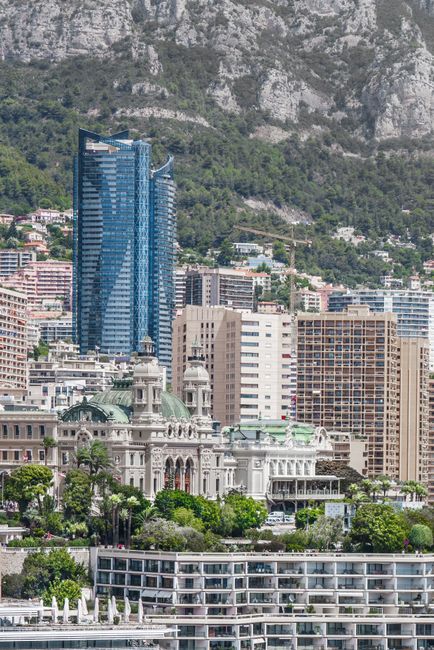
Monaco is the second-smallest country in the world: a principality of about 2 km² squeezed between the mountains and the Mediterranean on the French Riviera, a few kilometres from the Italian border. In a single day you can watch the changing of the guard outside the Prince’s Palace on the Rock, look at sharks and coral in the cliff-top Oceanographic Museum, walk part of the Formula 1 circuit through the streets of Monte Carlo, step inside the Belle Époque Casino and end with a swim at Larvotto beach. Monaco uses the euro and has an open border with France, so most visitors simply arrive by train or bus from Nice, 20–30 minutes away. Prices are high, but many of the best things are free: the views, the old town, the harbour and the gardens. Come from April to June or in September and October, avoid Grand Prix week unless you are coming for the race, and give it one full day, or two if you want the museums and an evening in Monte Carlo.
Right now in Monaco
- Wed 19–22°C 66–71°F 32 mm Heavy rain
- Thu 18–21°C 65–70°F 6 mm Showers
- Fri 16–20°C 61–68°F Mostly clear
Weather: MET Norway (CC BY 4.0)
Multi-day tours of Monaco
Multi-day tours from local operators. You check dates and book on Viator, our partner; we may earn a commission at no extra cost to you. How we earn money
Monaco at a glance: overview and geography
The Principality of Monaco covers only about 2.08 km², less than many city parks, and is surrounded on three sides by the French department of Alpes-Maritimes, with the sea on the fourth. It is a city-state: there is no separate capital, and the whole country is one continuous built-up area climbing steeply from the water to the foot of the Tête de Chien and Mont Agel, whose summits are in France. Around 38,000–39,000 people live here, according to the latest census figures published by Monaco’s statistics office, which makes it one of the most densely populated countries on Earth. Only about a fifth of residents are Monégasque citizens; the rest come from France, Italy, the United Kingdom and dozens of other countries, and tens of thousands more commute in every day from France and Italy.
The Grimaldi family has ruled Monaco since 1297, when, according to tradition, François Grimaldi took the fortress on the Rock disguised as a monk, which is why two sword-carrying monks appear on the princely coat of arms. Monaco lost Menton and Roquebrune in the 19th century and, short of money, reinvented itself as a resort: the Casino opened in Monte Carlo in the 1860s, the railway from Nice arrived soon after, and the principality became a winter playground for Europe’s wealthy. Prince Albert I, a pioneering oceanographer, built the Oceanographic Museum, which opened in 1910. Prince Rainier III married the American film star Grace Kelly in 1956, and their son, Prince Albert II, has reigned since 2005. Monaco is an independent sovereign state and a member of the United Nations, but it is closely tied to France by treaty for defence, customs and border control.
Monaco is famous for its tax regime, its superyachts and its motor racing, but it is also a real place with schools, markets and local festivals. The national day is 19 November, and the feast of Sainte Dévote, the patron saint, on 27 January is preceded on the evening of the 26th by the burning of a boat in front of her church. French is the official language; Italian and English are widely spoken in hotels and shops, and you will see the old Monégasque dialect on street signs in the old town.
Time zone: Monaco runs on Central European Time (UTC+1, UTC+2 in summer), the same as France and Italy.
The quarters of Monaco
- Monaco-Ville (the Rock): the old town on a rocky headland about 60 m above the sea, with the Prince’s Palace, the Cathedral, the Oceanographic Museum and quiet medieval lanes. Traffic is restricted, so most visitors walk up or take the bus.
- Monte Carlo: the glamorous quarter around the Casino, the Opera, the Hôtel de Paris and the luxury shops of the Golden Circle, with the Grimaldi Forum and the Japanese Garden on the seafront. It has its own TravelerCenter guide.
- La Condamine: the low-lying district around Port Hercule, the main harbour, with the daily market on Place d’Armes, the church of Sainte-Dévote, cafés and the start-finish straight of the Grand Prix circuit.
- Fontvieille: a modern district built on land reclaimed from the sea below the Rock, with a second marina, the Princess Grace Rose Garden, the Louis II Stadium, a shopping centre and the heliport.
- Larvotto and the east: the public beach, the Larvotto promenade and the new Mareterra district on reclaimed land next to it, towards the French border at Roquebrune-Cap-Martin.
- The upper districts: Moneghetti, the Jardin Exotique and Saint-Roman, mostly residential, with steep streets, viewpoints and free public lifts linking them to the coast.
Where to go in Monaco: the Rock, Monte Carlo and the harbour
Monaco is small enough to cross on foot in about an hour, though it is very steep, so the real question is not where to go but how to divide your time. Most people start on the Rock in the morning, go down to the harbour for lunch and spend the afternoon and evening in Monte Carlo. Free public lifts and escalators connect the levels, and the red Monaco buses cover the whole principality.
Monaco-Ville and the Prince’s Palace
The Rock is the historic heart of the principality and its most rewarding area for a first visit. On Place du Palais, with cannons and wide views over Port Hercule and Monte Carlo, the Prince’s Carabiniers change the guard every day at 11:55. The State Apartments of the Prince’s Palace, with their Renaissance frescoes, painted galleries and throne room, are open to visitors in season only: in 2026 from 30 March to 15 October, daily from 10:00 to 18:00 in September and October (last entry 17:15). Adult tickets cost €13, students €11 and children aged 6–17 €8; under-6s go free, and a combined ticket with the Oceanographic Museum costs €31 for adults (prices as of October 2026). Tickets are valid for the whole season but cannot be refunded, and the palace can close without notice because it is a working royal residence. It has stairs only, so it is not wheelchair accessible.
A few minutes away, the white stone Cathedral of Our Lady Immaculate, built at the end of the 19th century, holds the tombs of past princes and of Princess Grace and Prince Rainier III; entry is free outside services. The lanes between the palace and the cathedral are full of small restaurants and souvenir shops, and the Saint-Martin Gardens run along the cliff edge to the Oceanographic Museum.
The Oceanographic Museum
Built into the sheer cliff face of the Rock, the Oceanographic Museum is Monaco’s most popular sight and a good one for families. Its aquarium shows Mediterranean and tropical sea life, including a large shark lagoon and a living coral reef, and the upper floors hold Albert I’s collections, research vessels’ instruments and changing exhibitions. The roof terrace has one of the best views in Monaco. As of October 2026 an adult ticket costs about €20.50–22.50 depending on how and when you buy (online is cheaper), students and children aged 4–17 about €13–14, and under-4s go free. The museum opens every day except Christmas Day and the Formula 1 Grand Prix weekend: 10:00–18:00 from October to March, 10:00–19:00 in April, May, June and September, and 9:30–20:00 in July and August, with last admission 30 minutes before closing. Allow about two hours.
Monte Carlo
Monte Carlo is the Monaco of postcards: the Casino and its gardens, the Hôtel de Paris and the Café de Paris on Place du Casino, supercars parked outside and the Opera’s Salle Garnier behind. You can visit the Casino’s gaming rooms in the morning as a sightseer, or go in to play from 14:00 if you are over 18 and dressed for it. The quarter also has the best-known stretch of the Grand Prix circuit, from Casino Square down to the Fairmont hairpin and the tunnel, and the Japanese Garden and Larvotto beach by the sea. See our separate Monte Carlo guide for Casino rules, prices and a walking route.
La Condamine and Port Hercule
Port Hercule is the principality’s main harbour, lined with yachts of every size and, on the opposite side, the grandstands of the Grand Prix in late spring. La Condamine, around it, is the most lived-in part of Monaco: the morning market on Place d’Armes, the covered food hall, bakeries and reasonably priced lunch places on Rue Princesse Caroline. The little church of Sainte-Dévote sits in a ravine at the end of the harbour, at the first corner of the circuit. The Prince’s car collection, around a hundred vehicles from a 1903 De Dion-Bouton to Formula 1 cars, moved in 2022 to a new building on the Port Hercule side; it costs €15 for adults (€10 for children aged 6–17) as of October 2026 and closes on Grand Prix weekends, 19 November and 25 December. In summer a solar-powered boat bus crosses the harbour, and in winter an outdoor skating rink replaces the swimming pool on the quay.
Fontvieille
Fontvieille, on the western side of the Rock, was built on reclaimed land from the 1970s onwards. It is quieter and more residential, with a small marina, the Louis II Stadium, home of AS Monaco football club, and the Princess Grace Rose Garden, a free park with several thousand rose bushes. Monaco’s heliport, with flights to Nice airport, is here too.
Larvotto beach and Mareterra
Larvotto is Monaco’s free public beach, a sheltered stretch of fine pebbles and imported sand protected by breakwaters, redeveloped in the early 2020s with a new promenade, showers and beach clubs. Next to it, Mareterra is a new eco-district built on about six hectares of land reclaimed from the sea, with gardens and a seafront path. Further east, beyond the border, the Monte-Carlo Beach hotel and Cap Martin are actually in France.
Beyond the border: Èze, La Turbie, Menton and Nice
Monaco’s neighbours are worth adding. The medieval perched village of Èze, the Roman Trophy of Augustus at La Turbie, with its view down onto the whole principality, and the coastal path around Cap Martin are all within half an hour. Lemon-scented Menton, the last French town before Italy, is ten minutes away by train, and Villefranche-sur-Mer, Beaulieu and Nice lie in the other direction. Many visitors sleep in Nice and day-trip to Monaco; see our Nice guide, our Provence guide and our France guide for the wider region.
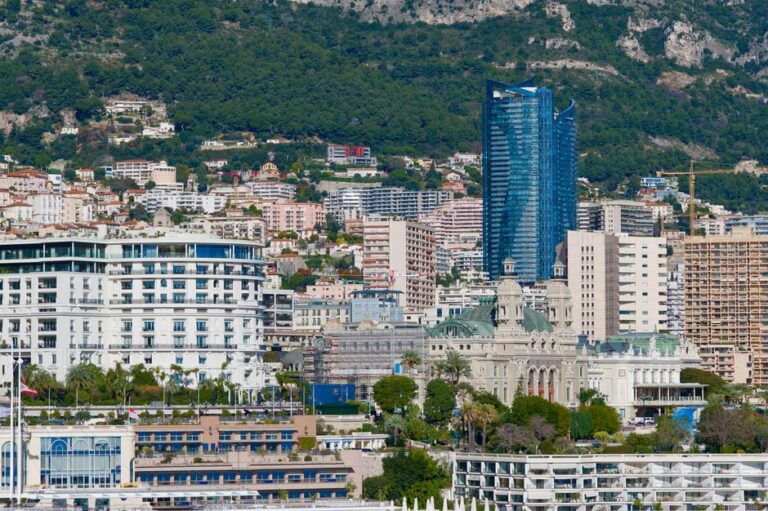
Monte Carlo Travel Guide
Plan a visit to Monte Carlo: the Casino de Monte-Carlo with 2026 prices, hours, age and ID rules and the dress code, Place du…
Best time to visit Monaco
Monaco has a Mediterranean climate, sheltered by the mountains behind it: mild, fairly sunny winters, warm springs and hot, dry summers, with most rain falling in autumn. Monaco has no long-term climate normals published in a form we could check, so the table below uses Météo-France’s official 1991–2020 averages for Nice, about 15 km away along the same coast. Monaco is usually similar, and often a degree or so milder on winter nights.
| Season (Nice, 1991–2020) | Average afternoon high | Average night low | Days with rain a month | What it’s like |
|---|---|---|---|---|
| Spring (Mar–May) | 15–21 °C | 8–15 °C | 5–6 | Pleasant for walking; the sea is still cool; Grand Prix set-up from May into early June. |
| Summer (Jun–Aug) | 25–28 °C | 18–21 °C | 2–4 | Hot and dry, good for swimming; peak crowds and hotel prices. |
| Autumn (Sep–Nov) | 25 °C falling to 17 °C | 18 °C falling to 10 °C | 5–9 | Warm sea in September; October and November are the wettest months, with heavy downpours. |
| Winter (Dec–Feb) | 13–14 °C | 6–7 °C | 5–6 | Mild and often sunny; quiet, cheaper, with the opera season and the circus festival. |
Overall, the best months are May, June and September: warm enough to swim, with long days and fewer crowds than July and August. April and October are good for sightseeing. Late May or early June is dominated by the Grand Prix, when hotel prices soar, roads and pavements are closed for days of set-up, and some sights shut. The sea is usually warmest, at around 24–25 °C, in August and early September.
Monaco’s events calendar for 2027
- Rallye Monte-Carlo: 21–24 January 2027, followed by the Rallye Monte-Carlo Historique from 27 January to 3 February 2027 (Automobile Club de Monaco).
- Sainte Dévote: 27 January, with the traditional burning of a boat the evening before. The International Circus Festival of Monte-Carlo also takes place in January; check the 2027 dates when they are published.
- Monaco E-Prix: 1–2 May 2027 (Formula E, on a shortened version of the street circuit).
- Formula 1 Grand Prix de Monaco: 3–6 June 2027, the 84th edition, with the race on Sunday 6 June. The Automobile Club de Monaco has confirmed that 2027 is the first Monaco Grand Prix with the Sprint format, meaning two qualifying sessions and two races. Tickets are on sale on the official sites. In 2027 the Grand Prix moves to early June, so check the date if you are planning a late-May trip.
- Grand Prix de Monaco Historique: this historic car race is held every two years; the next edition is in 2028, not 2027.
- Monaco Yacht Show: 22–25 September 2027 at Port Hercule; tickets are sold online only.
- National Day: 19 November, with a mass, a parade on the Rock and fireworks the evening before.
Monaco itineraries: one day to a Riviera week
One day in Monaco
Arrive by train from Nice and walk up to the Rock for the changing of the guard at 11:55. Visit the Prince’s Palace (in season) or the Cathedral, then the Oceanographic Museum, and have lunch on the Rock or down in La Condamine. In the afternoon walk around Port Hercule, past the yachts, and up to Place du Casino; take photos of the Casino and the Hôtel de Paris, look into the Casino atrium, then walk down past the Fairmont hairpin to the Japanese Garden and Larvotto beach. Have an early evening drink near the Casino before the train back.
Two days in Monaco
On the second day, add the car collection on Port Hercule, the Princess Grace Rose Garden in Fontvieille, the Jardin Exotique if you want cacti and a view, a swim at Larvotto, and a morning visit inside the Casino’s gaming rooms. In the evening, book an opera or concert at the Salle Garnier or the Grimaldi Forum, or dress up for the Casino after 14:00.
Four days to a week on the Riviera
Base yourself in Nice and use the train and buses. Spend a day in Monaco, then add Èze and the Trophy of Augustus at La Turbie, Villefranche and Cap Ferrat, Menton and its gardens, and Antibes and Cannes in the other direction. With a week, add the hill villages of the hinterland or a few days further west in Marseille and Provence. Our city sightseeing guide has more ideas for combining cities.
Entry rules, money and costs
Entry and borders
Monaco is not a member of the European Union or formally part of the Schengen area, but it applies Schengen rules through its treaties with France, which handles immigration and customs on its behalf. In practice, the border between Monaco and France is open: there are no passport checks when you arrive by train, bus or car, and a Schengen visa (where you need one) covers Monaco. Visitors who need a visa for France need one for Monaco.
Because almost everyone reaches Monaco through France, the rules that matter are the Schengen ones. Since 10 April 2026 the EU’s Entry/Exit System (EES) has been fully operational at the Schengen area’s external borders: non-EU visitors on short stays, such as British, American, Canadian and Australian travellers, have their passport scanned, a photo taken and (from age 12) fingerprints recorded when they first enter, for example at Nice airport. It is free and replaces passport stamps, and the record lasts three years. The 90-days-in-180 rule applies across the whole Schengen area. Your passport must have been issued less than 10 years before you arrive and be valid for at least three months after you plan to leave the Schengen area. ETIAS, the EU’s planned travel authorisation, is not in operation as of October 2026: the EU has not set a start date, the fee will be €20, and press reports point to 2027. Arriving by yacht from outside the Schengen area is different: you must clear immigration with the maritime police in port.
Carry your passport or national ID card in Monaco, as you may need it for the Casino, hotels and any police check. France handles customs for Monaco, and the usual EU rules apply, including declaring €10,000 or more in cash.
Money
Monaco uses the euro and mints its own euro coins, which collectors prize. Cards are accepted almost everywhere, including contactless payment on the buses, and cash machines are easy to find. Service is usually included in restaurant bills; rounding up or leaving 5–10% for good service is appreciated but not expected.
How expensive is Monaco?
Monaco is one of the most expensive places in Europe to sleep and eat, but a day trip can be surprisingly affordable. Buses cost €2 on board, the public lifts are free, and the views, gardens, Cathedral, harbour and beach cost nothing. The figures below are our estimates for one person per day, sharing a double room, as of October 2026.
| Style | Estimated cost per day | What that looks like |
|---|---|---|
| Day trip from Nice | about €40–80 | Train, a bus pass, lunch in La Condamine, the Oceanographic Museum or the palace |
| Mid-range stay | about €250–450 | A 3- or 4-star hotel in Monaco or next door in Beausoleil, restaurant meals, museums |
| High-end | about €800+ | A palace hotel in Monte Carlo, fine dining, the Casino at night, a boat or helicopter transfer |
Hotel prices can triple during the Grand Prix and the Yacht Show. For better value, stay in Nice, Menton or the French towns that border Monaco, Beausoleil and Cap-d’Ail, which are a short walk from the centre.
Getting there and getting around
By air
Monaco has no airport. The nearest is Nice Côte d’Azur, about 30 km away. From the airport, the ZOU! regional bus line 80 runs along the coast to Monaco and Menton, or you can take the tram into Nice and then the train. A taxi takes about 30–40 minutes depending on traffic. Helicopter shuttles fly from Nice airport to the Monaco heliport in Fontvieille in about seven minutes, a popular, if expensive, way to arrive; book with the operators directly.
By train
The easiest way in. Regional TER trains (branded ZOU! in the Provence-Alpes-Côte d’Azur region) run frequently along the coast between Cannes, Nice, Monaco and Menton, with some continuing to Ventimiglia in Italy. Nice to Monaco takes about 20–25 minutes, and a single ticket costs a few euros. The Monaco-Monte-Carlo station is underground, cut into the hillside, with several exits: follow the signs for the Rock and the harbour (La Condamine) or for Monte Carlo. The PASS Sud Azur Explore gives unlimited train, tram and bus travel across the Alpes-Maritimes and Monaco: €35 for 3 days, €50 for 7 days or €80 for 14 days for adults (as of October 2026, sold in agencies).
By bus from France
ZOU! buses run along the coast from Nice to Monaco, slower than the train but scenic, and stop at several points in the principality. In September 2026 ZOU! was recommending lines 600, 601 and 602 for the trip from Nice. Check the current timetable on the ZOU! website or app, as line numbers and fares change.
By car
Monaco has many well-signed public car parks, but traffic is heavy at rush hour, and only cars registered in Monaco or the Alpes-Maritimes (06) may drive up onto the Rock; everyone else parks below, for example at the Parking des Pêcheurs, and takes the lift. During the Grand Prix, and for weeks of set-up and dismantling before and after, many central roads are closed or diverted. Unless you are touring the Riviera, leave the car at your hotel.
Getting around Monaco
- On foot: the best way, but expect steep climbs and stairs. Dozens of free public lifts and escalators link the coast with the upper streets; look for the signs.
- Buses: the Compagnie des Autobus de Monaco runs about ten urban lines. As of October 2026, a single ticket bought on board costs €2; on the Monapass app a trip costs €1.50 and a 24-hour pass €5.50. You can also tap a contactless bank card on the validator for €1.50 per trip, capped at €5.50 per day (not American Express). Transfers are free within 30 minutes. Lines 1 and 2 serve the Rock (Place de la Visitation stop).
- Boat bus: a small solar-electric ferry crosses Port Hercule between Quai des États-Unis and Quai Antoine Ier; the same tickets and cards apply.
- Bikes and taxis: the Monabike electric bike-share system has stations around the principality, and taxis wait at the station, the Casino and the port.
Outdoors: beaches, swimming and walks
Monaco is mostly city, but you can still swim, walk and get out on the water. Larvotto is the main free beach, with lifeguards in season, and there are small rocky swimming spots below the Rock and in Fontvieille. Private beach clubs rent loungers in summer. In winter, the Rainier III swimming pool on Port Hercule becomes an ice rink.
For walkers, the coastal path from Monaco’s eastern edge around Cap Martin to Menton is one of the nicest easy walks on the Riviera, and steeper paths climb from Cap-d’Ail and Beausoleil towards La Turbie and the Tête de Chien. In summer, boat trips run from Port Hercule along the coast. See our hiking guide, our beaches guide and our boat trips guide for the wider Riviera.
Safety, health and staying connected
Monaco is one of the safest places in Europe, with police and cameras everywhere and very little street crime. The usual care applies on crowded trains from Nice and on Grand Prix weekend. The general emergency number is 112, and the police number is 17. The Princess Grace Hospital Centre (CHPG) is the main hospital.
Tap water is safe to drink. Plugs are the European two-pin type (C/E/F) at 230 V. Monaco has its own country code, +377, and its own mobile network, Monaco Telecom. Monaco is not in the EU, so the EU’s roam-like-at-home rules do not automatically apply: some European phone plans include Monaco, others charge it as a non-EU country, and phones near the border may switch between French and Monégasque networks. Check with your provider before you go.
Food and culture
Monaco’s food is Niçois and Ligurian at heart. Try barbagiuan, the national snack, a fried pastry stuffed with Swiss chard, ricotta and herbs; socca, a thin chickpea pancake; pissaladière, onion and anchovy tart; stocafi, dried cod stewed with tomatoes and olives; and fougasse monégasque, a sweet orange-flower bread topped with aniseed sprinkles in the national colours. The market and food hall on Place d’Armes in La Condamine are the best places for an inexpensive lunch. At the other end of the scale, Monaco has several Michelin-starred restaurants, including Alain Ducasse’s Louis XV at the Hôtel de Paris.
Culture punches far above the country’s size. The Opéra de Monte-Carlo, the Monte-Carlo Philharmonic Orchestra and Les Ballets de Monte-Carlo perform mainly from autumn to spring, the Grimaldi Forum hosts big summer exhibitions, and the Nouveau Musée National de Monaco shows contemporary art. Remember that the Rock, the Cathedral and the Palace square are places where local people live and worship: dress respectfully inside churches, and note that beachwear and bare chests are not welcome in the streets away from the beach.
Things to do in Monaco
- Watch the changing of the guard at 11:55 on Place du Palais.
- Tour the Prince’s Palace State Apartments (late March to mid-October).
- See the sharks, corals and the rooftop view at the Oceanographic Museum.
- Visit the tombs of Princess Grace and Prince Rainier in the Cathedral.
- Walk the Saint-Martin Gardens along the cliffs of the Rock.
- Look inside the Monte Carlo Casino, as a morning visitor or an evening player.
- Walk the Grand Prix circuit: Sainte-Dévote, Casino Square, the Fairmont hairpin, the tunnel and the harbour chicane.
- Admire a century of cars at the Prince’s car collection on Port Hercule.
- Swim at Larvotto beach and stroll through the Japanese Garden.
- Smell the roses in the Princess Grace Rose Garden in Fontvieille.
- Shop for barbagiuan and fresh produce at the Condamine market.
- Catch an opera or ballet in the Salle Garnier.
- Walk the coastal path around Cap Martin, or look down on the principality from La Turbie.
What to pack
For a summer visit, bring light clothes, a sun hat, sunglasses, sunscreen, a refillable water bottle and swimwear, plus water shoes for the pebbles and rocks. Comfortable shoes with grip are essential: Monaco is all slopes and steps. Pack one smarter outfit if you plan to visit the Casino gaming rooms or dine out in Monte Carlo (no shorts, sportswear or trainers after 14:00, and no T-shirts after 19:00), and something to cover shoulders in the Cathedral. From November to March, add a warm layer and a waterproof jacket, as autumn and winter storms can be heavy. Keep your passport or ID card with you.
Monaco travel FAQ
Is Monaco a separate country from France?
Yes. Monaco is an independent principality ruled by Prince Albert II, with its own government, flag and seat at the United Nations. It is closely linked to France by treaty, and the border between them is open.
Do I need a passport to go from France to Monaco?
There are no border checks between France and Monaco, but carry your passport or national ID card anyway. Non-EU visitors need to meet the Schengen entry rules, because they enter through France or another Schengen country.
Is Monaco in the EU or the Schengen area?
Neither formally, but it applies Schengen rules through France and uses the euro. A Schengen visa, where you need one, covers Monaco, and the EU’s Entry/Exit System registers non-EU visitors at the external border, for example at Nice airport.
When is the Monaco Grand Prix in 2027?
From 3 to 6 June 2027, with the race on Sunday 6 June. It is the first Monaco Grand Prix with the Sprint format. The Monaco E-Prix is on 1–2 May 2027.
How do I get from Nice to Monaco?
By train, in about 20–25 minutes, with frequent departures from Nice-Ville. ZOU! buses are slower but scenic, and helicopters from Nice airport take about seven minutes.
How many days do you need in Monaco?
One full day covers the Rock, the Oceanographic Museum, the harbour and the Casino. Two days let you add the car collection, the gardens, the beach and an evening in Monte Carlo.
Can I visit Monaco on a budget?
Yes, as a day trip. Stay in Nice or Menton, come by train, use the free public lifts and €2 buses, eat at the Condamine market and enjoy the free sights: the changing of the guard, the Cathedral, the gardens, the harbour and Larvotto beach.
What time is the changing of the guard in Monaco?
Every day at 11:55 in front of the Prince’s Palace on the Rock. Arrive ten minutes early for a good spot.
Can you visit the Prince’s Palace?
Yes, from late March to mid-October. In 2026 the State Apartments open from 30 March to 15 October; adult tickets cost €13. The palace can close without notice for official events.
Can anyone go into the Monte Carlo Casino?
Morning visits from 10:00 to 13:00 are open to all ages for €20 (free under 13). From 14:00 the gaming rooms are for over-18s only, with a passport or ID card, a dress code and a €20 entry fee. Our Monte Carlo guide has the details.
Can you swim in Monaco?
Yes. Larvotto is a free public beach with lifeguards in season, and there are rocky swimming spots and private beach clubs. The water is warmest in August and September.
Is Monaco safe?
Very. Crime is low and police are visible everywhere. Watch your belongings on crowded trains and during big events, and call 112 in an emergency.
What language do they speak in Monaco?
French is the official language. Italian and English are widely understood, and the traditional Monégasque dialect is taught in schools and appears on old-town street signs.
Sources and last review
Researched and last reviewed on 4 October 2026. Event dates for 2027 come from the Automobile Club de Monaco and the Monaco Yacht Show; palace prices and season from the Prince’s Palace visitor website; the changing of the guard and the car collection from the Palais Princier; Oceanographic Museum hours and prices from the museum; Casino rules and prices from the Société des Bains de Mer; bus fares from the Compagnie des Autobus de Monaco; regional passes from ZOU!; entry rules from the European Commission and the UK Foreign Office; climate averages from Météo-France (Nice station). The population, the train fare and journey time, helicopter details and the mobile roaming note come from secondary sources and are flagged for checking; daily costs are our estimates. Prices, timetables and rules change, so check the official sites before you travel.
Plugs and power in Monaco
Monaco uses 230 V, 50 Hz and these plugs (left) and wall sockets (right):
All plug types and voltages by country → · Check what you need to pack →
Plan your trip
Partner links: TravelerCenter may earn a commission if you book, at no extra cost to you.
🇫🇷 Useful French phrases for Monaco
All 38 French phrases: restaurant, hotel, emergencies, romance (printable) →