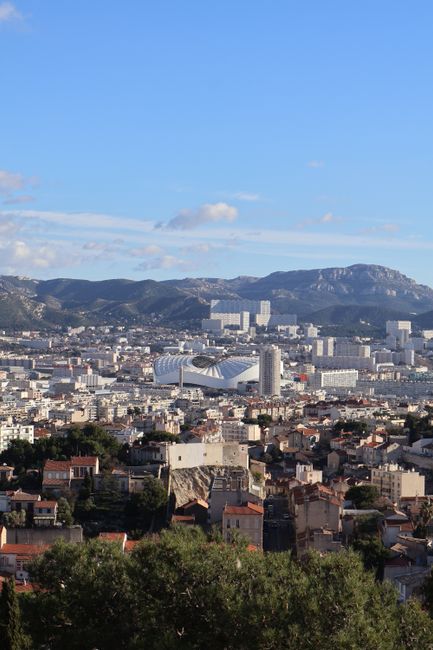
Marseille is France’s oldest city and its great Mediterranean port: a loud, sunny, multicultural place where fishing boats still sell their catch on the Vieux-Port, a gold-topped basilica watches over the bay and the white limestone cliffs of the Calanques National Park begin inside the city limits. It mixes big museums and old-town lanes with swimming spots, island boat trips and some of the best fish soup in the world. The best months are May, June and September, warm and sunny without the August crowds and fire-risk closures. Give the city two or three days, plus a day or two for the Calanques and Cassis.
Right now in Marseille
- Wed 18–20°C 64–67°F 43 mm Heavy rain
- Thu 15–18°C 58–64°F 3 mm Partly cloudy
- Fri 11–17°C 52–63°F Mostly clear
Weather: MET Norway (CC BY 4.0) · Sea temperature: NOAA CoastWatch · Rates: ECB
Top tours in Marseille
See all tours for Marseille →
From local operators, with prices and reviews; you check availability and book on Viator, our partner. We may earn a commission at no extra cost to you. How we earn money
Marseille at a glance
- Best months: May–June and September–October. Average highs run from about 24 °C in May to 31 °C in July, with only 1–3 rainy days a month in summer (Météo-France normals 1991–2020, Marseille-Marignane airport). Marseille is one of France’s sunniest cities, with about 2,900 hours of sunshine a year.
- Days needed: 2–3 for the city, 4–5 with the Calanques, Cassis and a day in Aix or Arles.
- Airport: Marseille Provence (MRS), at Marignane, about 25 km north-west of the centre. Shuttle bus A1 reaches Saint-Charles station in 25–35 minutes.
- Getting around: two metro lines, three tram lines and RTM buses for €1.70 a trip (as of October 2026), plus ferries across the port and out to the islands.
- Budget level: cheaper than Nice or Paris for food and rooms, though bouillabaisse is a splurge. A tourist tax is added per person per night. See our France guide for money, entry rules and daily costs.
- Summer rule to know: from 1 June to 30 September, access to the Calanques and other wild hills depends on the daily fire-risk map, and the Sugiton cove needs a free booking on summer days.
Marseille’s neighbourhoods
Marseille is big and spread out, but most visitors stay within walking distance of the Vieux-Port, with the coast road (the Corniche) running south towards the beaches and the Calanques.
- Vieux-Port: the old harbour, ringed with cafés, hotels and boat ticket booths, and the start point for island and Calanques cruises. The most convenient base, with the metro at the top of the quay.
- Le Panier: the oldest quarter, on the hill north of the port, with steep lanes, street art, small squares and craft shops. Charming by day, quieter at night.
- Noailles and Belsunce: the market streets behind the Canebière, with North African spice shops, bakeries and the city’s busiest food stalls. Lively and cheap; keep an eye on your bag.
- Cours Julien and La Plaine: the creative district on the hill east of the centre, with murals, bars, live music and vintage shops. Best for nightlife.
- La Joliette: the modern waterfront north of the MuCEM, with new hotels, the Terrasses du Port shopping centre and the ferry terminal for Corsica.
- The Corniche, Malmousque and Vallon des Auffes: the coast road south of the port, with sea-view villas, rocky swimming spots and the little fishing harbour of the Vallon des Auffes. Quieter and beautiful at sunset, a bus ride from the centre.
- Prado and Pointe Rouge: the southern beach districts, with the big Prado beach park, sailing clubs and seafood restaurants, on the way to Les Goudes and the Calanques.
Top things to see in Marseille
Prices and hours below come from the official websites, as of October 2026. Notre-Dame de la Garde, Le Panier, the Vieux-Port and the MuCEM’s rooftop gardens are all free.
Vieux-Port
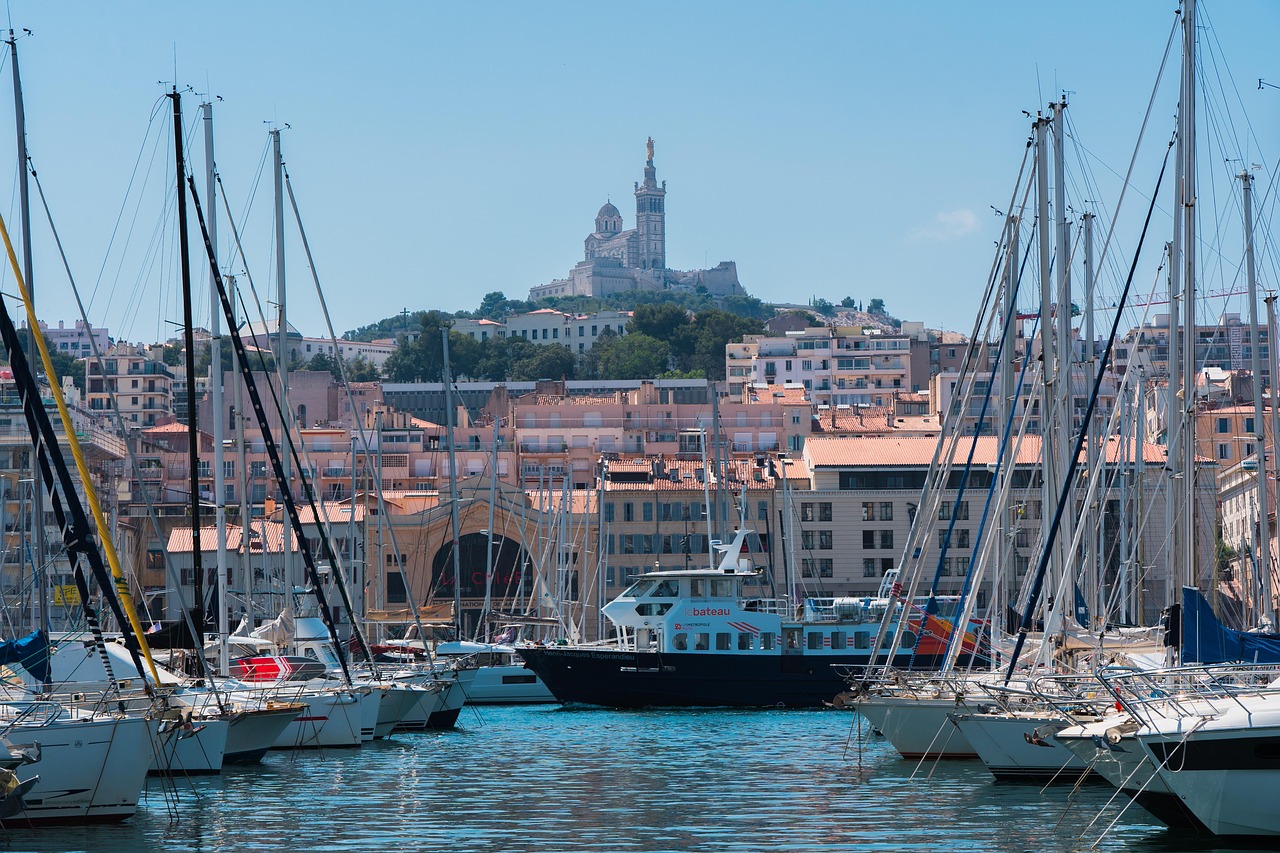
Marseille was founded here by Greek sailors around 600 BC, and the port is still the heart of the city. Come in the morning for the fish market on the Quai des Belges, stand under the mirrored Ombrière canopy at the eastern end, and take the little ferry boat that crosses the harbour. Two forts, Saint-Jean and Saint-Nicolas, guard the entrance.
Notre-Dame de la Garde
The 19th-century basilica on the city’s highest hill is topped by a gilded statue of the Virgin and Child that sailors called “La Bonne Mère”, the good mother. Inside, model ships and votive paintings thank her for rescues at sea, and the terrace has a 360° view over the city, the islands and the hills. How to visit: entry is free and the sanctuary opens daily from early morning until early evening; visits inside are limited during services. Walk up from the port (about 30–40 minutes, steep) or take RTM bus 60 from the Vieux-Port, which stops at the foot of the basilica.
MuCEM and Fort Saint-Jean
The Museum of European and Mediterranean Civilisations sits in a dark lace-like concrete cube on the harbour mouth, linked by a footbridge to the 17th-century Fort Saint-Jean. Its exhibitions cover Mediterranean history and everyday culture. How to visit: open every day except Tuesday (and 1 May and 25 December), from 10:00, closing at 18:00–20:00 depending on the season; last entry 45 minutes before closing. A ticket is €11 (reduced €7.50, family €18) and covers all exhibitions for the day. Entry is free on the first Sunday of the month. The fort’s gardens, ramparts and the rooftop terrace are free to walk around, and are the best place to watch the sun set over the port.
Le Panier and the Vieille Charité
Climb from the port into Le Panier’s lanes, painted with murals and lined with soap and ceramics shops. At the top, the Vieille Charité is a 17th-century almshouse with arcaded galleries around a domed chapel, now home to archaeology and non-European art museums. Finish at the striped Cathédrale de la Major, overlooking the sea.
Château d’If and the Frioul islands
The island fortress in the bay was a state prison, made world-famous by Alexandre Dumas’s novel The Count of Monte Cristo. How to visit: boats leave from the Quai de la Fraternité on the Vieux-Port. A return to one island (If or Frioul) costs €17.70, and a return to both is €26 (as of October 2026); buy at the maritime station on the day or online. Entry to the castle is a separate €7 ticket, free for under-18s and EU residents aged 18–25. The castle opens 10:00–18:00 in summer and 10:00–17:15 from late September to March, when it also closes on Mondays. It shuts in bad weather, has many steps and is not accessible for wheelchairs. The Frioul islands next door have walking paths, small coves and a harbour with restaurants.
Other sights
- Old Port of Marseille
Monuments
- Abbey of St. Victor
- Château d'If
- Marseille Cathedral
Museums
- MuCEM
Churches and cathedrals
- Notre-Dame de la Garde
Protected areas
The Calanques National Park
The Calanques are steep, narrow inlets cut into white limestone cliffs, with turquoise water at their feet, running for about 20 km between Marseille and Cassis. They became France’s tenth national park in 2012, on land and sea, right on the edge of a big city. You can hike in, take a boat trip along the cliffs or, in summer, paddle out by kayak. See our hiking guide and our boat trips guide.
Sugiton and Pierres Tombées: book in summer
The two most popular coves on the Marseille side, Sugiton and the Pierres Tombées, suffer from erosion caused by overcrowding, so the national park requires a free online booking on busy days. In 2026 bookings were needed on 20–21 June, every day from 27 June to 30 August, and on 5–6 and 12–13 September. Each booking covers one day for up to five people (children under 3 are not counted), opens three days before at 9:00 and closes the day before at 18:00. Show the confirmation email when asked. If the hills are closed for fire risk, all bookings for that day are cancelled. Check the park’s website for the 2027 dates in late spring. The walk starts at the Luminy university campus (city bus from Castellane), about 45 minutes down to the cove and longer back up.
Fire-risk closures from June to September
From 1 June to 30 September, the Bouches-du-Rhône prefecture decides each day whether the wild hills (massifs), including the Calanques, are open. The map for the next day is published around 18:00 on risque-prevention-incendie.fr/bouches-du-rhone, on the park’s Mes Calanques app and on 0811 20 13 13. Green means access is allowed; red means you may not enter on foot, by bike or by car. On red days you can still see the Calanques from a boat, but landing is strictly forbidden; the Frioul islands stay open. Fires and smoking are always banned in the park. Check the map the evening before every summer hike.
Getting to the coves
- On foot: marked trails lead in from Luminy (Sugiton), Les Goudes and Callelongue, Sormiou, Morgiou and the Col de la Gardiole, and from Cassis (Port-Miou, Port-Pin and En-Vau). Paths are rocky and hot, with little shade and no water; bring at least two litres each and proper shoes.
- By car: the narrow roads to Sormiou, Morgiou and Callelongue are closed to unauthorised vehicles from 7:00 to 19:00 in the busy season, so come by bus and on foot.
- By boat: cruises from the Vieux-Port and from Cassis run along the cliffs to En-Vau and back, usually 1–3 hours. They are the easiest way to see the Calanques with children or in the heat.
Things to do in Marseille
Eat a real bouillabaisse
Bouillabaisse began as a fishermen’s stew of rockfish that could not be sold. Today it is a two-course ritual: first the saffron-coloured soup with croutons and rouille (a garlic and saffron mayonnaise), then the fish, filleted at the table. A group of local restaurants signed a charter in 1980 setting out how it should be made and served. Expect to pay well over €60 per person in the classic restaurants on the Vieux-Port, the Corniche and in Les Goudes, and order a day ahead in some places. For a cheaper taste of the city, try panisse (chickpea fries), a pizza from a wood oven or a navette biscuit.
Swim in the city
You can swim right in town. The Plage des Catalans is the closest sandy beach to the port; the Prado beaches in the south are big, with lawns and space for children; and locals jump off the rocks at Malmousque and the Vallon des Auffes. The water is clear but cool when the mistral blows, as it pushes surface water out to sea. See our beaches guide, and pack a mask for the rocky spots (our snorkelling guide).
Markets, street art and nightlife
Browse the Noailles market streets and the Capucins market, look for murals in Le Panier and the Cours Julien, and finish with a drink on the Cours Julien or the Vieux-Port. Marseille’s football club, OM, plays at the Stade Vélodrome, and a home match is an experience in itself.
Activities and best months
- Beaches and swimmingJulAugSepMarseille has 21 beaches (6 of them private), among them Borély, Bonneveine, Prado Sud and the Sormiou calanque. The tourist office calls July-August the peak beach season and says September is still summery with fewer people. · source
- Boat tripsBoats leave the Vieux-Port for the Calanques (about 20 km of coast from Les Goudes to Cassis) on 1.5-3.5 hour trips, and a daily shuttle serves the Frioul islands (about 30 min) and the Château d'If (about 20 min). · source
- City sightseeingThe tourist office's one-day route covers the Vieux-Port fish market, the Le Panier district, the MuCEM, the Major cathedral and the Vieille Charité, ending at Notre-Dame de la Garde for the 360° view. · source
- HikingSepOctThe Calanques National Park describes a 44 km crossing in three stages from Mont Rose (Marseille) to Cassis and La Ciotat, all rated very difficult, among 23 walks it lists. Access to the massifs can be limited in summer because of fire risk; the tourist office recommends September and October for the calanques. · source
- SnorkelingJunJulAugSepTwo free self-guided underwater trails, at Plage des Catalans and at Saint-Estève cove on the Frioul islands, are marked with buoys from 1 June to 30 September and open to all levels; a guided snorkel trail in the Calanques leaves from Pointe Rouge from April to October. · source
Day trips from Marseille
- Cassis: a pretty fishing port with pastel houses, white wine from the surrounding vineyards, the Cap Canaille cliffs (among the highest sea cliffs in Europe) and boat trips into the Calanques. About 20 minutes by train plus a bus or a 30-minute walk down from the station, or by bus. See our wine tasting guide.
- Aix-en-Provence: elegant fountains, the Cours Mirabeau and Cézanne country, 30–40 minutes by express bus. Read our Provence guide.
- Arles and Avignon: Roman monuments in Arles and the Palais des Papes in Avignon, each about an hour or a little more by train.
- La Ciotat: the town where the Lumière brothers filmed one of the first films, with the Eden cinema, a calanque of its own (Figuerolles) and the Île Verte offshore.
- The Côte Bleue: small fishing harbours and coves west of the city, reached by a scenic coastal railway from Saint-Charles.
Nearby destinations
- Aix-en-Provence26 km
- Avignon86 km
- Verdon Gorge92 km
- Provence93 km
- Saint-Tropez102 km
- French Riviera104 km
- Montpellier126 km
- Cannes136 km
Getting there and getting around
From the airport to the city
- Shuttle bus A1 (formerly line 91): runs from both terminals to Saint-Charles station in about 25–35 minutes in normal traffic, every 10–20 minutes from early morning until after midnight. A single costs €10, or €10.90 including one RTM trip in the city; a return is €16 (as of October 2026).
- Train: a free shuttle bus links the terminals to the Vitrolles Aéroport Marseille Provence station, where regional trains reach Saint-Charles. Useful if you are heading straight on to Avignon or Arles.
- Taxi: taxis wait outside arrivals; the motorway ride takes about 30 minutes without traffic.
Trains and ferries
TGV high-speed trains link Paris Gare de Lyon and Marseille Saint-Charles in about 3 h 10–3 h 30, and run on to Toulon and Nice. Regional trains reach Aix, Arles, Avignon, Cassis and Toulon. Ferries to Corsica leave from the Joliette terminal, north of the MuCEM.
Getting around the city
The RTM network has two metro lines, three tram lines and many buses. A single trip costs €1.70 and allows connections for an hour; you can also tap a contactless bank card on the metro gates and on bus and tram validators (as of October 2026). Metro line 1 serves the Vieux-Port and Saint-Charles. RTM ferries cross the Vieux-Port and, in summer, link it with L’Estaque, Pointe Rouge and Les Goudes. The Corniche and the southern beaches are best reached by bus. Driving in the centre is slow and parking is tight; leave the car outside unless you are heading for Cassis or the countryside.
When to go and how long to stay
Marseille has hot, dry summers and mild, sunny winters. Average highs reach about 31 °C in July and August, and January averages 12 °C by day and 4 °C at night. Rain falls on only about 50 days a year, mostly in autumn storms. The defining feature is the mistral, a cold, dry north-westerly wind that can blow for days, especially in winter and spring: skies are brilliant blue but it feels much colder, boats may be cancelled and the sea becomes rough and chilly. It also raises the summer fire risk.
| Season | Average high / low | Rainy days a month | What it’s like |
|---|---|---|---|
| Spring (Mar–May) | 16–24 °C / 7–13 °C | 4–6 | Sunny and mild, with mistral days; good for Calanques hikes before the summer restrictions. |
| Summer (Jun–Aug) | 28–31 °C / 17–20 °C | 1–3 | Hot and busy; Sugiton bookings and daily fire-risk closures of the hills. |
| Autumn (Sep–Nov) | 16–26 °C / 8–16 °C | 5–7 | September is ideal for swimming and hiking; October and November bring heavy storms. |
| Winter (Dec–Feb) | 12–13 °C / 4 °C | 5 | Cool and often bright; the mistral can be bitter. Quiet museums and trails. |
Figures are Météo-France’s 1991–2020 normals for Marseille-Marignane airport (rainy day = at least 1 mm of rain). The city centre, by the sea, is usually a little milder at night.
2 days in Marseille
Day 1: the Vieux-Port fish market, Le Panier and the Vieille Charité, the MuCEM and Fort Saint-Jean, and sunset from Notre-Dame de la Garde. Day 2: a boat to the Château d’If and the Frioul islands in the morning, a swim at the Vallon des Auffes or Malmousque, and bouillabaisse for dinner.
3 days in Marseille
Add the Calanques: hike to Sugiton from Luminy (book in summer and check the fire map), or take a boat trip along the cliffs, then spend the evening in Cassis.
4–5 days or more
Add Aix-en-Provence, or Arles and Avignon by train, and use Marseille as a base for Provence. With a week, take the ferry to Corsica or the train along the coast to Nice.
Where to stay in Marseille
- First visit: around the Vieux-Port, for walking to almost everything and boats from the quay.
- Character: Le Panier, for small guesthouses and holiday flats in the old lanes.
- Trains and value: near Saint-Charles station or along the Canebière, but check the exact street, as some blocks feel rough at night.
- Sea and quiet: the Corniche or Endoume, with sea views and a short bus ride to the centre.
- Beach holiday: Prado or Pointe Rouge, near the beaches and on the way to the Calanques.
Like all French cities, Marseille adds a tourist tax (taxe de séjour) per person per night, set by star rating and paid at the hotel or included in rental bookings. Under-18s are exempt.
Practical tips for Marseille
- Check the fire map in summer: from June to September, look at the next day’s access map after 18:00 before any hike in the Calanques, the Côte Bleue hills or the Sainte-Victoire.
- Book Sugiton: on summer days the cove needs a free booking, which opens three days ahead at 9:00.
- Tuesday closures: the MuCEM closes on Tuesdays; the Château d’If closes on Mondays in the low season and in bad weather.
- Pickpockets and phone thieves: keep valuables close on the metro, around Saint-Charles, Noailles and the Canebière, and on crowded beaches. The emergency number is 112.
- Mistral days: boat trips may be cancelled and swimming can be cold and rough; switch to museums or the old town.
- Heat on the trails: start Calanques hikes early, carry plenty of water and never go down into a cove you cannot climb back out of in the heat.
Weather month by month
Averages from Météo-France normals 1991–2020, Marseille-Marignane (airport) · Last reviewed 4 Oct 2026
What to pack for Marseille
For the Calanques, bring hiking shoes with good grip for the slippery limestone, a small daypack, at least two litres of water each, sunscreen, a hat and sunglasses; there is little shade and nowhere to buy water on the trails. Pack a swimsuit, a quick-dry towel and water shoes for the rocky swimming spots, and a mask if you like to snorkel. A windproof jacket is worth carrying on mistral days in any season, as the wind makes it feel much colder. From November to March, add a warm layer for evenings, which drop to about 4–5 °C.
What to pack
- City walking shoesLisbon and Porto are steep, with polished limestone cobbles that get slippery, so grippy soles matter.
- Day packs and anti-theft bagsCarries water, towel and sunscreen down the long stairways to Algarve coves.
- Dry bags and phone pouchesProtects phones and cameras from sand and spray on beaches reached by ferry or steep paths.
- Fleeces and warm layersIt is cooler at sea than on land, especially on morning whale-watching trips.
- HeadlampsLevada routes such as PR1 and PR9 pass through long, dark, wet tunnels.
- Hiking shoes and bootsMadeira's levadas and the Azores' crater rims are wet, rocky and slippery, so grippy shoes matter more than anywhere else in Portugal.
- Quick-dry beach towelsA sand-shedding quick-dry towel packs small for beach days and lido visits.
- Rain jacketsA windproof, waterproof shell keeps you warm on open boats, where wind and spray cool you quickly.
- Reef-friendly sunscreenSummer UV is strong on Portuguese beaches and there is little shade below the cliffs.
- Snorkel masks and finsYour own mask fits better than a rental and makes clear-water coves and lava pools more fun.
- Travel adapters and convertersPortugal uses Type C and F sockets at 230 V, so most visitors from outside Europe need an adapter.
- Trekking polesLong stone staircases and steep descents on Madeira's peaks and the Azores' crater rims are easier on the knees with poles.
- Water bottles and hydration packsAlgarve and Alentejo trails are hot and exposed with few refill points.
- Water shoesRocky coves, lava pools and weever fish in shallow sand make water shoes useful.
- WetsuitsOn the west and north coasts the sea stays around 16–18 °C even in summer, so a thin suit helps for long swims.
Marseille travel FAQ
How many days do you need in Marseille?
Two days covers the Vieux-Port, Le Panier, the MuCEM, Notre-Dame de la Garde and the Château d’If. Allow three or four with a Calanques hike or boat trip and a day in Cassis or Aix.
What is the best time to visit Marseille?
May, June and September: warm and sunny, good for swimming and hiking, and before or after the busiest summer weeks and fire-risk closures.
Do I need to book to visit the Calanque de Sugiton?
Yes, on summer days. In 2026 a free online booking was required on 20–21 June, every day from 27 June to 30 August, and on 5–6 and 12–13 September, for both Sugiton and the Pierres Tombées. Bookings open three days ahead at 9:00.
Are the Calanques open in summer?
It depends on the day. From 1 June to 30 September, the prefecture publishes a map around 18:00 for the next day: green means open, red means closed on foot. On red days you can only see the Calanques from a boat, without landing.
Can I see the Calanques by boat?
Yes. Cruises leave from the Vieux-Port and from Cassis and follow the cliffs, typically for 1–3 hours. They also run on many days when the trails are closed for fire risk.
How do I get to the Château d’If?
Take the boat from the Quai de la Fraternité on the Vieux-Port: €17.70 return to one island or €26 for If and Frioul (as of October 2026). The castle ticket is a separate €7, free for under-18s and EU residents aged 18–25.
Is Notre-Dame de la Garde free?
Yes, entry is free. Walk up from the port or take bus 60 from the Vieux-Port.
How much does the MuCEM cost?
€11, or €7.50 reduced, and free for everyone on the first Sunday of the month (as of October 2026). The gardens and terraces of Fort Saint-Jean are free. It closes on Tuesdays.
How do I get from Marseille airport to the city?
Take shuttle bus A1 to Saint-Charles station, about 25–35 minutes for €10 one way (as of October 2026), or the free shuttle to Vitrolles station and a regional train.
How much is a bouillabaisse in Marseille?
In the classic restaurants, expect well over €60 per person; some ask you to order a day ahead. Cheaper versions are rarely the real thing.
What is the mistral?
A strong, cold and dry north-westerly wind that can blow for several days, mostly in winter and spring. It brings clear skies but rough seas, cancelled boats and higher fire risk.
Is Marseille safe for tourists?
Mostly, with big-city care: watch for pickpockets and phone snatchers in crowded areas and on the metro, and check the street before booking a cheap room. Call 112 in an emergency.
Sources
- © OpenStreetMap contributors · ODbL · fetched 3 Oct 2026
- Wikidata · CC0 · fetched 3 Oct 2026
Sources and last review
Researched and last reviewed on 3 October 2026. Booking and access rules come from the Calanques National Park, the Ville de Marseille and the Bouches-du-Rhône fire-risk map; prices and hours from the official websites of the MuCEM, the Château d’If (Centre des monuments nationaux), the Frioul–If boat service, RTM and Marseille Provence airport. Climate figures are Météo-France’s 1991–2020 normals for Marseille-Marignane. Prices, timetables and access rules change, so check the official sites before you travel.
Plan your trip
Partner links: TravelerCenter may earn a commission if you book, at no extra cost to you.
🇫🇷 Useful French phrases for Marseille
All 38 French phrases: restaurant, hotel, emergencies, romance (printable) →