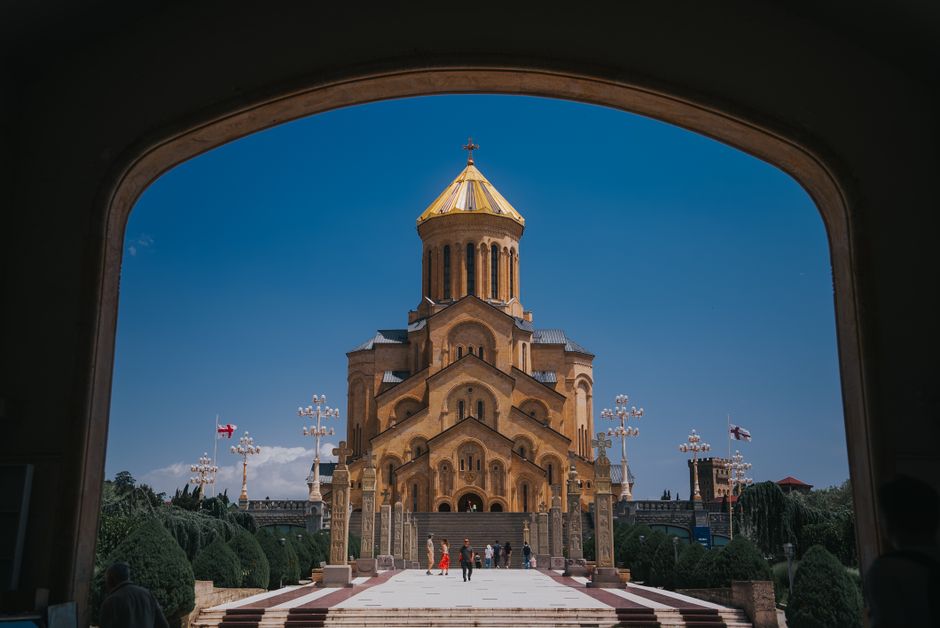
Georgia sits where Europe meets Asia, between the Black Sea and the high peaks of the Greater Caucasus. It is small, but it packs in an old, hilly capital full of balconies and sulphur baths, a subtropical seaside city, monasteries perched on ridges, glaciers, and one of the oldest winemaking traditions in the world. Start in Tbilisi, take a day out to the old royal capital Mtskheta, drive the Georgian Military Highway to Kazbegi for the classic view of Gergeti Trinity Church under Mount Kazbek, taste wine in Kakheti, and finish on the Black Sea at Batumi. Georgians are famously hospitable, and most visitors can stay for up to a year without a visa. Before you plan, read the safety section below: two regions, Abkhazia and South Ossetia, are outside the Georgian government’s control, and the land border with Azerbaijan is closed to ordinary traffic. Late spring and September–October are the sweet spots. Give it ten days to two weeks.
Right now in Georgia
- Wed 14–21°C 58–70°F Partly cloudy
- Thu 14–22°C 57–72°F Mostly clear
- Fri 14–19°C 56–66°F 1 mm Light showers
Weather: MET Norway (CC BY 4.0)
Multi-day tours of Georgia
Multi-day tours from local operators. You check dates and book on Viator, our partner; we may earn a commission at no extra cost to you. How we earn money
Safety and current conditions
Most visits to Georgia are trouble-free, including Tbilisi, Batumi, Kazbegi, Kakheti and the other main tourist areas. Two regions, Abkhazia and South Ossetia, are outside the Georgian government’s control, and the political situation in Tbilisi has been tense since late 2024. Points to know:
- Abkhazia and South Ossetia: both are internationally recognised as part of Georgia but are controlled by Russian-backed authorities, with Russian troops present. The boundary lines are mostly unmarked and away from roads, and people who stray across them have been detained. The areas right next to the boundary lines are restricted, and there is no consular help inside either region. Under Georgian law, entering either region from Russia is illegal, with heavy fines or up to four years in prison, and entry stamps from the local authorities may be treated as illegal entry.
- Landmines and unexploded weapons: these remain along the boundary lines and near the border with Azerbaijan, especially around the Red Bridge crossing. At the David Gareja monastery complex the border with Azerbaijan is unmarked and disputed, so stay on the marked paths and go with a local guide.
- Protests in Tbilisi: daily anti-government protests have continued since late 2024, passing their 650th consecutive day on 9 September 2026. They centre on the Parliament building on Rustaveli Avenue and can spread, particularly on Saturday evenings and on political anniversaries, and some have turned violent. Avoid demonstrations. Some foreigners linked to protests or with unpaid fines have been questioned or refused entry.
- Everywhere else: crime against visitors is low. Watch for pickpockets and drink spiking in nightlife areas, use a taxi app rather than hailing cars in the street, and take mountain roads seriously.
Land borders at a glance
- Turkey: open. The Sarpi crossing on the coast, about 15–20 km south of Batumi, runs around the clock.
- Armenia: open. The main road crossing is Sadakhlo–Bagratashen, and an overnight train runs between Tbilisi and Yerevan every other night.
- Azerbaijan: the land border has been closed to ordinary road traffic since the COVID-19 pandemic. Azerbaijan has extended the closure to 2 January 2027, according to Azerbaijani press reports. A daily Tbilisi–Baku train restarted in May 2026, but Azerbaijan only lets people who can enter visa-free use it; most Western visitors need an e-visa and must fly.
- Russia: the Upper Lars (Verkhny Lars) crossing beyond Kazbegi is open but often closes for hours or days in bad weather. You need a valid Russian visa or visa-free status.
- Armenia and Azerbaijan: the two neighbours initialled a peace agreement in Washington in August 2025, but it had not been signed by October 2026, and their shared border stays closed. Georgia is the easy way to combine all three countries, flying between Tbilisi or Yerevan and Baku.
Conditions change, so check the latest official information shortly before you travel.
Georgia at a glance: overview and geography
Georgia (Sakartvelo in Georgian) is about the size of Ireland or West Virginia. The Greater Caucasus runs along its northern border with Russia, rising above 5,000 m at Mount Kazbek and Shkhara; the Lesser Caucasus fills the south, towards Turkey and Armenia; and between them lie the fertile lowlands of Imereti and Kakheti and the humid, subtropical Black Sea coast. The National Statistics Office (Geostat) puts the population at about 3.72 million on 1 January 2026, not counting Abkhazia and South Ossetia, and more than a third live in Tbilisi.
This is an ancient Christian country: King Mirian III adopted Christianity in the 4th century, and churches, cave monasteries and frescoes are everywhere. Georgian has its own alphabet, the rounded Mkhedruli script you will see on every sign. Over the centuries Georgia was fought over by Persians, Arabs, Mongols, Ottomans and Russians, with a medieval golden age under King David the Builder and Queen Tamar. It was absorbed by the Russian Empire in the 19th century, briefly independent from 1918 to 1921, then part of the Soviet Union until independence in 1991. Wars in the early 1990s and in 2008 left Abkhazia and South Ossetia outside the government’s control. Georgia has four UNESCO World Heritage Sites: the Historical Monuments of Mtskheta, Gelati Monastery, Upper Svaneti and the Colchic Rainforests and Wetlands.
Time zone: Georgia uses Georgia Time, UTC+4 all year, with no summer time. That is three hours ahead of the UK in winter and two in summer.
The regions
- Tbilisi and Mtskheta: the capital in the Mtkvari (Kura) valley, and the old royal capital 20 km upstream with its UNESCO-listed churches.
- Kakheti: the main wine region east of Tbilisi, with the hilltop town of Sighnaghi, Telavi, Alaverdi and the Alazani valley below the Caucasus.
- Mtskheta-Mtianeti and Kazbegi: the Georgian Military Highway north through Ananuri and the Gudauri ski area to Stepantsminda, Gergeti and the Russian border.
- Imereti and Samegrelo: western Georgia around Kutaisi, with Gelati Monastery, canyons and caves.
- Svaneti and Racha: high, remote valleys of the western Caucasus; Mestia and Ushguli are famous for their medieval defensive towers.
- Adjara and the Black Sea: Batumi, Kobuleti and the green hills behind them.
- Samtskhe-Javakheti: the south-west, with the spa town of Borjomi and the cave city of Vardzia.
Where to go: city, mountains, wine and sea
Most trips start in Tbilisi and fan out from there: north to the mountains, east to the vineyards and west towards Kutaisi and the coast. Distances are short on the map, but mountain roads are slow, so plan on two or three bases.
Tbilisi and Mtskheta
Tbilisi is a city of contrasts: the old town’s crooked lanes, wooden balconies and domed sulphur baths at Abanotubani, the Narikala fortress above them (reached by cable car from Rike Park for 2.50 lari), the golden-domed Holy Trinity (Sameba) Cathedral, Soviet-era boulevards and some bold new architecture. The Georgian National Museum on Rustaveli Avenue holds a dazzling gold treasury. Day trips run to Mtskheta, where Jvari Monastery looks down on the confluence of two rivers and Svetitskhoveli Cathedral is the spiritual heart of the Georgian church. Our Tbilisi guide (coming soon) has the details.
Kazbegi and the Georgian Military Highway
The road north from Tbilisi is one of the great drives of the Caucasus. It passes the fortress church of Ananuri on its reservoir, climbs through the ski resort of Gudauri to the Jvari Pass at 2,379 m, and drops into the Tergi (Terek) valley at Stepantsminda, still widely called Kazbegi. From there, a steep walk or a 4×4 ride takes you up to the 14th-century Gergeti Trinity Church, with the glaciers of Mount Kazbek (about 5,054 m) behind it. The pass is prone to snow and avalanches, so the road can close in winter. Our Kazbegi guide (coming soon) covers hikes, the Truso and Juta valleys and the road.
Kakheti wine country
Two hours east of Tbilisi, Kakheti produces most of Georgia’s wine. Base yourself in walled, hilltop Sighnaghi or in Telavi, visit family cellars and larger wineries, and see wine made the traditional way in qvevri, large clay jars buried in the ground. The harvest, rtveli, usually happens in late September and early October in the east. Add the Alaverdi and Gremi churches and the Bodbe convent. See our wine tasting guide.
Batumi and the Black Sea
Batumi, about 350 km west of Tbilisi, is Georgia’s seaside city: a long palm-lined boulevard, pebble beaches, a 19th-century old town, glittering towers and casinos, and the leafy Batumi Botanical Garden on the cliffs to the north. The Ottoman-era Gonio fortress lies a few kilometres south, near the Turkish border. It is the place to swim from June to early October, but it is also one of the wettest corners of Europe, so pack an umbrella. Our Batumi guide (coming soon) has the details.
Kutaisi, Svaneti and the south
Kutaisi, Georgia’s third city and home to a budget-airline airport, is the base for Gelati Monastery, the Prometheus cave and the Martvili and Okatse canyons. From there, a long road climbs to Mestia and Ushguli in Svaneti, a world of stone towers and glaciers that is superb for summer hiking. In the south, Borjomi is famous for its mineral water and park, and Vardzia is a 12th-century monastery carved into a cliff.
A few more worth your time
Uplistsikhe, an ancient cave town near Gori; the Stalin Museum in Gori itself, a strange relic of Soviet times; the semi-desert monasteries of David Gareja (keep to marked paths); the mountain villages of Tusheti, reached by one of the world’s most dramatic dirt roads in summer only; and the forests and waterfalls of Mtirala National Park above Batumi.
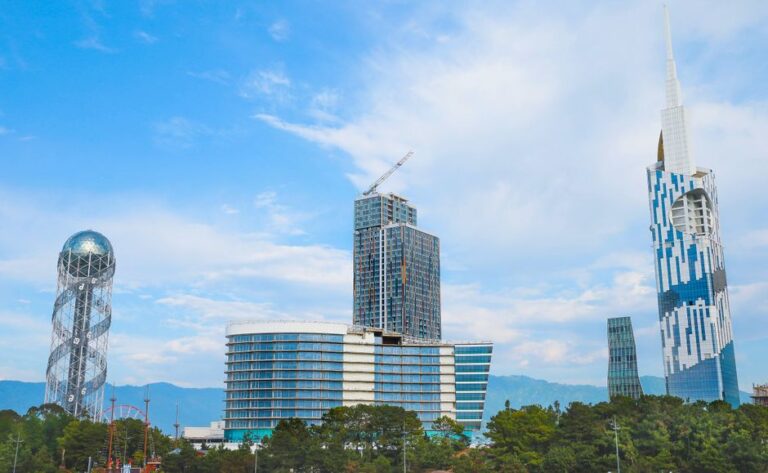
Batumi Travel Guide
Plan a trip to Batumi on Georgia's Black Sea coast: Batumi Boulevard, Ali and Nino and the Alphabetic Tower, the Argo cable car (2026…
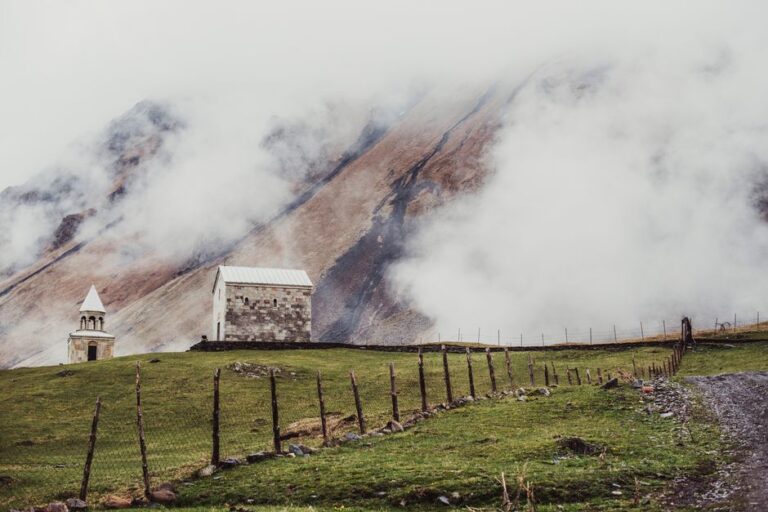
Kazbegi Travel Guide
Plan a visit to Kazbegi (Stepantsminda): Gergeti Trinity Church on foot or by 4×4, Kazbegi National Park, the Gergeti glacier, Gveleti waterfall, the Juta…
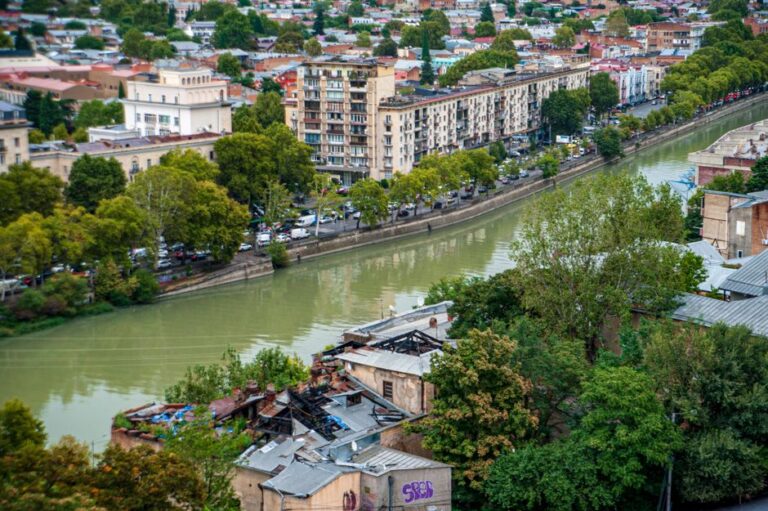
Tbilisi Travel Guide
Plan a trip to Tbilisi: the old town and Abanotubani sulphur baths, the Narikala cable car, Holy Trinity Cathedral, the Georgian National Museum's hours…
Best time to visit Georgia
Georgia squeezes several climates into a small space. Tbilisi and the east are dry and continental, with hot summers and cold, fairly dry winters. The Black Sea coast is humid and subtropical, mild in winter and very wet all year. The mountains get heavy snow from November to April. The table shows average daily highs and lows from the official 1991–2020 climate normals that Georgia submitted to the World Meteorological Organization. There is no official station in Batumi or Stepantsminda in that set, so we show nearby Kobuleti for the coast and Pasanauri, on the Military Highway at 1,080 m, for the mountains; Stepantsminda, at about 1,750 m, is several degrees colder.
| Area (weather station) | Spring (Mar–May) | Summer (Jun–Aug) | Autumn (Sep–Nov) | Winter (Dec–Feb) | Best months |
|---|---|---|---|---|---|
| Tbilisi and the east (Tbilisi, 432 m) | highs 14–24 °C | highs 29–32 °C, lows 17–20 °C | highs 27 °C falling to 13 °C | highs 7–9 °C, lows about 0 °C | May–June, September–October |
| Black Sea coast (Kobuleti, near Batumi) | highs 14–21 °C | highs 25–28 °C, lows 17–20 °C | highs 26 °C falling to 17 °C | highs 11–13 °C, lows about 3 °C | June–September |
| Western lowlands (Kutaisi, 109 m) | highs 15–25 °C | highs 28–30 °C, lows 18–21 °C | highs 27 °C falling to 16 °C | highs 10–12 °C, lows about 4 °C | May–June, September–October |
| Military Highway (Pasanauri, 1,080 m) | highs 9–20 °C | highs 24–27 °C, lows 11–14 °C | highs 22 °C falling to 10 °C | highs 3–5 °C, lows −4 to −6 °C | June–September |
Rain is the big difference. Tbilisi gets only about 510 mm a year, with May and June the wettest months. Kobuleti, just north of Batumi, averages about 2,520 mm, with more than 300 mm in both September and October, so the “velvet season” on the coast is warm but showery. In the mountains, May to July bring frequent afternoon storms.
Mountain roads and passes
The Jvari Pass on the Military Highway is open most of the year but closes during heavy snow and high avalanche risk, sometimes for days, as it did in February 2026; trucks and trailers are restricted first. A bypass with a 9 km tunnel between Kvesheti and Kobi is being built, but Georgia’s Roads Department said in August 2026 that it now expects completion by the end of 2028. Higher roads such as the Truso and Juta valleys and the track to Tusheti are open only in summer and early autumn. If you drive in winter, check the Roads Department’s restriction notices on the day.
Crowds, prices and festivals
July and August are peak season on the coast and in the mountains, and Batumi is busiest then. Tbilisi is hot in midsummer, but lively. May, June, September and October are the most comfortable months almost everywhere. In winter, Gudauri and Bakuriani fill with skiers. Festivals include Tbilisoba, the city’s autumn festival (held on 3–4 October in 2026), the wine harvest, and the Black Sea Jazz Festival in Batumi. Public holidays include New Year (1–2 January), Orthodox Christmas (7 January), Epiphany (19 January), Orthodox Easter from Good Friday to Easter Monday (Easter Sunday falls on 2 May 2027), Independence Day (26 May), Mariamoba (28 August), Svetitskhovloba (14 October) and Giorgoba (23 November).
How long to stay: sample itineraries
Tbilisi to Stepantsminda is about three hours by road, Tbilisi to Batumi about four hours by train, and Tbilisi to Sighnaghi about two hours by car.
5 days: Tbilisi, Mtskheta and Kazbegi
Three nights in Tbilisi with a half-day in Mtskheta, then two nights in Stepantsminda for Gergeti Trinity Church, the Gveleti waterfall and a walk towards the Gergeti glacier or the Juta valley in summer.
8–10 days: the classic loop
Three nights in Tbilisi, two in Kazbegi, two in Kakheti (Sighnaghi or Telavi) for wine, and then the train west to Batumi for two or three nights by the sea, flying home from Batumi or Kutaisi.
2 weeks: the whole country, or the whole Caucasus
Add Kutaisi and its canyons, three or four nights in Svaneti for hiking, and Borjomi and Vardzia on the way back. Or combine Georgia with Armenia, taking the overnight train or a minibus to Yerevan, and fly on to Baku, since the land border with Azerbaijan is closed to most travellers. Istanbul and the north-east of Turkey are close too; see our Turkey guide.
Entry, money, fees and costs
Entry and visas (last reviewed October 2026)
- Visa-free for up to a year: citizens of the EU, the UK, the United States, Canada, Australia, New Zealand, Japan and dozens of other countries can stay up to one year without a visa, according to the Georgian National Tourism Administration. EU citizens can also enter with a national ID card.
- e-Visa: nationalities that do need a visa can apply online on Georgia’s official e-Visa portal (evisa.gov.ge). Apply well in advance.
- Compulsory travel insurance since 1 January 2026: under Georgia’s Law on Tourism, every foreign tourist must hold health and accident insurance covering the whole stay, including the arrival and departure dates, with cover of at least 30,000 lari, in Georgian or English. Your airline may ask for proof at check-in, or border officers on arrival, according to the US Embassy in Tbilisi.
- Passports: must be valid for the whole stay. Families have been refused entry when a child’s passport photo no longer matched the child, so renew old children’s passports.
- Working while visiting: since 1 March 2026, foreigners who work in Georgia, including remote work for a foreign employer or running a business, need a work permit.
- Medicines: rules are strict. Carry prescriptions and original packaging, and note that some common codeine-based painkillers are illegal.
Georgia is not in the EU or the Schengen area, so the EU’s EES and ETIAS do not apply here. Check the Georgian Ministry of Foreign Affairs before you go.
The lari, cash and tipping
The currency is the Georgian lari (GEL, ₾). On 2 October 2026, the National Bank of Georgia’s official rate was 2.94 lari to the euro and 2.60 to the US dollar, so 1 lari is about €0.34. You must pay in lari, even when hotels quote prices in dollars or euros. Cards and contactless payment work almost everywhere in Tbilisi and Batumi, and cash machines are common in towns, but carry cash in villages and the mountains, where machines can be scarce. Many restaurants in Tbilisi and Batumi add a service charge of 10% or more; if not, round up or leave 5–10%.
Language and a few useful words
Georgian is the official language, with its own alphabet. Russian is widely understood, especially by older people, and Armenian and Azerbaijani are spoken in the south. English is spreading fast among younger Georgians and in tourism. Try gamarjoba (hello), madloba (thank you), ki and ara (yes and no), bodishi (sorry) and gaumarjos (cheers), which you will hear a lot at a Georgian feast.
Typical travel costs
Georgia is good value by European standards, especially for food, wine and transport, though hotels in central Tbilisi and Batumi in summer are no longer cheap. These estimates, per person per day, are a planning guide as of October 2026:
| Style | Estimated cost per day | What that looks like |
|---|---|---|
| Budget | about €30–50 | Hostel bed or guesthouse, bakery breakfasts and khachapuri, one restaurant meal, metro, minibuses and trains |
| Mid-range | about €70–130 | Boutique guesthouse or 3–4 star hotel shared by two, restaurant meals with wine, a driver or tour for a day trip, museum tickets |
| High-end | about €250+ | Design hotel in Tbilisi, a wine-estate stay in Kakheti, private driver-guides and fine dining |
The figures are our estimates, not official statistics.
Getting there and getting around
Arrival airports
Georgia has three international airports. Tbilisi (TBS) is 17 km south-east of the capital, linked to the centre by city bus 337 or taxi. Kutaisi (KUT), 14 km west of Kutaisi, is the low-cost hub, with many Wizz Air flights; shuttle buses connect it with Tbilisi and Batumi. Batumi (BUS) is on the southern edge of the city, served by city bus 10, with more flights in summer.
Trains
Georgian Railway runs modern double-decker trains between Tbilisi and Batumi in about four hours, with year-round morning and evening departures and extra trains in summer, stopping at Kutaisi airport and Kobuleti. On the railway’s official price list, a second-class ticket costs 32–34 lari, and press reports in September 2026 quote around 36 lari; first class costs roughly twice as much. You need your passport to buy a ticket and to board, and tickets go on sale 20 days ahead at stations, online and in the app; book early in summer. There is also an overnight train between Tbilisi and Yerevan every other night, and slow local trains to Borjomi and elsewhere.
Minibuses and taxis
Shared minibuses (marshrutkas) link almost every town. In Tbilisi, most leave from Didube station (for Kazbegi, Gori and the west), Samgori or Ortachala (for Kakheti and the south). They are cheap and frequent but can be cramped, and the driving is fast; Tbilisi to Stepantsminda costs about 20 lari and takes two and a half to three hours, according to travel guides updated in 2026. Many visitors hire a driver for the day instead, which lets you stop at viewpoints. Use apps such as Bolt or Yandex Go for city taxis.
Driving
Driving gives you freedom, but standards are erratic: overtaking on blind bends, cows on the road, potholes, poor lighting at night, and landslides and snow in the mountains. Drive on the right. Speed limits are 60 km/h in towns, 90 km/h outside and 110 km/h on motorways, and the blood alcohol limit is lower than in the UK, reported at 0.3 g/l, so do not drink and drive. A UK licence is valid for up to a year, but rental firms may ask for an International Driving Permit. For winter trips over the Jvari Pass, use a 4×4 with winter tyres or hire a driver.
Safety, health and connectivity
Everyday safety
Start with the safety section at the top of this page. Beyond that, Georgia is generally safe and welcoming. Avoid demonstrations, especially around Parliament on Rustaveli Avenue in Tbilisi. Be wary of strangers who invite you to a bar or restaurant, and watch your drink. Georgian drug laws are very strict, with prison sentences of five to 25 years for illegal drugs, including cannabis. Flying a drone with a camera needs registration with the Civil Aviation Agency. Georgia is earthquake country, and wildfires and lightning are a risk in the mountains in summer. Emergency number: 112 for police, fire and ambulance.
In the mountains
Rescue services in remote valleys are limited, and altitude sickness is a risk at places such as Gudauri and Mount Kazbek. Hike with a local guide on glaciers, start early, carry warm and waterproof layers even in August, and tell your guesthouse where you are going. Never wander towards the boundary lines of South Ossetia or Abkhazia, which can be close to valleys such as Truso.
Health
Your compulsory insurance must cover medical treatment, and it is worth having cover for evacuation too. Private clinics in Tbilisi and Batumi are good; standards are lower in rural areas. Pharmacies are everywhere. Many locals drink tap water in Tbilisi, which comes from mountain sources, but bottled water is cheap if you prefer it.
Connectivity and power
Georgia is not in the EU, so EU roaming rules do not apply. Local SIM cards and eSIMs from Magti, Silknet and Cellfie are cheap, with good coverage in towns and along main roads but gaps in remote valleys. Plugs are the European two-pin type (C and F), at 220 V; see our travel adapters guide.
Food, wine and culture
Georgian food is one of the best reasons to come. Try khachapuri, cheese bread in many regional forms, including the boat-shaped Adjarian version with an egg and butter in the middle; khinkali, soup dumplings you hold by the knot and eat by hand; aubergine rolls with walnut paste (badrijani); grilled meat (mtsvadi); bean stew (lobio) in a clay pot; and churchkhela, strings of walnuts dipped in grape juice. Wine has been made here for about 8,000 years, and traditional amber wines aged in qvevri are on many menus, alongside the fiery grape spirit chacha. A formal feast, the supra, is led by a toastmaster, the tamada, who proposes long toasts to family, friends and the dead. In churches, dress modestly: women usually cover their heads and wear a skirt, and men wear long trousers; scarves and wraps are often available at the door.
Things to do: hiking, wine, cities and the sea
- Hiking: Kazbegi, the Juta and Truso valleys, Svaneti’s Mestia–Ushguli trek, Tusheti and Borjomi-Kharagauli National Park, from June to September. See our hiking guide.
- Wine tasting: Kakheti’s family cellars and estates, and wine bars in Tbilisi. See our wine tasting guide.
- City sightseeing: Tbilisi’s old town and museums, Mtskheta, Kutaisi and Batumi. See our city sightseeing guide.
- Beaches: pebble beaches at Batumi and Kobuleti, and dark magnetic sand at Ureki. See our beaches guide.
- Skiing: Gudauri, Bakuriani and the Svaneti resorts from about December to March.
- Cycling: quiet wine roads in Kakheti and tough mountain climbs for experienced riders. See our cycling guide.
What to pack
Bring layers: Tbilisi can be hot while Kazbegi is chilly the same day. Pack comfortable shoes for steep, cobbled streets, hiking shoes and a fleece for the mountains, a rain jacket for Batumi and spring storms, sun protection, and water shoes for Batumi’s pebbles. Carry a scarf or wrap and long trousers or a skirt for churches, and keep proof of your travel insurance with your passport.
Georgia travel FAQ
Is Georgia safe to visit?
Yes, for the main tourist areas. Abkhazia and South Ossetia are outside the Georgian government’s control and the areas next to their boundary lines are restricted. Avoid political protests in Tbilisi.
Can I visit Abkhazia or South Ossetia?
Both regions are controlled by Russian-backed authorities, not the Georgian government. There is no consular help inside, people who cross the boundary lines have been detained, and entering from Russia breaks Georgian law, with fines or prison.
Do I need a visa for Georgia?
Not if you are from the EU, the UK, the US, Canada, Australia or many other countries: you can stay up to a year without a visa. Others can apply on Georgia’s official e-Visa portal.
Is travel insurance compulsory in Georgia?
Yes, since 1 January 2026. Foreign tourists need health and accident insurance for the whole stay, with at least 30,000 lari of cover, in Georgian or English. Airlines or border officers may ask to see it.
Can I cross from Georgia to Azerbaijan by land?
Not by road. Azerbaijan’s land borders are closed to ordinary travellers, reportedly until at least 2 January 2027. The Tbilisi–Baku train is open only to people who can enter Azerbaijan visa-free, so most Western visitors fly.
How do I get from Tbilisi to Armenia?
By the overnight train to Yerevan, which runs every other night, or by minibus, shared taxi or car via the Sadakhlo–Bagratashen border, about five to six hours in all.
When is the best time to visit Georgia?
May–June and September–October for Tbilisi and the wine country; July to September for the high mountains; June to September for swimming in the Black Sea.
How many days do you need in Georgia?
Five days for Tbilisi and Kazbegi; eight to ten to add Kakheti and Batumi; two weeks to include Svaneti or Armenia.
Is the road to Kazbegi open in winter?
Usually, but the Jvari Pass closes during heavy snow and avalanche risk, sometimes for days. Check the Roads Department’s notices and allow a spare day.
What currency does Georgia use?
The lari (GEL), about 2.94 to the euro in early October 2026. You must pay in lari, but cards work widely in the cities.
Can you drink the tap water in Georgia?
Many locals drink it in Tbilisi, but bottled or filtered water is the cautious choice, especially in rural areas and on the coast.
Can I combine Georgia with Turkey?
Easily. The Sarpi border near Batumi is open around the clock, and there are many flights to Istanbul. See our Istanbul guide.
Sources and last review
Researched and last reviewed on 4 October 2026. Safety information comes from GOV.UK foreign travel information (updated 15 September 2026) and the US State Department’s country information (12 March 2025); visa-free stays from the Georgian National Tourism Administration and GOV.UK; the insurance rule from the US Embassy in Tbilisi and GOV.UK; exchange rates from the National Bank of Georgia; population from Geostat; climate from the official 1991–2020 WMO normals; trains from Georgian Railway; the Kvesheti–Kobi road from Georgia’s Roads Department; UNESCO sites from UNESCO. Azerbaijan’s border closure, train times, minibus fares, speed and alcohol limits and service charges come from press and travel guides and are flagged for checking. Daily costs are estimates. Rules and prices change, so check the official sites before you travel.
Plugs and power in Georgia
Georgia uses 220 V, 50 Hz and these plugs (left) and wall sockets (right):
All plug types and voltages by country → · Check what you need to pack →
Plan your trip
Partner links: TravelerCenter may earn a commission if you book, at no extra cost to you.
🇬🇪 Useful Georgian phrases for Georgia
All 38 Georgian phrases: restaurant, hotel, emergencies, romance (printable) →