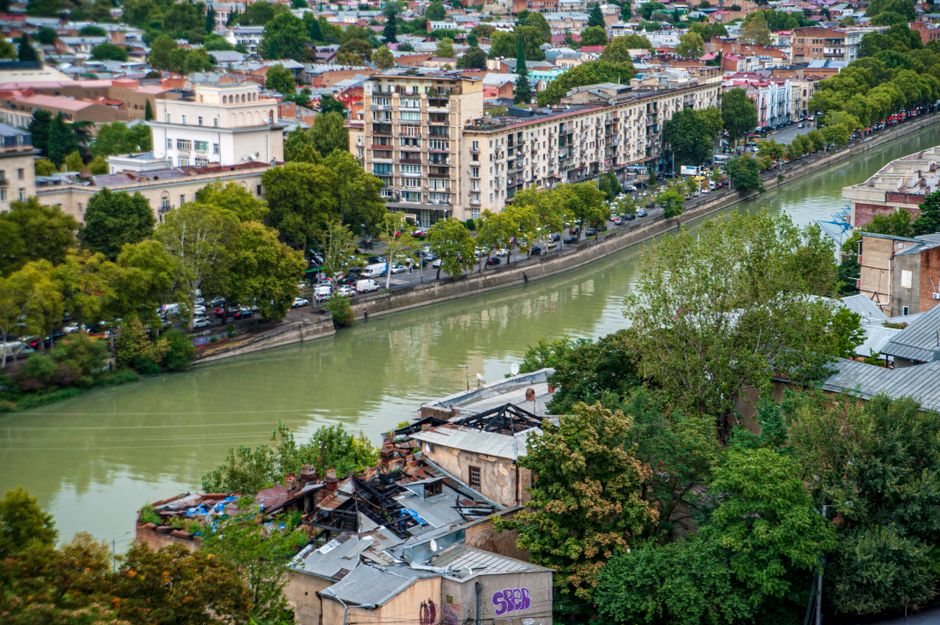
Tbilisi is one of the most characterful capitals between Europe and Asia: a city of crooked lanes and carved wooden balconies tumbling down to the Mtkvari river, of brick-domed sulphur baths, golden church domes, Soviet boulevards and daring modern bridges, all watched over by a ruined fortress on the cliff. It is lively, creative and very hospitable, with superb food and wine at friendly prices. Ride the cable car to Narikala, soak in the hot springs of Abanotubani, see the gold treasures of the National Museum, and spend the evening in a wine bar in the old town or a courtyard at Fabrika. Give it two or three days, plus day trips to Mtskheta and the mountains. Spring and autumn are the loveliest seasons. One note before you go: daily political protests have continued in the city centre since late 2024, so read the safety tips below.
Right now in Tbilisi
- Wed14–21°C58–70°FPartly cloudy
- Thu14–22°C57–72°FMostly clear
- Fri14–19°C56–66°F1 mm rain
Top tours in Tbilisi
See all tours for Tbilisi →
From local operators, with prices and reviews; you check availability and book on Viator, our partner. We may earn a commission at no extra cost to you. How we earn money
Tbilisi at a glance
- Best months: May–June and September–October. Average highs are about 24 °C in May and 27 °C in September, and July and August reach 31–32 °C (official 1991–2020 normals for Tbilisi).
- Days needed: 2–3 for the city; 4–5 with day trips to Mtskheta, Kazbegi or Kakheti.
- Getting there: Tbilisi International Airport (TBS) is 17 km south-east of the centre; city bus 337 costs 1 lari.
- Getting around: on foot in the old town (steep and cobbled), plus the metro, buses, cable cars and taxi apps. One fare of 1 lari covers 90 minutes of travel.
- Safety: generally safe; avoid demonstrations around Parliament on Rustaveli Avenue.
- Budget level: good value for food, wine and transport; central hotels are mid-priced. See our Georgia guide for entry rules, including the compulsory travel insurance.
Tbilisi’s neighbourhoods and who each one suits
- Old Tbilisi (Kala and Abanotubani): the historic core below Narikala, with the baths, churches, wine bars and guesthouses. Atmospheric and central, but hilly and busy at night.
- Sololaki: elegant 19th-century streets with painted entrance halls, just above Freedom Square. A great base for walkers, close to everything.
- Avlabari and Metekhi: across the river, around Holy Trinity Cathedral and the cliff-top Metekhi church. Good value, with a metro station.
- Marjanishvili and Chugureti: on the left bank, home to Fabrika and a growing café scene along Aghmashenebeli Avenue. Young and creative.
- Vera and Vake: leafy residential districts with smart cafés, restaurants and parks, a short taxi ride from the centre. Quieter and good for longer stays.
Top things to see in Tbilisi
Prices and hours are as of October 2026, in Georgian lari (about 2.94 lari to the euro on 2 October 2026). Some come from published reports and are flagged in our sources.
The old town and the sulphur baths
Legend says Tbilisi was founded where King Vakhtang Gorgasali’s falcon fell into a hot spring, and the name comes from tbili, “warm”. The springs still feed the Abanotubani bath district, a cluster of low brick domes, from which you can smell the sulphur. You can book a private room with its own pool by the hour or use a cheaper public section; a scrub (kisi) and massage cost extra. Travel guides in 2026 report private rooms from about 70 to more than 200 lari an hour depending on the bathhouse and size, and public sections at roughly 10–20 lari. Book ahead at weekends. Behind the baths, a short path leads into the leafy Leghvtakhevi gorge to a small waterfall. Then wander the old lanes past the 6th-century Anchiskhati Basilica, Sioni Cathedral and the leaning clock tower of the Gabriadze Marionette Theatre, where an angel comes out to strike the bell and a little show plays at 12:00 and 19:00 every day, according to the Georgian National Tourism Administration.
Narikala fortress and the cable car
The ruined walls of Narikala, first built in the 4th century, crown the ridge above the old town, next to the National Botanical Garden and the aluminium statue of Kartlis Deda, Mother of Georgia, holding a sword for enemies and a cup of wine for friends. Walk up from the baths in 15 minutes, or ride the cable car from Rike Park across the river: a one-way trip costs 2.50 lari with a Metromoney card or bank card, according to Tbilisi Transport Company. Travel guides report it running from 10:00 until late evening, to midnight in summer. The views over the domes and balconies are best around sunset.
Holy Trinity Cathedral and Metekhi
On the Elia hill in Avlabari stands Sameba, the Holy Trinity Cathedral, built between 1995 and 2004 and about 86 m tall, one of the largest Orthodox cathedrals in the world. Entry is free; dress modestly, with shoulders and knees covered, and women usually cover their hair. Closer to the river, the 13th-century Metekhi church and an equestrian statue of King Vakhtang stand on the cliff above the old town, a classic viewpoint.
Rustaveli Avenue and the Georgian National Museum
Rustaveli Avenue, the grand boulevard from Freedom Square, is lined with the Parliament, the Opera, the Rustaveli Theatre, the National Gallery and the Kashveti church. It is also where most demonstrations happen, and since 23 July 2026 the central section has been closed to traffic for a full rebuild, expected to last until about the end of November 2026, according to Tbilisi City Hall as reported in the press. The Simon Janashia Museum of Georgia, part of the Georgian National Museum, is the essential museum, with the gold of ancient Colchis in its treasury. It is open Tuesday to Sunday from 10:00 to 18:00 (last entry 17:30) and closed on Mondays and public holidays; foreign adults pay 40 lari, students 15 lari, according to the museum’s own price list.
Mtatsminda, Fabrika and the Dry Bridge market
Mtatsminda Park, at about 770 m the highest point in the city, has a Ferris wheel, rides and a restaurant with the best panorama of Tbilisi. It is reached by a funicular dating from 1905, reported at 12 lari one way plus a 2-lari park card in 2026. On the left bank, Fabrika, a former Soviet sewing factory, is now a hostel and a courtyard of bars, cafés and street art, busy every evening. At the Dry Bridge market, open daily from about 10:00 to 17:00, traders sell Soviet badges, cameras, old maps, carpets and paintings; it is busiest at weekends and thin in bad weather. Above the Tbilisi Sea reservoir, the Chronicles of Georgia, giant carved pillars by Zurab Tsereteli about 35 m high, are free to visit and best in daylight.
Food, wine and nightlife
Eat khinkali (soup dumplings), cheese-filled khachapuri, aubergine rolls with walnut paste, lobio beans in clay pots and grilled mtsvadi, and buy warm bread from the round tone bakeries in the old town. Natural wine bars are everywhere in the old town and Sololaki, pouring amber and red wines made in clay qvevri; ask for a tasting flight. Sulphur-bath evenings, live polyphonic singing in some restaurants and late-night clubs give Tbilisi a famous nightlife. Many restaurants add a 10% or higher service charge to the bill, so check before tipping. See our wine tasting guide.
Day trips from Tbilisi
- Mtskheta: about 30 minutes north, the old royal capital with Jvari Monastery on its hilltop, Svetitskhoveli Cathedral (built 1010–1029) and Samtavro convent, all part of a UNESCO World Heritage Site.
- Ananuri and Kazbegi: a long day up the Georgian Military Highway to Gergeti Trinity Church, better as an overnight trip. See our Kazbegi guide.
- Kakheti and Sighnaghi: about two hours east for wine cellars, the walled hill town of Sighnaghi and the Bodbe convent.
- Gori and Uplistsikhe: about an hour west, a rock-cut cave town and the Stalin Museum.
- David Gareja: cave monasteries in semi-desert near the Azerbaijani border. The border here is unmarked and disputed; stay on marked paths and go with a guide.
For more walking ideas in the city and beyond, see our city sightseeing guide and our hiking guide.
Nearby destinations
- Kazbegi105 km
- Lake Sevan164 km
- Yerevan173 km
- Sheki207 km
- Batumi262 km
Getting there and getting around
From the airport
Tbilisi International Airport (TBS) is 17 km south-east of the city. City bus 337 runs from the terminal to the centre and the Central Railway Station for 1 lari. Travel guides report it running about every 15–30 minutes from about 07:00 to 23:00, taking 50–60 minutes; pay with a Metromoney card (sold at the Bank of Georgia desk in arrivals) or a contactless bank card. While Rustaveli Avenue is closed for works, its route is diverted. Taxis wait outside around the clock, or use a taxi app such as Bolt; the ride takes 20–30 minutes outside rush hour.
Metro, buses and cable cars
Tbilisi Transport Company runs two metro lines, buses, minibuses and cable cars. A fare of 1 lari buys 90 minutes of unlimited travel on the metro, buses, minibuses and the Bagebi–University ropeway when you tap a Metromoney card or a bank card, according to the operator. The Metromoney card costs 2 lari at any metro station and can be refunded within a month. Passes cost 3 lari for a day and 20 lari for a week. Travel guides report the metro running from about 06:00 to midnight. Fare dodgers are fined, so always tap in.
Trains, minibuses and onward travel
Trains to Batumi (about four hours), Kutaisi and the overnight train to Yerevan leave from the Central Railway Station (Station Square metro). Minibuses to Kazbegi, Gori and western Georgia go from Didube (Didube metro), and those to Kakheti from Samgori or Ortachala. Driving in the city is stressful, with heavy traffic and few parking spaces, so pick up a hire car on your way out.
When to go and how long to stay
Tbilisi has a dry, continental climate, sheltered by mountains: hot summers, cool winters with occasional snow, and long, sunny springs and autumns. It gets only about 510 mm of rain a year, most of it in May and June, often in short thunderstorms.
| Season | Average high / low | Days with rain a month | What it’s like |
|---|---|---|---|
| Spring (Mar–May) | 14–24 °C / 4–13 °C | 5–10 | Blossom and green hills; May is warm but showery. |
| Summer (Jun–Aug) | 29–32 °C / 17–20 °C | 5–8 | Hot, especially in July and August; explore early and late. |
| Autumn (Sep–Nov) | 27 °C falling to 13 °C / 16–5 °C | 5–6 | Golden and mild; harvest season and the Tbilisoba festival. |
| Winter (Dec–Feb) | 7–9 °C / about 0 °C | about 4 | Cool and grey with occasional snow; the baths are at their best. |
Figures are from the official 1991–2020 climate normals for the Tbilisi weather station (432 m), with days of at least 1 mm of rain. The city’s big autumn festival, Tbilisoba, fills the old town with food, wine and music each October, and was held on 3–4 October in 2026.
2 days in Tbilisi
Day 1: the old town, the Gabriadze clock tower, the cable car up to Narikala and Mother of Georgia, then down through the botanical garden to the sulphur baths, and dinner with wine in Sololaki. Day 2: the National Museum on Rustaveli Avenue, the Dry Bridge market, Holy Trinity Cathedral and Metekhi, and evening drinks at Fabrika.
4 days in Tbilisi
Add a morning in Mtskheta and an afternoon at Mtatsminda Park, and a day in Kakheti for wine. Then head north to Kazbegi for a night or two, or west by train to Kutaisi and Batumi.
Where to stay in Tbilisi
- First visit: Sololaki or the old town, within walking distance of most sights.
- Nightlife and cafés: Marjanishvili, near Fabrika.
- Value with views: Avlabari, across the river from the old town.
- Families and longer stays: apartments in Vera or Vake.
- Quiet nights: avoid rooms facing Rustaveli Avenue while protests and road works continue.
Practical tips for Tbilisi
- Protests: daily demonstrations at Parliament on Rustaveli Avenue sometimes spread and have occasionally turned violent; keep away, and check local news.
- Taxis: use an app rather than hailing cars in the street, and check that seatbelts work.
- Nightlife: be wary of strangers who invite you to a particular bar, and watch your drink.
- Hills: streets in the old town are steep and slippery when wet; wear shoes with grip.
- Money: cards work nearly everywhere, but carry some lari for markets, bakeries and minibuses.
- Mondays: the National Museum is closed; plan the baths or a day trip.
- Emergencies: call 112.
What to pack for Tbilisi
Comfortable shoes with good grip for steep cobbles, light clothes, a sun hat and sunscreen in summer, and a warm jacket from November to March. Bring a scarf or wrap and long trousers or a skirt for churches, swimwear or a towel for the baths, and a rain jacket for spring showers. For the mountains on day trips, add hiking shoes. Plugs are the European two-pin type; bring a travel adapter if you need one.
Tbilisi travel FAQ
Is Tbilisi safe for tourists?
Yes, generally. Crime against visitors is low. The main things to avoid are political demonstrations around Parliament on Rustaveli Avenue, unlicensed street taxis and drink spiking in nightlife areas.
How do I get from Tbilisi airport to the city?
Take bus 337 for 1 lari, paying by Metromoney or bank card, which takes about an hour to the centre, or a taxi app ride of 20–30 minutes.
How much does the metro cost in Tbilisi?
1 lari for 90 minutes of travel on the metro, buses and minibuses, tapping a Metromoney card (2 lari) or a contactless bank card. A day pass costs 3 lari.
How much are the sulphur baths in Tbilisi?
Public sections are reported at about 10–20 lari, and private rooms from about 70 to more than 200 lari an hour, depending on the bathhouse. Scrubs and massages cost extra.
How much is the Narikala cable car?
2.50 lari one way from Rike Park, paid with a Metromoney or bank card. You can also walk up from the baths in about 15 minutes.
When is the Georgian National Museum open?
Tuesday to Sunday, 10:00–18:00, with last entry at 17:30. It is closed on Mondays and public holidays. Foreign adults pay 40 lari.
How many days do you need in Tbilisi?
Two or three days for the city, and four or five with day trips to Mtskheta, Kakheti or Kazbegi.
How do I get from Tbilisi to Kazbegi?
By minibus from Didube station, reported at about 20 lari and two and a half to three hours, by shared taxi, or with a driver or tour. The road over the Jvari Pass can close in heavy snow.
What should I wear to visit churches in Tbilisi?
Cover shoulders and knees. Women usually cover their hair and wear a skirt; wraps are often available at the door. Men remove hats.
Is Tbilisi worth visiting?
Very much so. Its mix of old town, baths, churches, Soviet relics, food and wine, and its easy access to the mountains make it one of the most rewarding cities in the region.
Plan your trip
Partner links: TravelerCenter may earn a commission if you book, at no extra cost to you.
🇬🇪 Useful Georgian phrases for Tbilisi
All 38 Georgian phrases: restaurant, hotel, emergencies, romance (printable) →
Sources · last reviewed 4 October 2026
Researched and last reviewed on 4 October 2026. Fares come from Tbilisi Transport Company; museum hours and prices from the Georgian National Museum; airport and clock-tower details from the Georgian National Tourism Administration; climate from the official 1991–2020 WMO normals for Tbilisi; the exchange rate from the National Bank of Georgia; safety from GOV.UK foreign travel information. Bus 337 times, cable car and metro hours, bath and funicular prices, the market’s hours and the Rustaveli Avenue works come from travel guides and the press and are flagged for checking. Prices, timetables and rules change, so check the official sites before you travel.
Data: Weather: MET Norway (CC BY 4.0) · Rates: ECB · Costs: World Bank ICP and price levels · Wikidata (CC0)