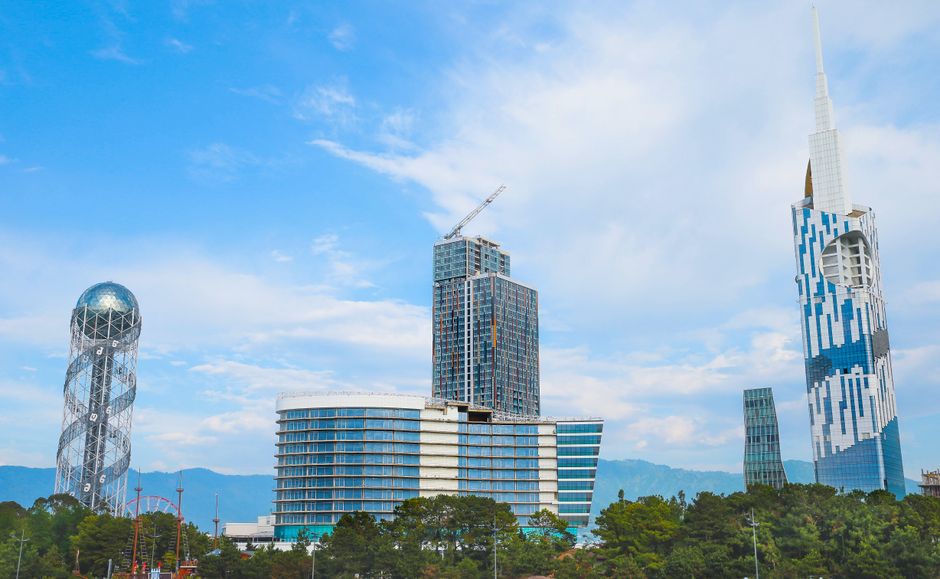
Batumi is Georgia’s summer playground: a subtropical port city on the Black Sea where palm trees line a seafront boulevard several kilometres long, green hills rise straight behind the town, and the snow-dusted Lesser Caucasus show on clear days. It mixes a charming 19th-century old town of wrought-iron balconies and cafés with bold, sometimes outlandish modern towers, casinos and fountains that light up at night. Come for the beaches and the sea from June to early October, the lush Botanical Garden on the cliffs, the Roman and Byzantine walls of Gonio, Adjarian khachapuri and an easy-going holiday mood. Give it two or three days, more if you want beach time or trips into the hills. Be ready for rain: Batumi is one of the wettest cities in Europe, even in the warm months.
Right now in Batumi
- Wed 17–19°C 63–66°F 1 mm Partly cloudy
- Thu 17–21°C 63–70°F Partly cloudy
- Fri 18–22°C 64–71°F Clear
Weather: MET Norway (CC BY 4.0) · Sea temperature: NOAA CoastWatch
Top tours in Batumi
See all tours for Batumi →
From local operators, with prices and reviews; you check availability and book on Viator, our partner. We may earn a commission at no extra cost to you. How we earn money
Batumi at a glance
- Best months: June to September for swimming, with average highs of 25–28 °C on this coast; late May and early October for quieter, cheaper visits (official 1991–2020 normals for Kobuleti, just north of Batumi).
- Days needed: 2 for the city, 3–4 with beach time, Gonio and the hills.
- Getting there: Batumi International Airport on the southern edge of the city, the train from Tbilisi in about four hours, or overland from Turkey via Sarpi.
- Getting around: flat and walkable along the seafront, with city buses, taxis, taxi apps and bike lanes.
- Budget level: cheap to mid-priced, but hotels fill up and prices rise in July and August. See our Georgia guide for entry rules and the compulsory travel insurance.
Batumi’s neighbourhoods and who each one suits
- The old town: low 19th-century buildings, Europe Square, the Piazza and dozens of cafés, a few minutes from the beach. Best for a first visit.
- The boulevard and New Boulevard: high-rise hotels and apartments along the seafront, with sea views and quick beach access; noisier near the clubs in summer.
- Around Lake Nurigeli and the port: green, central and handy for the Argo cable car and the ferry and cruise port.
- Green Cape and Makhinjauri: just north of the city near the Botanical Garden, with quieter beaches and wooded hills.
- Gonio and Kvariati: resorts 12–15 km south towards Turkey, with clearer water and a slower pace.
Top things to see in Batumi
Prices and hours are as of October 2026, in Georgian lari (about 2.94 lari to the euro on 2 October 2026). Many come from the Adjara tourism department’s official site; a few come from published reports and are flagged in our sources.
Batumi Boulevard, Ali and Nino and the Alphabetic Tower
The seafront Batumi Boulevard runs for kilometres between the pebble beach and the city, with shady paths, cycle lanes, fountains, sculptures and cafés. At the northern end, near the port, stand three landmarks: the 1863 lighthouse; Ali and Nino, two tall steel figures by Tamara Kvesitadze that slowly glide towards each other and pass through one another, a love story told in metal; and the 130-metre-tall Alphabetic Tower, wrapped in the 33 letters of the Georgian alphabet. The Adjara tourism department lists the tower as open from 10:00 to midnight, with a viewing level near the top. Come at dusk, when the lights come on and families stroll the promenade.
The old town and the Piazza
Behind the seafront, the grid of the old town is good for wandering: Europe Square with its statue of Medea holding the Golden Fleece and an astronomical clock, the Italianate Piazza with its mosaics and bell tower, the Neptune Fountain in front of the theatre, and the Orthodox and Catholic cathedrals and the Ortajame mosque, a reminder of Batumi’s Ottoman past. On summer evenings the squares fill with music.
The Argo cable car
The Argo cable car climbs from the city centre to an observation deck and restaurant at about 256 m on Anuria hill, a ride of about 15 minutes each way with views across the port, the towers and the sea to the mountains. According to the operator, a standard round trip costs 39 lari for anyone aged 12 and over and 9 lari for children aged 5–11, with under-5s free; it runs from 10:00 to 23:00 and can stop in strong wind. Go up before sunset and come down after dark.
Batumi Botanical Garden
About 9 km north of the centre at Green Cape (Mtsvane Kontskhi), the Batumi Botanical Garden, opened in 1912, spreads over steep, terraced hills above the sea, with bamboo groves, eucalyptus, magnolias, tea bushes and gardens from the Himalayas to Australia. Allow two to three hours, and wear good shoes for the slopes; there are three entrances and an electric car for part of the route. The Adjara tourism department lists entry at 25 lari for foreign visitors and hours of 09:00–20:00, while the garden’s own site has been reported to show 20 lari with shorter hours outside summer, so check at the gate. Reach it by city bus or taxi from the centre.
Gonio-Apsaros fortress
Twelve kilometres south of Batumi, near the mouth of the Chorokhi river, the walls of Gonio-Apsaros enclose a large rectangle of grass and ruins. It was a Roman fort from the 1st century AD, then Byzantine and Ottoman, and 18 of its towers survive; tradition holds that the Apostle Matthias is buried here. A small museum shows coins and jewellery found on the site. Foreign visitors pay 15 lari, and the Adjara tourism department lists hours of 10:00 to 17:00. Combine it with a swim at Gonio or Kvariati beach.
Beaches and the sea
Batumi’s city beach runs the length of the boulevard. It is pebble and shingle, not sand, and shelves steeply, so the water gets deep quickly; wear water shoes and keep an eye on children. Lifeguards are on duty from about June to September, and the official beach season runs to mid-October, according to local guides. Sea temperatures peak in August and are still around 20 °C in early October. South of the city, Gonio, Kvariati and Sarpi have clearer water and smaller crowds; north of the city, Kobuleti has a long beach, and Ureki, further north, is known for dark magnetic sand. On stormy days, red flags mean no swimming. See our beaches guide, plus snorkeling and boat trips.
Food, cafés and nightlife
Batumi is the home of Adjarian khachapuri (acharuli), a boat-shaped bread filled with molten cheese, topped with a raw egg and a knob of butter that you stir in at the table. Try also borano (cheese melted in butter), Black Sea fish such as red mullet and turbot in season, and local tea and citrus. The old town has cosy wine bars and cafés, the boulevard has beach bars, and summer brings open-air clubs and the Black Sea Jazz Festival. Casinos are a big part of the city’s nightlife, aimed mostly at visitors from Turkey and the region.
Day trips from Batumi
- Mtirala National Park: about an hour inland, a rainforest of chestnut and beech with waterfalls, trails and a lake, part of the UNESCO-listed Colchic Rainforests and Wetlands.
- Makhuntseti waterfall and Queen Tamar’s bridge: about 30 km up the Adjaristskali valley, with a medieval stone arch bridge and wine and honey stalls.
- Gonio and Sarpi: the fortress, quieter beaches and the Turkish border, with the Turkish town of Hopa just beyond.
- Kobuleti and Petra fortress: a long beach resort 20 km north and the ruins of the Byzantine fortress at Tsikhisdziri.
- Kutaisi: about two hours by train, with Gelati Monastery, a UNESCO site, and nearby canyons; better as an overnight stop.
For walks in the green hills, see our hiking guide.
Getting there and getting around
By air
Batumi International Airport (BUS) lies on the southern edge of the city, on the right bank of the Chorokhi river, a short taxi ride from the centre; city bus 10 links it with the centre, according to the Georgian National Tourism Administration. It has more flights in summer, many from Turkey, Israel and Eastern Europe. Year-round, Kutaisi (KUT), with low-cost flights across Europe, is about two hours away, and the Tbilisi–Batumi train stops at Kutaisi airport.
By train from Tbilisi
Georgian Railway’s double-decker trains link Tbilisi and Batumi in about four hours, with morning and late-afternoon departures all year and extra trains in summer, stopping at Kutaisi airport and Kobuleti. Second-class seats cost 32–34 lari on the railway’s official price list, and press reports quote around 36 lari in September 2026. You need your passport to buy and board, and summer trains sell out, so book online up to 20 days ahead. Trains arrive at Batumi Central station, north-east of the centre, a short bus or taxi ride from the old town.
From Turkey and around town
The Sarpi border crossing with Turkey, about 15–20 km south, is open around the clock; minibuses and taxis run from Batumi to the border, and buses continue to Hopa, Rize and Trabzon. Within the city, walk or cycle along the boulevard, use city buses (pay by card), or take a taxi app such as Bolt. Minibuses run along the coast to Gonio, Sarpi and Kobuleti.
When to go and how long to stay
Batumi has a humid subtropical climate: mild, wet winters without much frost, and warm, sticky summers. It rains a lot in every season, but the heaviest rain falls from September to January, often in big downpours; May and April are the driest months.
| Season | Average high / low | Rain | What it’s like |
|---|---|---|---|
| Spring (Mar–May) | 14–21 °C / 5–13 °C | 85–175 mm a month | Mild and green; the sea is still cool for swimming. |
| Summer (Jun–Aug) | 25–28 °C / 17–20 °C | 170–240 mm a month | Warm, humid beach season, with showers and thunderstorms. |
| Autumn (Sep–Nov) | 26 °C falling to 17 °C / 16–7 °C | 255–320 mm a month | Warm sea in September, but the wettest time of year. |
| Winter (Dec–Feb) | 11–13 °C / about 3 °C | 175–270 mm a month | Mild and rainy; quiet, with occasional snow on the hills. |
Figures are the official 1991–2020 climate normals for Kobuleti, about 20 km north of Batumi, which averages about 2,520 mm of rain a year on 140 days; Batumi airport records a similar total. Expect rain on around 10 days a month even in summer.
2 days in Batumi
Day 1: the old town, Europe Square and the Piazza, lunch with Adjarian khachapuri, the boulevard, Ali and Nino and the Alphabetic Tower, and the Argo cable car at sunset. Day 2: the Botanical Garden in the morning, beach time in the afternoon, and dinner in the old town.
4 days in Batumi
Add Gonio fortress with a swim at Kvariati, and a day in the hills at Mtirala National Park or Makhuntseti. Then take the train to Kutaisi or Tbilisi, or cross into Turkey at Sarpi.
Where to stay in Batumi
- First visit: the old town, close to cafés, sights and the beach.
- Sea views: a high-rise hotel or apartment along the boulevard; ask for a high floor away from the clubs.
- Quiet beaches: Gonio or Kvariati to the south, or Green Cape to the north.
- Families: apartments near the New Boulevard parks or in Kobuleti.
Practical tips for Batumi
- Rain: carry an umbrella or rain jacket in every season, and plan the Botanical Garden for a dry morning.
- Pebbles: water shoes make swimming much easier.
- Summer prices: book accommodation early for July and August.
- Money: pay in lari; cards work widely, and many restaurants add a service charge.
- Nightlife: be wary of strangers who invite you to a bar, and watch your drink.
- Emergencies: call 112.
What to pack for Batumi
Pack swimwear, high-factor sunscreen, a sun hat and water shoes for the pebbles, plus light clothes for humid days. Add a rain jacket or umbrella whatever the season, comfortable shoes for the Botanical Garden’s hills, hiking shoes for Mtirala, and a scarf for churches and the mosque. Plugs are the European two-pin type; bring a travel adapter if you need one.
Batumi travel FAQ
When is the best time to visit Batumi?
June to September for swimming and beach life; late May and early October for fewer crowds. Expect some rain in every month.
Are Batumi’s beaches sandy?
No. The city beach is pebble and shingle and shelves steeply. Water shoes help. Ureki, further north, has dark sand.
How much is the Argo cable car in Batumi?
A standard round trip costs 39 lari for ages 12 and over and 9 lari for children aged 5–11, according to the operator. It runs from 10:00 to 23:00.
How much is the Batumi Botanical Garden?
About 20–25 lari for foreign visitors: the Adjara tourism department lists 25 lari, and the garden’s own site has been reported at 20 lari. Allow two to three hours.
How do I get from Tbilisi to Batumi?
By train in about four hours, from about 32–36 lari in second class; book ahead in summer. Flights and minibuses also run.
Can I cross from Batumi to Turkey?
Yes. The Sarpi border, about 15–20 km south, is open 24 hours. Minibuses and taxis go to the border, and buses run on to Hopa and Trabzon.
Is Batumi safe?
Yes, generally. Take normal care at night, watch your drink in clubs, and swim only where it is safe, as the beach drops off quickly.
How many days do you need in Batumi?
Two days for the city and the Botanical Garden; three or four for beach time, Gonio and a trip into the hills.
Is Batumi expensive?
Not by European standards. Food and transport are cheap; hotels cost more in July and August, when the city is busiest.
How much is Gonio fortress?
15 lari for foreign visitors. The Adjara tourism department lists opening hours of 10:00–17:00.
Sources and last review
Researched and last reviewed on 4 October 2026. Botanical Garden, Gonio and Alphabetic Tower details come from the Adjara Department of Tourism and Resorts (visitajara.com); Argo fares and hours from the operator; airport details from the Georgian National Tourism Administration; train fares from Georgian Railway; climate from the official 1991–2020 WMO normals for Kobuleti; the exchange rate from the National Bank of Georgia. The garden’s own price, the train timetable, the Sarpi opening hours and the beach season come from guides and the press and are flagged for checking. Prices and timetables change, so check the official sites before you travel.
Plan your trip
Partner links: TravelerCenter may earn a commission if you book, at no extra cost to you.
🇬🇪 Useful Georgian phrases for Batumi
All 38 Georgian phrases: restaurant, hotel, emergencies, romance (printable) →