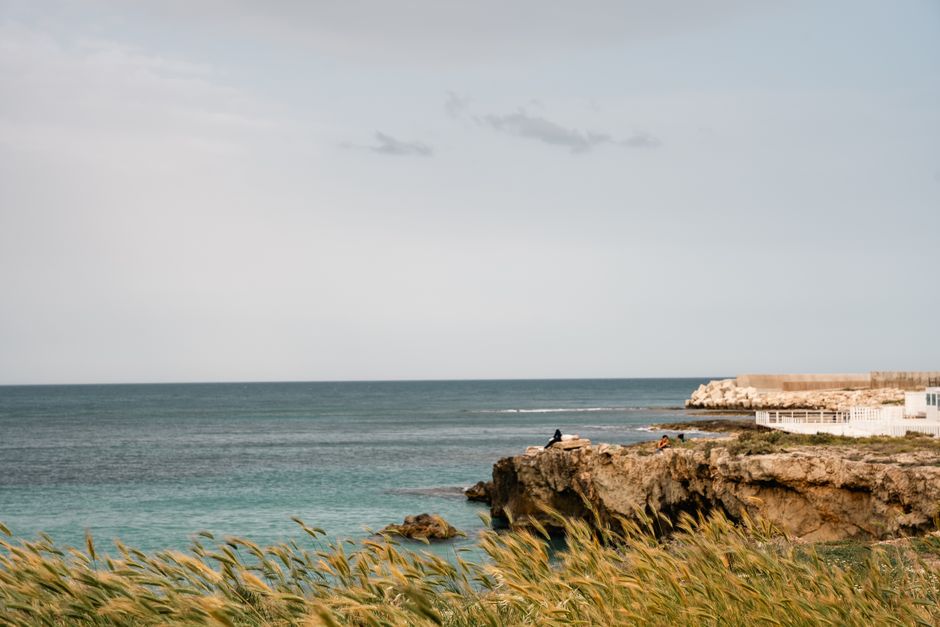
Apulia, Puglia in Italian, is the heel of the Italian boot: a long, sun-baked region of olive groves, dry-stone walls and whitewashed towns between the Adriatic and Ionian seas. It has some of the most distinctive sights in Italy, from the cone-roofed trulli of Alberobello and the white hill town of Ostuni to the golden baroque churches of Lecce and the cliff-top houses of Polignano a Mare, and some 800 km of coastline, with sandy beaches in the Salento and sea caves on the Gargano. Life is slower and prices are lower than in the north, the food is simple and superb, and many visitors stay in a masseria, a fortified farmhouse turned hotel. You will want a car and at least a week; the best months are May, June, September and October.
Right now in Apulia (Alberobello)
- Wed 16–23°C 61–74°F Cloudy
- Thu 18–26°C 64–78°F Partly cloudy
- Fri 19–24°C 66–76°F 1 mm Cloudy
Weather: MET Norway (CC BY 4.0) · Sea temperature: NOAA CoastWatch · Rates: ECB
Top tours in Apulia
See all tours for Apulia →
From local operators, with prices and reviews; you check availability and book on Viator, our partner. We may earn a commission at no extra cost to you. How we earn money
Apulia at a glance
- Best for: road trips through white towns and olive groves, beaches and clear sea, baroque architecture, food and wine, and slow countryside stays.
- How long: 5–7 days for Bari, the Valle d’Itria and Lecce; 10–14 days to add the Salento beaches and the Gargano.
- Best time: May–June and September–October. July and August are hot (average highs over 30 °C in the Salento) and the beaches are packed; winter is mild but quiet.
- Getting there: fly into Bari (BRI) or Brindisi (BDS); fast trains reach Bari and Lecce from Rome, Milan and Bologna.
- Getting around: a car is by far the easiest way; trains link the main coastal towns and Lecce, and local railways reach Alberobello and the Salento.
- Before you go: entry rules, money, trains and general safety are on our Italy travel guide.
Apulia’s areas and who each one suits
Apulia is about 400 km long, so it pays to choose one or two bases rather than moving every night. From north to south:
The Gargano
The “spur” of the boot is a mountainous headland of beech forest (the Foresta Umbra), white limestone cliffs, sea caves and sandy coves, protected as a national park. Vieste and Peschici are the main resorts, and boats leave in summer for the small Tremiti islands. Best for beach holidays, families and nature; it is far from the rest of the region, so give it its own few days.
Bari and the central coast
Bari, the regional capital, has a lively old town and the main airport. South along the coast, Polignano a Mare perches on cliffs above the sea and Monopoli has a pretty old port; north, Trani’s Romanesque cathedral stands right on the water. Good for a first base with trains and an easy arrival.
The Valle d’Itria
The green, rolling heart of Apulia, dotted with trulli, vineyards and masserie, between the white towns of Alberobello, Locorotondo, Cisternino, Martina Franca and Ostuni. This is the classic base for a countryside stay, a pool and day trips in every direction.
Lecce and the Salento
The far south of the heel. Lecce, the “Florence of the south”, is a honey-coloured baroque city with a great food and evening scene. Around it, the Salento peninsula has the region’s best beaches, from the clear Ionian shallows near Gallipoli and Porto Cesareo to the rocky Adriatic coast near Otranto and the lighthouse at Santa Maria di Leuca. Best for beaches, nightlife in summer and a city base with character.
Top things to see in Apulia
Prices and hours were checked on the official sites in October 2026, unless we say otherwise; check again before you go.
Alberobello and the trulli
Alberobello has around 1,500 trulli, whitewashed stone houses with conical roofs of grey stone slabs, many painted with symbols, packed into two hillside districts that are a UNESCO World Heritage Site. Rione Monti is the more photographed, full of shops; Aia Piccola is quieter and still lived in. The Trullo Sovrano, the only two-storey trullo, is a small house museum: as of October 2026 entry costs €2.50, and it is open 10:00–12:45 and 15:30–18:30 from April to October and until 18:00 from November to March. Come early or late in the day to avoid tour groups, and climb to the Belvedere Santa Lucia for the view over the roofs.
Polignano a Mare and Monopoli
Polignano’s old town sits on limestone cliffs riddled with sea caves. The famous view is of Lama Monachile (Cala Porto), a pebble cove between the cliffs, from the bridge or the viewpoints above. It is tiny and very crowded on summer afternoons; come in the morning or evening. Monopoli, ten minutes south, has a working harbour of blue fishing boats, a castle on the sea and small rocky coves along the coast.
Ostuni and the white towns of the Valle d’Itria
Ostuni, the “white city”, is a hill of whitewashed lanes and stairways crowned by a Gothic cathedral, looking over a sea of olive trees to the Adriatic. Locorotondo is built in a perfect circle and known for its white wine; Cisternino is famous for its fornelli pronti, butchers who grill your chosen meat to order; Martina Franca has elegant baroque palazzi and hosts a summer opera festival. Drive between them on the narrow lanes, or cycle: the quiet country roads are wonderful for cycling.
Lecce
Lecce’s soft local limestone, easy to carve, gave rise to an extravagant baroque style: the façade of the Basilica di Santa Croce is a riot of cherubs, animals and flowers, and Piazza del Duomo is a theatrical enclosed square. A Roman amphitheatre is half-excavated in the main square, Piazza Sant’Oronzo. The cathedral with its bell tower, the old seminary museum, Santa Croce, San Matteo and Santa Chiara are covered by the LeccEcclesiae pass (€11, or €21 with the bell tower), run with the archdiocese and valid for 15 days; buy it at chieselecce.it or the ticket office on Piazza del Duomo, where you can check the current price. Lecce is also a great food city: try a pasticciotto, a custard tart, for breakfast and a rustico at lunch.
Castel del Monte
Frederick II’s mysterious 13th-century castle crowns a lonely hill near Andria: a perfect octagon with eight octagonal towers, built with no moat or kitchens, and a UNESCO World Heritage Site. As of October 2026, the Ministry of Culture’s regional museums directorate charges €12 (€3 reduced; free for EU citizens under 18). It is open every day from 9:00 to 17:45 (last entry 17:00) from 1 October to 31 March, and 10:00 to 18:45 (last entry 18:00) from April to September; closed on 25 December and 1 January. Visits are in time slots of up to 120 people, with 45 minutes inside. Park at the paid car park on the SS170 and take the shuttle up. Without a car, take a train to Andria and the local bus no. 6, which runs daily from 1 April to 1 November and only at weekends after that.
Bari old town
Bari Vecchia is a maze of white lanes on a peninsula, where women still make orecchiette pasta by hand outside their doors on Strada Arco Basso. Visit the Romanesque Basilica of San Nicola, which holds the relics of St Nicholas and is a pilgrimage site for Orthodox and Catholic Christians alike, the cathedral and the Swabian castle, then walk the seafront promenade.
More to see
- Trani: a pale Romanesque cathedral on the edge of the sea and a harbour of fish restaurants.
- Otranto: a walled town on the Adriatic with a cathedral whose 12th-century floor mosaic shows a huge Tree of Life.
- Gallipoli: an old town on an island in the Ionian Sea, joined by a bridge, with sunset bars on the walls.
- Grotte di Castellana: one of Italy’s largest show caves, with guided tours, near Alberobello.
Beaches, sea and the outdoors
Apulia’s coast changes as you go south. The Adriatic side from Bari to Brindisi is mostly low rocks and small coves; the Salento has long sandy beaches and turquoise shallows on the Ionian side (Porto Cesareo, Punta Prosciutto, Pescoluse) and cliffs, coves and natural pools on the Adriatic side (Torre dell’Orso, the Grotta della Poesia at Roca Vecchia, Porto Badisco). The Gargano has sandy bays below white cliffs at Vieste and Peschici. Beaches are a mix of paid lidos with sunbeds and free stretches; in August arrive early. See our beaches guide.
Boat trips explore the sea caves of Polignano, the Gargano’s arches and grottoes from Vieste, and the Tremiti islands. The clear water of the Salento and the Tremiti is good for snorkeling and diving; see also our boat trips guide. Inland, the Porto Selvaggio nature park near Nardò and the Foresta Umbra on the Gargano have good walking trails.
Food and wine in Apulia
This is one of the best regions in Italy to eat, simply and cheaply. Look for orecchiette con cime di rapa (ear-shaped pasta with turnip tops), burrata from Andria, focaccia barese with tomatoes, fried panzerotti, raw seafood in Bari, bombette (little meat rolls) grilled in the Valle d’Itria, and fava bean purée with chicory. Apulia produces more olive oil than any other Italian region; many masserie offer tastings. The red wines are Primitivo, especially from Manduria, and Negroamaro from the Salento, plus rosés and fresh whites from Locorotondo. See our wine tasting guide.
Day trips and onward travel
The cave city of Matera, in the neighbouring region of Basilicata, is about an hour by car from Bari or Alberobello and an easy addition to any trip. North-west, the coast road continues towards the Gargano; across the Adriatic, ferries sail from Bari and Brindisi to Greece and Albania. For a longer southern Italy trip, combine Apulia with Naples and the Amalfi Coast, about four hours west by car or train.
Nearby destinations
- Matera39 km
- Alberobello66 km
- Lecce158 km
- Amalfi Coast166 km
- Sorrento185 km
- Naples191 km
- Capri199 km
- Ischia222 km
Getting there and getting around
Flights
- Bari (BRI): the main airport, with many European flights; a train links the terminal to Bari Centrale in about 20 minutes, and buses run to Matera and other towns.
- Brindisi (BDS): best for Lecce and the Salento, about 40 minutes away by road; buses link the airport with Brindisi station and Lecce.
By train
Trenitalia’s main line runs down the Adriatic coast from Bologna and Ancona to Bari, then on to Polignano a Mare, Monopoli, Ostuni, Brindisi and Lecce, with direct Frecciarossa and Intercity trains from Rome and Milan. Bari to Lecce takes about 1½ hours. Local railways fill the gaps: the Ferrovie del Sud Est (FSE) runs to Alberobello, Locorotondo and Martina Franca, and around the Salento to Otranto and Gallipoli, with buses replacing trains on some lines during works, so check timetables on the operator’s site. Ferrotramviaria trains run from Bari to Andria for Castel del Monte.
Driving and the ZTLs
A car makes Apulia much easier: the masserie, beaches and small towns are spread out, and buses are infrequent. Roads are generally good and quiet, but nearly every old town, including Bari, Lecce, Ostuni, Polignano a Mare, Monopoli and Alberobello, has a ZTL restricted traffic zone watched by cameras. Park outside the walls in a marked car park and walk in; blue lines mean paid parking. In summer, coastal roads and beach car parks fill up early. Italian speed limits and rules apply; see our Italy guide.
When to go and how long to stay
Apulia has a hot, dry Mediterranean climate with long summers and mild winters. The table uses the WMO 1991–2020 climate normals of the Italian Air Force weather station at Bari Palese airport: average daily highs and lows, and days with at least 1 mm of rain. These are long-term averages; the Salento is a little hotter in summer (Lecce averages about 33 °C in July and August) and recent summers have often been hotter still.
| Season | Average high / low | Rainy days per month | What it’s like | Good for |
|---|---|---|---|---|
| Winter (Dec–Feb) | 13–14 °C / 4–6 °C | 6–7 | Mild, often windy and damp; many beach hotels closed | Cities, olive oil, quiet towns |
| Spring (Mar–May) | 16–24 °C / 6–13 °C | 5–7 | Wildflowers, green countryside, sea still cool | Touring, cycling, Easter in the towns |
| Summer (Jun–Aug) | 28–31 °C / 17–20 °C | 2–3 | Hot, dry and sunny; busy beaches in August | Beaches, sea, evening festivals |
| Autumn (Sep–Nov) | 26 °C falling to 18 °C / 17 °C falling to 9 °C | 5 in September, 7 in November | Warm sea in September, grape and olive harvests | Swimming, food and wine, fewer crowds |
September is perhaps the best month, with a warm sea, the grape harvest and far fewer people than in August. The olive harvest runs from October to December.
Events worth planning around
- 7–9 May: the Festa di San Nicola in Bari, with a costumed procession and a sea procession carrying the saint’s statue.
- July–August: the Festival della Valle d’Itria opera festival in Martina Franca, and village food festivals (sagre) all over the region.
- Late August: the Notte della Taranta in Melpignano, a huge night of pizzica folk music and dance closing a summer-long festival in the Salento; and the feast of Sant’Oronzo in Lecce and Ostuni.
- Autumn: new wine and new olive oil; truffle and mushroom fairs on the Gargano.
How long to stay: 5-, 7- and 10-day plans
5 days: two nights in Bari or Polignano (Bari old town, Polignano, Monopoli), then three in the Valle d’Itria (Alberobello, Locorotondo, Ostuni and a masseria).
7 days: add two nights in Lecce with a beach day in the Salento. 10 days: add Castel del Monte and Trani on the way in, Otranto, Gallipoli and Santa Maria di Leuca in the south, and a day in Matera.
Where to stay in Apulia and the tourist tax
- Bari or Polignano a Mare: easy arrival, trains, old towns and the sea.
- A masseria in the Valle d’Itria: the classic stay, often with a pool and farm breakfasts; you need a car.
- A trullo: many restored trulli around Alberobello, Locorotondo and Cisternino are rented as holiday homes.
- Lecce: the best city base in the south, with restaurants and evening life; day trips to the beaches.
- Salento coast: Otranto, Gallipoli or a beach town for a sea holiday; book July and August early.
- Gargano: Vieste or Peschici for a separate beach stay.
Most Apulian towns charge a tourist tax (imposta di soggiorno) per person per night for a limited number of nights; some only in the main season, others (Lecce and Alberobello among them) all year. Each town sets its own rates, so ask your accommodation when you book; it is normally paid on arrival or at check-out.
Practical tips for Apulia
- Rent a car for anything beyond Bari, Lecce and the coastal train towns, and avoid driving into old towns.
- Respect the siesta: many shops and churches close from about 13:00 to 16:30 or 17:00, and towns come alive in the evening.
- Book beaches in August: lidos sell out sunbeds; free stretches fill early.
- Carry cash for small bars, markets and beach kiosks, although cards are widely accepted.
- Dress for churches: shoulders and knees covered.
- Emergencies: call 112.
What to pack for Apulia
Light, breathable clothes, a sun hat, sunglasses and high-factor sunscreen for summer, when the sun is fierce and shade is scarce, plus a refillable water bottle. Bring comfortable walking shoes for the stone lanes and stairways of the white towns, sandals or water shoes for the rocky coves, a swimsuit, a beach towel and a snorkel mask. Pack a light layer for breezy evenings on the coast and a scarf to cover your shoulders in churches. In spring and autumn add a light jacket and a compact umbrella. If you drive, carry your licence (and an International Driving Permit if your licence needs one) and a phone holder for navigation.
Apulia travel FAQ
Is it Apulia or Puglia?
The same place: Puglia is the Italian name, Apulia the English one. Locally and on signs you will see Puglia.
How many days do you need in Apulia?
A week covers Bari, Polignano, the Valle d’Itria and Lecce. Ten to fourteen days lets you add the Salento beaches, Castel del Monte, the Gargano or Matera.
Do I need a car in Apulia?
It is strongly recommended. Trains link Bari, Polignano, Monopoli, Ostuni, Brindisi and Lecce, and local railways reach Alberobello, but masserie, beaches and small towns are hard to reach without a car.
What is the best base in Apulia?
The Valle d’Itria, around Alberobello, Locorotondo, Cisternino or Ostuni, is the most central for touring. Lecce is the best city base in the south, and Polignano or Monopoli suit a seaside stay with trains.
Where are the best beaches in Apulia?
In the Salento: the Ionian beaches near Porto Cesareo, Punta Prosciutto and Pescoluse for sand and shallow water, and the coves around Otranto and Torre dell’Orso. The Gargano around Vieste is the other big beach area.
How much does it cost to visit Castel del Monte?
As of October 2026, €12, or €3 reduced; EU citizens under 18 enter free. It is open daily, 9:00–17:45 from October to March and 10:00–18:45 from April to September.
Can you go inside a trullo in Alberobello?
Yes. The Trullo Sovrano, a two-storey trullo turned house museum, costs €2.50 as of October 2026, and many shops and cafés occupy trulli. You can also sleep in one.
Which airport is best for Apulia?
Bari for the north and centre, the Valle d’Itria and Matera; Brindisi for Lecce and the Salento. Many trips fly into one and out of the other.
When is the best time to visit Apulia?
May, June, September and early October. July and August are very hot and crowded on the coast; winter is mild but many beach hotels close.
Is Apulia expensive?
It is better value than the Amalfi Coast or Tuscany, especially for food. Prices for masserie and beach hotels rise sharply in August.
Can you visit Matera from Apulia?
Yes. Matera is in Basilicata but only about an hour by car from Bari or Alberobello, and Ferrovie Appulo Lucane trains run from Bari to Matera.
Sources
- © OpenStreetMap contributors · ODbL · fetched 4 Oct 2026
- Wikidata · CC0 · fetched 4 Oct 2026
Sources and last review
Researched and last reviewed on 4 October 2026. Castel del Monte prices, hours and access: the site’s official page of the Ministry of Culture; Trullo Sovrano: the museum’s official site; the LeccEcclesiae pass: the official Lecce churches site; climate: WMO 1991–2020 normals of the Italian Air Force stations at Bari Palese and Lecce. The airport and FSE websites could not be read, so airport transfers, train times, ZTL details and tourist tax rules are general information flagged for checking. Prices, hours and timetables change, so check the official sites before you go. For entry rules, money and general safety, see our Italy travel guide.
Plan your trip
Partner links: TravelerCenter may earn a commission if you book, at no extra cost to you.
🇮🇹 Useful Italian phrases for Apulia
All 38 Italian phrases: restaurant, hotel, emergencies, romance (printable) →