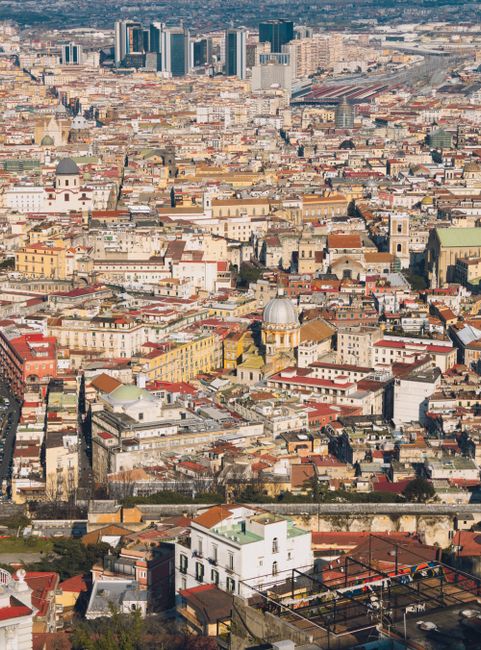
Naples is loud, generous, chaotic and completely alive: a city of narrow lanes hung with washing, baroque churches and underground tunnels, scooters and street shrines, where the world’s most famous pizza costs less than a cocktail elsewhere. It sits on one of the most beautiful bays in Europe, with Vesuvius on the skyline, Pompeii and Herculaneum at its feet and the islands of Capri, Ischia and Procida a ferry ride away. The Amalfi Coast starts just south. The best months are April to June and September to October. Give the city three days, and five or more with Pompeii, Vesuvius and an island.
Right now in Naples
- Wed 19–22°C 66–72°F 54 mm Light showers
- Thu 22–24°C 71–76°F 23 mm Heavy rain
- Fri 20–22°C 68–72°F 6 mm Mostly clear
Weather: MET Norway (CC BY 4.0) · Sea temperature: NOAA CoastWatch · Rates: ECB
Top tours in Naples
See all tours for Naples →
From local operators, with prices and reviews; you check availability and book on Viator, our partner. We may earn a commission at no extra cost to you. How we earn money
Naples at a glance
- Best months: April–June and September–October. Average highs on the bay run from about 20 °C in April to 32 °C in August, and winters are mild (WMO normals 1991–2020, Capri station).
- Days needed: 3 for the city; 5–7 with Pompeii, Herculaneum, Vesuvius and a day on Capri, Ischia or Procida.
- Getting there: Naples International Airport (NAP, Capodichino) is 15–30 minutes from the centre by the Alibus. High-speed trains reach Napoli Centrale from Rome in about 1 h 10.
- Getting around: walk the old centre; use the metro and funiculars for the hills, the Circumvesuviana train for Herculaneum, Pompeii and Sorrento, and ferries for the islands. Do not drive in the city.
- Budget level: one of the best-value big cities in Italy for food and rooms; Pompeii, the museums and the islands add up. A city tourist tax is added per person per night. See our Italy guide for money, entry rules and daily costs.
Naples’ neighbourhoods
- Centro Storico: the Greek and Roman grid of the old city, a UNESCO World Heritage Site since 1995, crossed by Spaccanapoli and Via dei Tribunali. Churches, pizzerias, the Underground and Via San Gregorio Armeno’s nativity-scene workshops. The heart of any visit.
- Toledo and the Quartieri Spagnoli: Via Toledo is the main shopping street; climb into the steep lanes of the Spanish Quarter for street life, murals and the Maradona shrine. Central and lively at all hours.
- Royal Naples: Piazza del Plebiscito, the Royal Palace, the San Carlo opera house, the Galleria Umberto I and the Castel Nuovo, with the seafront a few steps away.
- Chiaia and the Lungomare: the elegant side of town, with boutiques, aperitivo bars and the seafront promenade to the Castel dell’Ovo and Borgo Marinari. Calmer evenings and the best sea views.
- Vomero: a residential hilltop reached by funicular, with the Castel Sant’Elmo and the Certosa di San Martino looking over the whole bay. Quieter and greener.
- Rione Sanità: a working-class district north of the centre, with the Fontanelle cemetery, the catacombs of San Gennaro and a young, community-run tourism scene.
Top things to see in Naples
Prices and hours below come from the official websites, as of October 2026.
Spaccanapoli and the old town
Spaccanapoli, the “Naples splitter”, is the long, straight lane that cuts the old city in two, following the line of a Greek street. Walk it from the Gesù Nuovo church, with its diamond-studded stone façade, past the cloister of Santa Chiara, covered in painted majolica tiles, to Piazza San Domenico Maggiore and on towards the Duomo, where the relics of San Gennaro, the city’s patron saint, are kept. Parallel to it, Via dei Tribunali is lined with the city’s most famous pizzerias. In between, Via San Gregorio Armeno is filled all year with workshops making figures for nativity scenes, from shepherds to footballers and politicians.
The Veiled Christ in the Sansevero Chapel
In a small chapel off Piazza San Domenico Maggiore lies Giuseppe Sanmartino’s Veiled Christ (1753), a marble figure under a “veil” so fine it looks like real cloth. How to visit: the museum is open 9:00–19:00 and closed on Tuesdays, with last entry 30 minutes before closing. A ticket is €12, and €6 for ages 10–17; under-10s go free. Every visit must be booked in advance; tickets go on sale 60 days ahead and sell out at busy times.
Naples Underground
Below the old town lies a second city: Greek quarries, Roman aqueducts and cisterns, and shelters used during the Second World War bombings. The best-known tour, Napoli Sotterranea, starts on Piazza San Gaetano on Via dei Tribunali and goes about 40 m down, with a stretch through a narrow passage lit by candles, and a visit to the remains of the Roman theatre hidden inside a family home. Tours run in English several times a day. Other routes include the Galleria Borbonica, a 19th-century tunnel under the Royal Palace, and the catacombs of San Gennaro in the Sanità.
National Archaeological Museum (MANN)
Naples’ archaeological museum holds the greatest collection of finds from Pompeii and Herculaneum: frescoes and mosaics (including the huge Alexander Mosaic), bronzes, everyday objects, the Farnese marbles and the “Secret Cabinet” of erotic art. See it before or after Pompeii, as many of the best pieces from the ruins are here. How to visit: open 9:00–19:30, last entry 18:30, closed on Tuesdays. A ticket is €20, €2 for EU citizens aged 18–25, and free for under-18s. Entry is free for everyone on the first Sunday of the month, when some sections stay closed.
Piazza del Plebiscito, the seafront and the castles
The vast Piazza del Plebiscito faces the Royal Palace, with the San Carlo, one of the oldest working opera houses in Europe, and the glass-roofed Galleria Umberto I next door. From there, walk down to the Castel Nuovo, the fortress at the port, and along the Lungomare to the Castel dell’Ovo on its islet, the best place in town for sunset over the bay. For the view from above, take a funicular up to Vomero and the Castel Sant’Elmo.
The art stations of the metro
Several stations on metro line 1 were designed by leading artists and architects. The deep blue mosaic “sea” of Toledo station is the most famous; Università, Dante and Municipio are also worth getting off for. A single metro ticket is the cheapest art gallery in town.
Palaces
- Royal Palace of Naples
Other sights
- Teatro di San Carlo
Castles and forts
- Castel dell'Ovo
- Castel Nuovo
- Castel Sant'Elmo
Museums
- Capodimonte Museum
- Naples National Archaeological Museum
Archaeological sites
- Pompeii
- Herculaneum
Viewpoints
- Mount Vesuvius
Pizza and food in Naples
Naples invented pizza as we know it, and the art of the Neapolitan pizzaiuolo is on UNESCO’s list of intangible cultural heritage. The real thing has a soft, puffy, slightly charred crust, cooked for about a minute in a wood-fired oven. Order a margherita (tomato, mozzarella, basil) or a marinara (tomato, garlic, oregano, no cheese), and eat it with a knife and fork, or folded “a portafoglio” from a street window. The famous pizzerias of Via dei Tribunali and around the station have long queues: put your name down and wait, it moves fast. Also try a fried pizza, a sfogliatella or a babà with your coffee, and a caffè standing at the bar. Many bars keep up the tradition of the caffè sospeso, a coffee paid in advance for a stranger.
Pompeii and Herculaneum
In AD 79 Vesuvius buried the Roman towns of Pompeii and Herculaneum, preserving streets, houses, frescoes, bakeries and even graffiti. Both are UNESCO World Heritage Sites and both are easy day trips from Naples on the Circumvesuviana train. Pompeii is huge (allow at least four hours); Herculaneum is smaller, closer to Naples and better preserved, with upper floors and wooden beams still in place. If you only have half a day, choose Herculaneum.
Pompeii tickets and timed entry
- Tickets: Pompeii Express (the ancient city) is €20; Pompeii Plus (the city plus the suburban villas, including the Villa of the Mysteries, and the Villa Regina at Boscoreale, with a shuttle bus) is €25. A combined ticket at €30 adds Oplontis and the villas and museum of Stabiae, valid for three days. EU citizens aged 18–25 pay €2. The MyPompeii card (€45, or €10 for under-25s) gives a year of unlimited entry to all the park’s sites.
- Named tickets and a daily cap: tickets carry each visitor’s name, so bring ID, and no more than 20,000 people may enter in a day. From 16 March to 14 October you also choose a time slot: 9:00–13:00 (up to 15,000 entries) or 13:00–17:30 (up to 5,000).
- Where to buy: on the park’s official ticketing partner, Vivaticket, linked from pompeiisites.org, or at the ticket offices at Porta Marina, Piazza Anfiteatro and Piazza Esedra. Book ahead for weekends, holidays and the morning slot. Ignore the resellers that charge more for the same ticket.
- Hours: from 16 March to 14 October, 9:00–19:00 with last entry at 17:30; from 15 October to 14 March, 9:00–17:00 with last entry at 15:30. Closed on 1 January and 25 December. Entry is free on the first Sunday of the month, and very busy.
Herculaneum
Herculaneum (Ercolano) is a separate archaeological park with its own ticket: €16, €2 for EU citizens aged 18–25, and free on the first Sunday of the month (tickets at the box office on the day only). It is open every day, 8:30–19:30 from 16 March to 14 October (last entry 18:00) and 8:30–17:00 the rest of the year (last entry 15:30). Book on the park’s official ticket site, run by CoopCulture. The Ercolano Scavi station on the Circumvesuviana is a 10-minute walk downhill from the entrance.
Tips for the ruins
There is little shade at Pompeii: bring a hat, water (there are fountains) and good shoes for the uneven Roman paving. Arrive at opening time or take the afternoon slot in summer to avoid the worst heat and the tour groups. Hire an official guide or download the park’s app to make sense of what you see, and remember the best mosaics are in the Naples museum.
Climbing Vesuvius
The volcano that destroyed Pompeii is still active, and a short walk takes you to the rim of its crater, with the whole bay below. The Gran Cono path (trail no. 5 of the Vesuvius National Park) climbs from the car park at about 1,000 m to 1,170 m on a wide gravel track: about 4 km return, around two and a half hours, easy but steep and dusty.
- Booking is compulsory: tickets are sold only online, on the park’s official Vivaticket site, up to 30 days ahead, for a 10-minute time slot. A full ticket is €11.68 including the booking fee (as of October 2026); under-6s go free. A few last-minute tickets are released 30 minutes before each slot, bought on the Wi-Fi at the entrance, and they are named.
- Hours: 9:00–15:00 in November to February, 9:00–16:00 in March and October, 9:00–17:00 in April to June and September, and 9:00–18:00 in July and August.
- Getting there: buses run from Ercolano, Pompeii and Naples up to the car park at about 800 m, where a shuttle (€1 each way) or a 30-minute walk takes you to the start of the path. Parking is run by the town of Ercolano.
- Closures: the path closes automatically on days with an orange weather alert from the regional civil protection, and tickets are refunded.
It is often windy and several degrees cooler at the top: bring a layer and closed shoes. See our hiking guide.
The islands: Capri, Ischia and Procida
Fast ferries and hydrofoils leave Naples from Molo Beverello, in front of the Castel Nuovo, and slower car ferries from Calata Porta di Massa, a few minutes’ walk away. Several companies share the routes, so compare timetables, and buy the first boat of the day early in summer.
- Capri (about 50 minutes by fast ferry): the glamorous one, with the Faraglioni rocks, the Piazzetta, the chairlift up Monte Solaro in Anacapri and the Blue Grotto, reached by rowing boat when the sea is calm. A landing fee for day visitors is added to the ferry ticket. It is very crowded from late morning in summer: go early and stay for the evening calm if you can.
- Ischia (about an hour): the biggest island, green and volcanic, famous for its thermal spas and gardens, with the Aragonese Castle on its rock. Better for a few days than for a rush.
- Procida (about 40 minutes): the smallest and most colourful, with the pastel houses of the Marina Corricella and a relaxed, local feel. Perfect for a slow day of seafood and swimming.
Boat trips around Capri and along the Sorrento peninsula leave from Naples, Sorrento and the island itself. See our boat trips guide and our beaches guide.
Activities and best months
- Boat tripsCaremar, the regional public ferry operator, runs Naples to Capri, Ischia and Procida: hydrofoils from Molo Beverello, ferries from Porta di Massa. · source
- City sightseeingNaples' UNESCO historic centre: the Duomo, Santa Chiara, San Lorenzo Maggiore, the Sansevero Chapel and Pio Monte della Misericordia, plus Piazza del Plebiscito, the Royal Palace, Castel Nuovo, Castel dell'Ovo and the San Gennaro catacombs. · source
Nearby destinations
- Sorrento25 km
- Capri32 km
- Ischia32 km
- Amalfi Coast37 km
- Rome189 km
- Apulia191 km
- Matera199 km
- Alberobello252 km
Getting there and getting around
From the airport to the city
- Alibus: the airport bus run by ANM leaves from outside arrivals for Piazza Garibaldi (Napoli Centrale station) and the port at Molo Beverello, for the island ferries, every 15–25 minutes from early morning to around midnight. A ticket is €5, valid for 90 minutes, and also covers the city’s buses and metro in that time. Buy it from the machines at arrivals, in the apps, on board or by tapping a contactless card.
- Taxi: official white taxis wait outside arrivals and offer fixed fares to the main city areas; ask for the fixed fare (“tariffa predeterminata”) before you set off. Travel time is about 15–30 minutes depending on traffic.
- To Sorrento and the Amalfi Coast: direct buses run from the airport to Sorrento in summer; otherwise take the Alibus to the station and the Circumvesuviana.
Trains
Frecciarossa and Italo high-speed trains link Napoli Centrale with Rome in about 1 h 10, Florence in about 3 h and Milan in about 4 h 30; some also stop at Napoli Afragola, outside the city. Regional trains run north along the coast to Pozzuoli and south to Salerno, the gateway to the eastern Amalfi Coast. See our Rome guide and our Florence guide.
The Circumvesuviana
This narrow-gauge railway, run by EAV, leaves from Porta Nolana and from the underground platforms of Garibaldi station, next to Napoli Centrale. The Sorrento line stops at Ercolano Scavi (about 20 minutes) for Herculaneum, Pompei Scavi – Villa dei Misteri (about 35–40 minutes) for Pompeii, and ends in Sorrento (about 1 h 10). It is cheap, frequent and crowded, with old trains and occasional cancellations, and it is known for pickpockets: keep bags in front of you. In the 2026 season EAV also ran the Campania Express, a faster tourist train with reserved seats, until 30 September; check its 2027 season in spring.
Getting around the city
The centre is best on foot. Metro line 1 links Garibaldi, the university, Toledo, Municipio (for the port) and Vomero; line 2 is a city railway along the coast to Mergellina and Pozzuoli. Four funiculars climb the hill to Vomero. Buses are slow in traffic. Tickets are part of the regional UnicoCampania system: buy them at tobacconists, newsstands, machines or in the apps, and validate them before you travel. Taxis are a good idea late at night. Do not rent a car for the city: traffic is intense, much of the centre is a limited-traffic zone and parking is hard to find.
When to go and how long to stay
Naples has a classic Mediterranean climate: hot, sunny and dry from June to August, mild and green in spring, and wettest in autumn and early winter, when storms roll in from the sea. July and August are hot and humid in the old town and at Pompeii, and many Neapolitans leave the city in mid-August. April, May, June, September and October are the best months for sightseeing, with sea swimming warm enough from June to early October. The busiest times are Easter, the long weekends of late April and early May, and the Christmas season, when the nativity workshops are in full swing.
| Season | Average high / low | Rainy days a month | What it’s like |
|---|---|---|---|
| Spring (Mar–May) | 17–24 °C / 10–16 °C | 4–7 | Fresh and flowery; ideal for Pompeii and Vesuvius; busy at Easter. |
| Summer (Jun–Aug) | 29–32 °C / 20–23 °C | 1–2 | Hot, dry and humid; great for the islands and the sea, tiring at the ruins. |
| Autumn (Sep–Nov) | 18–28 °C / 13–20 °C | 6–9 | September and October are warm and golden; November is the wettest month. |
| Winter (Dec–Feb) | 14–15 °C / 8–10 °C | 7–9 | Mild and quiet; Christmas markets and nativity scenes; ferries run less often. |
Figures are the WMO 1991–2020 climate normals for the Capri station of Italy’s national weather service, on the island across the bay (rainy day = at least 1 mm of rain). The city itself has slightly cooler nights in winter. Capri receives about 630 mm of rain a year, most of it from October to January.
3 days in Naples
Day 1: the old town, Spaccanapoli, the Sansevero Chapel, the Underground and pizza on Via dei Tribunali. Day 2: the Archaeological Museum in the morning, then Pompeii or Herculaneum by Circumvesuviana. Day 3: Piazza del Plebiscito, the Spanish Quarter, a funicular to Vomero and sunset on the Lungomare.
5 days in Naples
Add Vesuvius with Herculaneum on the same day (book both), and a day on Procida or Capri.
7 days or more
Move on to Sorrento or the Amalfi Coast for three or four nights, or spend two nights on Ischia for the spas. Naples also works well before or after Rome, or with a ferry or flight to Sicily.
Where to stay in Naples
- First visit: the Centro Storico or around Via Toledo, walking distance from everything and from metro line 1.
- Sea views and calmer evenings: Chiaia or the Lungomare, near the ferry port at Molo Beverello.
- Quiet and local: Vomero, with funiculars down to the centre.
- Early trains: around Piazza Garibaldi is practical for the station and the Circumvesuviana, but less pleasant at night; choose a well-reviewed hotel on a main street.
- Ruins first: some travellers sleep in Sorrento and visit Naples, Pompeii and Herculaneum from there.
A tourist tax (imposta di soggiorno) is added per person per night, set by the city and the type of accommodation.
Safety and practical tips for Naples
- Naples is safer than its reputation: violent crime against visitors is rare, but petty theft is common. Carry a cross-body bag, keep phones away from the kerb (scooter snatching happens), and watch your pockets on the Circumvesuviana, the metro, buses and around Piazza Garibaldi.
- Crossing the road: traffic rarely stops for you. Cross with confidence at crossings, ideally with locals, and watch for scooters in pedestrian lanes.
- Book the essentials: the Sansevero Chapel and Vesuvius need a booking; Pompeii needs a named ticket and, from mid-March to mid-October, a time slot.
- Tuesday closures: the Archaeological Museum and the Sansevero Chapel close on Tuesdays; Pompeii and Herculaneum are open.
- Taxis: use official white taxis with a meter or an agreed fixed fare, never unofficial drivers at the station.
- Cash: cards are widely accepted, but carry some coins for coffee, street food and tips.
- Emergencies: call 112.
Weather month by month
Averages from Aeronautica Militare normals 1991–2020, Capri · Last reviewed 4 Oct 2026
What to pack for Naples
Bring comfortable walking shoes with good grip: the old town’s lava-stone paving is uneven and slippery when wet, Pompeii’s Roman streets are rough, and the Vesuvius path is loose gravel. In summer pack a sun hat, sunscreen, sunglasses and a refillable bottle for the shadeless ruins, plus a swimsuit and a light towel for the islands. Add a windproof layer for the top of Vesuvius and the ferry deck, and an umbrella from October to January. Cover your shoulders and knees for churches, carry a cross-body bag that zips shut, and keep a copy of your ID for your named Pompeii ticket.
What to pack
- City walking shoesLisbon and Porto are steep, with polished limestone cobbles that get slippery, so grippy soles matter.
- Day packs and anti-theft bagsA small zipped or anti-theft bag makes crowded trams and viewpoints less stressful.
- Dry bags and phone pouchesSpray soaks phones and cameras on open boats to the Algarve caves and on whale-watching trips.
- Fleeces and warm layersIt is cooler at sea than on land, especially on morning whale-watching trips.
- Rain jacketsA windproof, waterproof shell keeps you warm on open boats, where wind and spray cool you quickly.
- Reef-friendly sunscreenSun reflects off the water on cruises and cave tours.
- Travel adapters and convertersPortugal uses Type C and F sockets at 230 V, so most visitors from outside Europe need an adapter.
- Water shoesKayak and small-boat trips to the Algarve grottoes land on rock and wet sand.
Naples travel FAQ
How many days do you need in Naples?
Three days for the city and one of the ruins, and five to seven to add Pompeii, Herculaneum, Vesuvius and a day on an island.
Is Naples safe for tourists?
Yes, for the usual city precautions. The main risk is petty theft: watch your bag and phone on public transport, around the station and in crowds, and take official taxis at night.
How much is a ticket to Pompeii?
€20 for Pompeii Express (the ancient city) or €25 for Pompeii Plus, which adds the suburban villas, as of October 2026. A three-day combined ticket with Oplontis, Stabiae and Boscoreale is €30.
Do I need to book Pompeii in advance?
It is strongly advised. Tickets are named, entries are capped at 20,000 a day, and from 16 March to 14 October you must choose a morning (9:00–13:00) or afternoon (13:00–17:30) slot. Buy on the official Vivaticket site linked from pompeiisites.org.
Pompeii or Herculaneum: which is better?
Pompeii is bigger and more famous, a whole city to explore; Herculaneum is smaller, closer to Naples and better preserved. With half a day, choose Herculaneum; with a full day, Pompeii; with two, see both.
How do I get from Naples to Pompeii?
Take the Circumvesuviana Sorrento line from Porta Nolana or Garibaldi to Pompei Scavi – Villa dei Misteri, about 35–40 minutes. The station is next to the Porta Marina entrance.
Do I need to book Vesuvius?
Yes. Entry to the Gran Cono path is by online ticket only, for a set time slot, on the national park’s official Vivaticket site (€11.68 as of October 2026). A few last-minute tickets are released at the entrance 30 minutes before each slot.
How do I get from Naples airport to the city?
By the Alibus to Piazza Garibaldi and Molo Beverello: €5, valid 90 minutes, every 15–25 minutes. Official taxis offer fixed fares to the centre.
Where is the best pizza in Naples?
The classic pizzerias are on and around Via dei Tribunali and near the station, but good pizza is everywhere in Naples. Go for a margherita or marinara, expect a queue at the famous names and a fair price almost anywhere.
Can you do Capri as a day trip from Naples?
Yes. Fast ferries from Molo Beverello take about 50 minutes. Take an early boat, as the island is busiest from late morning to mid-afternoon.
Is the Naples Archaeological Museum worth it?
Yes, especially with Pompeii: many of the best mosaics, frescoes and statues from the ruins are here. It closes on Tuesdays; a ticket is €20 and under-18s go free.
Is Naples a good base for the Amalfi Coast?
For a day trip it works, but it is a long day. To explore the coast properly, sleep in Sorrento, Positano, Amalfi or Salerno for a few nights.
Sources
- © OpenStreetMap contributors · ODbL · fetched 4 Oct 2026
- Wikidata · CC0 · fetched 4 Oct 2026
Sources and last review
Researched and last reviewed on 3 October 2026. Prices, hours and booking rules come from the official websites of the Archaeological Park of Pompeii, the Archaeological Park of Herculaneum and its ticket office, the Vesuvius National Park, the National Archaeological Museum of Naples and the Sansevero Chapel Museum. Climate figures are the WMO 1991–2020 normals for the Capri station. Transport times and fares are typical and change by season, so check the official sites of ANM, EAV, Trenitalia and the ferry companies before you travel.
Plan your trip
Partner links: TravelerCenter may earn a commission if you book, at no extra cost to you.
🇮🇹 Useful Italian phrases for Naples
All 38 Italian phrases: restaurant, hotel, emergencies, romance (printable) →