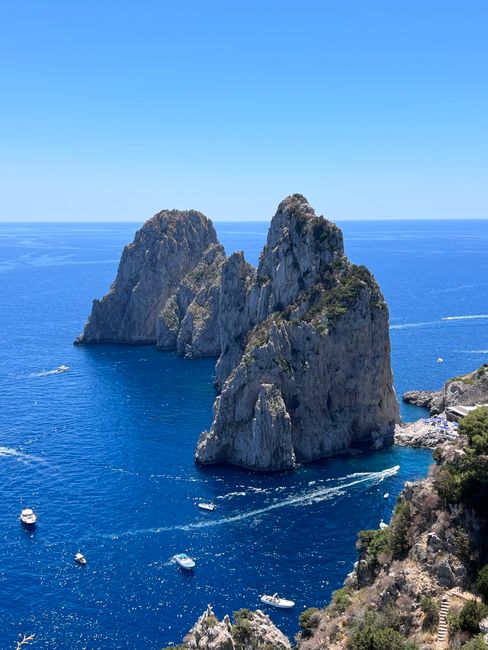
Capri is the limestone island at the mouth of the Bay of Naples that has drawn emperors, painters, writers and film stars for 2,000 years. Its sheer white cliffs drop into impossibly clear water, the three Faraglioni rocks stand off its southern tip, and the Blue Grotto glows like a lamp in its western sea wall. Up top there are two towns: chic little Capri, built around the famous Piazzetta, and quieter Anacapri, below Monte Solaro. Most visitors come for a day from Naples, Sorrento or the Amalfi Coast, and the island is very busy from late morning to late afternoon. Stay a night or two and you get the other Capri: empty lanes in the evening, sunset walks to the cliff-top viewpoints and swims before the first boats arrive. The best months are May, June, September and early October.
Right now in Capri
- Wed 20–22°C 69–72°F 46 mm Showers
- Thu 21–23°C 70–74°F 29 mm Heavy rain
- Fri 20–22°C 69–71°F 4 mm Partly cloudy
Weather: MET Norway (CC BY 4.0) · Sea temperature: NOAA CoastWatch · Rates: ECB
Top tours in Capri
See all tours for Capri →
From local operators, with prices and reviews; you check availability and book on Viator, our partner. We may earn a commission at no extra cost to you. How we earn money
Capri at a glance
- Best for: sea views and cliff walks, boat trips around the grottoes, swimming off the rocks, gardens, villas and a long lunch with a view.
- How long: a day trip covers the highlights if you start early; 2–3 nights let you see the island at its calmest and add the walks and a boat day.
- Best time: May–June and September–early October. July and August are hot and crowded; from November to March many hotels and restaurants close.
- Getting there: ferries and hydrofoils from Naples (about 50 minutes by fast boat) and Sorrento (about 20–25 minutes), and in season from Positano and Amalfi. A €5 landing fee is added to your ticket.
- Getting around: on foot, by funicular, by small public buses and by open-top taxi. Visitors cannot bring a car.
- Before you go: entry rules, money, trains and general safety are on our Italy travel guide.
Capri’s towns and who each one suits
The island is only about 6 km long, and it splits naturally into the port, the town of Capri on the saddle above it, and Anacapri on the higher western plateau. Where you stay shapes your trip.
Marina Grande
The island’s only real port, where every ferry and hydrofoil docks. It has a pebbly public beach, boat-tour kiosks, ticket offices, cafés and the bottom station of the funicular. It is practical for an early boat, but busy and functional by day; few people stay here.
Capri town and the Piazzetta
The glamorous heart of the island. The funicular lands you a few steps from Piazza Umberto I, the Piazzetta, a tiny square of café tables under a clock tower. From here lanes of white houses and designer boutiques lead to the Gardens of Augustus, the Faraglioni viewpoints and the walks to the Arco Naturale and Villa Jovis. Capri town is the most central and the most expensive base, full of day visitors from about 10:00 to 17:00 and delightful in the evening.
Anacapri
Higher, greener and calmer, with a more village-like feel and slightly lower prices. It is the base for Villa San Michele, the chairlift up Monte Solaro, the church of San Michele with its majolica floor, and the bus down to the Blue Grotto and the Punta Carena lighthouse. A good choice for families and longer stays; buses and taxis link it with Capri town in about 15 minutes.
Top things to see on Capri
Prices and hours below were checked on the official sites in October 2026, unless we say otherwise; check again before you go. Many sites take cards only.
The Blue Grotto
The Grotta Azzurra is a sea cave on the north-west coast whose water glows an electric blue as sunlight enters through an underwater opening. The entrance is only about a metre high, so you transfer to a small rowing boat, lie back as the boatman pulls you in on a chain, and get a few magical minutes inside. You can get there by motorboat from Marina Grande or by bus from Anacapri to the steps above the cave. As of October 2026 the island’s tourist guide lists an entry ticket of €6 (€2 for EU citizens aged 18–25, free for under-18s), paid on the spot, plus €12 for the rowing boat, plus the motorboat from Marina Grande (about €24) if you come by sea; tickets cannot be bought in advance. The grotto opens daily from 9:00 and closes in mid-afternoon in October, earlier in winter, and it is closed whenever the sea is rough, which happens often, and on 25 December and 1 January. Queues can top an hour in summer; come early or late.
The Piazzetta and the Gardens of Augustus
Start with a coffee in the Piazzetta, the island’s open-air living room, then walk five minutes to the Gardens of Augustus, the terraced flower gardens laid out on the land of the German industrialist Friedrich Alfred Krupp. They hang above the sea with a classic view of the Faraglioni, the bay of Marina Piccola and the hairpin bends of Via Krupp, the path carved into the cliff below. As of October 2026 a ticket costs €2.50 (free under 12), sold on the city’s official culture site and at card-only machines at the gate. Online tickets can be bought up to 30 days ahead and are valid for 15 days from the date you choose. The gardens are open 9:30–19:00 from 1 to 15 October, 9:30–18:30 from 16 October to 3 November and 9:30–16:30 from 4 November to the end of the year, with last entry 15 minutes before closing. Via Krupp itself has been closed for long periods because of rockfalls; check locally whether it is open.
The Faraglioni and the cliff-top walks
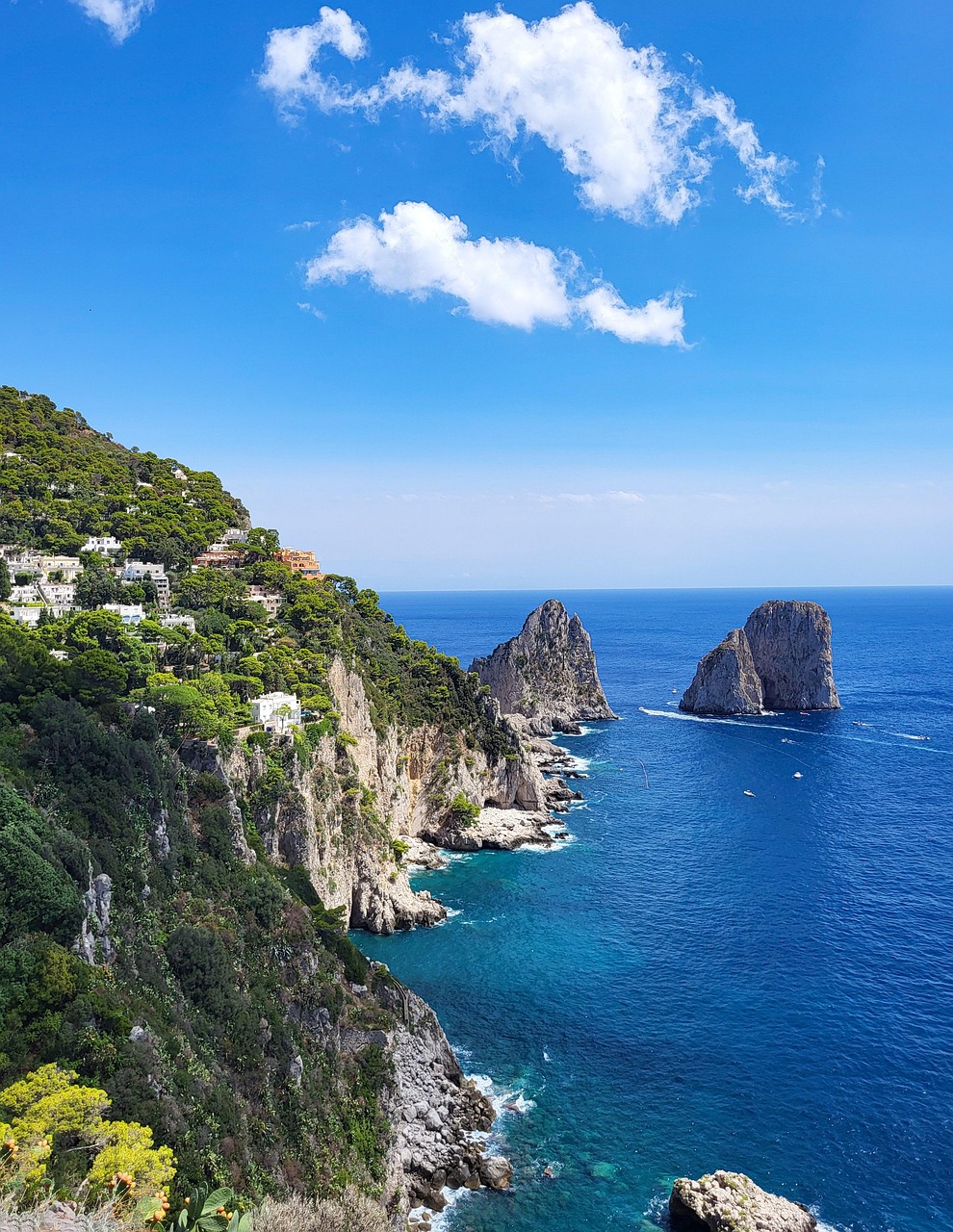
The three rock stacks off the south-east tip are Capri’s symbol. See them from the Belvedere di Tragara at the end of Via Tragara, a flat 20-minute walk from the Piazzetta past villas and gardens, and then from the water on a boat trip, which passes through the arch in the middle stack. From Tragara, the Pizzolungo path continues to the Arco Naturale, a natural rock arch: about an hour and a half with steps.
Villa San Michele, Anacapri
The Swedish doctor and writer Axel Munthe built this white villa on the ruins of a Roman chapel above the Phoenician Steps, filling it with antiquities and surrounding it with a garden that ends at a granite sphinx gazing over the bay. As of October 2026 tickets cost €12 (€8 for young people and students, free under 12), and the villa is open daily 9:00–17:00 in October and 9:00–15:30 in November and December, closed in February and on Tuesdays in December and January.
Monte Solaro by chairlift
The single-seat chairlift from Piazza Vittoria in Anacapri floats over gardens and vineyards to the top of Monte Solaro, at 589 m the island’s highest point, in about 13 minutes. At the top a terrace bar looks down on the Faraglioni and across to the Amalfi Coast. The operator’s prices are €15 return or €12 one way as of October 2026; it runs 9:15–17:00 from April to October (last ride down 17:30) and 9:30–16:00 in February, March, November and December, weather permitting. Many people ride up and walk down via the hermitage of Santa Maria a Cetrella, about an hour on a stony path.
Villa Jovis
The ruins of the Emperor Tiberius’s main palace crown Monte Tiberio, at the island’s eastern tip, with dizzying views over the Sorrento peninsula. According to the island’s tourist guide, entry costs €6 (€2 for EU citizens aged 18–25, free for under-18s), cards only; it is closed on Mondays and opens roughly 10:00–17:00 in October, with shorter winter hours. The walk up from the Piazzetta takes about 45 minutes, all uphill; ask at the tourist office in the Piazzetta that it is open before you go.
More to see
- Certosa di San Giacomo: a 14th-century monastery near the Gardens of Augustus, now home to paintings by Karl Wilhelm Diefenbach and Roman statues found on the island.
- Villa Lysis: an Art Nouveau villa on the cliffs near Villa Jovis, owned by the city; the garden costs €2.50, or €8 with the Jago Museum inside (€6 reduced), as of October 2026.
- Church of San Michele, Anacapri: an 18th-century church whose majolica floor shows Adam and Eve leaving the Garden of Eden.
- Punta Carena lighthouse: at the island’s south-west tip, with rocks for swimming and the best sunsets.
Other things to do on Capri
Boat trips around the island
The best way to understand Capri is from the sea. Shared boat tours leave Marina Grande all day in season and circle the island in about an hour or two, passing the grottoes, the lighthouse and the Faraglioni, with an optional stop at the Blue Grotto. A private gozzo, the traditional wooden boat, with a skipper costs much more but lets you stop for swims in coves you cannot reach on foot. See our boat trips guide.
Swimming and beach clubs
Capri has no long sandy beaches. Instead there are rocky platforms and small pebble coves with beach clubs that rent sunbeds and serve lunch: Marina Piccola, the Bagni di Tiberio west of Marina Grande, the clubs near the Faraglioni and the rocks at Punta Carena. There are free public spots at Marina Grande and Marina Piccola. The water is very clear and good for snorkeling along the rocks. See our beaches guide.
Walking
Away from the Piazzetta, Capri is a walker’s island. Beyond the Tragara and Pizzolungo loop, the Sentiero dei Fortini follows the wild west coast from the Blue Grotto towards Punta Carena past old coastal forts, about three hours one way, with little shade. The Phoenician Steps, the old stairway of several hundred steps between Marina Grande and Anacapri, are best walked downhill. Wear proper shoes and carry water; see our hiking guide.
Food and evenings
Capri gave the world the insalata caprese, ravioli capresi and the almond and chocolate torta caprese. When the day boats leave, the Piazzetta fills again for an aperitivo.
Day trips and onward travel
Sorrento and the Amalfi Coast
The fast ferry to Sorrento takes about 20–25 minutes, and in season boats also run to Positano and Amalfi. Combine two or three nights on Capri with a few nights on the Amalfi Coast for the classic trip.
Naples, Pompeii and the other islands
Naples is about 50 minutes away by hydrofoil, with its archaeological museum, pizza and old centre, and from Naples or Sorrento the Circumvesuviana train reaches Pompeii. Ischia, with its thermal spas, and colourful little Procida are reached via Naples; see our Naples guide.
Nearby destinations
- Sorrento15 km
- Naples32 km
- Amalfi Coast32 km
- Ischia35 km
- Apulia199 km
- Matera200 km
- Rome209 km
- Aeolian Islands236 km
Getting there and getting around
Ferries and hydrofoils
All boats arrive at Marina Grande. Several companies, including the regional ferry company Caremar and private hydrofoil lines, sail from Naples (Molo Beverello and Calata Porta di Massa) and Sorrento all year, and in season from Positano, Amalfi, Salerno and Ischia. Fast boats take about 50 minutes from Naples and 20–25 minutes from Sorrento; slower car ferries take about 1 hour 20 from Naples. As examples, Caremar’s published fares in October 2026 are €21.50 for the fast boat from Naples, €14.80 for the slow ferry from Naples and €17.40 for the fast boat from Sorrento, one way. Every ticket to Capri also includes the island’s €5 landing fee (contributo di sbarco), and advance tickets carry a small booking charge. Buy return tickets with the same company, take an early boat out, and keep a margin on your last day: crossings are cancelled in rough seas.
The funicular, buses and taxis
The funicular climbs from Marina Grande to the Piazzetta in a few minutes, for €2.40 a ride according to the island’s tourist guide. Small orange public buses link Marina Grande, Capri, Anacapri, Marina Piccola, the Blue Grotto and the Punta Carena lighthouse; tickets cost about the same as the funicular. In summer the queues for both can be long, so walk when you can: the stepped path from the port to the Piazzetta takes about 20 minutes. Open-top taxis wait at the port, the Piazzetta and Anacapri; agree the fare first.
Luggage and cars
Lanes in Capri town are too narrow for cars, and hotels are often reached only on foot. Licensed porters meet the boats and deliver bags to your hotel for a fee per piece; ask your hotel to arrange it. Non-residents cannot bring a car to the island, so leave yours in a garage in Naples or Sorrento.
When to go and how long to stay
Capri has a mild Mediterranean climate: warm, dry, sunny summers and soft, wet winters. The table uses the WMO 1991–2020 climate normals of the Italian Air Force weather station on Capri itself, at 160 m: average daily highs and lows, and days with at least 1 mm of rain. These are long-term averages; recent summers have often been hotter.
| Season | Average high / low | Rainy days per month | What it’s like | Good for |
|---|---|---|---|---|
| Winter (Dec–Feb) | 14–15 °C / 8–10 °C | 7–9 | Mild, often windy; many hotels and restaurants closed | Quiet walks, low prices, Christmas lights in the Piazzetta |
| Spring (Mar–May) | 17–24 °C / 10–16 °C | 4–7 | Flowers on the cliffs; the season opens around Easter | Walking, gardens, first swims in late May |
| Summer (Jun–Aug) | 29–32 °C / 20–23 °C | 1–2 | Hot, sunny and very crowded by day | Swimming, boat trips, evenings in the Piazzetta |
| Autumn (Sep–Nov) | 28 °C falling to 18 °C / 20 °C falling to 13 °C | 6 in September, 9 in November | Warm sea in September, quieter October, storms and closures in November | Swimming, walking, fewer crowds |
The sea is warmest from July to September. Rough seas close the Blue Grotto and cancel boats more often from October onwards, and many hotels shut from November to Easter.
Events worth planning around
- 14 May: the feast of San Costanzo, Capri’s patron saint, with a procession from Marina Grande.
- 13 June: the feast of Sant’Antonio in Anacapri, with processions and fireworks.
- All year: the City of Capri publishes a monthly events programme.
How long to stay: day trip, 2 and 3 days
Day trip: take the first boat, go straight to the Blue Grotto if the sea is calm, then bus to Anacapri for Villa San Michele and the Monte Solaro chairlift. In the afternoon, the Piazzetta, the Gardens of Augustus and the walk to the Belvedere di Tragara, then one of the last boats back.
2 days: add a boat trip round the island, a swim at Marina Piccola or Punta Carena, and the Pizzolungo walk to the Arco Naturale at sunset. 3 days: add Villa Jovis, the Sentiero dei Fortini and a long, slow lunch, or a morning in Sorrento.
Where to stay on Capri and the tourist tax
- Capri town: the most central and glamorous, close to the funicular and the Piazzetta; expensive and busy by day.
- Anacapri: quieter and better value, with more space and family-run hotels; buses to everything.
- Marina Grande: handy for early boats and the beach; less atmosphere.
- On the mainland: Sorrento is cheaper and has frequent boats, if you are happy with a day trip.
Rooms are scarce and pricey from June to September, so book months ahead. A tourist tax (imposta di soggiorno) is charged per person per night by the towns of Capri and Anacapri and paid at your hotel; ask for the current rate when you book. The €5 landing fee is separate and comes with your ferry ticket.
Practical tips for Capri
- Beat the crowds: catch a boat before 9:00 or stay overnight; the island empties after the last day boats leave.
- Check the sea: the Blue Grotto and boat trips depend on calm water; ask at Marina Grande before you pay.
- Carry a card: the Gardens of Augustus, Villa Jovis and several other sites take electronic payments only.
- Travel light: use the porters, or leave big bags at left-luggage desks at the port.
- Book the boat back: the last ferries of the day fill up in summer.
- Emergencies: call 112.
What to pack for Capri
Comfortable shoes with good grip are essential: Capri is all steps, stone lanes and steep paths, and the walks to Villa Jovis and the Arco Naturale are long. For swimming, bring a swimsuit, a quick-dry towel and water shoes for the rocks and pebbles, and a snorkel mask for the clear water. In summer add a sun hat, sunglasses, high-factor sunscreen and a refillable bottle. A light jacket helps on the ferry deck and on spring and autumn evenings, and a smart-casual outfit fits in at dinner. If boats make you queasy, pack travel-sickness tablets.
Capri travel FAQ
Is a day trip to Capri worth it?
Yes, if you start early and accept the crowds. A day covers the Blue Grotto (sea permitting), Anacapri, Monte Solaro, the Piazzetta and the Gardens of Augustus. To see the island at its best, stay at least one night.
How do I get to Capri?
By ferry or hydrofoil to Marina Grande: about 50 minutes from Naples and 20–25 minutes from Sorrento by fast boat, all year, plus seasonal boats from Positano and Amalfi.
What is the Capri landing fee?
It is a €5 contributo di sbarco per person, added automatically to every ferry ticket to the island, as listed in the ferry companies’ fares in October 2026.
How much does the Blue Grotto cost?
As of October 2026 the island’s tourist guide lists €6 for the entry ticket plus €12 for the rowing boat, paid on the spot, plus about €24 for the motorboat from Marina Grande if you do not take the bus. Under-18s from the EU enter free.
When is the Blue Grotto closed?
Whenever the sea is rough or the wind is strong, which can happen on any day and more often from autumn to spring, and on 25 December and 1 January. It also closes earlier in the afternoon in October and winter.
How much is the Monte Solaro chairlift?
€15 return or €12 one way, according to the operator in October 2026. It runs from about 9:15 to 17:00 from April to October.
Can I take a car to Capri?
No. Non-resident cars are not allowed on the island, and you would not need one: buses, the funicular and taxis cover everything, and most of Capri town is pedestrian.
Where should I stay on Capri?
Capri town for glamour and the evening scene, Anacapri for a quieter, better-value base. Book months ahead for June to September.
What is the best time to visit Capri?
May, June, September and early October, when the sea is warm and the island is a little calmer than in July and August. Many places close from November to Easter.
Are there beaches on Capri?
Mostly rocks and small pebble coves with beach clubs: Marina Piccola, the Bagni di Tiberio and Punta Carena are the favourites. Bring water shoes.
Sources and last review
Researched and last reviewed on 4 October 2026. Gardens of Augustus and Villa Lysis prices and hours: the City of Capri’s culture and tourism site; Villa San Michele: the Axel Munthe Foundation; Monte Solaro chairlift: the operator’s official site; ferry fares and the €5 landing fee: Caremar’s published fares; climate: WMO 1991–2020 normals of the Italian Air Force station on Capri. The Blue Grotto prices and hours, Villa Jovis, the funicular fare, the car ban and the luggage arrangements come from the island’s private tourist guide and other secondary sources and are flagged for checking. Prices, hours and boat timetables change, so check the official sites before you go. For entry rules, money and general safety, see our Italy travel guide.
Plan your trip
Partner links: TravelerCenter may earn a commission if you book, at no extra cost to you.
🇮🇹 Useful Italian phrases for Capri
All 38 Italian phrases: restaurant, hotel, emergencies, romance (printable) →