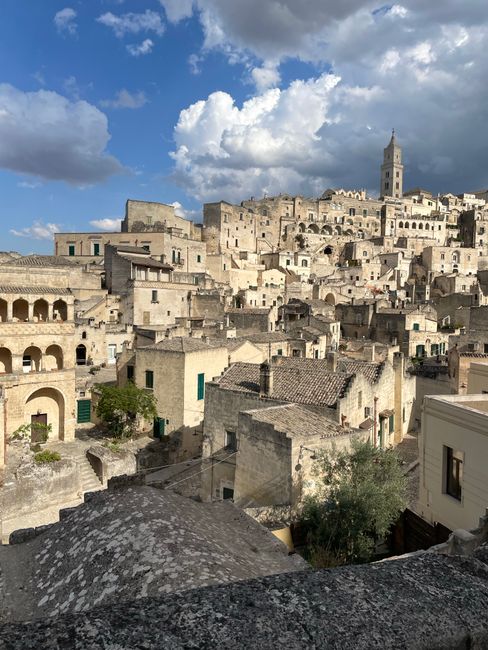
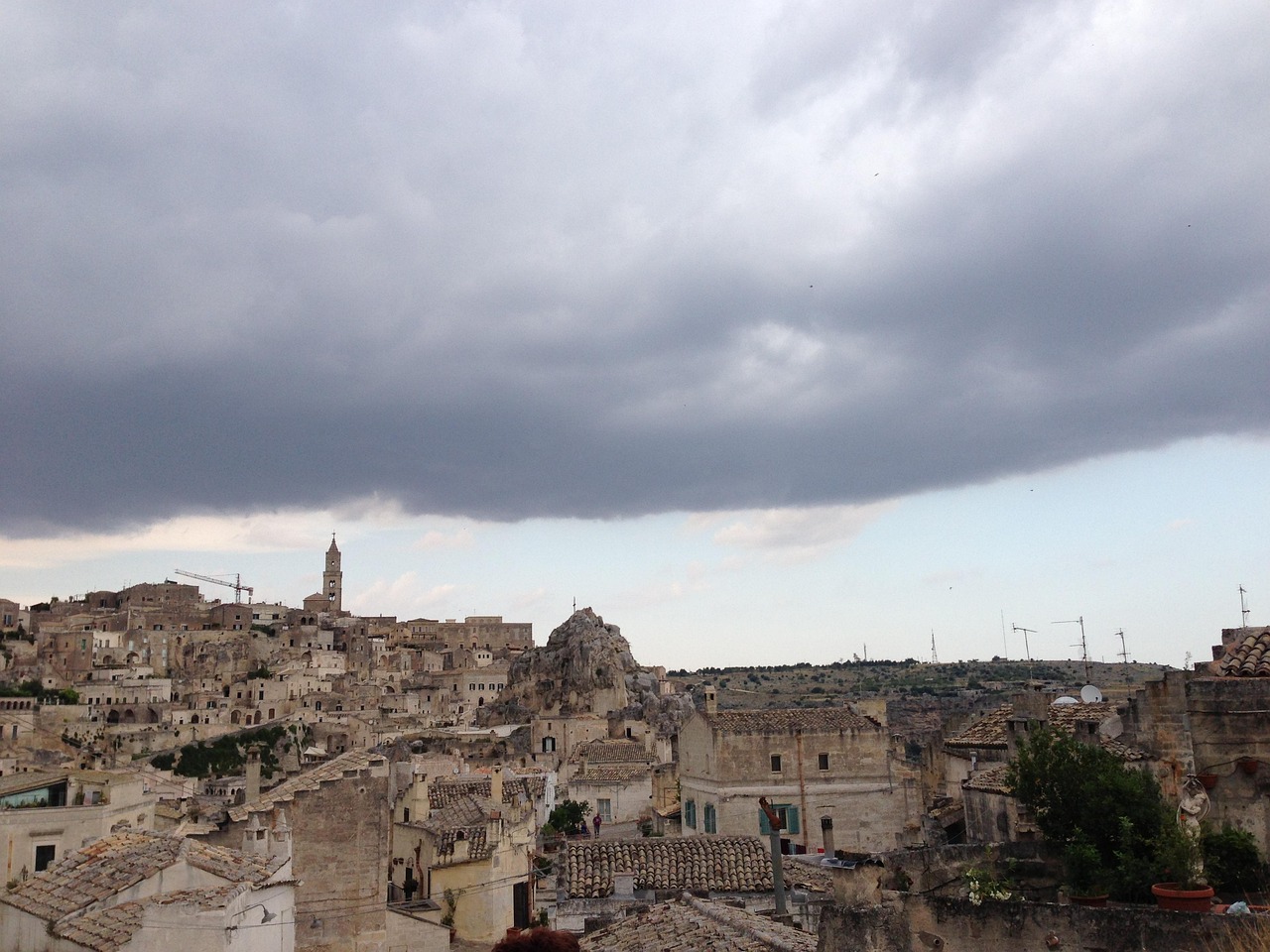
Matera is one of the oldest continuously inhabited towns in the world and one of the most extraordinary sights in Italy: two ravines of cave houses, rock churches and stairways, the Sassi, carved into the side of a deep gorge in Basilicata. Seventy years ago the Sassi were a byword for poverty, and their inhabitants were moved out to new districts in the 1950s; today the caves have been restored as hotels, restaurants and museums, the whole ensemble is a UNESCO World Heritage Site, and in 2019 Matera was European Capital of Culture. Come for the view at dusk, when the lights come on across the honey-coloured stone, the frescoed cave churches, and a hike across the gorge to the plateau of the Murgia. Two nights is ideal; the best months are April to June and September to October.
Right now in Matera
- Wed 16–24°C 61–75°F Partly cloudy
- Thu 16–26°C 61–80°F Partly cloudy
- Fri 19–24°C 65–76°F 1 mm Cloudy
Weather: MET Norway (CC BY 4.0) · Rates: ECB
Top tours in Matera
See all tours for Matera →
From local operators, with prices and reviews; you check availability and book on Viator, our partner. We may earn a commission at no extra cost to you. How we earn money
Matera at a glance
- Best for: unforgettable views, cave architecture and rock churches, photography, walking and slow food.
- How long: 1 full day for the Sassi; 2 nights to add the Murgia park, the museums and Matera by night.
- Best time: April to June and September to October. Summer is hot and bright on the stone; winter is cold for the south, at about 400 m.
- Getting there: about an hour by car from Bari or its airport; Ferrovie Appulo Lucane trains from Bari; buses from Bari airport. Matera has no main-line Trenitalia station.
- Getting around: on foot, with lots of steps; the Sassi are a restricted traffic zone.
- Before you go: entry rules, money, trains and general safety are on our Italy travel guide.
Matera’s districts and who each one suits
Matera has two faces: the upper, 17th- and 18th-century town along the ridge, with its piazzas, palazzi and shops, and below it the Sassi, the cave districts that tumble down to the gorge of the Gravina.
Sasso Barisano
The northern of the two Sassi, facing north-west, with more façades built in front of the caves, many of them now hotels, restaurants and shops. It is the livelier, more restored district, with the rock church of San Pietro Barisano.
Sasso Caveoso
The southern district, older-looking and more open, where the caves are cut straight into the rock and the stairways spill down towards the gorge. Here you find the cave-house museums, the rock churches of Santa Maria de Idris and Santa Lucia alle Malve, and the path down to the Gravina.
The Civita
The rocky spur between the two Sassi, crowned by the Romanesque cathedral. It has the best viewpoints over both districts and some of the most atmospheric hotels.
The Piano: the upper town
Along the ridge above the Sassi, Piazza Vittorio Veneto, Via Ridola and Via del Corso form the everyday centre, with baroque churches, cafés and the evening passeggiata. Staying here is a little cheaper and easier with luggage, and the viewpoints over the Sassi are just steps away.
Top things to see in Matera
Prices and hours were checked on the official sites in October 2026, unless we say otherwise; check again before you go.
The Sassi and the viewpoints
Simply walking the Sassi is the main attraction: up and down stairways, along lanes that run over the roofs of the houses below, past cisterns, courtyards and bell towers. Start at the viewpoints along the ridge, the Belvedere Luigi Guerricchio and the terrace of Piazza Vittorio Veneto, for the panorama, then go down. Come back at blue hour, when the caves light up. Signs are few and the lanes twist, so allow time to get lost.
The rock churches
More than 150 churches were carved into the rock around Matera, many with Byzantine and medieval frescoes. Several in the Sassi are run as a circuit by the Oltre l’Arte cooperative, sold as single tickets or combined tickets for one, two or three churches plus other sites on its official website. As of October 2026 the opening hours are:
- Santa Maria de Idris and San Giovanni in Monterrone: on top of the Montirone rock in the Sasso Caveoso; daily 9:30–19:30.
- Santa Lucia alle Malve: one of the oldest, with fine frescoes; daily 9:30–19:30.
- San Pietro Barisano: the largest rock church in the Sassi, with tombs and a crypt; daily 10:00–19:00.
- Cathedral cultural route and the MATA diocesan museum: daily 9:00–19:00.
All the circuit’s sites close on 25 December and 2 July, the day of the Festa della Bruna. Book online in high season and keep the confirmation email, which you show at the door.
The cave houses: Casa Grotta di Vico Solitario
To understand how families lived in the Sassi until the 1950s, sharing one cave with their mule, chickens and a pig, visit a furnished casa grotta. The best known is the Casa Grotta di Vico Solitario in the Sasso Caveoso: as of October 2026 a ticket costs €8, including a snow store (neviera), a natural cave and the rock church of Sant’Agostino al Casalnuovo, with reduced tickets of €5 (over-65s and university students) and €3 (ages 11–18) and free entry for children up to 10. Oltre l’Arte runs another cave house on Via Fiorentini, with a model of the Sassi, and a small bread museum (€3).
The cathedral
Matera’s 13th-century Apulian Romanesque cathedral stands at the top of the Civita, with a tall bell tower and a rose window, and a richly decorated interior with a 14th-century fresco of the Last Judgement. It is visited with the cultural route of the diocese (see above).
The Palombaro Lungo
Under Piazza Vittorio Veneto lies one of the largest cisterns in Europe, a vast cathedral of water carved into the rock and lined with waterproof plaster, which collected rain for the upper town. Guided visits run through the day; check the current price and times locally.
Museums
- MUSMA: a museum of contemporary sculpture installed in caves and a palazzo in the Sasso Caveoso.
- Palazzo Lanfranchi: a national museum of medieval and modern art, with Carlo Levi’s huge painting Lucania ’61, a panorama of peasant life in Basilicata.
- Museo Ridola: the national archaeological museum, with finds from the prehistoric settlements around Matera.
The Murgia park and the gorge
Across the Gravina, the deep ravine below the Sassi, stretches the Murgia Materana park, a rocky plateau of grassland, caves, Neolithic villages and dozens more rock churches. It gives the classic view back to Matera. The most popular walk starts from the Sasso Caveoso near Santa Maria de Idris: steps lead down to the bottom of the gorge, where a suspension footbridge crosses the stream, then a steep path climbs to the Belvedere di Murgia Timone. Allow 1–1½ hours each way, with a stiff climb on rough ground; avoid the middle of the day in summer, carry water and wear proper shoes. You can also drive round to the belvedere, or join a guided walk to the frescoed churches on the plateau. See our hiking guide.
Food in Matera
Matera’s food is the hearty cooking of the countryside. Its sourdough bread, pane di Matera, is made from durum wheat semolina in a high, horn-like shape that lasts for days. Try cavatelli and orecchiette with tomato or turnip tops, crapiata, a summer soup of pulses and grains, and dishes finished with peperoni cruschi, crisp dried sweet peppers fried in oil. The red wines of the region, especially Aglianico del Vulture, are robust and good value; see our wine tasting guide. Many restaurants are in caves, and a dinner with a view of the Sassi is part of the experience.
Day trips from Matera
Matera combines well with Apulia, just across the regional border.
- Altamura: 20 km north, famous for its bread, with a fine Romanesque cathedral.
- Gravina in Puglia: another town on a ravine, with a bridge-aqueduct and rock churches.
- Craco: an abandoned hill town about an hour south, visited on guided tours, and a favourite film location.
- Alberobello and the Valle d’Itria: the trulli towns are about an hour east by car.
- The Ionian coast: the beaches of Metaponto, with its Greek temple ruins, are about 45 minutes away.
For a longer trip, continue to Naples and the Amalfi Coast, about three and a half hours west by car, or south to Sicily.
Nearby destinations
- Apulia39 km
- Alberobello55 km
- Lecce137 km
- Amalfi Coast169 km
- Sorrento188 km
- Naples199 km
- Capri200 km
- Ischia228 km
Getting there and getting around
By train and bus
Matera has no main-line Trenitalia station. The regional railway Ferrovie Appulo Lucane (FAL) runs from its own platforms next to Bari Centrale to Matera Centrale, in the upper town, in about 1½ hours; some services change at Altamura, and buses replace trains on some runs, so check the timetable and buy tickets on the FAL website or at the station. Coaches also link Matera with Bari airport and with other cities in southern Italy; from Rome or Naples, a high-speed train to Salerno or Bari and a bus or the FAL is the usual combination.
Flying in
The nearest airport is Bari (BRI), about 65 km away; shuttle buses run to Matera, or hire a car. Brindisi is the alternative for a combined trip with the Salento.
Driving, parking and the ZTL
A car is useful for the Murgia viewpoints and day trips, but not in town. The Sassi and parts of the upper town are a ZTL restricted traffic zone with cameras and barriers. If your hotel is inside, it can register your plate with the city for access; otherwise park in one of the car parks on the edge of the centre and walk. Fines for unauthorised entry are sent to the rental company and passed on to you.
On foot
The Sassi are a maze of stairways, slopes and uneven stone. Wear good shoes, travel light, and ask your hotel about luggage help: many cave hotels can only be reached on foot.
When to go and how long to stay
Matera stands at about 400 m above sea level on the edge of the Murge plateau, so it is cooler than the coast in winter and hot and dry in summer. There is no long-term climate station in the town; the table uses the WMO 1991–2020 normals of the Italian Air Force station at Gioia del Colle, at 345 m about 40 km to the east, which has a similar climate: average daily highs and lows, and days with at least 1 mm of rain. These are long-term averages; recent summers have often been hotter.
| Season | Average high / low | Rainy days per month | What it’s like | Good for |
|---|---|---|---|---|
| Winter (Dec–Feb) | 10–11 °C / 2–4 °C | 7–8 | Cold, sometimes frosty or snowy; atmospheric and quiet | Low prices, nativity scenes, empty lanes |
| Spring (Mar–May) | 14–23 °C / 4–11 °C | 5–7 | Fresh and green on the Murgia, cool evenings | Walking, rock churches, photography |
| Summer (Jun–Aug) | 28–31 °C / 15–18 °C | 3–4 | Hot and glaring on the stone, pleasant evenings | Early walks, long evenings, the Festa della Bruna |
| Autumn (Sep–Nov) | 26 °C falling to 15 °C / 15 °C falling to 8 °C | 6 in September, 8 in November | Warm September, cooler and wetter November | Walking the gorge, food, fewer crowds |
The Sassi stone reflects the heat, so in July and August explore early and late and rest in the middle of the day.
Events worth planning around
- 2 July: the Festa della Bruna, Matera’s great feast for its patron, the Madonna della Bruna. A papier-mâché float is paraded through the city and, in the evening, torn to pieces by the crowd (the strazzo), followed by fireworks. The rock churches circuit is closed that day.
- Christmas: living nativity scenes in the Sassi in some years, with the caves as a natural set.
- Summer: concerts, open-air cinema and festivals.
How long to stay: 1-, 2- and 3-day plans
1 day: morning viewpoints from the upper town, then down into the Sasso Caveoso for Santa Maria de Idris, a cave house and Santa Lucia alle Malve; lunch, the cathedral and the Sasso Barisano with San Pietro Barisano; sunset from the Belvedere Luigi Guerricchio.
2 days: add the walk across the gorge to Murgia Timone, the Palombaro Lungo and the museums, and dinner in a cave restaurant. 3 days: add Craco, Altamura and Gravina, or the trulli of Alberobello.
Where to stay in Matera and the tourist tax
- A cave hotel in the Sassi: the unforgettable choice, from simple rooms to luxury suites in restored caves; expect steps and little natural light in some rooms.
- The Civita: central, with views over both Sassi.
- The upper town: easier with luggage and a car, slightly cheaper, close to the station and the viewpoints.
Matera charges a tourist tax (imposta di soggiorno) per person per night, paid at your accommodation. We could not confirm the 2026 rates on the city’s website, so ask when you book. Book ahead for weekends, Easter, summer and the Festa della Bruna.
Practical tips for Matera
- Wear proper shoes: the Sassi are all steps and polished stone, slippery when wet.
- Visit early and late: tour groups arrive mid-morning; the light is best at dawn and blue hour.
- Book cave churches and tours online in high season, and carry your confirmation.
- Check the ZTL with your hotel before you drive in.
- Respect the residents: some caves are still lived in; do not enter courtyards or climb on roofs uninvited.
- Emergencies: call 112.
What to pack for Matera
Walking shoes with good grip are the most important item, plus hiking shoes or trail shoes if you plan to cross the gorge to the Murgia. In summer bring a sun hat, sunglasses, sunscreen and a refillable bottle, as the stone throws back the heat. In spring and autumn add layers and a light waterproof; in winter a warm coat, as Matera is surprisingly cold. A small backpack is easier than a wheeled case on the steps, and a wide-angle lens or a phone with a panorama mode will earn its place.
Matera travel FAQ
Is Matera worth visiting?
Yes. The Sassi are unlike anything else in Italy, and the view at dusk is one of the great sights of the south. Even a day trip is worthwhile; a night or two is better.
How many days do you need in Matera?
One full day covers the Sassi, a rock church or two and a cave house. Two nights lets you hike to the Murgia viewpoint, visit the museums and see Matera at night.
How do I get to Matera from Bari?
By car in about an hour, or by Ferrovie Appulo Lucane train from Bari Centrale in about 1½ hours. Coaches also run from Bari airport.
Does Matera have a train station?
It has stations on the regional FAL line from Bari, including Matera Centrale in the upper town, but no main-line Trenitalia station.
What are the Sassi of Matera?
The two ancient cave districts, Sasso Caveoso and Sasso Barisano, carved into the side of the Gravina gorge. They were evacuated in the 1950s, restored from the 1980s and listed by UNESCO in 1993.
How much does it cost to visit the rock churches?
The Oltre l’Arte circuit sells tickets for one, two or three churches and combined tickets on its website. Opening hours in October 2026 run from about 9:30 to 19:30.
How much is the Casa Grotta di Vico Solitario?
As of October 2026, €8 for adults, including the snow store, a natural cave and the church of Sant’Agostino; €3 for ages 11–18 and free for children up to 10.
Can I drive into the Sassi?
No, not without authorisation: the Sassi are a camera-controlled ZTL. If your hotel is inside, it can register your number plate; otherwise park outside the centre.
When is the Festa della Bruna?
Every year on 2 July, with the procession of the float, its tearing apart in the evening and fireworks. The rock churches circuit is closed that day.
What is the best time to visit Matera?
April to June and September to October, when it is warm enough to walk the gorge but not too hot on the stone.
Can you visit Matera on a day trip?
Yes, from Bari, Alberobello or the Valle d’Itria, about an hour by car. Staying overnight lets you see the Sassi lit up at night and without the day visitors.
Sources and last review
Researched and last reviewed on 4 October 2026. Rock church opening hours and closures: the Oltre l’Arte cooperative that runs the circuit; Casa Grotta di Vico Solitario prices: the museum’s official site; the ZTL and hotel plate registration: the City of Matera; trains: Ferrovie Appulo Lucane; climate: WMO 1991–2020 normals of the Italian Air Force station at Gioia del Colle. The rock church prices, the Palombaro Lungo, the tourist tax and journey times were not confirmed on official pages and are flagged for checking. Prices, hours and timetables change, so check the official sites before you go. For entry rules, money and general safety, see our Italy travel guide.
Plan your trip
Partner links: TravelerCenter may earn a commission if you book, at no extra cost to you.
🇮🇹 Useful Italian phrases for Matera
All 38 Italian phrases: restaurant, hotel, emergencies, romance (printable) →