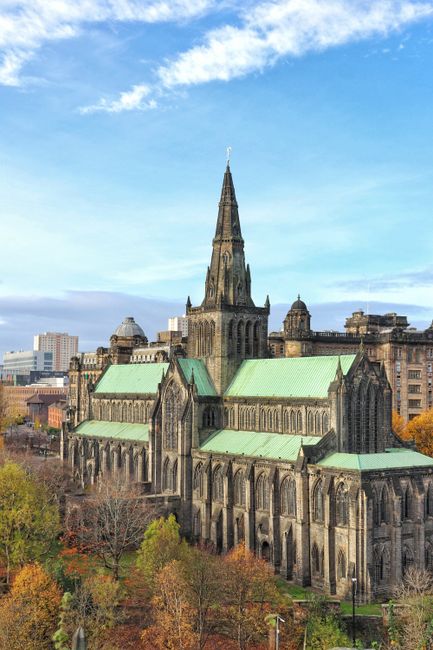
Glasgow is Scotland’s biggest city: a proud, funny, music-mad place of grand Victorian sandstone, world-class free museums and some of the best street art in Britain. You come to see Salvador Dalí’s Christ of Saint John of the Cross at Kelvingrove, the trams and steam engines of the Riverside Museum, the treasures of the Burrell Collection in a country park, the medieval cathedral and the hilltop Necropolis, and the buildings of Charles Rennie Mackintosh, the city’s own genius of design. Then you eat well, hear a gig in a legendary venue and find out why Glaswegians are famous for their welcome. It is under an hour from Edinburgh by train and the gateway to Loch Lomond and the Highlands. Give it two days for the highlights, or three or four to add a day out to the lochs.
Right now in Glasgow
- Wed5–11°C42–52°F1 mm rain
- Thu4–12°C39–53°F7 mm rain
- Fri10–13°C50–56°F5 mm rain
Top tours in Glasgow
See all tours for Glasgow →
From local operators, with prices and reviews; you check availability and book on Viator, our partner. We may earn a commission at no extra cost to you. How we earn money
Glasgow at a glance
- Best for: free museums and galleries, Mackintosh and Victorian architecture, street art, live music, food and nightlife, shopping, and trips to Loch Lomond and the Highlands.
- How long: 1 day for Kelvingrove, the cathedral and the city-centre murals; 2–3 days to add the Riverside Museum, the Burrell Collection and the Mackintosh sights; 4 days with a day trip.
- Best time: May to September for long days and festivals; January for the Celtic Connections music festival; December for the Christmas lights. It rains in every month.
- Getting in: Glasgow Airport is 15 minutes from the city centre by the 24-hour Airport Express bus; ScotRail trains from Edinburgh take under an hour; Avanti West Coast and the Caledonian Sleeper come from London.
- Getting around: on foot in the centre, then the Subway, a single loop of 15 stations that links the centre, the West End and the Southside. As of October 2026 a contactless Subway journey cost £1.80, capped at £3.40 a day.
- Before you go: entry rules, money and general safety are in our United Kingdom travel guide. Glasgow plans a 5% visitor levy on accommodation from 25 January 2027 (see below).
Glasgow, area by area
Glasgow grew up along the River Clyde, and its neighbourhoods are spread out more than Edinburgh’s. The grid of the city centre sits on the north bank, the leafy West End lies a couple of kilometres to the north-west, the old East End holds the cathedral, and the Southside stretches across the river to the parks. The Subway and short train rides link them all.
City Centre and the Merchant City
The centre is built on a grid of Victorian streets climbing up from the river, with George Square, the City Chambers and the shopping streets of Buchanan Street, Sauchiehall Street and Argyle Street, known as the “Style Mile”. East of George Square, the Merchant City has restored warehouses full of bars, restaurants and boutique hotels, and many of the mural trail paintings are close by. Best for: first visits, shopping, nightlife and easy arrivals by train.
The West End
Around Kelvingrove Park, the Gothic towers of the University of Glasgow and Byres Road, the West End is Glasgow’s most attractive district: terraces of red and blond sandstone, the Botanic Gardens and their glasshouses, the cobbled lanes of Ashton Lane with its bars and cinema, and Kelvingrove Art Gallery and Museum. Best for: museums, cafés and restaurants, walks in the parks and a slower pace.
Finnieston and the Clyde waterfront
Finnieston, between the centre and the West End, is the city’s food and drink hotspot. Below it, the riverside has changed from shipyards to big venues: the SEC conference centre, the OVO Hydro arena and the “Armadillo”, plus the Glasgow Science Centre on the south bank and the Riverside Museum further west. Best for: dinner, concerts and the Riverside Museum.
The East End
The oldest part of the city surrounds Glasgow Cathedral and the Necropolis on the hill above it. Further south lie Glasgow Green, the city’s oldest park, and the Barras, the famous weekend market, next to the Barrowland Ballroom, one of Britain’s best-loved music venues. Best for: history, markets and gigs.
The Southside
Across the river, the Southside has the city’s biggest green spaces: Pollok Country Park, home of the Burrell Collection and Pollok House, and Bellahouston Park with Mackintosh’s House for an Art Lover. Shawlands and Strathbungo have a relaxed neighbourhood feel with independent cafés and restaurants. Best for: the Burrell Collection, parks and local life.
Top things to see in Glasgow
Prices and hours below were checked on the official sites in October 2026. They change, so check before you go.
Kelvingrove Art Gallery and Museum
Glasgow’s best-loved museum is a red sandstone palace of 1901 in Kelvingrove Park, crammed with some 8,000 objects: Dalí’s Christ of Saint John of the Cross, Dutch and French paintings, a Spitfire hanging above the natural history galleries, Scottish art, armour, and a gallery of Mackintosh and the Glasgow Style. Every day a recital on the great organ fills the central hall. Entry is free. As of October 2026 it opened 10:00–17:00 Monday to Thursday and Saturday, and 11:00–17:00 on Friday and Sunday. Conservation and repair work on the stonework, roofs and windows began in September 2025, so expect some scaffolding. The ticketed Barbie: The Exhibition runs until 18 October 2026, and an exhibition about the comedian Billy Connolly is planned for June 2027.
Riverside Museum
Glasgow’s museum of transport stands on the Clyde in a striking zigzag building by the architect Zaha Hadid. Inside are trams, buses, locomotives, Scottish-built cars and bicycles, a recreated Glasgow street from the early 20th century and the story of the shipyards that once made the Clyde famous; the tall ship Glenlee, built on the river in 1896, is moored outside. Entry is free, with the same hours as Kelvingrove. Take the Subway to Govan and walk 5 minutes across the Govan–Partick footbridge, or walk from Partick station.
The Burrell Collection
Shipping magnate Sir William Burrell gave the city more than 9,000 objects, from Chinese ceramics and medieval tapestries to stained glass, ancient art and paintings by Degas and Cézanne. They are shown in a glass-walled building in the woods of Pollok Country Park, which reopened after a major refurbishment in 2022 and was named Art Fund Museum of the Year 2023. Entry is free and the hours are as at Kelvingrove. Trains from Glasgow Central reach Pollokshaws West in about 10 minutes, and a free electric shuttle bus runs through the park. Drivers pay for parking: as of October 2026, £5 for up to 4 hours or £10 for the day. Pollok House, a National Trust for Scotland mansion, is a short walk away.
Glasgow Cathedral and the Necropolis
Glasgow Cathedral is the finest medieval church in mainland Scotland and one of the few to survive the Reformation almost intact. Its lower church holds the tomb of St Mungo, the city’s founder, among a forest of stone pillars; look for the 15th-century stone screen and the fine post-war stained glass. Historic Environment Scotland runs it; entry is free (donations welcome), and you can choose an entry slot and buy an audio guide online. From 1 October to 31 March it opens Monday to Saturday 10:00–16:00 and Sunday 13:00–17:00, and from April to September Monday to Saturday 9:30–17:00. As a working church it sometimes closes for services, and it is shut from 25 December to 4 January. Behind it, a bridge leads up to the Necropolis, a Victorian “city of the dead” of grand tombs and monuments on a hill with one of the best views over Glasgow. It is free and open daily 7:00–16:30.
Charles Rennie Mackintosh
Mackintosh (1868–1928) is to Glasgow what Gaudí is to Barcelona, and his elegant mix of Art Nouveau and Scottish tradition is everywhere. His masterpiece, the Glasgow School of Art, was destroyed by fires in 2014 and 2018 and is still a burned-out shell; in July 2026 the school said a full rebuild would cost about £265 million, more than it can afford alone, so there is no visit inside for now. Instead, see the Mackintosh Tearooms at 217 Sauchiehall Street, his restored Willow Tea Rooms of 1903, now run by the National Trust for Scotland, where you can have afternoon tea in the original Salon de Luxe and visit an exhibition; guided tours run daily at 10:00 and 11:00. Mackintosh Queen’s Cross, the only church he designed, opens on Monday, Wednesday and Friday 11:00–16:00. The Hunterian at the university has the Mackintosh House, a reconstruction of his home, and House for an Art Lover in Bellahouston Park was built in the 1990s to his 1901 designs. The Lighthouse, his former newspaper building off Buchanan Street, has been closed to the public since 2020.
The City Centre Mural Trail
Since 2008 the city has commissioned huge murals on gable ends and shutters across the centre, and they are now one of Glasgow’s most popular sights: a modern St Mungo with a robin, a giant girl with a magnifying glass, a taxi floating on balloons, a man with a cat on the Ingram Street car park, and many more. The trail is free and self-guided; follow the official map from the City Centre Mural Trail website or the Glasgow City Council leaflet. You can see a dozen or more in two or three hours on foot.
More museums and galleries
The Gallery of Modern Art (GoMA) on Royal Exchange Square, with the statue of the Duke of Wellington always wearing a traffic cone; St Mungo Museum of Religious Life and Art beside the cathedral; the Hunterian Museum at the university, Scotland’s oldest public museum; the Tenement House, a perfectly preserved early 20th-century flat run by the National Trust for Scotland; and the Glasgow Science Centre on the Clyde, good for families. Most Glasgow Life museums are free.
Music and nights out in Glasgow
Glasgow is a UNESCO City of Music and one of the best places in Britain to hear a gig. The Barrowland Ballroom, with its neon sign, is a favourite of bands; King Tut’s Wah Wah Hut is where Oasis were discovered; the OVO Hydro hosts the big tours; and the Royal Concert Hall and City Halls host the Royal Scottish National Orchestra and Celtic Connections, the winter festival of folk, roots and traditional music, which in 2027 runs from 14 to 31 January. Add pubs with traditional music and the converted railway arches of SWG3.
Things to do in Glasgow
Walk the murals and the Merchant City
Combine the City Centre Mural Trail with the Merchant City’s grand old buildings, George Square and the City Chambers (free guided tours run on some weekdays), and a coffee in one of the converted warehouses. See our city sightseeing guide.
Explore the West End
Walk through Kelvingrove Park to the university cloisters and the Botanic Gardens’ Kibble Palace, then browse Byres Road and eat on Ashton Lane.
Walk or cycle along the Clyde
A riverside path runs along the Clyde from Glasgow Green past the city centre to the Riverside Museum, and National Cycle Route 7 continues west towards Loch Lomond. The Forth and Clyde Canal towpath is another flat, traffic-free route. See our cycling guide.
Eat and drink like a local
Try a Scottish breakfast with square sausage and tattie scones, fish and chips, a curry (Glasgow claims to have invented chicken tikka masala), Scottish salmon and langoustines, and a dram of single malt whisky. Irn-Bru, Scotland’s other national drink, is everywhere.
Getting to Glasgow
By air. Glasgow Airport (GLA) has flights from London, the rest of the UK, Europe and North America. As of October 2026 First Glasgow’s Airport Express (service 500) ran 24 hours a day, up to every 10 minutes, between the airport and Buchanan Bus Station in about 15 minutes, for a £2 single fare. Glasgow Prestwick Airport, about 50 km south-west, has a few low-cost flights and a station with trains to Glasgow Central. Edinburgh Airport is also an option, about an hour away by bus or tram and train.
By train from Edinburgh. ScotRail runs fast trains between Edinburgh Waverley and Glasgow Queen Street every 15 minutes or so, taking about 50 minutes; slower trains run to Glasgow Central. Since September 2025 ScotRail has scrapped peak fares, so the off-peak price applies at any time of day. For the capital, see our Edinburgh guide.
By train from London. Avanti West Coast runs from London Euston to Glasgow Central in about 4 hours 30 minutes, and LNER runs some trains from King’s Cross via Edinburgh. The Caledonian Sleeper leaves London Euston late in the evening and arrives in Glasgow early next morning.
By car. The M8 motorway runs through the city centre; parking is expensive and the Low Emission Zone applies (see below).
Getting around Glasgow
On foot. The city centre is compact but hilly; the West End is about 30–40 minutes’ walk from George Square.
The Subway. Glasgow’s underground railway, opened in 1896 and nicknamed the “Clockwork Orange” after its orange trains, runs in a single loop of 15 stations in both directions, linking the centre (Buchanan Street, St Enoch), the West End (Hillhead, Kelvinhall), Partick and Govan for the Riverside Museum, and the Southside. As of October 2026 a contactless single cost £1.80, with a daily cap of £3.40 and a Monday-to-Sunday cap of £15.50; tap in and out with the same card or phone.
Trains and buses. Local trains from Glasgow Central and Queen Street reach the suburbs, Pollokshaws West for the Burrell Collection, and Balloch on Loch Lomond. First Glasgow runs most city buses; pay contactless or buy day tickets in the First Bus app.
Driving and the Low Emission Zone. Glasgow’s Low Emission Zone covers the city centre and operates 24 hours a day, every day. Petrol cars must meet at least the Euro 4 standard and diesel cars Euro 6, which most hire cars do; motorbikes and fully electric cars are exempt. Cameras check every vehicle and you cannot pay to enter: as of October 2026 a penalty for a non-compliant car started at £60 (halved to £30 if paid within 14 days) and doubled for each repeat within 90 days, up to £480. Foreign-registered vehicles cannot use the online checker, so check your car’s Euro standard with the manufacturer.
When to go and how long to stay
Glasgow has a mild, wet maritime climate: cool summers, damp winters that are rarely very cold, and rain in every season. The table uses the Met Office 1991–2020 averages for Paisley, the nearest station with a full record, about 11 km west of the city centre near the airport; the city itself is very similar.
| Season | Average high / low | Rainy days per month | What it’s like |
|---|---|---|---|
| Spring (Mar–May) | 10–16 °C / 3–7 °C | 12–14 | Daffodils in the parks, the driest months are April and May, cool evenings |
| Summer (Jun–Aug) | 18–20 °C / 10–12 °C | 12–14 | Long light evenings until after 22:00 in June, outdoor gigs, busiest hotels during big concerts |
| Autumn (Sep–Nov) | 17 °C falling to 10 °C / 10 °C falling to 4 °C | 14–17 | Golden parks, cosy pubs, wetter and windier from October |
| Winter (Dec–Feb) | 7–8 °C / about 2 °C | 15–18 | Short days, Christmas lights and markets, Hogmanay, Celtic Connections in January |
Paisley records about 1,260 mm of rain a year, falling on about 174 days; October to January are the wettest months, with 130–160 mm each, and April to June the driest, with under 70 mm. Plan museum time for the wet days.
Glasgow in 1 day
Start at Glasgow Cathedral and climb the Necropolis for the view, then walk the City Centre Mural Trail through the Merchant City to George Square and GoMA. Lunch at the Mackintosh Tearooms on Sauchiehall Street, then take the Subway to Kelvinhall for Kelvingrove and the park. End with dinner in Finnieston and a gig or a pub with live music.
Glasgow in 3 days
Add the Riverside Museum and a walk along the Clyde, a morning at the Burrell Collection and Pollok Country Park, the West End’s university, Botanic Gardens and Ashton Lane, and Mackintosh Queen’s Cross or House for an Art Lover. On the third day, take the train to Balloch for Loch Lomond, or a day trip to Edinburgh or Stirling.
Day trips from Glasgow
Loch Lomond, the largest lake in Great Britain by area, is about 45 minutes by train to Balloch, where boats cruise the loch in season and paths lead along the shore; beyond it lies Loch Lomond and The Trossachs National Park. The West Highland Line, one of the world’s great railway journeys, runs from Glasgow Queen Street past Loch Lomond and across Rannoch Moor to Fort William and Mallaig. Stirling, with its castle and the Wallace Monument, is about 30 minutes by train, and New Lanark, a UNESCO-listed mill village on the Clyde, is about an hour away. For the capital, see our Edinburgh guide; for longer trips north, see our guides to the Scottish Highlands and the Isle of Skye, about five hours’ drive away.
Where to stay in Glasgow
- City Centre and Merchant City: chain and boutique hotels and apartments close to the stations and the shops, best for a short stay and nightlife.
- West End: Victorian townhouse hotels and guesthouses near Kelvingrove and the university, quieter and charming.
- Finnieston and the Clyde: modern hotels near the SEC and the Hydro, handy for concerts and restaurants.
- Southside: good-value guesthouses and apartments near the parks, with quick train links to the centre.
From 25 January 2027 Glasgow City Council will add a visitor levy of 5% of the accommodation price to every paid overnight stay in the city, for the whole length of the stay, in hotels, hostels, guesthouses, B&Bs and self-catering. Advance bookings made from April 2026 for stays from that date include it. Book well ahead for big concerts at the Hydro, football internationals and Celtic Connections weekends.
Practical tips for Glasgow
- Museums are free: Kelvingrove, the Riverside Museum, the Burrell Collection, GoMA and the cathedral cost nothing, so a rainy day is easy to fill.
- Check Friday and Sunday hours: the main Glasgow Life museums open at 11:00 on those days.
- Use the Subway: tap in and out with the same contactless card to get the daily cap.
- Leave the car: the city-centre Low Emission Zone is enforced by cameras, and parking is expensive.
- Book the Mackintosh Tearooms: afternoon tea and the guided tours fill up, especially at weekends.
- Bring layers and a waterproof: the weather can change several times a day.
What to pack for Glasgow
A waterproof jacket and umbrella, comfortable shoes for the hills and cobbles of the Merchant City, warm layers and a hat for winter evenings, and a small day bag. If you plan to walk by Loch Lomond or take the West Highland Line, add walking shoes with grip and insect repellent from June to September for the midges.
Glasgow travel FAQ
Are Glasgow’s museums free?
Yes. Kelvingrove Art Gallery and Museum, the Riverside Museum, the Burrell Collection, GoMA and St Mungo Museum are free, and so is Glasgow Cathedral. Some special exhibitions and the Burrell Collection car park charge.
How do I get from Glasgow Airport to the city centre?
By the 24-hour Airport Express bus (service 500), which runs up to every 10 minutes and takes about 15 minutes to Buchanan Bus Station. As of October 2026 a single cost £2.
How long is the train from Glasgow to Edinburgh?
About 50 minutes on the fastest ScotRail trains between Glasgow Queen Street and Edinburgh Waverley, with trains every 15 minutes or so. Peak fares were scrapped in 2025, so the same fare applies all day.
Is there a tourist tax in Glasgow?
Not yet. From 25 January 2027 a 5% visitor levy will apply to the cost of paid overnight accommodation in the city, for the whole stay. Advance bookings made from April 2026 for stays from that date include it.
Can you visit the Glasgow School of Art?
Not the Mackintosh Building: it was gutted by fire in 2018 and is a shell awaiting a decision on its future. To see Mackintosh’s work, visit the Mackintosh Tearooms, Mackintosh Queen’s Cross, the Mackintosh House at the Hunterian and House for an Art Lover.
What is the Glasgow Low Emission Zone?
A zone covering the city centre where older, more polluting vehicles may not drive, enforced by cameras 24 hours a day. Petrol cars need Euro 4 and diesel cars Euro 6. As of October 2026 a penalty started at £60, reduced to £30 if paid within 14 days.
How much is the Glasgow Subway?
As of October 2026, £1.80 for a single journey with a contactless card or phone, capped at £3.40 a day and £15.50 from Monday to Sunday.
Where is the Glasgow mural trail?
Mostly in the city centre and the Merchant City, between High Street, George Square and the river, with more in the West End and Finnieston. It is free; follow the official map and allow two or three hours.
How many days do you need in Glasgow?
Two days cover the main museums, the cathedral, the murals and the West End. Three or four days let you add the Burrell Collection, the Mackintosh sights and a day trip to Loch Lomond or Edinburgh.
When is Celtic Connections?
In 2027 the festival runs from 14 to 31 January, with concerts of folk, roots and traditional music across the city, centred on the Glasgow Royal Concert Hall.
Can you visit Loch Lomond from Glasgow without a car?
Yes. Trains from Glasgow Queen Street Low Level and other city stations run to Balloch, at the southern end of the loch, in about 45 minutes; from there you can take a boat trip in season or walk along the shore.
Nearby destinations
- Edinburgh67 km
- Scottish Highlands143 km
- Causeway Coast159 km
- Lake District173 km
- Belfast176 km
- Isle of Skye208 km
- Liverpool285 km
- York293 km
Plan your trip
Partner links: TravelerCenter may earn a commission if you book, at no extra cost to you.
Sources · last reviewed 4 October 2026
Researched and last reviewed on 4 October 2026. Museum hours and admission: Glasgow Life; Glasgow Cathedral: Historic Environment Scotland; the Necropolis: the Friends of Glasgow Necropolis; the Mackintosh Tearooms: the National Trust for Scotland; Mackintosh Queen’s Cross: the Charles Rennie Mackintosh Society; the visitor levy: Glasgow City Council and VisitScotland; the Low Emission Zone: the Scottish Government’s mygov.scot service; Subway fares: Strathclyde Partnership for Transport; the Airport Express: First Glasgow; peak rail fares: the Scottish Government; climate: Met Office 1991–2020 averages for Paisley. Some details, including the Glasgow School of Art’s plans, Celtic Connections dates and train journey times, come from press reports or general knowledge and are flagged for checking. Prices, timetables and rules change, so check the official links before you go. For entry rules, money and general safety, see our United Kingdom travel guide; for the capital, our Edinburgh guide; and for the north, our Scottish Highlands guide.
Data: Weather: MET Norway (CC BY 4.0) · Rates: ECB · Costs: World Bank ICP and price levels · Wikidata (CC0)