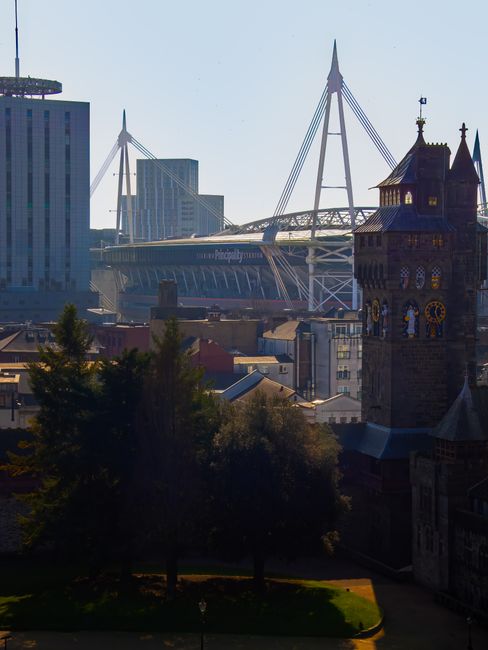
Cardiff is the young, green capital of Wales: a compact city of Victorian arcades, a castle with a Roman wall and Gothic fantasy rooms in its heart, and a rebuilt waterfront on Cardiff Bay. You come to tour Cardiff Castle, see Impressionist paintings and dinosaurs for free at National Museum Cardiff, wander through 500 years of Welsh life at St Fagans, feel the roar of the Principality Stadium on a rugby day, and walk the bay past the Senedd, the Welsh Parliament, and the Wales Millennium Centre. Welsh is spoken alongside English and every sign is bilingual: croeso means welcome. Cardiff is about two hours from London by train and a good base for the castles of the valleys, the mountains of Bannau Brycheiniog and the beaches of Gower. Give it two days for the city, or three or four with day trips.
Right now in Cardiff
- Wed9–15°C48–59°F4 mm rain
- Thu8–14°C46–58°F1 mm rain
- Fri13–16°C56–60°F12 mm rain
Top tours in Cardiff
See all tours for Cardiff →
From local operators, with prices and reviews; you check availability and book on Viator, our partner. We may earn a commission at no extra cost to you. How we earn money
Cardiff at a glance
- Best for: castles and history, free national museums, rugby and big concerts, shopping in the arcades, waterfront walks, Welsh culture and day trips to the mountains and coast.
- How long: 1 day for the castle, the arcades and the National Museum; 2–3 days to add St Fagans, Cardiff Bay and Castell Coch; 4 days with Caerphilly, the Brecon Beacons or Gower.
- Best time: May to September for the warmest, longest days; February and March for Six Nations rugby; December for the Christmas markets and ice rink. It rains often, most of all from October to January.
- Getting in: GWR trains from London Paddington reach Cardiff Central in about 1 hour 50 minutes to 2 hours; Cardiff Airport is small, and many visitors fly to Bristol or London.
- Getting around: on foot in the centre, then Cardiff Bus or a short train ride to the bay. As of October 2026 an adult ticket to Cardiff Castle cost £16.50.
- Before you go: entry rules, money and general safety are in our United Kingdom travel guide. From 1 April 2027 Cardiff will charge a small visitor levy on overnight stays (see below).
Cardiff, area by area
Cardiff grew from a small town into the world’s biggest coal port in the 19th century, and the Bute family, who owned much of it, left the castle, the parks and the docks. Today the centre sits around the castle, with Bute Park to the north-west and Cardiff Bay about 2 km to the south.
City Centre and the arcades
Around the castle and Queen Street, the centre is mostly pedestrianised, with the big St David’s shopping centre, the Victorian Cardiff Market and a network of glass-roofed Victorian and Edwardian arcades full of independent shops, cafés and record stores. The Principality Stadium stands right on the river, next to Cardiff Central station. Best for: first visits, shopping and nightlife.
Cathays Park and the civic centre
North of the castle, the white Portland-stone buildings of Cathays Park, including City Hall and National Museum Cardiff, form one of the finest civic centres in Britain, beside Cardiff University and the green spaces of Alexandra Gardens. Best for: museums and architecture.
Bute Park and Llandaff
Behind the castle, Bute Park stretches for more than a mile along the River Taff, with arboretum trees, gardens and riverside paths. Follow it north to Llandaff, a village-like suburb with its medieval cathedral, a green and pubs; Roald Dahl was born here. Best for: walks, cycling and a quieter stay.
Cardiff Bay
The old docklands, once the heart of the coal trade, were transformed after a barrage closed off the bay in 1999 to create a freshwater lake. Today you find the Senedd and the red-brick Pierhead, the Wales Millennium Centre, the little white Norwegian Church where Roald Dahl was christened, Mermaid Quay’s restaurants and the Cardiff Bay Barrage walk to Penarth. Best for: waterfront walks, culture, families and dinner by the water.
Pontcanna and Canton
West of the river, leafy Pontcanna and Canton have Victorian terraces, cafés, bakeries and independent restaurants along Cowbridge Road East and Kings Road. Best for: local food and a neighbourhood feel.
Top things to see in Cardiff
Prices and hours below were checked on the official sites in October 2026. They change, so check before you go.
Cardiff Castle
Few castles pack in so much history: a Roman fort, whose rebuilt walls you can see, a Norman keep on its mound, and a Victorian mansion that the architect William Burges turned into a Gothic fairy tale for the third Marquess of Bute, with gilded ceilings, painted walls and an Arab Room. You can also climb the keep, walk the battlements, shelter in the wartime tunnels used as air-raid shelters and visit the Firing Line regimental museum.
Tickets. As of October 2026, a Castle Ticket cost £16.50 for adults, £11 for children aged 5–16, £13 for seniors, students and disabled visitors (with a carer free), and £44 for a family of two adults and two children; under-5s go free. The ticket lets you come and go all day. Guided House Tours of the Victorian apartments, about 50 minutes long, run on the hour and cost £5 extra for adults; they cannot be booked ahead, so ask at the ticket office. The castle opens every day except 25 and 26 December and 1 January; allow about an hour and a half, plus the tour.
National Museum Cardiff
Wales’s national museum and art gallery, in Cathays Park, has one of the best collections of Impressionist art in Britain, thanks to the Davies sisters of Llandinam: Monet’s water lilies, Renoir’s La Parisienne, Cézanne and Van Gogh, plus Welsh art, a natural history gallery with dinosaurs and a giant leatherback turtle, and the story of the evolution of Wales. Entry is free; book a free ticket online. It opens Tuesday to Sunday 10:00–17:00 and on bank holidays, and is closed on Mondays. The car park behind the museum cost £6.50 as of October 2026.
St Fagans National Museum of History
On the edge of the city, St Fagans is one of Europe’s great open-air museums: more than 40 historic buildings moved here from all over Wales, from Iron Age roundhouses and a medieval church to a row of miners’ cottages, a chapel, a school and a working bakery, set around an Elizabethan manor and its gardens. Entry is free and it opens daily 10:00–17:00; parking costs £7 a day. As of October 2026 only some downstairs rooms of St Fagans Castle were open during re-roofing work, and Llwyn-yr-eos Farm was closed for woodland work. Allow at least half a day; buses run from the city centre.
Cardiff Bay, the Senedd and the Wales Millennium Centre
Walk or take the bus to the bay for its mix of old docks and bold new buildings. The Senedd, home of the Welsh Parliament, is a glass and Welsh-oak building that is open to everyone and free; as of October 2026 it opened Monday to Friday 9:00–16:30 and on Saturdays and bank holidays 10:30–16:30, with free guided tours and public galleries for debates. Next door, the Pierhead (1897) has a free exhibition on the docks, and the Wales Millennium Centre, with its bronze-coloured steel dome and giant Welsh and English poetry across the front, is the national arts centre, home of Welsh National Opera, with shows and free foyer events.
Principality Stadium
Wales’s national stadium, with a retractable roof and room for about 74,000, sits in the middle of the city: on a match day for Welsh rugby, the whole centre turns red. On other days you can take a guided tour of the dressing rooms, the players’ tunnel and the pitch side. The stadium’s booking site listed adult tours at £19.50 online and £21 on the day, and children at £12.50; tours do not run on event days, so check the calendar.
Castell Coch
On a wooded hill north of the city, Castell Coch, the “Red Castle”, is a Victorian dream of a medieval castle, rebuilt by William Burges for the Marquess of Bute on medieval ruins, with conical towers and fantastical painted rooms. It is run by Cadw, the Welsh government’s historic environment service; the adult ticket was reported at £10.90, with a discount for booking online. Take the bus to Tongwynlais and walk up through the woods, or drive about 20 minutes from the centre.
The arcades and Cardiff Market
Cardiff’s covered arcades, built from the 1850s onwards, are the city’s shopping treasure: the Royal Arcade, the oldest, and the Morgan, Castle, High Street and Wyndham arcades, with independent shops, cafés and the world’s oldest record shop, Spillers Records. Cardiff Market, a Victorian hall of 1891, sells Welsh cakes fresh off the griddle, laverbread, cheese and street food.
Rugby, music and Welsh culture
Rugby is close to a religion in Wales. During the Six Nations Championship in February and March, and for autumn internationals, Cardiff fills with fans in red shirts singing hymns and the anthem, Hen Wlad Fy Nhadau, and the pubs around Westgate Street and St Mary Street are packed. The Principality Stadium also hosts big concerts and the Cardiff City Stadium has football. For music, St David’s Hall and the Wales Millennium Centre host classical concerts and musicals, and the city has a lively scene of small live venues and pubs. Listen for Welsh, spoken by about a fifth of people in Wales: try diolch (thank you) and iechyd da (cheers).
Things to do in Cardiff
Walk the Cardiff Bay Barrage
A flat, traffic-free path of about 1.1 km crosses the barrage from Cardiff Bay to Penarth, with views of the bay and the Bristol Channel, a play area and locks where boats pass out to sea. Carry on to Penarth’s Victorian pier, or take a boat back across the bay. See our boat trips guide.
Cycle or stroll the Taff Trail
The Taff Trail runs from Cardiff Bay through Bute Park and north along the river to Castell Coch and beyond, all the way to Brecon. The section through Bute Park and Llandaff is flat and easy; bikes can be hired in the city. See our cycling guide.
Explore the arcades and the castle quarter
Combine Cardiff Castle with the arcades, the market and the Animal Wall along Bute Park, decorated with stone animals climbing over it. See our city sightseeing guide.
Eat and drink like a local
Try Welsh cakes, bara brith (fruit loaf), Welsh rarebit, cawl (lamb and vegetable stew), laverbread made from seaweed, Caerphilly cheese and Welsh lamb, washed down with a local ale; Brains has been brewed in Cardiff since the 1880s. Pontcanna, Canton and the bay are the best areas for dinner.
Getting to Cardiff
By train from London. Great Western Railway (GWR) runs fast trains from London Paddington to Cardiff Central, taking about 1 hour 50 minutes to 2 hours, usually twice an hour, via Reading, Bristol Parkway and Newport. Book advance tickets for the best fares. Trains also run from Bristol (about 45 minutes), Bath, Birmingham and Manchester.
By air. Cardiff Airport, about 20 km south-west near Rhoose, has a limited choice of flights; a bus and a train from Rhoose Cardiff Airport station link it with the city. Many visitors fly into Bristol Airport, London Heathrow or London Gatwick and continue by coach or train.
By car and coach. Cardiff is just off the M4 motorway, about 2 hours 30 minutes from London without traffic. Since 2018 there have been no tolls on the Severn bridges. National Express and other coaches arrive from across Britain.
Getting around Cardiff
On foot. The centre is flat and small; the castle, the arcades, the stadium and the National Museum are within 10–15 minutes of each other, and Cardiff Bay is about 30 minutes’ walk.
Buses. Cardiff Bus runs the city network, including frequent buses to Cardiff Bay. According to the company’s fare notices, from May 2026 an adult single cost £2.60 paid on board and an adult day ticket for Cardiff and Penarth about £5.20, with cheaper app tickets. England’s £3 bus fare cap does not apply in Wales.
Trains. Transport for Wales trains link Cardiff Central and Queen Street with Cardiff Bay station, Llandaff, Penarth, Caerphilly and the valleys; they are a quick way to reach Caerphilly Castle.
Driving. Since September 2023 the default speed limit on most roads in towns and villages across Wales has been 20 mph, rather than 30 mph, with no repeater signs; some main roads remain at 30 mph or more, as signed. Speed cameras enforce it. Parking in the centre is expensive; use the park and ride sites on the edge of the city on busy days.
When to go and how long to stay
Cardiff has a mild, wet climate: warm summers, mild winters with only occasional frost and snow, and rain spread through the year. The table uses the Met Office 1991–2020 averages for Cardiff Bute Park, in the city centre.
| Season | Average high / low | Rainy days per month | What it’s like |
|---|---|---|---|
| Spring (Mar–May) | 11–17 °C / 4–8 °C | 11–12 | Blossom in Bute Park, St David’s Day on 1 March, April and May among the driest months |
| Summer (Jun–Aug) | 20–22 °C / 11–13 °C | 10–12 | Warmest and sunniest, outdoor events, concerts at the stadium, busiest weekends |
| Autumn (Sep–Nov) | 19 °C falling to 12 °C / 11 °C falling to 5 °C | 12–16 | Autumn rugby internationals, golden parks, wetter and windier from October |
| Winter (Dec–Feb) | about 9 °C / about 2–3 °C | 12–16 | Christmas markets and ice rink, Six Nations in February, short days and frequent rain |
Bute Park records about 1,200 mm of rain a year, almost twice London’s, falling on about 153 days; October to January are the wettest months, with 125–140 mm each, and April to June the driest, with 72–78 mm. Summer brings about 200 hours of sunshine a month. In practice, May to September is best for the bay and day trips, and any time works for the museums.
Cardiff in 1 day
Start at Cardiff Castle and join a House Tour, then walk through the arcades and Cardiff Market for lunch with Welsh cakes. Spend the afternoon at National Museum Cardiff (closed Mondays), then take the bus to Cardiff Bay for sunset along the waterfront and dinner at Mermaid Quay.
Cardiff in 3 days
Add a full morning at St Fagans, a stadium tour or a match, the Senedd and the Wales Millennium Centre, a walk across the barrage to Penarth and the Taff Trail through Bute Park to Llandaff Cathedral. On the third day, visit Castell Coch and Caerphilly Castle, or head for the mountains of Bannau Brycheiniog.
Day trips from Cardiff
Caerphilly Castle, one of the largest castles in Britain, with lakes and a famously leaning tower, is about 20 minutes by train; Cadw’s adult ticket was reported at £11.90. Bannau Brycheiniog National Park (the Brecon Beacons) is about an hour’s drive north, with the climb up Pen y Fan, the highest peak in southern Britain, waterfalls and the town of Brecon. The Gower peninsula, Britain’s first Area of Outstanding Natural Beauty, has the golden sweep of Rhossili Bay, about 1 hour 15 minutes by car beyond Swansea. Tintern Abbey in the Wye Valley is about 50 minutes away. Across the Severn, Bath is about an hour by train; see our Bath guide.
Where to stay in Cardiff
- City Centre: chain and boutique hotels near the castle, the station and the stadium, best for short stays, but busy and pricier on match and concert days.
- Cardiff Bay: waterfront hotels and apartments, quieter at night, a short bus or train ride from the centre.
- Cathays and the civic centre: good-value guesthouses and hotels near the museum and the university.
- Pontcanna and Llandaff: B&Bs and small hotels in leafy streets near Bute Park, a walk from the centre.
From 1 April 2027 Cardiff Council will charge a visitor levy, collected by your accommodation, of £1.30 per person per night in hotels, B&Bs, guesthouses and self-catering, and 75p per adult per night in hostel dorms and on campsites; providers apply it to bookings made from 28 September 2026 for stays from April 2027. It is the only council in Wales to have decided to charge. Book far ahead for rugby internationals and big concerts, when prices soar.
Practical tips for Cardiff
- Check the event calendar: on international rugby days and big concerts the centre is packed, roads close and hotels sell out.
- Plan around Mondays: National Museum Cardiff is closed on Mondays; St Fagans opens daily.
- Free museums, paid parking: both national museums are free, but their car parks charge.
- Watch your speed: 20 mph is the default limit in built-up areas across Wales.
- Learn a few Welsh words: bore da (good morning), diolch (thank you) and iechyd da (cheers) go down well.
- Carry a waterproof: Cardiff gets twice London’s rain.
What to pack for Cardiff
A waterproof jacket and umbrella, comfortable walking shoes for the castle’s steps and the bay walk, warm layers for autumn and winter, and something red if you are going to a rugby match. For a day in the Brecon Beacons, add walking boots, a warm hat and gloves and a proper rain shell.
Cardiff travel FAQ
How much does it cost to visit Cardiff Castle?
As of October 2026, £16.50 for adults, £11 for children aged 5–16, £13 for seniors and students and £44 for a family of four; under-5s go free. A guided House Tour costs £5 extra for adults.
Is National Museum Cardiff free?
Yes. Entry is free; book a free ticket online. It opens Tuesday to Sunday 10:00–17:00 and on bank holidays, and is closed on Mondays.
Is St Fagans free?
Yes, entry is free and it opens daily 10:00–17:00. Parking costs £7 a day as of October 2026.
Is there a tourist tax in Cardiff?
Not yet. From 1 April 2027 Cardiff will charge a visitor levy of £1.30 per person per night in most accommodation, and 75p per adult per night in hostel dorms and on campsites.
How long is the train from London to Cardiff?
About 1 hour 50 minutes to 2 hours on GWR’s fast trains from London Paddington to Cardiff Central, usually twice an hour.
Can you tour the Principality Stadium?
Yes, on days without events. Tours visit the dressing rooms, the tunnel and the pitch side; the stadium listed adult tickets at £19.50 online. Check the calendar, as tours stop on event days.
Is Cardiff Bay worth visiting?
Yes. It has the Senedd, the Pierhead, the Wales Millennium Centre, the Norwegian Church, waterfront restaurants and the barrage walk to Penarth. It is about 30 minutes’ walk or a short bus or train ride from the centre.
What is the speed limit in Cardiff?
Mostly 20 mph on built-up roads, the default across Wales since September 2023, unless signs show a higher limit. Main roads and motorways have higher limits.
How many days do you need in Cardiff?
Two days cover the castle, the National Museum, the arcades and the bay. Three or four let you add St Fagans, Castell Coch, Caerphilly Castle and a day in the mountains or on Gower.
Do people speak Welsh in Cardiff?
English is spoken by everyone, but Welsh is an official language: signs, announcements and many names are bilingual, and you will hear Welsh in shops and on the radio.
When is the best time to visit Cardiff?
May to September for the warmest weather and outdoor events, and February to March for the Six Nations rugby atmosphere if you book early. Winter is wet but has Christmas markets.
Nearby destinations
- Bath58 km
- Cotswolds87 km
- Jurassic Coast87 km
- Stratford-upon-Avon128 km
- Oxford136 km
- Birmingham141 km
- Eryri (Snowdonia)169 km
- Cornwall178 km
Plan your trip
Partner links: TravelerCenter may earn a commission if you book, at no extra cost to you.
Sources · last reviewed 4 October 2026
Researched and last reviewed on 4 October 2026. Cardiff Castle prices and opening: Cardiff Castle (Cardiff Council); National Museum Cardiff and St Fagans: Amgueddfa Cymru – Museum Wales; the Senedd: the Welsh Parliament; the visitor levy: the Welsh Government and the Welsh Revenue Authority; the 20 mph default: the Welsh Government; climate: Met Office 1991–2020 averages for Cardiff Bute Park. Some details, including Cadw castle prices, Principality Stadium tour prices, Cardiff Bus fares and train journey times, come from official pages read through search summaries or general knowledge and are flagged for checking. Prices, timetables and rules change, so check the official links before you go. For entry rules, money and general safety, see our United Kingdom travel guide; for the capital, our London guide; and for the next stop east, our Bath guide.
Data: Weather: MET Norway (CC BY 4.0) · Sea temperature: NOAA CoastWatch · Rates: ECB · Costs: World Bank ICP and price levels · Wikidata (CC0)