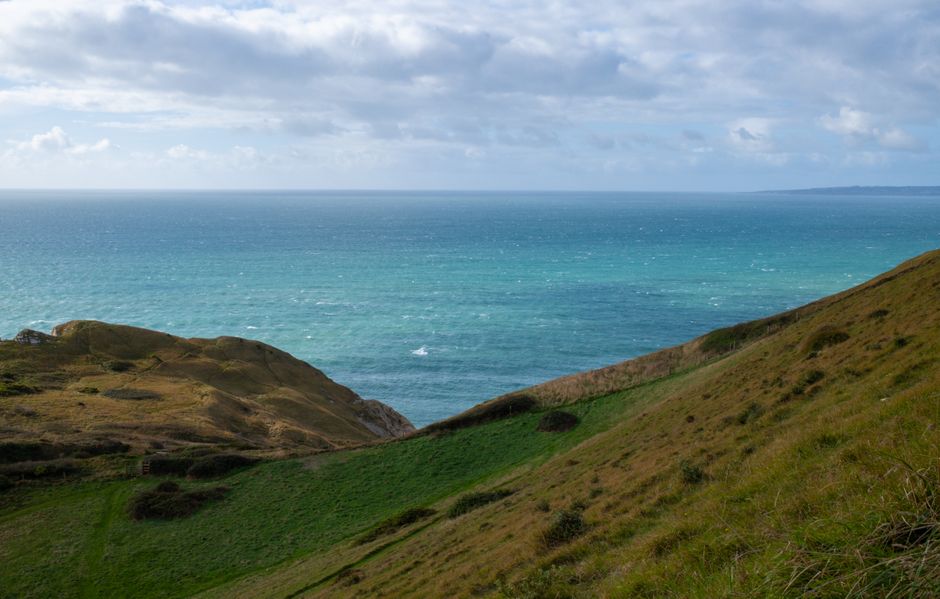
The Jurassic Coast is a 95-mile (153 km) stretch of England’s south coast, from Exmouth in East Devon to Studland Bay in Dorset, where the cliffs reveal about 185 million years of the Earth’s history: red Triassic deserts in the west, Jurassic seas full of ichthyosaurs in the middle and Cretaceous chalk in the east. In 2001 it became England’s first natural UNESCO World Heritage Site, and it is still the only one. You come for the limestone arch of Durdle Door and the shell-shaped bay of Lulworth Cove, to hunt for ammonites on the beaches of Lyme Regis and Charmouth, to walk the clifftop South West Coast Path over Golden Cap, to stare along the pebble bank of Chesil Beach and to see the chalk stacks of Old Harry Rocks, with seaside towns, harbours, crab sandwiches and a ruined castle along the way. It is about two and a half to three hours from London by train. Give it three days for the highlights, or a week to walk and explore both ends.
Right now in Jurassic Coast (Lulworth Cove)
- Wed11–16°C53–61°F5 mm rain
- Thu10–15°C51–59°FPartly cloudy
- Fri15–18°C58–64°F10 mm rain
Top tours in Jurassic Coast
See all tours for Jurassic Coast →
From local operators, with prices and reviews; you check availability and book on Viator, our partner. We may earn a commission at no extra cost to you. How we earn money
Jurassic Coast at a glance
- Best for: dramatic coastal scenery, fossil hunting, clifftop walks, swimming and kayaking in sheltered coves, seaside towns, seafood and family holidays.
- How long: 1 day for Lulworth Cove and Durdle Door; 3 days to add Lyme Regis, Chesil Beach and Corfe Castle; a week to walk the coast path and see both Devon and Dorset.
- Best time: May, June and September for warm days and fewer crowds; July and August for swimming but busy car parks; winter for fossil hunting after storms.
- Getting in: trains from London Waterloo reach Wareham, Weymouth and Axminster, and from London Paddington or Waterloo reach Exeter for Exmouth.
- Getting around: a car is easiest, but coastal buses link many places. As of October 2026, a full day’s parking at Durdle Door cost £25.
- Before you go: entry rules, money and general safety are in our United Kingdom travel guide.
The Jurassic Coast, area by area
Walking the coast from west to east is like walking forward through time, as the rocks get younger. The western third lies in East Devon, the rest in Dorset. There is no single centre: most visitors base themselves in Lyme Regis, Bridport, Weymouth or the Isle of Purbeck, and the World Heritage Site is now looked after by Dorset Council, since the Jurassic Coast Trust charity closed.
East Devon: Exmouth to Seaton
The coast begins at Orcombe Point near Exmouth, with red Triassic sandstone cliffs, and continues past the sea stacks of Ladram Bay, the Regency resort of Sidmouth, the fishing village of Beer with boats pulled up on its beach, and Branscombe’s thatched cottages. Best for: red cliffs, gentle seaside towns and easy access from Exeter.
Lyme Regis and Charmouth
Just over the Dorset border, Lyme Regis is a pretty harbour town with the curving stone breakwater of the Cobb, the home of the pioneering fossil hunter Mary Anning, and the best fossil beaches in Britain stretching east to Charmouth. Best for: fossil hunting, families and a charming base.
Bridport, West Bay and Golden Cap
Bridport is a lively market town with a Saturday market; its harbour, West Bay, sits under striking golden sandstone cliffs made famous by the TV drama Broadchurch. To the west, Golden Cap is the highest point on England’s south coast. Best for: walking, food and a relaxed, creative atmosphere.
Chesil Beach, Portland and Weymouth
Chesil Beach is a pebble bank about 29 km long, enclosing the Fleet lagoon and linking the mainland to the rocky Isle of Portland, with its lighthouse at Portland Bill and the quarries that supplied the stone for St Paul’s Cathedral. Weymouth has a long sandy beach, a Georgian seafront and a busy harbour. Best for: sandy beaches, families and good transport links.
Lulworth and the Isle of Purbeck
The eastern end is the most famous: Lulworth Cove and Durdle Door, the ledges and rock pools of Kimmeridge Bay, the ruined Corfe Castle, the old seaside town of Swanage, and the sandy beaches of Studland Bay below the chalk stacks of Old Harry Rocks, where the World Heritage Site ends. Best for: iconic views, swimming and steam trains.
Top things to see on the Jurassic Coast
Prices and hours below were checked on the official sites in October 2026. They change, so check before you go.
Durdle Door and Lulworth Cove
Durdle Door is a natural limestone arch reaching out into a clear turquoise sea, with long shingle beaches on both sides. A mile to the east, Lulworth Cove is an almost perfectly round bay carved by the sea through a narrow gap in the cliffs, and next to it Stair Hole shows the folded rock layers known as the Lulworth Crumple. Both belong to the private Lulworth Estate and are open all year; a steep, well-made path of about 1.5 km over the hill links the two car parks, and the path down to Durdle Door beach is steep and uneven. Do not climb on or jump from the arch, and keep out of the caves at the foot of the cliffs, where rock falls are common.
Parking. As of October 2026, the Lulworth Estate charges every day of the year, including weekends and holidays. At the Durdle Door car park, a car costs £15 for up to 6 hours, £25 for up to 9 hours and £35 for longer; at Lulworth Cove, £9 for up to 3 hours, £17 for up to 6 hours, £25 for up to 9 hours and £32 for longer. In summer both fill early, so arrive before 10:00. Nearby, Lulworth Castle, a 17th-century hunting lodge, opens Sunday to Friday 10:30–17:00 and closes for winter from 24 December 2026 to 1 February 2027.
Old Harry Rocks and Studland
At the eastern end of the coast, the chalk stacks of Old Harry Rocks stand off the white cliffs of Handfast Point, the same chalk as the Needles on the Isle of Wight across the bay. A flat clifftop walk of about 5 km there and back from the village of Studland reaches the viewpoint; keep well back from the edge. Studland Bay below has long sandy beaches and dunes, cared for by the National Trust, and the Sandbanks chain ferry crosses to Poole and Bournemouth.
Corfe Castle
The jagged ruins of Corfe Castle crown a steep hill in a gap in the Purbeck Hills, above a stone village. A royal fortress for 600 years, it was besieged during the Civil War and deliberately blown up by Parliament in 1646. The National Trust looks after it. As of October 2026 adult tickets cost £15–£16 (£16.50–£17.60 with a Gift Aid donation) depending on the season, and children (5–17) £7.50–£8; in October the castle opens 10:00–16:30. The National Trust car park charges non-members. The Swanage Railway’s steam trains stop at Corfe Castle station below the ruins, a lovely way to arrive.
Lyme Regis and the Cobb
Walk along the Cobb, the harbour wall that features in Jane Austen’s Persuasion and the film of The French Lieutenant’s Woman, then explore the small town and its sandy beach. The Lyme Regis Museum stands on the site of Mary Anning’s birthplace and tells her story and the town’s; it also leads guided fossil walks. On the beach to the west, the Ammonite Pavement at Monmouth Beach shows hundreds of giant fossil shells in the rock at low tide.
Chesil Beach and Portland Bill
For the best view of Chesil Beach, stop at the viewpoint on the road up to Portland, then walk onto the shingle from the Chesil Beach Centre in Portland or from Abbotsbury and West Bexington further west. Swimming is dangerous here: the beach shelves very steeply and the undertow is strong. At the tip of Portland, the red-and-white lighthouse at Portland Bill looks out over the Race, one of the roughest stretches of sea in the Channel.
Golden Cap and West Bay
Golden Cap, at 191 metres the highest cliff on England’s south coast, is a steep climb from Seatown, about an hour up and back, with views along the whole of Lyme Bay. To the east, the sheer sandstone cliffs at West Bay glow gold in the evening sun; enjoy them from the beach or the coast path, but never sit beneath them.
Fossil hunting and cliff safety
The Jurassic Coast is one of the best places in the world to find fossils, and anyone can look on the beaches. The cliffs are made of soft clays and shales that slip in rain and storms, washing new ammonites, belemnites and crinoids onto the shore after every high tide. The same slips make the cliffs dangerous.
How to hunt for fossils
Start at the Charmouth Heritage Coast Centre on the seafront at Charmouth, which is free to enter, shows local fossils and runs guided fossil hunting walks; the Lyme Regis Museum runs walks too. Go on a falling tide, search the loose material on the beach rather than the cliffs, and look in the shingle where the waves sort the stones. The West Dorset Fossil Collecting Code of Conduct asks collectors not to dig into the cliffs or the rock in place, to take only a few common fossils for themselves, and to report important finds so that they can end up in a museum. Hammering is not allowed on the Ammonite Pavement and other protected ledges.
How to stay safe on the beaches and cliffs
- Keep away from the cliffs: rock falls and mudslides happen without warning, especially after rain and in winter. Do not sit or shelter beneath the cliffs, and keep well back from clifftop edges, which can collapse.
- Check the tide: on beaches such as those between Lyme Regis and Charmouth you can be cut off by the rising tide; set out on a falling tide and turn back in time.
- Watch out for mud: fresh landslips can be soft and deep; do not walk on them.
- Swim where it is safe: lifeguarded beaches in summer include Weymouth and parts of Studland; Chesil Beach is dangerous for swimming.
- In an emergency: call 999 and ask for the Coastguard.
Walking the South West Coast Path
The South West Coast Path follows the whole Jurassic Coast as part of its 630-mile (1,014 km) route around the south-west peninsula. The Dorset section is some of the toughest walking on it, with steep climbs and descents between Lulworth and Kimmeridge and over Golden Cap, but there are easy stretches too. Favourite day walks are Lulworth Cove to Durdle Door and on to the Bat’s Head headland, Seatown to Golden Cap, Studland to Old Harry Rocks and on to Swanage, and Sidmouth to Branscombe in Devon. Between Lulworth and Kimmeridge, the path crosses the Lulworth army firing ranges, which are open only at weekends and in most school holidays; check the range opening times before you set off. Coastal erosion sometimes closes or diverts sections. See our hiking guide, and continue west along the same path in our Cornwall guide.
Things to do on the Jurassic Coast
Swim, paddle and explore by kayak
Lulworth Cove, Durdle Door, Studland and Weymouth are the best places to swim, and guided kayak and coasteering trips run from Lulworth in summer, the best way to see the arch from the sea. Boat trips from Weymouth, Lyme Regis, Swanage and Poole cruise along the cliffs. See our beaches guide and boat trips guide.
Ride the Swanage Railway
This heritage railway runs steam and vintage diesel trains from Swanage through the Purbeck Hills to Corfe Castle and Norden, with some trains continuing to Wareham on the main line. Check the timetable, as services are reduced in winter.
Eat and drink like a local
Eat a crab sandwich in a harbour café, fish and chips on the Cobb, local oysters from the Fleet lagoon, Dorset apple cake and a Devon or Dorset cream tea, with local cider or ale from Bridport’s brewery. Bridport and Lyme Regis have some of the best seafood restaurants on the coast.
Rainy-day ideas
Visit the Lyme Regis Museum or the Charmouth Heritage Coast Centre, see the marine fossils of the Etches Collection at Kimmeridge, tour the Dorset Museum in Dorchester, or watch the swans at Abbotsbury Swannery in season.
Getting to the Jurassic Coast
By train. South Western Railway runs from London Waterloo to Wareham (for Purbeck and Corfe), Dorchester South and Weymouth, about 2 hours 40 minutes to 3 hours to Weymouth, and on a second line to Axminster (for Lyme Regis), about 2 hours 45 minutes to 3 hours. Great Western Railway runs from London Paddington to Exeter in about two hours, and a branch line continues to Exmouth in about 25 minutes. Rail fares in England are frozen until March 2027, and a railcard saves a third; see our UK guide.
By air. Exeter and Bournemouth airports are the closest; from further away, fly to London or Bristol and take the train.
By car. From London, the M3 and A31/A35 lead to Purbeck and Dorchester in about three hours; from Bristol and Bath, the A37 leads south. The coast roads are narrow and slow in summer. Bath is about two hours away, so the two make a good combination: see our Bath guide.
Getting around and parking
Buses. In West Dorset, First’s X53 “Jurassic Coaster” runs along the coast from Weymouth through Abbotsbury, Burton Bradstock, West Bay, Bridport, Charmouth and Lyme Regis to Axminster station, and the X51 runs inland between Weymouth, Dorchester, Bridport and Axminster; an open-top X52 adds summer journeys between Weymouth and Bridport. In Purbeck, local buses link Wareham, Corfe Castle, Swanage and Studland and cross on the chain ferry to Poole and Bournemouth, and in summer buses reach Lulworth. As in the rest of England outside London, a single bus fare is capped at £3 until 1 January 2027, and at £2 for all of 2027. Timetables change between summer and winter, so check before you rely on a bus.
Parking. Car parks at the famous spots are pay-and-display and expensive in season: see the Lulworth prices above. National Trust car parks at Corfe Castle, Studland and Golden Cap are free for members and charge others. Council car parks in the towns take coins, cards or apps. On hot summer days, Lulworth, Studland and West Bay can be full by mid-morning, and traffic queues build on the roads to Studland and Lulworth; arrive early or late in the afternoon.
When to go and how long to stay
The Jurassic Coast has one of the sunniest and mildest climates in Britain: warm summers tempered by sea breezes, mild winters with very little frost, and rain mostly in autumn and winter. The table uses the Met Office 1991–2020 averages for Weymouth (Wyke Regis), a station on the shore of the Fleet near the middle of the coast; East Devon is a little wetter and the Purbeck hills a little cooler.
| Season | Average high / low | Rainy days per month | What it’s like |
|---|---|---|---|
| Spring (Mar–May) | 11–16 °C / 5–9 °C | 8–9 | Sunny and dry, wild flowers on the clifftops, cold sea, quieter beaches |
| Summer (Jun–Aug) | 18–20 °C / 12–14 °C | 7–8 | Sunniest months, warm enough to swim, busiest roads and car parks |
| Autumn (Sep–Nov) | 19 °C falling to 12 °C / 13 °C falling to 7 °C | 8–13 | Warm sea in September, golden light, storms and wetter from October |
| Winter (Dec–Feb) | 9–10 °C / 4–5 °C | 11–13 | Mild, windy and wet, empty beaches, the best fossil hunting after storms |
Wyke Regis records about 770 mm of rain a year, falling on about 117 days, and about 1,900 hours of sunshine, among the highest totals in the UK; July is the sunniest and driest month, with about 245 hours of sun and 40 mm of rain, and November and December the wettest, with 90–100 mm. There are only about 10 days of frost a year. In practice, late May, June and September are the sweet spot.
Jurassic Coast in 3 days
Day 1: Lulworth Cove and Stair Hole, the walk over to Durdle Door and a swim, then Corfe Castle in the late afternoon. Day 2: Studland and the walk to Old Harry Rocks, then the Swanage Railway or a stroll in Swanage. Day 3: drive west via the Chesil Beach viewpoint and Abbotsbury to West Bay and Lyme Regis for the Cobb, the museum and fossil hunting on a falling tide.
Jurassic Coast in a week
Add Portland Bill and Weymouth, Golden Cap from Seatown, a guided fossil walk from Charmouth, Kimmeridge Bay and the Etches Collection, and a day in East Devon for Beer, Branscombe and the red cliffs of Sidmouth and Ladram Bay, finishing at Exmouth.
Where to stay on the Jurassic Coast
- Lyme Regis: hotels, inns and cottages in a pretty harbour town, the best base for fossil hunting and the western coast.
- Bridport and West Bay: good-value guesthouses and pubs with rooms, central for Golden Cap and Chesil Beach.
- Weymouth: the widest range of hotels, a sandy beach and the best train and bus links.
- Lulworth and Purbeck: inns, holiday parks and campsites near Durdle Door, and seaside hotels in Swanage and Studland.
- East Devon: Sidmouth’s seafront hotels and Beer’s cottages, easy to reach from Exeter.
Book early for July and August and for bank holiday weekends, when the coast fills up; many holiday cottages rent only by the week in summer.
Practical tips for the Jurassic Coast
- Go early or late: Durdle Door and Lulworth Cove are calmest before 10:00 and in the evening light.
- Learn the tides: download a tide table before fossil hunting or beach walks.
- Respect the cliffs: never sit under them, and keep back from the edges on the coast path.
- Check the ranges: the coast path between Lulworth and Kimmeridge is open only when the army is not firing.
- Bring layers: the clifftops are windy even on warm days.
- Leave the drone: flying is restricted at many sites, including the Lulworth Estate; check the rules first.
What to pack for the Jurassic Coast
Walking shoes with good grip for the steep coast path, water shoes for shingle beaches, swimwear and a towel, sunscreen and a hat, a windproof and waterproof jacket, and a small bag or box to keep fossils in. A hand lens and an old toothbrush help with fossil hunting.
Jurassic Coast travel FAQ
Where does the Jurassic Coast start and end?
It runs for 95 miles (153 km) from Orcombe Point near Exmouth in East Devon to Old Harry Rocks at Studland in Dorset, and has been a UNESCO World Heritage Site since 2001.
How much is parking at Durdle Door?
As of October 2026, £15 for up to 6 hours, £25 for up to 9 hours and £35 for longer, every day of the year. At Lulworth Cove, a short stay of up to 3 hours costs £9.
Can you swim at Durdle Door?
Yes, from the shingle beaches either side of the arch, but the water deepens quickly and there are no lifeguards. Never jump off the arch.
Where is the best place to find fossils?
The beaches between Lyme Regis and Charmouth. Start at the free Charmouth Heritage Coast Centre or join a guided walk, search loose material on a falling tide, and follow the fossil collecting code.
Is it safe to walk under the cliffs?
No. Rock falls and landslides happen without warning, especially after rain. Walk on the beach away from the foot of the cliffs and watch the tide so you are not cut off.
How much does Corfe Castle cost?
As of October 2026, £15–£16 for adults depending on the season (£16.50–£17.60 with Gift Aid), and £7.50–£8 for children aged 5–17. National Trust members go free.
Can you visit the Jurassic Coast without a car?
Yes, with planning. Trains reach Wareham, Weymouth, Axminster and Exmouth, the X53 bus links Weymouth, Bridport and Lyme Regis, and Purbeck buses and the Swanage Railway reach Corfe, Swanage and Studland.
How long is the walk to Old Harry Rocks?
About 5 km there and back on a mostly flat path from Studland village, taking around 1 hour 30 minutes. You can continue over Ballard Down to Swanage.
Can you swim at Chesil Beach?
It is not recommended. The pebbles shelve steeply into deep water with strong currents and undertow; swim at Weymouth or in the coves of Purbeck instead.
When is the best time to visit the Jurassic Coast?
Late May, June and September for sunshine and fewer crowds, July and August for the warmest swimming, and winter for fossil hunting after storms.
How many days do you need on the Jurassic Coast?
Three days cover Lulworth, Durdle Door, Corfe Castle, Old Harry Rocks and Lyme Regis. A week lets you walk more of the coast path and visit Portland and East Devon.
Nearby destinations
- Bath87 km
- Cardiff87 km
- Cotswolds139 km
- Cornwall142 km
- Oxford168 km
- Stratford-upon-Avon188 km
- Brighton201 km
- Birmingham211 km
Plan your trip
Partner links: TravelerCenter may earn a commission if you book, at no extra cost to you.
Sources · last reviewed 4 October 2026
Researched and last reviewed on 4 October 2026. World Heritage Site status and management: the Jurassic Coast website (Dorset Council); Durdle Door, Lulworth Cove and Lulworth Castle parking, hours and safety: the Lulworth Estate; Corfe Castle prices and hours: the National Trust; fossil walks: the Charmouth Heritage Coast Centre and the Lyme Regis Museum; the fossil code: the West Dorset Fossil Collecting Code of Conduct; buses: First Bus (Wessex); bus fare cap: the Department for Transport; climate: Met Office 1991–2020 averages for Weymouth (Wyke Regis). Prices, timetables and rules change, so check the official links before you go. For entry rules, money and general safety, see our United Kingdom travel guide; for more of the south-west, see our guides to Cornwall and Bath, and for the capital, our London guide.
Data: Weather: MET Norway (CC BY 4.0) · Sea temperature: NOAA CoastWatch · Air quality: OpenAQ · Rates: ECB · Costs: World Bank ICP and price levels · Wikidata (CC0)