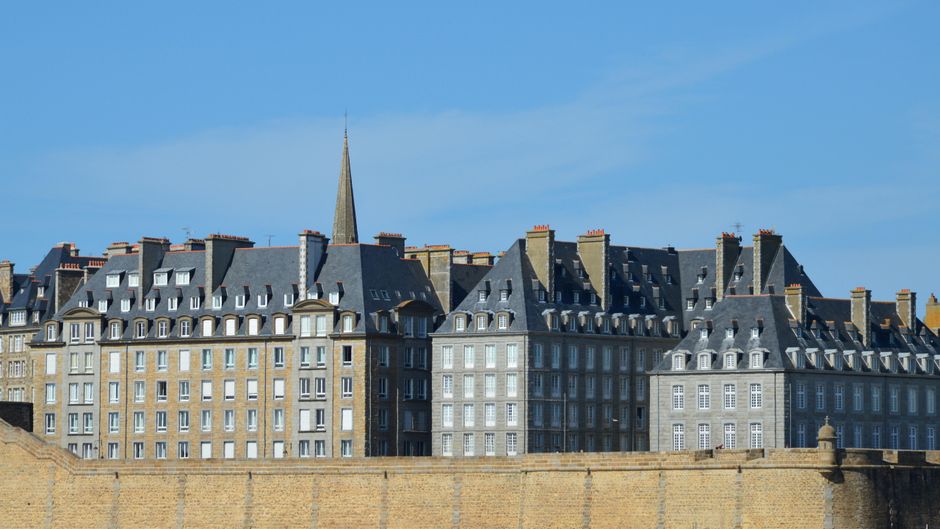
Saint-Malo is Brittany’s walled corsair city, a granite old town on the Emerald Coast where some of the biggest tides in Europe come and go twice a day. You come to walk the ramparts above golden beaches, cross the sand at low tide to the Grand Bé and the Fort National, eat oysters in Cancale and crêpes inside the walls, and take the little boat over to Belle Époque Dinard. It is about 2¼ hours from Paris by TGV, has ferries from Britain and makes an easy base for Mont-Saint-Michel. Give it two days for the town and its islands, three or four with Cancale, Dinan, Cap Fréhel and the Mont.
Right now in Saint-Malo
- Wed16–18°C61–65°F16 mm rain
- Thu15–16°C58–61°F1 mm rain
- Fri14–17°C57–62°FCloudy
Top tours in Saint-Malo
See all tours for Saint-Malo →
From local operators, with prices and reviews; you check availability and book on Viator, our partner. We may earn a commission at no extra cost to you. How we earn money
Saint-Malo at a glance
- Best for: a walled old town and ramparts, tidal islands and forts, beaches, seafood and oysters, boat trips and the coastal path.
- How long: 2 days for the town, the ramparts and the islands; 3–4 days with Cancale, Dinard, Dinan and Mont-Saint-Michel.
- Best time: May, June and September for mild weather and fewer crowds; spring and autumn equinoxes for the spectacular big tides; late October 2026 for the Route du Rhum sailing race.
- Getting in: TGV from Paris-Montparnasse in about 2 hours 15 minutes on the fastest trains; overnight ferries from Portsmouth; Dinard airport across the Rance.
- Getting around: on foot inside the walls; MAT buses at €1.40 a trip (€2 on board) as of October 2026; the sea bus to Dinard in 10 minutes.
- Before you go: entry rules, money, trains and general safety are on our France travel guide; the wider region is in our Brittany guide.
Saint-Malo’s areas and who each one suits
Saint-Malo sits at the mouth of the Rance estuary, facing Dinard across the water. The old walled town was once an island, linked to the mainland by a strip of sand called the Sillon; today the town also takes in Saint-Servan to the south, Paramé along the long beach to the east and Rothéneuf further up the coast.
Intra-muros, the walled town
Inside the ramparts, tall granite houses line narrow streets around the Cathedral of Saint-Vincent. Most of the old town was destroyed in August 1944 and rebuilt stone by stone over the following decades, so it looks 18th-century but is largely post-war. It is full of crêperies, seafood restaurants, shops and small hotels. Best for: a first visit and short stays without a car, though it is crowded and noisy on summer evenings.
Saint-Servan and the Cité d’Alet
South of the walls, Saint-Servan is a quieter residential quarter with its own harbour, the Port Saint-Père, and the 14th-century Tour Solidor guarding the Rance. The green headland of the Cité d’Alet, where the first town stood, has paths with views back to the ramparts. Best for: couples and families who want calm, good restaurants and a short walk to the old town.
The Sillon, Paramé and Rothéneuf
East of the walls, the Grande Plage du Sillon runs for about 3 km past a promenade, the old wooden breakwater posts and a line of villas and apartment blocks, merging into the beaches of Paramé and Rochebonne. Further on, Rothéneuf is a village-like corner with sheltered coves and the carved rocks. Best for: beach holidays, seafront apartments and the thalassotherapy hotels.
Top things to see in Saint-Malo
The ramparts, beaches and Grand Bé are free. Prices below are as of October 2026; check the official sites before you go.
The ramparts walk
The walls of Saint-Malo survived the war almost intact, and you can walk right round the old town on top of them, free and at any time, in about an hour with stops. Climb up at the Porte Saint-Vincent, by the castle, and go clockwise for views over the harbour, the Grand Bé, the Fort National, the islands of the bay and the Dinard shore. At high tide on a big tide, waves break against the walls along the Sillon; at low tide the beaches below stretch out for hundreds of metres. Sunset from the Bastion de la Hollande is a local ritual.
The Grand Bé and Petit Bé
At low tide you can walk across the sand from Bon-Secours beach to the Grand Bé, a small grassy island a few hundred metres off the walls, where the writer Chateaubriand is buried facing the sea. The view back to the ramparts is superb. The tourist office’s rule: take the time of the day’s low tide and allow 1½ hours before and 1½ hours after it, which gives a window of about three hours. Do it only inside that window, as shown on the signs at the beach and in the official tide tables, start back in good time, and never set off once the sea has reached the causeway. If you are cut off, stay on the island and call 112. Each year people are caught by the rising tide here. Behind it, the small Fort du Petit Bé, completed in 1707, is privately restored and can be visited when the tide allows.
The Fort National
Built in 1689 to plans by Vauban, on a rock off the Plage de l’Éventail, this fort protected the town from English and Dutch attacks. You can walk out to it at low tide, with the same caution as for the Grand Bé, and in season join a guided tour of its two enclosures and underground passages; when the French flag flies over the fort, it is open. It reopened for visits on 1 June 2026, and opening times depend on the tides, so check the fort’s website on the day for times and prices.
Grand Aquarium Saint-Malo
On the southern edge of town, the aquarium has ten themed areas, from the local seas to a tropical mangrove, a shark ring, touch pools and the “Nautibus”, a simulated submarine dive to 300 metres. It is a good rainy-day plan with children. How to visit: open every day; in October 2026 from 10:00 to 17:00 on weekdays and to 18:00 at weekends, with the ticket desk closing an hour earlier. As of October 2026, an open-date ticket costs €20.50 for adults (12 and over) and €16.50 for children aged 3–11, with cheaper dated tickets online from €19 and €15. Take MAT bus line 1 towards La Madeleine to the Aquarium stop.
Saint-Servan and the Tour Solidor
The Tour Solidor, three linked round towers built in the 14th century by the Duke of Brittany, stands on the shore of the Rance at Saint-Servan. The Cape Horners’ museum that used to be inside has been closed since 2019, like the history museum in the castle, so admire it from the outside and walk on round the Cité d’Alet headland. The walk from the walls along the quays and round Alet takes about an hour and a half there and back.
Beaches: Bon-Secours, the Sillon and beyond
Bon-Secours, right under the walls, has a seawater pool that fills at every high tide, with a diving board; it is free and popular for a bracing swim. The Grande Plage du Sillon is long and sandy, good for walks and sand yachting at low tide, with lifeguards in summer. The sea is cool, around 17–19 °C in August. On a big tide the water covers almost all the sand at high water, so check the tide time before you lay out your towel.
The carved rocks of Rothéneuf
Between 1894 and his death in 1910, a local priest, the Abbé Fouré, carved more than 300 figures into the granite cliffs at Rothéneuf, telling the legend of a family of corsairs. Paths wind among the sculptures above the sea. There is a small entry fee, used to protect the fragile site; check the opening hours, which follow the seasons.
The tides in Saint-Malo
Tides shape every visit. Around Saint-Malo and the bay of Mont-Saint-Michel, the difference between high and low water can exceed 12 metres on the biggest tides, among the largest in Europe. Tides come twice a day, about 50 minutes later each day, and their strength is measured by a coefficient from 20 to 120. The tourist office explains that coefficients usually pass 100 around the full and new moons, and are strongest near the equinoxes in March–April and September–October, when the sea goes out especially far for shellfish gatherers and waves can splash over the Sillon at high water.
Watching a big high tide break against the walls from a sheltered spot is one of the great sights of Brittany, but keep well back from the edge of the promenade when the sea is rough. Get the day’s times from the tourist office’s tide tables or from SHOM, the French Navy’s official tide service, and plan the Grand Bé, the Fort National and beach time around them. For sea rescue, call 196 or use VHF channel 16.
Boats, food and events
The sea bus to Dinard and boat trips
Since 1904 the Compagnie Corsaire’s sea bus has crossed between Saint-Malo, from the Cale de Dinan below the walls, and Dinard in about 10 minutes, avoiding the traffic over the Rance dam. In 2026 it runs daily from 28 March to 1 November, plus 7–15 November. As of October 2026 a return costs €8.90 for adults and €6.30 for children aged 2–12 (€9.30 and €6.60 from 20 October to 1 November), with bikes extra; buy tickets online to skip the queue. From 1 to 19 October the last boats leave Saint-Malo at 17:50 and Dinard at 18:10. The same company runs cruises round the bay, to the Île de Cézembre, to Cancale and up the Rance to Dinan in season; see our boat trips guide.
Seafood, crêpes and Breton butter
Inside the walls, every other door is a crêperie: start with a savoury buckwheat galette, finish with a sweet crêpe with salted-butter caramel and a bowl of dry cider. Moules-frites, seafood platters and grilled fish are everywhere, and Saint-Malo is known for its salted butter and its kouign-amann. For oysters, go to Cancale, 15 km east, where the farmers sell them by the dozen on the harbour.
The Route du Rhum 2026
Every four years Saint-Malo hosts the start of the Route du Rhum, a solo transatlantic sailing race to Guadeloupe. In 2026 the free race village opens in the port on Tuesday 20 October, and the 13th edition starts on Sunday 1 November 2026 at 13:02. The city expects huge crowds in the two weeks before the start, so book rooms early and use the bus, train or sea bus rather than a car.
Day trips from Saint-Malo
Mont-Saint-Michel
Mont-Saint-Michel is about an hour east by car, just over the border in Normandy; Keolis Armor coaches link Saint-Malo with the Mont in about an hour on some days. Cars stay in the mainland car parks, 2.5 km from the rock: in October 2026 they cost €16 for up to 3 hours, €19 for 6 hours and €22 for 24 hours, falling to €10, €12 and €14 from 2 November, with the first 30 minutes free. The free “Le Passeur” shuttle or a 45-minute walk takes you to the rock. The village is free; the abbey costs €13 from 1 October 2026 to 31 March 2027 (€16 from April to September), free for under-18s. Arrive early or after 16:00 to avoid the crowds.
Cancale and the Pointe du Grouin
Cancale, the oyster capital of the bay, is a fishing port of colourful houses at Port de la Houle, with oyster beds stretching out at low tide. Eat a dozen on the sea wall, then follow the coastal path north to the Pointe du Grouin, a wild headland facing the bird island of Les Landes, with views across to Mont-Saint-Michel on clear days.
Dinard and Dinan
Across the estuary, Dinard is a Belle Époque resort of grand villas and sheltered beaches, linked by the Clair de Lune promenade; the sea bus is the easiest way there. Dinan, about 30 km south, is one of the best-preserved medieval towns in Brittany, with ramparts, timber-framed houses and the steep Rue du Jerzual down to a little port on the Rance. In season you can sail up the Rance to Dinan and come back by bus.
Cap Fréhel and Fort La Latte
About 50 minutes west by car, the pink sandstone cliffs of Cap Fréhel rise 70 metres above the sea, with a lighthouse, heathland and seabird colonies. A section of the GR34 coastal path leads to Fort La Latte (the Château de la Roche Goyon), a medieval castle on its own rocky spur. As of October 2026 the castle opens daily from April to October; tickets cost €8.50 for adults and €6 for children under 12. See our hiking guide.
Nearby destinations
- Mont-Saint-Michel38 km
- Brittany102 km
- Normandy128 km
- Nantes163 km
- Loire Valley223 km
- Jurassic Coast239 km
- Île de Ré276 km
- Brighton277 km
Getting there and getting around
By train
TGVs from Paris-Montparnasse reach Saint-Malo in about 2 hours 15 minutes on the fastest direct services, and closer to 3 hours with stops or a change in Rennes; BreizhGo regional trains run from Rennes in under an hour. Saint-Malo station is about 20 minutes’ walk or a short bus ride from the walls. Check times and fares on SNCF Connect.
By ferry and air
Brittany Ferries sails overnight between Portsmouth and Saint-Malo, daily in summer and less often in winter, with a crossing of roughly 9–11 hours depending on the sailing. The Channel Islands routes changed in 2025: Brittany Ferries now runs the former Condor service to Guernsey (still sold on the Condor Ferries website), leaving Saint-Malo in the morning, and DFDS sails to Jersey. Check the operators’ 2026 timetables before you plan, as days vary by season. Dinard Bretagne airport, about 15 km away, has a few mainly seasonal flights; Rennes airport has more.
MAT buses
The MAT network covers Saint-Malo and its neighbours. As of October 2026, a single ticket valid for 1 hour 30 minutes costs €1.40 from ticket offices and outlets, or €2 bought on board, where you can also tap a bank card. A 24-hour ticket is €4 (€6 on board), a 10-trip ticket €13 and a 7-day ticket €13; groups of up to five can share a 24-hour ticket for €13, 48 hours for €20 or 72 hours for €30. Line 1 links the station, the walls and the aquarium. Regional BreizhGo coaches serve Cancale, Dinard and Dinan.
Driving and parking
Saint-Malo has no low-emission zone, and Brittany’s main roads are toll-free dual carriageways. Driving inside the walls is restricted and parking is scarce, so leave the car in the big car parks outside the walls or at a park-and-ride and walk or take the bus in. Traffic over the Rance dam to Dinard is heavy on summer weekends.
When to go and how long to stay
Saint-Malo has a mild, breezy maritime climate: rarely hot, rarely freezing, with rain spread through the year and showers that pass quickly. The table uses Météo-France’s official 1991–2020 normals for the Dinard station, across the Rance, the same station used on our Mont-Saint-Michel guide: average daily highs and lows, and days with at least 1 mm of rain.
| Season | Average high / low | Rainy days per month | What it’s like | Good for |
|---|---|---|---|---|
| Winter (Dec–Feb) | 9–10 °C / 4 °C | 11–14 | Cool, grey and windy, with winter storms | Storm-watching from the walls, cosy crêperies, cheap rooms |
| Spring (Mar–May) | 12–17 °C / 5–9 °C | 9–10 | Fresh and bright, equinox tides in March | Ramparts, island walks, Cap Fréhel |
| Summer (Jun–Aug) | 20–22 °C / 12–14 °C | 8–9 | Mild, long evenings, cool sea | Beaches, boat trips, Dinard and Cancale |
| Autumn (Sep–Nov) | 20 °C falling to 12 °C / 12 °C falling to 7 °C | 9 in September, 13–14 in October–November | Lovely September, big tides, wetter later | Big tides, seafood, the Route du Rhum (2026) |
August is the warmest month, with an average high of about 22 °C, and Dinard gets around 750 mm of rain a year, most of it from October to December, with about 1,730 hours of sunshine. The wind can make the walls feel colder than the thermometer says, so bring a layer in any season.
How long to stay: 2-, 3- and 4-day plans
2 days: Day 1, the ramparts walk, intra-muros and the cathedral, the Grand Bé at low tide and sunset from the walls. Day 2, the Fort National or the aquarium, a swim at Bon-Secours, Saint-Servan and the Tour Solidor, and the sea bus to Dinard for dinner. 3 days: add Cancale, its oysters and the coastal path to the Pointe du Grouin. 4 days: add Mont-Saint-Michel, or Dinan and Cap Fréhel with Fort La Latte.
Where to stay in Saint-Malo
- Intra-muros: character, the walls and the restaurants on the doorstep; small rooms and summer noise, and parking is difficult.
- Saint-Servan: quieter, with good restaurants and a 20-minute walk along the harbour to the old town.
- The Sillon and Paramé: sea-view hotels and apartments on the long beach, some with spas and thalassotherapy.
- Near the station: practical for trains and buses, with easier parking.
- Dinard or Cancale: a different mood across the water or by the oyster beds; best with a car or the sea bus.
Saint-Malo Agglomération adds a nightly tourist tax (taxe de séjour) per adult, including the Ille-et-Vilaine department’s 10% surcharge; under-18s are exempt. The 2026 rates, unchanged since 2022, are €1.35 per adult per night in a 3-star hotel, €2.05 in a 4-star, €2.20 in a 5-star and €4.40 in a palace; unclassified rentals pay a percentage of the nightly price per person, up to a cap. Prices peak in July, August, holiday weekends and Route du Rhum weeks.
Practical tips for Saint-Malo
- Check the tide every day: for the Grand Bé, the Fort National, the beaches and the sea pool.
- Never race the sea: if water is on the causeway, don’t cross; if cut off, stay put and call 112.
- Walk the walls early or late: mornings are calm, and sunset over the islands is the best show in town.
- Leave the car outside: park outside the walls and use buses and the sea bus.
- Book ahead for big events: rooms fill months ahead for the Route du Rhum and summer weekends.
What to pack for Saint-Malo
A windproof, waterproof jacket in every season and a warm layer for the walls and boat trips; the breeze off the sea is constant. Bring shoes with grip for wet granite and sand, plus sandals or water shoes for rocky beaches and the tidal crossings. In summer add swimwear, a towel, sunscreen and sunglasses, as the sea wind hides strong sun. A small backpack and a refillable bottle help on day trips to Cancale and Cap Fréhel.
Saint-Malo travel FAQ
How many days do you need in Saint-Malo?
Two days covers the ramparts, the old town, the Grand Bé and a trip to Dinard. Three or four days lets you add Cancale, Dinan, Cap Fréhel and a day at Mont-Saint-Michel.
When can you walk to the Grand Bé?
Only around low tide: the tourist office advises taking the day’s low-tide time and allowing 1½ hours before and after, a window of about three hours. Follow the signs at Bon-Secours beach, start back early, never cross once water reaches the causeway, and if cut off stay on the island and call 112.
Can you visit the Fort National?
Yes, on foot at low tide from the Plage de l’Éventail, with guided tours in season; it reopened on 1 June 2026. Opening times depend on the tides, and a French flag over the fort means it is open, so check its website on the day.
How much is the Grand Aquarium Saint-Malo?
As of October 2026, an open-date ticket costs €20.50 for adults and €16.50 for children aged 3–11, with dated online tickets from €19 and €15. It opens every day; in October from 10:00 to 17:00 on weekdays and to 18:00 at weekends.
How do I get from Saint-Malo to Dinard?
By the Compagnie Corsaire sea bus in about 10 minutes, daily from late March to 1 November 2026 plus 7–15 November. As of October 2026 a return costs €8.90 for adults and €6.30 for children (€9.30 and €6.60 from 20 October to 1 November).
How far is Mont-Saint-Michel from Saint-Malo?
About an hour by car or by Keolis Armor coach on the days it runs. Park on the mainland (€16–22 in October 2026, €10–14 from 2 November) and take the free shuttle; the abbey costs €13 from 1 October 2026, free for under-18s.
How long is the train from Paris to Saint-Malo?
About 2 hours 15 minutes on the fastest direct TGVs from Paris-Montparnasse, and closer to 3 hours with stops or a change in Rennes. Check times on SNCF Connect.
Can I take a ferry from Saint-Malo to Jersey or Guernsey?
Yes. Since 2025 DFDS sails to Jersey, and Brittany Ferries runs the former Condor service to Guernsey, booked on the Condor Ferries website. Sailing days vary by season, so check the 2026 timetables and bring your passport.
When is the Route du Rhum 2026?
The free race village opens in Saint-Malo on Tuesday 20 October 2026, and the race starts on Sunday 1 November 2026 at 13:02. Expect very large crowds and book accommodation early.
How much is the tourist tax in Saint-Malo?
In 2026, Saint-Malo Agglomération charges €1.35 per adult per night in a 3-star hotel, €2.05 in a 4-star and €2.20 in a 5-star, including the department’s 10% surcharge. Under-18s are exempt.
Can you swim in Saint-Malo?
Yes, on the Sillon, Bon-Secours and Paramé beaches, with lifeguards in summer, and in the free seawater pool at Bon-Secours. The sea is cool, about 17–19 °C in August, and the tide changes the beaches completely, so check the times.
Plan your trip
Partner links: TravelerCenter may earn a commission if you book, at no extra cost to you.
🇫🇷 Useful French phrases for Saint-Malo
All 38 French phrases: restaurant, hotel, emergencies, romance (printable) →
Sources · last reviewed 4 October 2026
Researched and last reviewed on 4 October 2026. Climate: Météo-France 1991–2020 normals for Dinard; Grand Bé access and tides: the Saint-Malo Baie du Mont-Saint-Michel tourist office; Fort National: the fort’s official site; aquarium prices and hours: Grand Aquarium Saint-Malo; sea bus: Compagnie Corsaire; buses: the MAT network; Route du Rhum dates: the City of Saint-Malo; Fort La Latte: the castle’s official site; Mont-Saint-Michel parking, shuttle and abbey: the Établissement public du Mont-Saint-Michel and the Centre des monuments nationaux; tourist tax: Saint-Malo Agglomération. Train and ferry times and the museum closures are flagged for checking. Prices, hours and timetables change, so check the official links before you go. For entry rules, money and general safety, see our France travel guide.
Data: Weather: MET Norway (CC BY 4.0) · Sea temperature: NOAA CoastWatch · Rates: ECB · Costs: World Bank ICP and price levels · Wikidata (CC0)