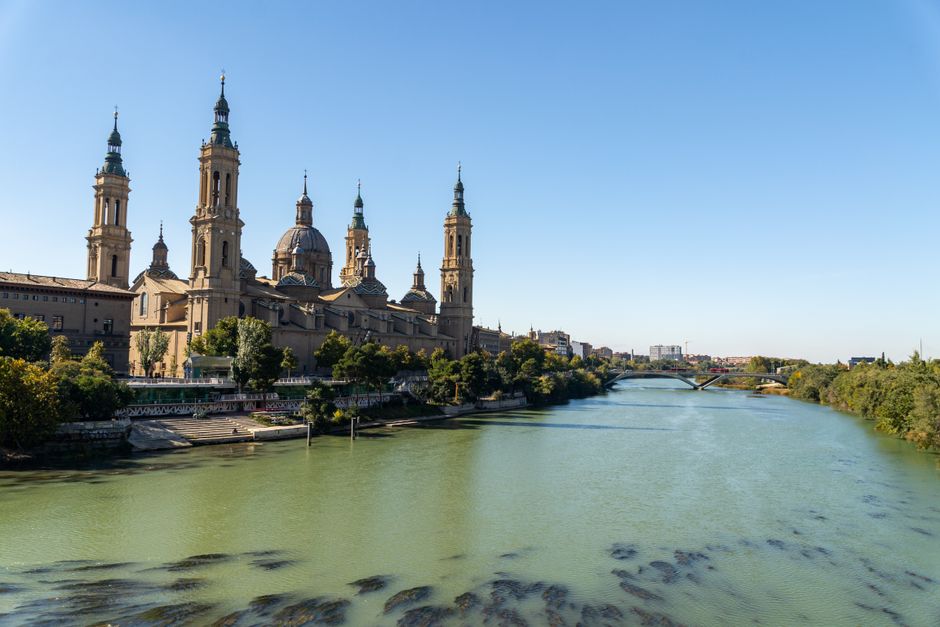
Zaragoza, the capital of Aragon, sits on the River Ebro halfway between Madrid and Barcelona, and high-speed trains make it an easy stop on the way. Spain’s fifth-largest city is often overlooked, which is a shame: it has two cathedrals side by side on one huge square, frescoes by Goya, who was born nearby, an 11th-century Islamic palace that rivals anything in Andalusia, Roman ruins under the streets and one of the country’s liveliest tapas quarters. It is a real, working city with friendly prices and few crowds, except during the October fiestas. Summers are hot and the cierzo wind can be fierce, so spring and autumn are the best times to come.
Right now in Zaragoza
- Wed16–23°C60–74°F2 mm rain
- Thu15–20°C60–68°FMostly clear
- Fri11–19°C52–66°FMostly clear
- Mon 12 Oct National Day of Spain (Fiesta Nacional de España)
Top tours in Zaragoza
See all tours for Zaragoza →
From local operators, with prices and reviews; you check availability and book on Viator, our partner. We may earn a commission at no extra cost to you. How we earn money
Zaragoza at a glance
- Best for: Baroque and Mudéjar architecture, Goya, Roman history, tapas, and a relaxed city break between Madrid and Barcelona.
- How long: 2 days for the old town and its museums; 3–4 days to add the Monasterio de Piedra, Belchite or Tarazona.
- Best time: April to early June and mid-September to October. July and August average highs of about 32–33 °C, and winter brings cold, windy days.
- Getting there: high-speed trains from Madrid and Barcelona to Zaragoza-Delicias; Zaragoza airport (ZAZ), about 10 km west, with bus line 505.
- Getting around: the old town is walkable; the tram runs north to south through the centre, and city buses cover the rest.
- Before you go: entry rules, money, trains and general safety are on our Spain travel guide.
Zaragoza’s neighbourhoods and who each one suits
Almost everything lies on the south bank of the Ebro, within a 20-minute walk of the Plaza del Pilar.
Casco Histórico (the old town)
The historic centre wraps around the long Plaza del Pilar, with the Basílica del Pilar, La Seo cathedral, the Lonja and the Roman museums all within a few minutes of each other. Just south is El Tubo, a maze of narrow lanes packed with tapas bars. It is the obvious base for a short stay and great for first-timers; ask for a quiet room, especially during the October fiestas.
Centro: Plaza de España and Paseo de la Independencia
The 19th- and 20th-century centre, built around the Plaza de España, the arcaded Paseo de la Independencia and the Plaza de los Sitios. It has the main shops, many mid-range hotels and the tram: a practical base, ten minutes’ walk from El Pilar.
La Magdalena and San Pablo
Two old working-class quarters on either side of the centre, each named after a church with a Mudéjar tower. La Magdalena, east of La Seo, has alternative bars, small restaurants and street art; San Pablo, west of the Mercado Central, is more traditional and multicultural. Good for travellers who like character and lower prices.
Delicias and the Expo riverside
The area around Zaragoza-Delicias station and the riverside site of Expo 2008 to the west has modern hotels, convenient for an early train or a stop on a longer journey. You will need the bus or a taxi to reach the old town.
Top things to see in Zaragoza
Prices and hours below were checked on the official sites in October 2026, unless we say otherwise; check again before you go.
Basílica del Pilar and its tower
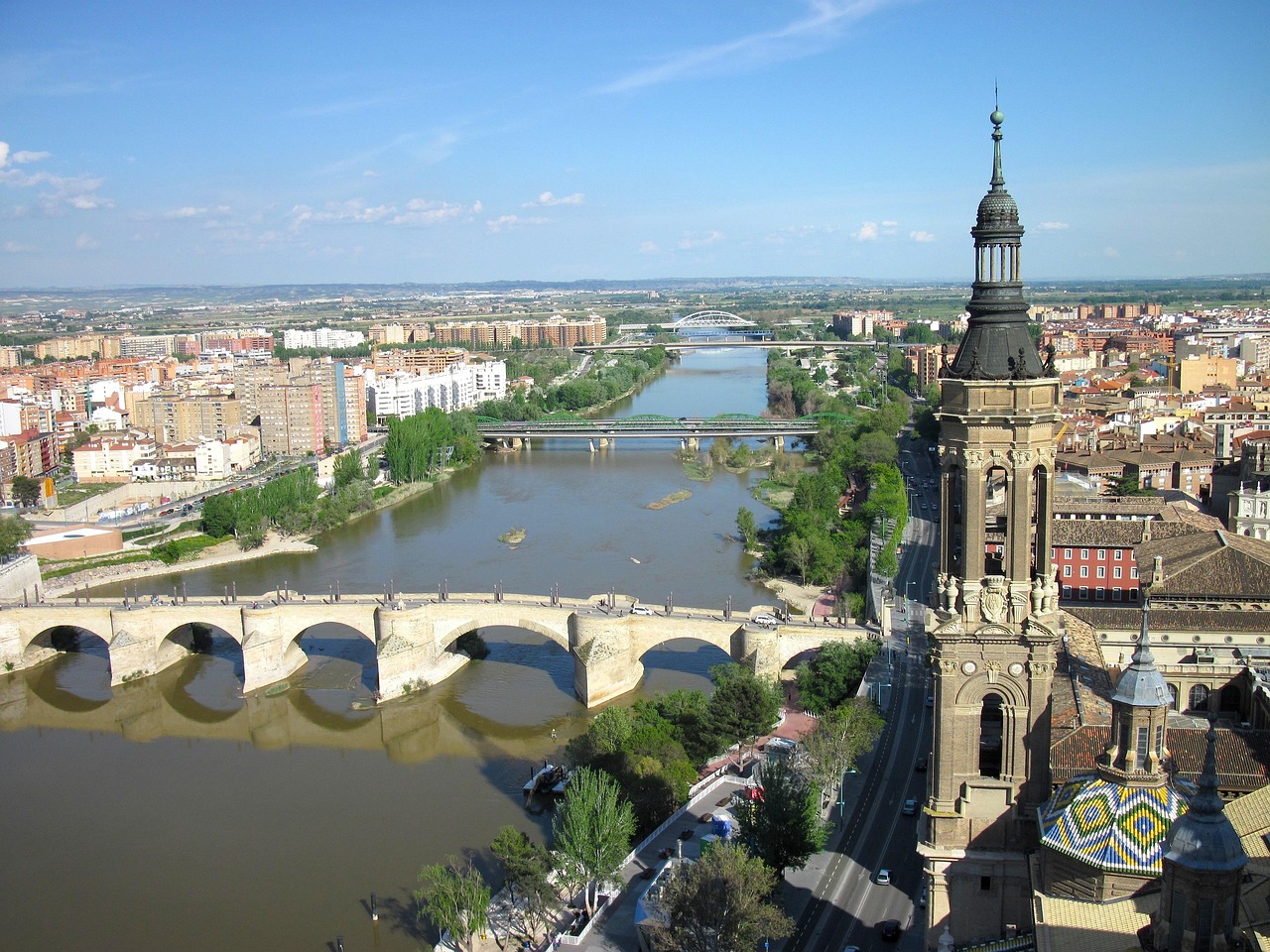
The vast Baroque basilica, with eleven domes covered in coloured tiles and four tall towers, is Zaragoza’s symbol and one of the great Marian shrines of the Catholic world. Pilgrims queue in the Santa Capilla to see the pillar on which, tradition says, the Virgin appeared to Saint James. Look up for two frescoes by Francisco de Goya: the Adoration of the Name of God (1772), on the vault of the small choir facing the Virgin’s chapel, and the dome of the Regina Martyrum (1781), painted with loose, bold strokes meant to be seen from almost 50 m below. Entry to the basilica is free. According to the cathedral chapter, the Santa Capilla area is open daily 8:00–20:30, and the high-altar area closes for a few hours at midday. For the best view in the city, a lift climbs 62 m inside the Torre de San Francisco de Borja in 20 seconds; after two short flights of stairs you reach a glassed-in viewpoint 80 m up. As of October 2026 the tower costs €6 (€4 for ages 13–18 and students up to 25, €5 for over-65s, free under 12), and it opens Monday to Thursday 10:30–14:30 and 16:00–20:00 and Friday to Sunday 10:00–20:00, with the last ascent 30 minutes before closing.
La Seo, Cathedral of the Saviour
At the other end of the Plaza del Pilar, La Seo is the older of Zaragoza’s two cathedrals, built over the city’s main mosque, mixing styles from Romanesque to Baroque. Its north-east wall is a masterpiece of Mudéjar brick and glazed tile, part of the UNESCO-listed Mudéjar architecture of Aragon. Inside, the Museo de Tapices shows a superb collection of Flemish tapestries. As of October 2026 the cathedral ticket costs €10 (€7 for ages 13–18 and students up to 25, €9 for over-65s, free under 12) and covers La Seo, the tapestry museum, the Museo Pilarista and the Rosario de Cristal lantern museum; with the Pilar tower it is €12. La Seo opens Monday to Saturday 10:00–14:30 and 16:00–20:00 and Sunday 10:00–12:00 and 16:00–20:00, with the last entry 45 minutes before closing; hours can change for services and weddings.
The Aljafería palace
Built in the 11th century as the pleasure palace of the Islamic kings of Saraqusta, the Aljafería is, with the Alhambra and the Mezquita of Córdoba, one of the finest Islamic buildings in Europe. Walk through its courtyard, framed by intricate interlacing arches, to the tiny octagonal oratory, then up to the rooms of the later Christian kings, with a gilded ceiling made for Ferdinand and Isabella. Today the palace is also the seat of the Cortes de Aragón, the regional parliament. Until the Museo de Zaragoza reopens after its refurbishment, seven rooms of the palace host the exhibition Goya. Del museo al palacio, with 62 works by the artist. According to Turismo de Aragón, tickets cost €7 (€9 with a guided tour), €2 for over-65s, students and youth-card holders, and are free for under-12s, for everyone all day on the first Sunday of the month and on the afternoon of the first Monday. From April to October it opens daily 10:00–18:00; from November to March, Monday to Saturday 10:00–18:00 and Sunday 10:00–14:00.
Roman Caesaraugusta
Zaragoza takes its name from Caesar Augustus, who founded the colony of Caesaraugusta here around 14 BC. The city council runs four small underground museums on the “Ruta de Caesaraugusta”: the Forum, under the Plaza de la Seo; the River Port, under the Plaza de San Bruno; the Public Baths; and, the most striking, the Theatre, with a large part of a 6,000-seat Roman theatre under a modern canopy. A combined pass covers all four, and another adds the Pablo Gargallo sculpture museum. The council’s own pages did not load for us, so check prices and hours on site; the museums are generally closed on Mondays. A stretch of the Roman walls stands next to the Mercado Central.
Museo Goya
In a Renaissance palace a few streets from El Pilar, the Museo Goya (Fundación Ibercaja – Museo Camón Aznar) shows all four of Goya’s great print series, the Caprichos, the Disasters of War, the Tauromaquia and the Disparates, alongside paintings by Goya and other artists. It is due to reopen on 9 October 2026 with the exhibition Solo Goya. El arte de ver, until 10 January 2027. According to the museum, tickets cost €14 (€10 reduced for under-18s, the unemployed and youth-card holders, €8 for Ibercaja customers, free under 12), with timed entry; a virtual-reality experience costs €2 extra. It opens Tuesday to Saturday 10:00–20:00 and Sundays and holidays 10:00–14:00, and closes on Mondays.
More to see
- Puente de Piedra: the 15th-century stone bridge with lion statues, for the classic view of El Pilar across the Ebro, best at sunset.
- La Lonja: the Renaissance merchants’ exchange on the Plaza del Pilar, used for exhibitions.
- Mercado Central: the early-1900s iron-and-glass market hall, good for a morning coffee and local produce.
- Mudéjar towers: the brick and tile bell towers of San Pablo and La Magdalena churches.
- Parque Grande José Antonio Labordeta: the city’s large, leafy park, south of the centre on the tram line.
Other things to do in Zaragoza
Tapas in El Tubo
El Tubo, the tangle of narrow lanes between the Calle Alfonso I and the Plaza de España, is Zaragoza’s tapas heartland. Hop from bar to bar for croquetas, fried madejas, mushroom skewers and migas, with a glass of Aragonese garnacha. The Plaza de Santa Marta and the streets around the Mercado Central are good too.
The Ebro riverside and the Expo 2008 site
Paths follow both banks of the Ebro from the old town west to the former Expo 2008 site, with the Water Tower, Zaha Hadid’s Bridge Pavilion and the Parque del Agua, a big riverside park. It is flat and easy on foot or by bike. See our cycling and city sightseeing guides.
Garnacha wine country
Aragon is garnacha country. The Campo de Cariñena vineyards begin about 45 minutes south of the city, and the Campo de Borja, near Tarazona, calls itself the “empire of garnacha”. Both have wine routes with cellars open to visitors, usually by appointment. See our wine tasting guide.
Day trips and onward travel
Monasterio de Piedra and Tarazona
Near Nuévalos, about 1 h 30 by car, the River Piedra tumbles through a green gorge in the middle of dry hills, forming waterfalls, grottoes and lakes around a 12th-century Cistercian monastery. As of October 2026 the official 2026 ticket for the park and monastery costs €20 for adults and €14.20 for children aged 4–11 and over-65s; the park opens daily from 9:00, with the last entry two hours before closing. Tarazona, an hour north-west at the foot of the Moncayo, has a Gothic-Mudéjar cathedral, an unusual octagonal bullring, a Jewish quarter and houses hanging over the River Queiles.
Belchite, Fuendetodos and the Pyrenees
The ruined old town of Belchite, destroyed in a Civil War battle in 1937 and left as it was, is a haunting place, about 45 minutes south-east; it is visited on guided tours by day or by night, run by local guides. Goya was born in 1746 in the village of Fuendetodos, where you can see his birthplace and a museum of his prints; Belchite and Fuendetodos fit into one day by car. For mountains, the Aragonese Pyrenees, with the Ordesa y Monte Perdido National Park and the Romanesque monastery of San Juan de la Peña, are about two and a half to three hours north; plan at least one night. See our hiking guide.
Nearby destinations
- Costa Daurada167 km
- Lourdes175 km
- Peñíscola180 km
- San Sebastián206 km
- Biarritz211 km
- Andorra la Vella220 km
- Sitges229 km
- Bilbao246 km
Getting there and getting around
By high-speed train and coach
Zaragoza-Delicias, west of the centre, is a stop on the Madrid–Barcelona high-speed line, with frequent Renfe AVE and Avlo trains and services from other high-speed operators. Expect roughly 1 h 20 to 1 h 45 from Madrid and 1 h 30 to 2 h from Barcelona; Spanish high-speed trains have run slower since speed restrictions were introduced in 2026, so check the timetable when you book. Long-distance coaches use the bus station in the same building. From Delicias, a taxi to the old town takes about 10 minutes.
From Zaragoza airport
Zaragoza airport (ZAZ) is about 10 km west of the centre and has a modest number of flights, mostly with low-cost airlines. According to Aena, bus line 505 runs between the airport and a provisional stop at Paseo María Agustín 5, on the edge of the old town, with a single stop at Delicias station; its timetable is matched to flight arrivals and departures. As of October 2026 a single ticket costs €4.65, and since 21 September 2026 you can pay on board with a contactless bank card or phone, according to the Consorcio de Transportes del Área de Zaragoza (CTAZ). Taxis wait outside the terminal.
Tram, buses and bikes
The old town is best on foot. Zaragoza’s single tram line runs north to south through the centre, via the Plaza de España, Plaza del Pilar–Murallas and the Paseo de la Independencia, and on to the Parque Grande. City buses cover the rest of the city, including Delicias station. Single tickets are sold on board, and a rechargeable transport card is cheaper if you make many trips; we could not confirm current fares on an official page. Bike-hire shops and a long network of cycle lanes make the riverside easy to explore.
Driving and the low-emission zone
You do not need a car in the city, though one is handy for the day trips. Zaragoza has a low-emission zone (ZBE) covering the historic centre, enforced by number-plate cameras; according to secondary sources, fines have been issued since December 2025, and cars without a Spanish environmental label, roughly petrol cars registered before 2000 and diesels before 2006, may not enter. The rules for foreign-registered cars were not confirmed on an official page, so if you drive, park outside the old town or check with your hotel before arriving.
When to go and how long to stay
Zaragoza has a dry, continental Mediterranean climate: hot summers, chilly winters and little rain at any time of year. Its trademark is the cierzo, a strong, dry north-west wind that blows down the Ebro valley, most often in winter and spring, and makes cold days feel much colder. The table uses AEMET’s 1991–2020 climate normals for the Zaragoza airport weather station, about 10 km west of the centre at 249 m: average daily highs and lows, and days with at least 1 mm of rain.
| Season | Average high / low | Rainy days per month | What it’s like | Good for |
|---|---|---|---|---|
| Winter (Dec–Feb) | 11–14 °C / 4 °C | 4–5 | Cool and often grey or foggy, with cold cierzo days | Museums, tapas, low prices |
| Spring (Mar–May) | 18–25 °C / 7–13 °C | 5–6 | Pleasant and sunny, the wettest season, often windy | Sightseeing, day trips, the Monasterio de Piedra |
| Summer (Jun–Aug) | 30–33 °C / 17–19 °C | 2–4 | Hot and very sunny, with occasional thunderstorms | Evenings by the river, early-morning sightseeing |
| Autumn (Sep–Nov) | 27 °C falling to 15 °C / 16 °C falling to 7 °C | 3–6 | Warm September, mild October, cooler November | The Fiestas del Pilar, walking, wine |
Zaragoza airport averages only about 325 mm of rain a year, on about 52 days, and around 2,850 hours of sunshine. These are long-term averages; recent summers have often been hotter.
Events worth planning around
- Easter: Holy Week processions with drums through the old town.
- 23 April: San Jorge, Aragon’s national day, with books and roses.
- October: the Fiestas del Pilar, nine days of concerts, giants and big-heads parades, fireworks and bullfights, from Saturday 10 to Sunday 18 October 2026. On 12 October, Spain’s national day, crowds in traditional dress cover a huge frame on the Plaza del Pilar with flowers in the Ofrenda de Flores; on 13 October come the Ofrenda de Frutos and the candle-lit Rosario de Cristal procession. Expect street closures and bus diversions.
How long to stay: 2, 3 and 4 days
2 days: day one, the Basílica del Pilar and its tower, La Seo and the Roman Forum, then tapas in El Tubo; day two, the Aljafería and its Goya exhibition, the Roman Theatre and the Museo Goya, and sunset from the Puente de Piedra.
3 days: add the Monasterio de Piedra, or Belchite and Fuendetodos. 4 days: add Tarazona and the Campo de Borja wineries, a bike ride along the Ebro to the Expo site, or continue to the Pyrenees.
Where to stay in Zaragoza and the tourist tax
- Casco Histórico: next to El Pilar and El Tubo; atmospheric but lively at night.
- Centro: the widest choice of hotels, on the tram line.
- La Magdalena and San Pablo: character and lower prices, close to the sights.
- Delicias: modern hotels near the station, best for an overnight stop.
Rooms are scarce and expensive during the Fiestas del Pilar and big trade fairs, so book early for October. There is no tourist tax in Zaragoza or anywhere in Aragon as of October 2026. In July 2026 the Government of Aragon said it was not planning a regional tax, nor a legal framework that would let towns charge one.
Practical tips for Zaragoza
- Free days: the Aljafería is free on the first Sunday of every month and on the afternoon of the first Monday.
- Combine tickets: the cathedral ticket covers La Seo and three museums, and the €12 version adds the Pilar tower.
- Church etiquette: El Pilar is a working church with Masses all day; cover shoulders and keep quiet near the Santa Capilla.
- Late meals: lunch is around 14:00–16:00 and dinner from about 21:00; tapas bars fill from 20:30.
- Emergencies: call 112.
What to pack for Zaragoza
Comfortable walking shoes are a must for the old town’s paving and the tower stairs. In summer, bring light clothes, a sun hat, sunglasses, sunscreen and a refillable water bottle, and plan to sightsee in the morning and evening. A windproof jacket is the most useful item from October to April, when the cierzo can make a sunny day feel bitter, with a warm coat, scarf and gloves in December to February. Bring modest clothing for the churches.
Zaragoza travel FAQ
Is the Basílica del Pilar free to visit?
Yes, entry to the basilica, with its Goya frescoes and the Santa Capilla, is free. You pay only for the tower lift (€6 as of October 2026) and for the Museo Pilarista, which is also part of the €10 cathedral ticket.
How high is the Pilar tower viewpoint?
A lift rises 62 m in 20 seconds, then two short flights of stairs lead to a glassed-in viewpoint 80 m above the square. It opens Monday to Thursday 10:30–14:30 and 16:00–20:00 and Friday to Sunday 10:00–20:00.
When are the Fiestas del Pilar in 2026?
From Saturday 10 to Sunday 18 October 2026. The flower offering is on 12 October and the Ofrenda de Frutos and Rosario de Cristal procession on 13 October.
How do I get from Zaragoza airport to the city?
Take bus line 505, timed to the flights, to Delicias station and Paseo María Agustín on the edge of the old town. A single costs €4.65 as of October 2026, payable by contactless card on board.
How long is the train from Madrid or Barcelona to Zaragoza?
Roughly 1 h 20 to 1 h 45 from Madrid and 1 h 30 to 2 h from Barcelona by high-speed train, though trains have run slower since 2026 speed restrictions. Check the timetable when you book.
Is there a tourist tax in Zaragoza?
No. As of October 2026 there is no tourist tax in Zaragoza or anywhere in Aragon, and the regional government has said it does not plan one.
Is the Museo Goya open?
It reopens on 9 October 2026, with tickets at €14 (€10 reduced, free under 12). It opens Tuesday to Sunday and closes on Mondays. The Aljafería also shows 62 Goya works for now.
Is two days enough for Zaragoza?
Two days covers El Pilar, La Seo, the Aljafería, the Roman museums and El Tubo. Add a day or two for the Monasterio de Piedra, Belchite or Tarazona.
What is the cierzo?
A strong, dry north-west wind that funnels down the Ebro valley, most often in winter and spring. It clears the sky but makes it feel much colder, so pack a windproof layer.
Plan your trip
Partner links: TravelerCenter may earn a commission if you book, at no extra cost to you.
🇪🇸 Useful Spanish phrases for Zaragoza
All 38 Spanish phrases: restaurant, hotel, emergencies, romance (printable) →
Sources · last reviewed 4 October 2026
Researched and last reviewed on 4 October 2026. Basílica del Pilar, tower, La Seo and cathedral tickets: the Cabildo’s official Catedrales de Zaragoza site; Aljafería and the Goya exhibition: Turismo de Aragón; Museo Goya: Fundación Ibercaja; Monasterio de Piedra: the monastery’s official site; Fiestas del Pilar 2026 dates: the CTAZ transport consortium and Turismo de Aragón; airport bus: Aena and CTAZ; climate: AEMET’s 1991–2020 normals for Zaragoza airport, published through the WMO. Zaragoza City Council’s websites did not load while we researched, so the Roman museums, the low-emission zone, the tram and the regional tourist-tax position come from secondary sources and are flagged for checking, as are train journey times. Prices, hours and timetables change, so check the official sites before you go. For entry rules, money and general safety, see our Spain travel guide.
Data: Weather: MET Norway (CC BY 4.0) · Air quality: OpenAQ · Rates: ECB · Holidays: Nager.Date · Costs: World Bank ICP and price levels · Wikidata (CC0)