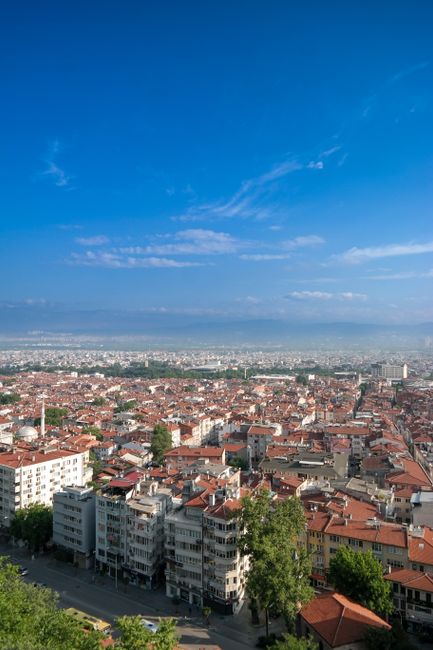
Bursa, at the foot of Mount Uludağ south of the Sea of Marmara, was the first great capital of the Ottoman Empire, and the sultans who founded it are buried here among green-tiled mosques, tombs and caravanserais. The city and the nearby village of Cumalıkızık are listed together by UNESCO as “the Birth of the Ottoman Empire”. Bursa is also the city of silk, sold in the Koza Han since 1491; of İskender kebab, which was invented here; of hot springs in the old spa quarter of Çekirge; and of the long cable car that climbs to the forests and ski slopes of Uludağ. It is Türkiye’s fourth-largest city, busy and industrial at the edges, but its historic heart is compact and rewarding. Fast ferries and buses make it an easy trip from Istanbul: one long day for the highlights, two days to add Uludağ and Cumalıkızık, three to include İznik.
Right now in Bursa
- Wed 12–21°C 53–70°F Partly cloudy
- Thu 14–21°C 58–70°F Cloudy
- Fri 15–24°C 59–74°F Clear
Weather: MET Norway (CC BY 4.0) · Rates: ECB
Top tours in Bursa
See all tours for Bursa →
From local operators, with prices and reviews; you check availability and book on Viator, our partner. We may earn a commission at no extra cost to you. How we earn money
Bursa at a glance
- Best months: April to June and September to October for sightseeing; December to March for skiing on Uludağ.
- Days needed: 1 day for the Grand Mosque, the silk bazaar and the Green Mosque; 2 days to add the Uludağ cable car and Cumalıkızık; 3 days with a day trip to İznik.
- Getting there: fast ferries from Istanbul to Mudanya (BUDO) or Güzelyalı (İDO), then a bus into the city; direct buses from Istanbul in about 2½–3 hours over the Osmangazi Bridge.
- Getting around: walk the historic centre; the Bursaray metro, trams and city buses with a BursaKart; taxis to the cable car and Cumalıkızık.
- Budget level: low to moderate. Mosques and tombs are free; the cable car is ₺500 return.
- Before you go: visas, money and transport around the country are in our Türkiye travel guide.
Bursa’s areas and who each one suits
The historic centre runs along the hillside between Heykel (the square with Atatürk’s statue) and the Grand Mosque, with the Hanlar district of old caravanserais and covered bazaars just below. Stay here if you are on foot for a day or two. East of Heykel, across the Gökdere stream, the Yeşil quarter holds the Green Mosque and Green Tomb and the Emir Sultan Mosque, with views over the plain. To the west, the Tophane hill has the tombs of Osman and Orhan, and beyond it the quiet, old-fashioned Muradiye quarter of wooden houses. Further west, Çekirge is the spa district, with thermal hotels and Ottoman baths on the slopes above the Kültürpark. Best for: the centre for first-timers; Çekirge for a relaxing stay with a thermal pool; Uludağ’s Oteller area for ski holidays.
Top things to see in Bursa
Most of Bursa’s great monuments are working mosques and tombs with free entry. Ministry museum details below are as of October 2026, from the Ministry of Culture and Tourism (muze.gov.tr). Visit mosques outside prayer times, with shoulders and knees covered, hair covered for women, and shoes off.
Bursa and Cumalıkızık: UNESCO World Heritage
In 2014 UNESCO listed parts of the city and the village of Cumalıkızık together as a World Heritage Site: the Hanlar commercial district and the great early Ottoman complexes (külliye) of Orhan, Murad I (Hüdavendigar), Bayezid I (Yıldırım), Mehmed I (Yeşil) and Murad II (Muradiye). Each complex combined a mosque with a soup kitchen, a school, a bath and a tomb, and together they show how the Ottomans planned a capital in the 14th and early 15th centuries, before they moved on to Edirne and Istanbul.
The Grand Mosque (Ulu Cami)
Built for Sultan Bayezid I between 1396 and 1400, the Grand Mosque is a vast hall of 20 domes on 12 great piers, its walls and columns covered with bold calligraphy by the great masters of Ottoman script. In the middle, under a glazed central dome, a marble fountain splashes, a rare feature inside a mosque. The carved walnut pulpit (minber) is a masterpiece. Free; it is one of the busiest mosques in the city at prayer times, so visit mid-morning or mid-afternoon.
Koza Han and the silk bazaar
Right next to the Grand Mosque, the Hanlar district is the old commercial heart of the city. The Koza Han (“cocoon inn”), built in 1491 for Bayezid II, is a two-storey caravanserai around a courtyard with a tiny mosque on a fountain in the middle; its shops sell silk scarves, ties and fabrics, and in early summer silk cocoons were traditionally auctioned here. The tea garden in the courtyard is a perfect place to rest. Around it, the Emir Han, Fidan Han, the Bedesten and the Kapalıçarşı (covered bazaar) sell towels, knives, Karagöz shadow puppets and everyday goods; Bursa’s cotton towels and bathrobes are famous.
The Green Mosque and the Green Tomb
East of the centre, the Green Mosque (Yeşil Cami), built for Mehmed I in 1419–1421, is one of the jewels of early Ottoman art: its interior and the sultan’s lodge above the entrance are covered with green and turquoise tiles made by masters from Tabriz, and the carved marble portal is superb. Across the road, the octagonal Green Tomb (Yeşil Türbe) of Mehmed I, clad outside in turquoise tiles, has a huge tiled sarcophagus and a beautiful mihrab. Both are free. The complex’s madrasa now houses the Bursa Turkish and Islamic Arts Museum, which the ministry lists as open daily 08:00–17:00 (ticket office until 16:30). Nearby, the Emir Sultan Mosque has fine views over the city.
Tophane: the tombs of Osman and Orhan
On the hill of Tophane, inside the old citadel walls west of the centre, stand the tombs of Osman, the founder of the Ottoman dynasty, and his son Orhan, who captured Bursa in 1326 and made it his capital. The 19th-century tombs replaced older ones destroyed by an earthquake in 1855. The terrace beside them, with the clock tower, has one of the best views in Bursa over the city and the plain. Free; dress respectfully.
The Muradiye complex
The Muradiye, built for Murad II from 1426, is the most peaceful corner of Bursa: a mosque and a walled garden of cypresses and roses with twelve tombs of Ottoman princes and princesses, some with exquisite tiles and painted decoration, including that of Prince Mustafa, son of Süleyman the Magnificent. The surrounding streets of old wooden houses are lovely to wander. Parts of the complex are periodically closed for repair, so ask the caretaker which tombs are open. The ministry’s Ottoman House Museum nearby was listed as closed when we checked.
Cumalıkızık
About 10 km east of the centre, on the lower slopes of Uludağ, Cumalıkızık is a village founded in the early Ottoman period, with cobbled lanes and some 270 houses of timber, stone and adobe, many still lived in. It is part of the UNESCO listing. Villagers sell jams, gözleme pancakes and raspberries, and the Sunday breakfasts in its café gardens are famous with Bursa families, so it is busiest at weekends. Go on a weekday morning for quiet lanes; reach it by taxi or city bus from the centre.
Uludağ: the cable car and the ski season
The cable car (Teleferik)
Bursa’s cable car climbs from the Teferrüç station on the edge of the city, past Kadıyayla and Sarıalan, to the hotel area (Oteller) of Uludağ, a ride of about 9 km and roughly half an hour, one of the longest cable car lines in the world, with views over the city and the Marmara plain. As of October 2026, according to the operator, a full-fare return ticket costs ₺500, students pay ₺250, and the fares apply to anyone born before 2020 (younger children ride free); the cable car runs from 10:00 to 18:00. Keep your ticket until the end of your journey. Queues build at weekends and in the ski season; go early. Sarıalan has picnic areas, restaurants and walks in the fir forest; it is several degrees colder than the city, so take a jacket even in summer. Uludağ is a national park, and the high plateaus are popular for walking in summer; see our hiking guide.
Skiing on Uludağ
Uludağ, which rises to 2,543 m, is one of Türkiye’s oldest and best-known ski resorts, with runs, chairlifts and big ski hotels in the Oteller area. The season usually runs from about December to March, depending on snow; dates are announced each autumn. In winter the road can need chains, and it gets very busy at weekends and in the school holidays in January and February.
Other things to do in Bursa
- Thermal baths in Çekirge: Bursa’s hot springs have been used since Roman times. In Çekirge, the old Eski Kaplıca and the 16th-century Yeni Kaplıca are historic Ottoman baths, and many hotels have their own thermal pools open to day visitors. Men’s and women’s sections or hours are separate in the traditional baths.
- İskender kebab: thin slices of döner lamb laid on cubes of pide bread, covered with tomato sauce and sizzling butter and served with yoghurt, was created in Bursa in the 19th century by İskender Efendi, whose family’s restaurants still serve it. Also try pideli köfte, cantık (a meat pide), the Kemalpaşa cheese dessert and the candied chestnuts (kestane şekeri) that Bursa is famous for.
- Karagöz shadow puppets: the comic duo Karagöz and Hacivat are said to have come from Bursa; the small Karagöz Museum in Çekirge and shops in the bazaars keep the tradition alive.
- Atatürk House Museum: Atatürk’s mansion in Çekirge, where he stayed on visits to Bursa, is a ministry museum, listed as open 08:00–17:00 and closed on Mondays.
- Silk and towels: shop in the Koza Han and the Kapalıçarşı.
- See our city sightseeing guide for more.
Day trips from Bursa
- İznik: the ancient Nicaea, about 80 km north-east on its lake, about 1¼ hours by bus. The First Council of Nicaea met here in 325, and İznik’s Hagia Sophia (now the Orhan Mosque), its Roman and Byzantine walls and gates, and the workshops reviving the famous İznik tiles make a fine day. The İznik Museum in the 14th-century Nilüfer Hatun soup kitchen costs €3 as of October 2026, open 08:00–17:00 and closed on Mondays; the ministry also lists the remains of a basilica submerged in the lake, discovered in 2014, as a visitable site with the same hours.
- Mudanya: the ferry port, with an attractive seafront and the house where the 1922 armistice ending the fighting of the War of Independence was signed, now a museum.
- Gölyazı: a village on a peninsula in Lake Uluabat, about 40 km west, with storks, old houses and lakeside fish restaurants; lovely at sunset.
- Istanbul and Ankara: see our Istanbul guide and Ankara guide.
Getting there and getting around
By fast ferry from Istanbul
The quickest and most pleasant way from Istanbul is by sea across the Sea of Marmara, then by bus into Bursa:
- BUDO (Bursa Sea Buses, run by the Bursa municipality’s transport company) sails between Mudanya and Istanbul’s Kabataş and Eminönü/Sirkeci piers. As of October 2026 the full fare is ₺1,440 to or from Kabataş and ₺1,250 to or from Eminönü/Sirkeci, with half-price “campaign” fares on some sailings. Book on the BUDO website or app.
- İDO (Istanbul Sea Buses) runs fast ferries from Yenikapı to Güzelyalı near Mudanya, and to Yalova, from where buses run to Bursa. Timetables and fares are on İDO’s website and app.
The crossing takes under two hours. From Mudanya or Güzelyalı, city buses and coaches take you into central Bursa in about 30–45 minutes. Sailings are cut or cancelled in strong winds, and timetables are reduced in winter, so check on the day.
By bus
Buses leave Istanbul’s Esenler and Alibeyköy terminals and the Asian-side stops at Harem and Kadıköy every half hour or so, crossing the Gulf of İzmit on the Osmangazi Bridge; the trip takes about 2½–3 hours, longer in holiday traffic. Bursa’s bus terminal is about 10 km north of the centre on the Yalova road, linked to the centre by tram, city buses and taxis. Buses also run to Ankara (about 5½ hours), İzmir and Çanakkale.
By train
Bursa is not yet on Türkiye’s high-speed network. A new line from Bursa to Osmaneli, where it will join the Istanbul–Ankara high-speed line, is in its final stage and being tested; the Ministry of Transport has said it should open in 2026, but no opening date or timetable had been published when we checked. Until then, TCDD Taşımacılık offers connections by bus to the high-speed trains at Bilecik or Eskişehir; check its website for the current options.
By air
Bursa Yenişehir Airport (YEI), about 50 km east of the city, has only a few domestic flights; most visitors fly into Istanbul.
Getting around
The historic centre between Heykel, the Grand Mosque and the Hanlar district is walkable, and the Green Mosque and Tophane are a 10–15-minute walk away. The Bursaray metro and the tram lines cross the city; a heritage-style tram loop runs around the centre. Pay with a BursaKart, sold at stations and kiosks. Taxis are metered and good value for the cable car station, Çekirge and Cumalıkızık. Traffic is heavy at rush hour.
When to go and how long to stay
Bursa has hot, dry summers and cool, wet winters, with snow on Uludağ from about December to March. Spring, when the parks and the Muradiye gardens are in flower, and autumn are best for sightseeing; summer is hot in the city but pleasant on the mountain. Rain totals about 720 mm a year on about 80 days, mostly from October to March; July and August are almost dry.
| Season | Average high / low | Rain | What it’s like |
|---|---|---|---|
| Spring (Mar–May) | 15–24 °C / 4–12 °C | 48–76 mm a month | Green and mild; the best time to walk the old city. |
| Summer (Jun–Aug) | 29–32 °C / 16–19 °C | 14–43 mm a month | Hot and dry in the city, cooler on Uludağ; busy with Gulf and domestic visitors. |
| Autumn (Sep–Nov) | 17–28 °C / 6–15 °C | 49–85 mm a month | Warm September, then cooler and wetter; chestnut season. |
| Winter (Dec–Feb) | 10–12 °C / 2–3 °C | 79–96 mm a month | Cool and damp in the city; ski season on Uludağ; thermal-bath weather. |
Temperatures and rainfall are the WMO 1991–2020 climate normals for the Bursa weather station, supplied by Türkiye’s State Meteorological Service (MGM). Uludağ is far colder: expect snow and sub-zero temperatures on the mountain in winter.
Bursa in 1 day
Arrive on an early ferry or bus. Start at the Grand Mosque and the Koza Han for tea, browse the Kapalıçarşı and the Bedesten, eat İskender kebab for lunch, then walk to the Green Mosque and the Green Tomb. End at Tophane for the view and the tombs of Osman and Orhan, and head back to Istanbul in the evening.
Bursa in 2 days
Add the cable car up Uludağ in the morning, with lunch at Sarıalan, then the Muradiye complex and an evening in a Çekirge thermal bath; or swap the mountain for a slow morning in Cumalıkızık.
Bursa in 3 days
Add a day trip to İznik for its Hagia Sophia, walls, museum and tile workshops, or an evening at Gölyazı on Lake Uluabat.
Where to stay in Bursa
The centre around Heykel and the Hanlar district is best for sightseeing on foot, with business hotels and a few restored historic buildings. Çekirge has thermal hotels, some with private bath suites, and is ideal for a relaxing stay; it is a short taxi or bus ride from the centre. In winter, ski hotels on Uludağ sell packages with lift passes and meals; book early for January and February weekends. Hotel bills include Türkiye’s accommodation tax (cut to 1% until the end of 2026).
Practical tips for Bursa
- Check ferry times: Marmara crossings are cut in strong winds and reduced in winter.
- Plan around prayer times: the Grand Mosque is very busy at Friday noon prayers; visit mid-morning or mid-afternoon.
- Carry a scarf: women need to cover their hair in mosques and tombs.
- Take a jacket for Uludağ: the top of the cable car is much colder than the city, even in summer.
- Go to Cumalıkızık on a weekday: weekend breakfasts make it very crowded.
- Pay in lira: there is no service charge on restaurant bills, and tipping is voluntary. Emergencies: call 112.
What to pack for Bursa
Comfortable shoes for the hills and cobbles, a scarf and clothes covering shoulders and knees for mosques and tombs, a swimsuit and flip-flops for the thermal baths, a warm layer for Uludağ in any season, and a coat and waterproof shoes from November to March, or full ski kit in winter.
Bursa travel FAQ
How much is the Bursa cable car in 2026?
As of October 2026 a full-fare return ticket costs ₺500 and a student ticket ₺250, according to the operator; children born in 2020 or later ride free. The cable car runs from 10:00 to 18:00.
How do I get from Istanbul to Bursa?
By fast ferry from Istanbul (Kabataş, Eminönü/Sirkeci or Yenikapı) to Mudanya or Güzelyalı, then a bus into the city, or by direct bus in about 2½–3 hours over the Osmangazi Bridge. BUDO’s full fare is ₺1,440 from Kabataş and ₺1,250 from Eminönü/Sirkeci.
Is there a high-speed train to Bursa?
Not yet. The Bursa–Osmaneli high-speed line is being tested and the Ministry of Transport expects it to open in 2026, but no date had been announced when we checked. Check TCDD Taşımacılık.
Is Bursa worth a day trip from Istanbul?
Yes. With an early ferry you can see the Grand Mosque, the Koza Han, the Green Mosque and Tomb and Tophane in a day. Stay a night to add Uludağ, Cumalıkızık or a thermal bath.
What is Bursa famous for?
As the first Ottoman capital, with UNESCO-listed mosques and tombs; for silk, sold in the Koza Han; for İskender kebab and candied chestnuts; for thermal baths; and for the Uludağ cable car and ski resort.
When is the ski season on Uludağ?
Usually from about December to March, depending on snow. Dates are announced each autumn; weekends and the January–February school holidays are the busiest times.
Are Bursa’s mosques and tombs free?
Yes. The Grand Mosque, the Green Mosque, the Green Tomb, the Muradiye tombs and the tombs of Osman and Orhan are free. Visit outside prayer times and dress modestly.
What is Cumalıkızık?
An early Ottoman village of timber and stone houses about 10 km east of the city, part of Bursa’s UNESCO World Heritage listing. It is famous for its village breakfasts; go on a weekday to avoid the crowds.
Can I visit İznik from Bursa?
Yes, İznik is about 1¼ hours by bus. See the Hagia Sophia (Orhan Mosque), the city walls, the İznik Museum (€3, closed Mondays) and the tile workshops.
How many days do you need in Bursa?
One full day for the historic centre, two to add Uludağ and Cumalıkızık, and three with a day trip to İznik.
Sources and last review
Researched and last reviewed on 4 October 2026. Cable car fares and hours: Bursa Teleferik. BUDO fares: BUDO’s official site. Ministry museum hours and prices, including İznik: the Ministry of Culture and Tourism (muze.gov.tr). Climate: WMO 1991–2020 normals for Bursa (MGM data). The high-speed line’s expected opening comes from the Ministry of Transport as reported by Turkish press. İDO routes, bus times, the ski-season dates and the cable car’s length are flagged for checking against the operators. Prices in lira change often, so check before you travel. For visas, money and safety, see our Türkiye travel guide.
Plan your trip
Partner links: TravelerCenter may earn a commission if you book, at no extra cost to you.
🇹🇷 Useful Turkish phrases for Bursa
All 38 Turkish phrases: restaurant, hotel, emergencies, romance (printable) →