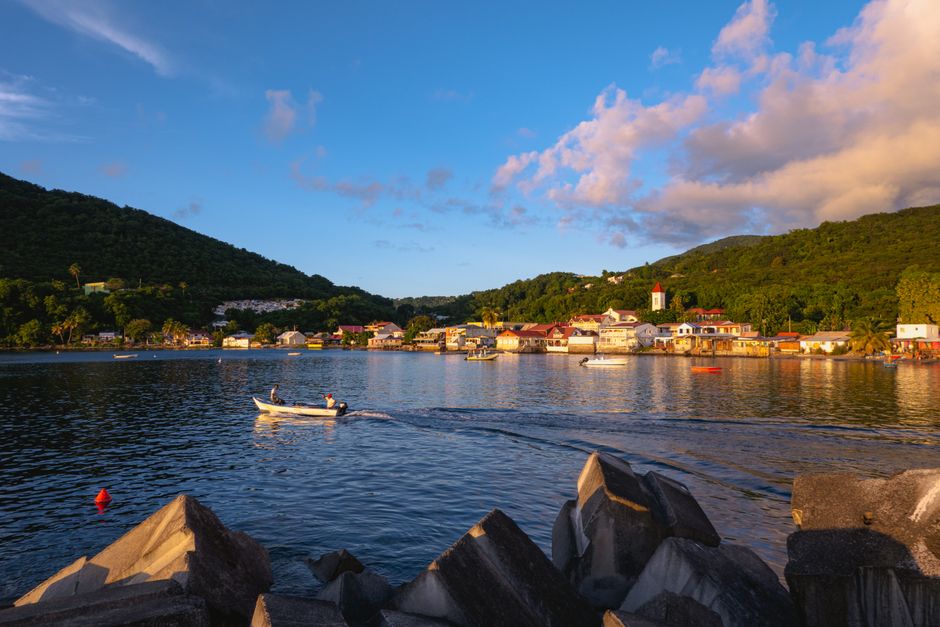
Guadeloupe is a French archipelago in the eastern Caribbean, between Antigua and Dominica, shaped like a butterfly. Its two main islands, joined by a narrow channel, could hardly be more different: Basse-Terre, to the west, is mountainous and volcanic, covered in rainforest and waterfalls and crowned by La Soufrière, the highest peak in the Lesser Antilles; Grande-Terre, to the east, is flat limestone country with white-sand beaches, sugarcane fields and lively resort towns such as Le Gosier, Sainte-Anne and Saint-François. Around them lie smaller islands that feel like the Caribbean of decades ago: the bay of Les Saintes, rural Marie-Galante with its rum and windmills, and remote La Désirade. Add the Cousteau Reserve’s reefs, Creole food, rhum agricole, the moving Memorial ACTe on the history of slavery, and the full comforts of France and the European Union, and Guadeloupe makes a rich, varied trip. December to April, the dry season, is the most popular time to visit.
Right now in Guadeloupe
- Tue 25–28°C 77–82°F 13 mm Cloudy
- Wed 26–30°C 79–85°F 3 mm Light rain
- Thu 24–29°C 75–84°F 7 mm Showers
Weather: MET Norway (CC BY 4.0)
Multi-day tours of Guadeloupe
Multi-day tours from local operators. You check dates and book on Viator, our partner; we may earn a commission at no extra cost to you. How we earn money
Guadeloupe at a glance: overview and geography
The archipelago covers about 1,628 km² (629 square miles), and has about 384,000 inhabitants. Basse-Terre (confusingly, the mountainous “low land”, named for its sheltered coast) holds the Guadeloupe National Park and La Soufrière, an active volcano at 1,467 m (4,813 feet), as well as the administrative capital, also called Basse-Terre, on its southern coast. Grande-Terre (the flat “big land”) holds the main city, Pointe-à-Pitre, the airport and most beach resorts. A narrow mangrove channel, the Rivière Salée, separates the two. The outer islands are Les Saintes to the south, Marie-Galante to the southeast, and La Désirade and the uninhabited Petite-Terre islets to the east.
The Kalinago and earlier Arawak-speaking peoples lived here when Columbus arrived in 1493. French settlement began in 1635, and the islands became a sugar colony worked by enslaved Africans. Slavery was abolished in 1794 during the French Revolution, restored by Napoleon in 1802 and finally ended in 1848, an anniversary marked on 27 May. After abolition, workers came from India, and their influence lives on in food and festivals. Guadeloupe has been an overseas department of France since 1946 and is part of the European Union.
Time zone: Guadeloupe is on Atlantic Standard Time (UTC−4) all year, with no daylight saving, the same as US Eastern Daylight Time in summer and one hour ahead of it in winter.
The islands and regions
- Grande-Terre south coast: Le Gosier, Sainte-Anne and Saint-François, with the most hotels, beaches and restaurants, and the cliffs of Pointe des Châteaux.
- Pointe-à-Pitre and around: the commercial city, its markets and the Memorial ACTe, the airport, and the shopping zones of Les Abymes, Baie-Mahault and Jarry.
- Northern Grande-Terre: wild Atlantic cliffs at the Pointe de la Grande Vigie and Porte d’Enfer, and quiet farming villages.
- Basse-Terre north and west: Deshaies and Grande Anse beach, the Caribbean coast, the Cousteau Reserve at Malendure and Bouillante’s hot springs.
- Basse-Terre south: La Soufrière, the town of Basse-Terre, Trois-Rivières and the Carbet Falls.
- The outer islands: Les Saintes (Terre-de-Haut and Terre-de-Bas), Marie-Galante, La Désirade and Petite-Terre.
Where to go: beaches, volcano and islands
Many visitors split their stay between Grande-Terre, for beaches and restaurants, and Basse-Terre, for rainforest, diving and the volcano, then add a day or two on Les Saintes or Marie-Galante.
Sainte-Anne, Saint-François and Pointe des Châteaux
Grande-Terre’s south coast is Guadeloupe’s beach strip. Sainte-Anne has a long, calm beach with a market and restaurants; Le Gosier has hotels and the tiny Îlet du Gosier just offshore; and Saint-François has a marina, a golf course and boats to La Désirade and Petite-Terre. At the eastern tip, Pointe des Châteaux is a dramatic headland of limestone rocks with a cross on its summit and views to La Désirade; the sea here is rough, so swim only at sheltered beaches nearby, such as Anse Tarare.
La Soufrière and the Guadeloupe National Park
La Soufrière is an active volcano, monitored by the Guadeloupe Volcanological and Seismological Observatory (OVSG), which has kept it at the yellow (“vigilance”) alert level since 2018. The usual hike starts at the Savane à Mulets parking area and climbs in about 1.5–2 hours through cloud forest to the summit plateau; parts of the summit are closed because of volcanic gases, so follow the park’s signs. The national park, created in 1989, protects much of Basse-Terre’s rainforest, with trails, rivers and the Route de la Traversée, a road across the mountains with the Cascade aux Écrevisses waterfall and a zoo park beside it.
The Carbet Falls
Three waterfalls drop from the slopes of La Soufrière above Capesterre-Belle-Eau. The second fall, about 110 m (360 feet) high, is reached by a short, well-made trail from the parking area; access to the other falls depends on trail conditions, which can close after storms or landslides, so check with the national park.
The Cousteau Reserve and Deshaies
Off Malendure beach on Basse-Terre’s Caribbean coast, the Pigeon Islets lie in the heart of the Cousteau Reserve, named after the French ocean explorer who praised the site. Snorkeling and diving trips from Malendure see turtles, sponges, coral and a submerged bust of Cousteau. Further north, Deshaies is a pretty fishing village with a botanical garden, and Grande Anse is one of the island’s most beautiful beaches, golden sand backed by palms.
Pointe-à-Pitre and the Memorial ACTe
Guadeloupe’s busiest city has colorful markets for spices, fruit and madras cloth, the Place de la Victoire, and the Memorial ACTe, the Caribbean Centre of Expressions and Memory of the Slave Trade and Slavery, opened in 2015 in a striking black-and-silver building on the waterfront. Its permanent exhibition is one of the most important museums on the history of slavery in the Americas.
Les Saintes
A small group of islands about an hour south by ferry. Terre-de-Haut, the main island, has a bay often called one of the most beautiful in the world, a village of white houses with colored shutters, Fort Napoléon with its museum and gardens of cactus and iguanas, and beaches such as Pompierre and Pain de Sucre. Cars are few; most people get around by scooter, electric cart or on foot.
Marie-Galante
A round, flat island of sugarcane fields, old windmills and ox carts, known for its strong rhum agricole and empty beaches such as Capesterre’s Petite Anse and the Plage de la Feuillère. See the Gueule Grand Gouffre sinkhole on the north coast, the restored Moulin de Bézard windmill, and the distilleries of Père Labat, Bielle and Bellevue.
La Désirade and Petite-Terre
La Désirade, a long, dry, rugged island off Saint-François, has a few beaches and a quiet pace. The uninhabited Petite-Terre islets, a nature reserve, are visited on boat trips for their iguanas, lagoon and lighthouse.
Best time to visit Guadeloupe
Guadeloupe has a tropical climate with a drier season, the carême, from about January to April, and a wetter season, the hivernage, from about July to November. Basse-Terre’s mountains are much wetter and cooler than Grande-Terre’s coast. The table shows Météo-France’s 1991–2020 averages for Le Raizet, the station at Pointe-à-Pitre’s airport.
| Season (Le Raizet, 1991–2020) | Average high | Average low | Rain per month | Days with rain | What it’s like |
|---|---|---|---|---|---|
| Dec–Apr | 29–30 °C (84–86 °F) | 21–22 °C (70–72 °F) | 58–127 mm (2.3–5.0 in) | 11–16 | The dry season and peak time: sunny, breezy and comfortable; February and March are the driest months. |
| May–Jul | 31–31.5 °C (87–89 °F) | 24–24.5 °C (75–76 °F) | 105–135 mm (4.1–5.3 in) | 13–15 | Hotter and more humid, with occasional showers; good value outside the July holidays. |
| Aug–Nov | 30.5–32 °C (87–89 °F) | 22.5–24 °C (73–76 °F) | 163–203 mm (6.4–8.0 in) | 16–17 | The wettest, most humid months and the peak of hurricane season; some hotels close in September. |
Le Raizet averages about 1,560 mm (61 in) of rain a year; the slopes of La Soufrière get several times more. The sea is warm all year, from about 26 °C (79 °F) in February to 29 °C (84 °F) in September and October.
Hurricanes, volcano and sargassum
According to NOAA’s National Hurricane Center (NHC), the Atlantic hurricane season runs from 1 June to 30 November, with most activity between mid-August and mid-October. Guadeloupe has been hit by major hurricanes, including Hugo in 1989 and Maria in September 2017, which caused severe damage on Marie-Galante and southern Basse-Terre; Tropical Storm Fiona brought deadly flooding to Basse-Terre in September 2022. As of 4 October 2026, the 2026 season had produced eight tropical storms and no hurricanes, and none had brought watches or warnings to Guadeloupe, according to the NHC. Météo-France issues cyclone alerts for the islands in colors from yellow to purple. La Soufrière is at the yellow vigilance level, with periodic earthquake swarms recorded by the OVSG; the authorities have said there is no threat of an eruption for residents at present. Sargassum seaweed is a recurring problem on the Atlantic- and south-facing coasts of Grande-Terre, Marie-Galante, La Désirade and Petite-Terre, where rotting piles can release hydrogen sulfide gas; Météo-France publishes sargassum stranding forecasts for Guadeloupe, and health notices may close affected beaches. 2026 has been one of the heaviest sargassum years since satellite monitoring began; in late September, Météo-France reported only small, scattered rafts, mostly passing the islands. Basse-Terre’s Caribbean coast is usually spared.
Crowds, prices and events
Mid-December to April is peak season, especially Christmas, New Year and Carnival, which runs from early January to Ash Wednesday, with weekly parades, gwo ka drumming groups and the burning of Vaval. Other events are the abolition of slavery on 27 May, Bastille Day on 14 July, the Fête des Cuisinières, a parade of women cooks in Creole dress in Pointe-à-Pitre in August, and the Route du Rhum, the single-handed sailing race from Saint-Malo, which ends in Pointe-à-Pitre every four years, with the next edition starting on 1 November 2026. July and August bring French holidaymakers; September to November is very quiet.
How long to stay: sample itineraries
Guadeloupe is bigger than it looks; plan a week to see both main islands and one outer island.
5 days: Grande-Terre and Basse-Terre
Day 1: Sainte-Anne’s beach and market. Day 2: Pointe des Châteaux and Saint-François. Day 3: the Memorial ACTe in Pointe-à-Pitre, then the Route de la Traversée. Day 4: snorkeling at the Cousteau Reserve and Grande Anse at Deshaies. Day 5: the Carbet Falls or La Soufrière.
7–10 days: with Les Saintes and Marie-Galante
Add two nights on Terre-de-Haut in Les Saintes and a day or two on Marie-Galante for beaches and rum distilleries, plus a boat trip to Petite-Terre.
Two weeks: Guadeloupe and Martinique or Dominica
Combine Guadeloupe with Martinique or Dominica by fast ferry, or with Saint Martin and Saint-Barthélemy by short flights.
Entry, money, fees and costs
Entry rules (last reviewed October 2026)
Guadeloupe is part of France and the European Union, but it is outside the Schengen area, so the EU’s Entry/Exit System and ETIAS do not apply, and a Schengen visa alone is not valid here. France sets separate visa rules for its overseas departments.
- US, Canadian and UK citizens can visit for up to 90 days without a visa, with a passport valid for the stay and a return or onward ticket.
- EU, EEA and Swiss citizens can travel with a national ID card or passport.
- Other nationalities should check France-Visas, the French government’s official visa site, which covers the overseas departments separately.
- There is no online arrival form or entry fee.
Rules change, so check France-Visas and your own government’s information before you travel. For France’s own rules, see our France travel guide.
Money and tipping
Guadeloupe uses the euro. Credit cards are accepted in hotels, supermarkets and most restaurants, but carry cash for markets, beach snack bars and the outer islands, where ATMs are few. US dollars are rarely accepted. Restaurant prices include service, so tipping is optional; leave a few euros for good service.
Hotel taxes
Room rates in France are quoted including VAT. On top, hotels, guesthouses (gîtes) and holiday rentals collect a taxe de séjour (tourist tax) per adult per night, set by each local community, usually from a few tens of cents to a few euros depending on the hotel’s classification; for unclassified rentals, French law sets it as a percentage of the nightly price, between 1% and 5%. Children under 18 are exempt. Check the total price when booking.
Typical travel costs
Guadeloupe is moderately priced for the Caribbean, with French prices for groceries and restaurants but many gîtes and self-catering options. These estimates, per person per day, are a planning guide as of October 2026:
| Style | Estimated cost per day | What that looks like |
|---|---|---|
| Budget | about US$80–130 (€70–110) | Gîte or studio shared by two, supermarket and market food, snack bars (lolos), a small rental car shared by two |
| Mid-range | about US$160–260 (€140–230) | Hotel or villa shared by two, restaurant meals, rental car, a dive or a ferry day trip to Les Saintes |
| High-end | about US$380+ (€330+) | Boutique resort or luxury villa, fine dining, private boat trips and guided hikes |
Add the tourist tax, fuel and ferry fares. The figures are our estimates, not official statistics.
Getting there and getting around
Flights
Pointe-à-Pitre International Airport (PTP), at Les Abymes on Grande-Terre, is the main gateway. Most flights come from Paris, with Air France, Air Caraïbes, Corsair and French bee; there are seasonal nonstops from New York and Montreal, and flights from Miami. Regional airlines link Guadeloupe with Martinique, Saint Martin, Saint-Barthélemy, Antigua, San Juan and French Guiana, and small planes fly to Marie-Galante, Les Saintes and La Désirade. Check current routes, as North American services are often seasonal.
Ferries
Ferries link the main islands with Les Saintes (from Trois-Rivières on Basse-Terre and from Pointe-à-Pitre), Marie-Galante (from Pointe-à-Pitre and Saint-François, about an hour) and La Désirade (from Saint-François). L’Express des Îles fast ferries run from Pointe-à-Pitre to Dominica and Martinique. Crossings can be rough in the trade winds; book ahead for weekends and holidays. Cruise ships dock in Pointe-à-Pitre.
Driving and buses
A rental car is the best way to explore; book early in peak season. Driving is on the right, as in mainland France, and foreign licenses are accepted for visits. Roads are good but busy around Pointe-à-Pitre, Les Abymes and Baie-Mahault, especially at rush hour, and winding in Basse-Terre’s mountains. Buses connect the main towns, mostly in daytime and less on Sundays. On Les Saintes and Marie-Galante, rent a scooter or electric cart, or a car on Marie-Galante.
Beaches, the sea and safety in the water
All beaches in Guadeloupe are public by law. Grande-Terre’s south coast and Basse-Terre’s Caribbean coast are generally calm and good for swimming; the Atlantic coasts of Grande-Terre and Basse-Terre have strong waves and currents. See our beaches guide, plus snorkeling, diving, surfing and boat trips.
- Lifeguards: only some beaches have lifeguards, mainly in season and on weekends; swim where they are on duty and follow the flags.
- Rough coasts: don’t swim at Pointe des Châteaux, Porte d’Enfer or other exposed Atlantic spots, and watch for currents at Grande Anse in winter swells.
- Sargassum and gas: avoid beaches with piles of rotting sargassum, especially with children, people with asthma and pregnant women, and follow posted health notices.
- Cousteau Reserve: don’t touch coral or turtles, and use the reserve’s moorings; fishing is banned.
- Rivers: flash floods can rise very fast after rain in the mountains, so leave river pools and falls if it starts to pour upstream.
- Manchineel trees: don’t shelter under them in the rain or touch their small green apples; many are marked with a red band.
- Rocks and urchins: wear water shoes at rocky entries and in rivers.
Safety, health and connectivity
Safety
Most visits to Guadeloupe are trouble-free. The main issues for visitors are theft from rental cars and beaches, so leave nothing visible in parked cars, especially at trailheads and isolated beaches. Violent crime, mostly between residents and linked to drugs, has risen in recent years and is concentrated in parts of Pointe-à-Pitre and Les Abymes at night. Strikes and occasional road blockades can disrupt travel, so follow local news. Emergency numbers: 15 for medical emergencies, 17 for police, 18 for fire, or 112. The main hospital is the university hospital (CHU de la Guadeloupe) at Pointe-à-Pitre and Les Abymes.
Health and water
Guadeloupe’s public water network is old and leaky, and many communes have regular water cuts, especially in the dry season; some have had notices advising residents not to drink tap water temporarily. Many visitors drink bottled water, and good hotels have reserve tanks. Mosquito-borne diseases such as dengue occur, so use repellent. As part of France, Guadeloupe has good hospitals; EU visitors can use a European Health Insurance Card, and others should have travel insurance.
Accessibility
Some hotels and adapted beaches with special equipment are accessible in season; Basse-Terre’s mountains, trails and the outer islands’ ferries and steep streets are difficult for wheelchair users.
Connectivity and power
As part of the EU, Guadeloupe is covered by EU “roam like at home” rules for EU mobile plans; visitors from North America should check their roaming charges. Local providers sell prepaid SIM cards, and Wi-Fi is standard in hotels. Electricity is 230 V at 50 Hz with European sockets, so North Americans need a travel adapter.
Food, drink and culture
Guadeloupean Creole cooking mixes French, African, Indian and Caribbean flavors. Try accras (fritters), boudin créole, colombo curry, bokit (a fried bread sandwich sold at roadside stands), agoulou burgers, Creole fish and lambi (conch), court-bouillon, the bébélé tripe stew of Marie-Galante, and sweet tourment d’amour cakes on Les Saintes. Rhum agricole, made from fresh cane juice, is the local spirit; drink it as a ti’ punch or in planteur cocktails, and visit the distilleries of Damoiseau, Longueteau or Bologne. Guadeloupean Creole is spoken alongside French, and English is less widely understood outside hotels. Music is everywhere, from the gwo ka drums, listed by UNESCO as intangible cultural heritage, to zouk and biguine. Madras cloth and Creole dress appear at festivals.
Things to do: hiking, diving, island hopping and rum
- Hiking: La Soufrière, the Carbet Falls, the Cascade aux Écrevisses and national-park trails; Pointe des Châteaux and Grande Vigie for coastal walks. See our hiking guide.
- Diving and snorkeling: the Cousteau Reserve, the Pigeon Islets, Les Saintes’ reefs and the lagoon at Petite-Terre.
- Boat trips: the mangroves of the Grand Cul-de-Sac Marin, whale and dolphin watching off the Caribbean coast, and day trips to Petite-Terre.
- Island hopping: ferries to Les Saintes, Marie-Galante and La Désirade.
- Surfing and kitesurfing: Le Moule and Port-Louis for surf; Saint-François and Sainte-Anne for kitesurfing.
- Culture: the Memorial ACTe, Carnival, Pointe-à-Pitre’s markets and rum distillery tours.
What to pack
Bring light clothes, swimwear, a sun hat, high-factor reef-friendly sunscreen, insect repellent, a rain jacket for Basse-Terre’s rainforest and La Soufrière, sturdy hiking shoes, water shoes for rivers and rocky beaches, snorkel gear, a refillable bottle, a European plug adapter, and an international driving permit if your license isn’t in English or French.
Guadeloupe travel FAQ
Do US citizens need a visa for Guadeloupe?
No. US citizens can visit for up to 90 days without a visa, with a passport and a return ticket. Guadeloupe is outside the Schengen area, so EES and ETIAS don’t apply.
Is Guadeloupe part of France?
Yes. Guadeloupe is an overseas department and region of France and part of the European Union, so it uses the euro and French law applies.
When is the best time to visit Guadeloupe?
December to April, the dry season, especially February and March. August to October is the wettest period and the peak of hurricane season.
Which side of Guadeloupe is better to stay on?
Grande-Terre for beaches, restaurants and nightlife; Basse-Terre for rainforest, waterfalls, diving and the volcano. Many visitors stay a few nights on each.
Can you hike La Soufrière?
Yes. The trail from Savane à Mulets reaches the summit plateau in about 1.5–2 hours. The volcano is on yellow alert, and parts of the summit are closed because of gases; follow park signs.
Is there sargassum in Guadeloupe?
Yes, mostly on Atlantic- and south-facing coasts of Grande-Terre, Marie-Galante and La Désirade. 2026 is a heavy year; Météo-France publishes stranding forecasts.
How do I get to Les Saintes and Marie-Galante?
By ferry: to Les Saintes from Trois-Rivières or Pointe-à-Pitre, and to Marie-Galante from Pointe-à-Pitre or Saint-François, each about an hour.
What is the tourist tax in Guadeloupe?
A taxe de séjour per adult per night, set by each local community and collected by your accommodation, from a few tens of cents to a few euros depending on the category.
Is the tap water safe in Guadeloupe?
The network suffers frequent cuts and some local water-quality notices, so many visitors drink bottled water. Ask your host about the local situation.
Do I need a car in Guadeloupe?
Yes, for most trips. Buses are limited, especially on Sundays. On Les Saintes, scooters and electric carts are enough.
Do they speak English in Guadeloupe?
French is the official language and Guadeloupean Creole is widely spoken. English is spoken in many hotels, but less elsewhere.
Is Guadeloupe safe for tourists?
Most visits are trouble-free. Don’t leave valuables in cars, be careful at night in parts of Pointe-à-Pitre, and follow local news for strikes or road blockades.
Sources and last review
Researched and last reviewed on 4 October 2026. The climate averages come from Météo-France’s 1991–2020 climate sheet for Le Raizet; sargassum forecasts and cyclone alert colors from Météo-France Guadeloupe; hurricane season and the 2026 season from NOAA’s National Hurricane Center; sargassum trends from the University of South Florida’s Sargassum Watch; the tourist-tax framework from France’s official public-service site; the Route du Rhum 2026 date from the city of Saint-Malo. Visa rules, flights, ferries, La Soufrière’s alert level, past hurricanes, crime, water supply, electricity and the population come from secondary sources and are flagged for checking. Daily costs are estimates. Prices and rules change, so check the official sites before you travel.
Plugs and power in Guadeloupe
Guadeloupe uses 230 V, 50 Hz and these plugs (left) and wall sockets (right):
All plug types and voltages by country → · Check what you need to pack →
Plan your trip
Partner links: TravelerCenter may earn a commission if you book, at no extra cost to you.
🇫🇷 Useful French phrases for Guadeloupe
All 38 French phrases: restaurant, hotel, emergencies, romance (printable) →