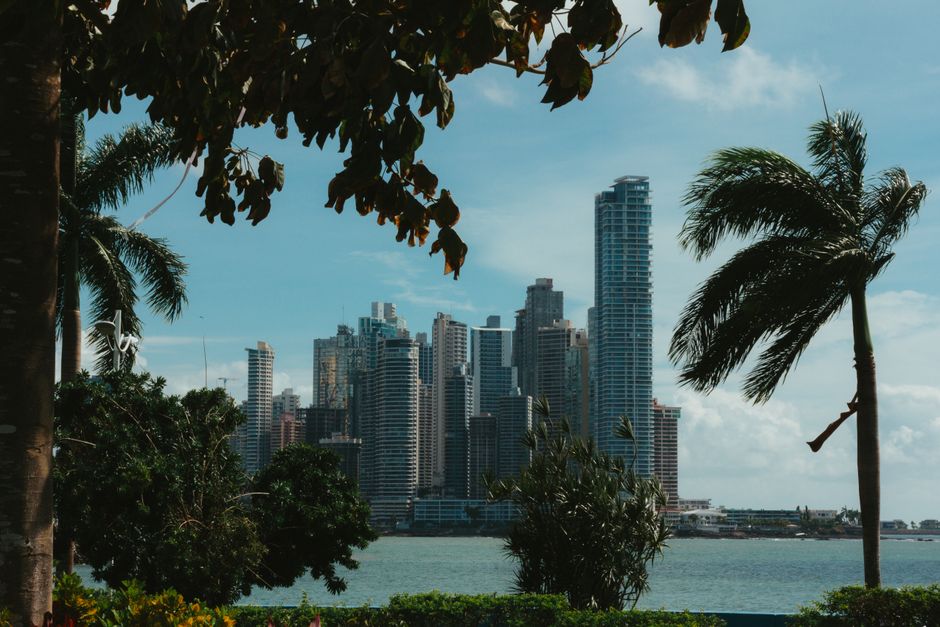
Panama City is where the Panama Canal meets the Pacific, and few capitals pack so much variety into such a small space. In one day you can walk the plazas and balconied streets of Casco Viejo, the colonial old town on a peninsula; climb the stone tower of Panamá Viejo, the ruins of the first Spanish city on the Pacific coast of the Americas; watch a container ship rise in the Miraflores Locks; and eat ceviche at the fish market below a skyline of glass towers. The rainforest begins at the city’s edge, in parks where you can see sloths and toucans, and the Amador Causeway runs out into the bay past the colorful Biomuseo. It is the gateway for the whole country, with Tocumen airport, Central America’s biggest hub, and Albrook’s domestic flights and bus terminal.
Right now in Panama City
- Tue 24–30°C 76–87°F 33 mm Heavy rain
- Wed 25–29°C 76–84°F 12 mm Light rain
- Thu 24–29°C 76–84°F 6 mm Cloudy
Weather: MET Norway (CC BY 4.0) · Sea temperature: NOAA CoastWatch
Top tours in Panama City
See all tours for Panama City →
From local operators, with prices and reviews; you check availability and book on Viator, our partner. We may earn a commission at no extra cost to you. How we earn money
Panama City at a glance
- Best for: the Panama Canal, colonial history, food and nightlife, rainforest on the doorstep, and a base for the islands.
- How long: two days for Casco Viejo, Panamá Viejo and Miraflores; three or four to add a rainforest park, Gamboa or Taboga.
- Best time: the dry season, which Panama’s meteorological institute (IMHPA) dates from December 16 to May 15; it is hot all year.
- Getting there: Tocumen International Airport (PTY), about 40 minutes east of downtown, with a Metro Line 2 branch, official taxis and app rides.
- Before you go: entry rules, money and the departure tax are in our Panama travel guide.
Panama City’s neighborhoods: where things are
Casco Viejo (Casco Antiguo)
The old town, founded in 1673 after pirates destroyed the first city, fills a small peninsula with plazas, churches, restored mansions, rooftop bars, boutique hotels and restaurants. Together with Panamá Viejo it is a UNESCO World Heritage Site. It is the most atmospheric place to stay or spend an evening.
The Cinta Costera, Bella Vista and the banking district
A seafront park and promenade, the Cinta Costera, curves along the bay from Casco Viejo past the fish market to the towers of Bella Vista, Marbella, El Cangrejo and Obarrio, the modern city of hotels, malls, restaurants and nightlife.
Balboa, Ancón and Amador
West of the center, the former Canal Zone has leafy streets, the canal’s administration building, Ancón Hill and the start of the Amador Causeway, built in 1913 with rock from the excavation of the Culebra Cut to join the city to four islands, Naos, Perico, Culebra and Flamenco, according to the Panama Canal Authority (ACP).
Top things to see in Panama City
Prices and hours below were checked on the official sites in October 2026. Panama uses the US dollar; B/.1 (balboa) equals US$1.
The Miraflores Locks and Visitor Center
At the Pacific end of the canal, about 20 minutes from downtown, Miraflores’s visitor center has terraces and bleachers overlooking the locks, a museum, a playground and a 3D IMAX film about the canal’s history and operation, narrated by Morgan Freeman. According to the ACP, it opens daily from 8 a.m. to 6 p.m. (ticket office 8 a.m. to 5 p.m.), and non-residents pay B/.17.22 (US$17.22) for adults and B/.7.22 for children aged 6 to 12, with children under 6 free; residents pay B/.3. A visit takes about an hour and a half.
Time your visit for the ships. Vessels don’t pass all day: the ACP’s visitor site (visitcanaldepanama.com) posts each day’s transit windows. On October 4, 2026, for example, ships passed Miraflores in the morning until 8:30 a.m. and again from 2:20 p.m. Aim for the afternoon window, buy tickets online, and expect fewer ships in late 2026: low rainfall in the canal watershed led the ACP to reduce the number of daily transit slots from September 2026.
Casco Viejo
Start at the Plaza de la Independencia with the cathedral, then wander to the Plaza de Francia and the Paseo de las Bóvedas along the old sea wall, with views of the skyline and the Bridge of the Americas. Look into the Church of San José’s golden altar, the Presidential Palace (from outside), and the Interoceanic Canal Museum on the main plaza, open Tuesday to Sunday from 10 a.m. to 6 p.m., where non-residents pay from B/.5 to B/.15, according to the ACP. The Mola Museum shows the Guna’s textile art. In the evening, rooftop bars and restaurants fill up.
Panamá Viejo
The archaeological site of the city founded in 1519 and burned during the pirate Henry Morgan’s attack of 1671 has the ruins of churches, convents and houses, a museum, and a cathedral tower you can climb for views over the bay. According to the Patronato Panamá Viejo, it opens Tuesday to Sunday from 8:30 a.m. to 5:30 p.m. (ticket office closes at 4:30 p.m.), and non-residents pay US$17 for adults and US$5 for children, including the museum, the cathedral viewpoint and the site’s internal transport; children under 6 are free.
The Amador Causeway and the Biomuseo
Walk, cycle or ride a rental bike along the causeway for views of ships waiting to enter the canal and of the skyline. At its start, the Biomuseo, a riot of colored roofs designed by Frank Gehry, explains how the rise of the isthmus changed the world’s biodiversity.
More to see
- Panama Canal Interactive Center: free exhibits in the former Canal Zone (Calle Gorgas), open Tuesday to Sunday from 9 a.m. to 5 p.m., according to the ACP.
- Panama Canal Administration Building: opened on July 15, 1914, with murals of the canal’s construction, at the foot of Ancón Hill.
- Ancón Hill: a short, steep walk to the city’s highest viewpoint, with sloths and agoutis on the way.
- Mercado de Mariscos: the fish market by the Cinta Costera, with cheap ceviche stalls outside.
- Metropolitan Natural Park: rainforest trails inside the city, with a viewpoint over the canal.
Other things to do in Panama City
Take a partial transit of the canal on a tour boat, usually on Saturdays, passing through Miraflores and Pedro Miguel locks. Eat your way around the city’s food scene, from Panamanian fondas to Casco Viejo’s chef-led restaurants. Shop for molas and Panama hats (which actually come from Ecuador) at craft markets, and visit Albrook Mall, one of the largest in the Americas. See our city sightseeing guide for general tips.
Food and drink in Panama City
Panama City’s food mixes Spanish, Afro-Caribbean, Indigenous, Chinese and, more recently, Venezuelan and Colombian influences. The national dish is sancocho, a chicken soup with yam (ñame) and culantro, eaten at any hour; breakfasts bring hojaldras (fried dough), carimañolas (yuca fritters filled with meat) and tortillas with fresh cheese; and lunch at a fonda is a set plate of rice, beans or lentils, a stew and patacones (fried green plantain). Look for ropa vieja (shredded beef), arroz con pollo and, at the end of the meal, raspao shaved ice from street carts.
Seafood is everywhere: the Mercado de Mariscos fish market on the Cinta Costera has upstairs restaurants and ceviche stalls outside, serving corvina ceviche in plastic cups. Casco Viejo has the city’s most celebrated chef-led restaurants, which cook Panamanian ingredients in new ways, plus rooftop bars with views of the skyline. Bella Vista, El Cangrejo and the Calle Uruguay area are the places for mid-range restaurants of every cuisine and for nightlife from Thursday to Saturday. Try a local beer, a seco (sugar cane spirit) cocktail or Panama’s rum, and finish with Boquete coffee. Restaurants usually add 10% for service or expect a tip.
Day trips from Panama City
- Soberanía National Park and Gamboa: rainforest on the canal’s banks, about 45 minutes away, with the famous Pipeline Road for birdwatching, boat trips on Gatún Lake to see monkeys on small islands, and Emberá village visits on the Chagres River. See our hiking guide.
- Agua Clara Visitor Center: the expanded canal’s Atlantic locks near Colón, about 1.5 hours away; according to the ACP, it opens daily including holidays from 8 a.m. to 5 p.m. (ticket office until 3:30 p.m.), and non-residents pay from B/.5 to B/.10. Combine it with the forts of Portobelo.
- Taboga Island: the “island of flowers”, about an hour by ferry from the Amador Causeway, with a quiet beach and village. See our boat trips guide.
- The San Blas Islands: about two and a half hours by 4×4 and boat; possible as a long day trip, better overnight. See our San Blas Islands guide.
- El Valle de Antón: a village in a volcanic crater, two hours west, with hikes and waterfalls.
Nearby destinations
- San Blas Islands113 km
Getting there and getting around
From Tocumen airport
Tocumen (PTY) is about 40 minutes from downtown, according to Panama’s tourism authority, longer at rush hour. The airport’s official taxis, from a cooperative with stands at the arrivals exits of both terminals, charge fixed fares by destination, published by the airport; drivers wear a uniform with the cooperative’s logo and photo ID, and their cars have official decals. The airport also connects directly with Metro Line 2 through its airport branch, and with MetroBus; app rides are another option. A free shuttle bus links Terminals 1 and 2 from 5 a.m. to 11 p.m. When you leave, the US$40 departure tax is usually in your ticket.
Getting around
The metro is the easiest way across the city: Line 1 runs north from Albrook through the center, and Line 2 runs east to Tocumen. Buy a rechargeable card at stations; the operator’s standard fare is B/.0.35, and the same card works on MetroBus. Taxis are everywhere but rarely use meters, so agree on the price first; ride-hailing apps are popular and transparent. Casco Viejo and the Cinta Costera are best on foot, and you can rent bikes on the Amador Causeway.
Onward travel
Domestic flights leave from Albrook (Marcos A. Gelabert) airport, closer to the center than Tocumen: Air Panama flies to David (for Boquete), Changuinola and Isla Colón in Bocas del Toro. The Gran Terminal de Albrook, next door, has long-distance buses across the country, including to David in about six hours. See our Bocas del Toro and Boquete guides.
When to go and how long to stay
Panama City is hot and humid all year, with daytime highs around 30–33 °C (86–91 °F). According to the IMHPA, the dry season normally runs from December 16 to May 15, when northeast trade winds bring breezy, sunny days, and the rainy season from May 16 to December 15, with heavy afternoon or evening storms; October is usually the wettest month, and a short dry spell often comes around June 24. In 2026, a strong El Niño has made the rainy season drier than usual, and the IMHPA forecasts below-normal rain for the Pacific side through December 2026.
| Season | What it’s like | Good for |
|---|---|---|
| Dry season (mid-Dec to mid-May) | Sunny and breezy, little rain; busiest at Christmas, Carnival and Easter | Walking tours, the canal, island trips |
| Early rainy season (mid-May to Aug) | Hot, humid, afternoon storms; mornings often clear | Lower hotel prices, green rainforest parks |
| Wettest months (Sep–Nov) | Heavy rain most days; October usually the wettest; patriotic holidays in November | Museums, food, canal visits in the dry hours |
| Early December | Rains easing as the dry season approaches | Shoulder season before the holidays |
There is no official 1991–2020 station normal for Panama City in the WMO dataset we use, so the temperatures above are general; the season dates are the IMHPA’s.
Panama City month by month
| Month | Weather | Crowds and prices | Why go |
|---|---|---|---|
| January | Dry, sunny and breezy | Busy; the Jazz Festival is usually held in January | Walking tours, island trips |
| February | Dry and breezy | Carnival week (before Ash Wednesday) empties the city as people head to the interior | The canal, Casco Viejo |
| March | Dry and hot | High season | Day trips, Taboga, San Blas |
| April | Hot; trade winds dropping | Busy around Holy Week | Canal, beaches |
| May | Rainy season begins mid-month | Quieter; lower rates | Museums, food |
| June | Afternoon storms; a short dry spell often around June 24 | Moderate | Rainforest parks |
| July | Hot, humid, afternoon rain | Moderate | Canal visits in the morning |
| August | Hot, humid, afternoon rain | Moderate; Founding of Panama City on August 15 | Panamá Viejo, food |
| September | Heavy rain most days | Quiet | Museums, shopping |
| October | Usually the wettest month | Quiet | Low prices, indoor sights |
| November | Very wet, easing late in the month | Patriotic holidays (November 3, 4, 5, 10 and 28) with parades | Independence celebrations |
| December | Dry season returns from mid-month | Busy at Christmas and New Year | Holiday lights, the Cinta Costera |
Two days in Panama City
Day one, Casco Viejo in the morning, lunch at the fish market, and the Miraflores Locks for the afternoon ship window. Day two, Panamá Viejo, then the Amador Causeway and the Biomuseo, with sunset drinks on a Casco Viejo rooftop.
Three or four days
Add an early morning on Pipeline Road or a Gatún Lake boat trip from Gamboa, a partial canal transit, or a day on Taboga, before heading to San Blas, Bocas del Toro or Boquete.
Where to stay in Panama City and the hotel taxes
- Casco Viejo: boutique hotels and hostels in restored buildings, walking distance from restaurants and bars; can be noisy on weekend nights.
- Bella Vista, El Cangrejo and Obarrio: international chains and apartments near the metro, malls and restaurants.
- Amador and Balboa: quieter hotels near the canal and the causeway.
- Near Tocumen: airport hotels for early flights or long layovers.
Hotel stays are taxed at 10% ITBMS, compared with the standard 7%, according to Panama’s tax authority (DGI). Many hotels quote rates before tax, so check the total; restaurants usually add 10% for service or expect a tip.
What a day in Panama City costs
Panama uses the US dollar alongside its balboa (B/.), fixed at par, so prices below apply in either. The city is pricier than most of Central America, especially for hotels and restaurants in Casco Viejo. Miraflores and Panamá Viejo are their official prices; the rest are our estimates for 2026.
| Item | Price (US$ = B/.) |
|---|---|
| Miraflores Visitor Center, non-resident adult (ACP) | US$17.22 |
| Panamá Viejo, non-resident adult (Patronato) | US$17 |
| Lunch at a fonda | US$5–9 |
| Ceviche cup at the Mercado de Mariscos | US$3–6 |
| Dinner at a mid-range restaurant | US$20–40 |
| Local beer at a bar | US$2.50–5 |
| App ride or taxi across the city | US$5–12 |
| Hostel dorm bed in Casco Viejo | US$18–30 |
| Mid-range double room | US$90–180 |
A budget traveler can manage on about US$50 to US$70 a day with a dorm bed, fondas, the metro and one paid sight; a mid-range day with a good hotel, the canal, a tour and dinner in Casco Viejo is more like US$200 to US$300.
Practical tips for Panama City
- Money: bring small US bills; US$50 and US$100 notes are often refused. Cards work almost everywhere in the city.
- Check the ship times on the ACP’s visitor site before going to Miraflores or Agua Clara.
- Heat: walk in the morning or late afternoon, carry water, and use the metro and taxis in the midday heat.
- Safety: the UK government notes pickpocketing in busy areas and on buses, and higher crime in some neighborhoods, including El Chorrillo and Santa Ana next to Casco Viejo, Calidonia, San Miguelito and Río Abajo. Stay on Casco Viejo’s main restored streets at night, take taxis between neighborhoods after dark, and use ATMs inside banks or malls. Don’t swim in the Bay of Panama, which is polluted.
- Emergencies: call 911; for an ambulance, 103.
What to pack for Panama City
Bring light, breathable clothes and one smart-casual outfit for restaurants and rooftop bars, a compact umbrella from May to December, a sweater for the cold air conditioning on buses and in malls, comfortable shoes for cobblestones, a hat and sunscreen, insect repellent for rainforest trips, and binoculars for birding. Plugs are the US type.
Panama City travel FAQ
How much does it cost to visit the Miraflores Locks?
B/.17.22 (US$17.22) for non-resident adults and B/.7.22 for children 6 to 12, including the IMAX film, according to the Panama Canal Authority. Children under 6 are free.
What is the best time to see ships at Miraflores?
It changes daily; check the transit windows on visitcanaldepanama.com. Ships usually pass early in the morning and again in the afternoon.
What are the Miraflores Visitor Center’s hours?
Daily from 8 a.m. to 6 p.m., with the ticket office open until 5 p.m.
How much is Panamá Viejo?
US$17 for non-resident adults and US$5 for children, including the museum and cathedral tower; it opens Tuesday to Sunday from 8:30 a.m. to 5:30 p.m.
How do I get from Tocumen airport to the city?
Take an official airport taxi with a fixed fare, an app ride, or Metro Line 2 from the airport branch. The drive takes about 40 minutes without heavy traffic.
Is Casco Viejo safe at night?
The main restored streets and plazas are busy and patrolled in the evening. Avoid the edges bordering El Chorrillo and Santa Ana, and take a taxi back to your hotel.
What is the hotel tax in Panama City?
10% ITBMS on lodging, according to the tax authority. Check whether quoted rates include it.
Is the Interoceanic Canal Museum open on Mondays?
No. It opens Tuesday to Sunday from 10 a.m. to 6 p.m., with non-resident tickets from B/.5 to B/.15.
What food should I try in Panama City?
Sancocho chicken soup, carimañolas and hojaldras at breakfast, a fonda lunch with patacones, and corvina ceviche at the Mercado de Mariscos. Casco Viejo has the city’s best chef-led restaurants.
How much does a day in Panama City cost?
By our estimates, about US$50 to US$70 on a budget and US$200 to US$300 mid-range. Miraflores costs US$17.22 for non-resident adults and Panamá Viejo US$17.
Sources and last review
Researched and last reviewed on 4 October 2026. Miraflores, Agua Clara, the Interactive Center and the Interoceanic Canal Museum (prices, hours, film, ship windows), the Administration Building and the Amador Causeway, and the reduced transit slots: the Panama Canal Authority (ACP); Panamá Viejo prices and hours: the Patronato Panamá Viejo; airport taxis, the metro connection and the terminal shuttle: Tocumen airport; metro fares: the Metro de Panamá; airport distance, Albrook flights and buses and the Mola Museum: Panama’s tourism authority (ATP); domestic routes: Air Panama; seasons and the 2026 El Niño: the IMHPA; the lodging tax: the DGI; crime areas and the Bay of Panama: the UK government’s Panama pages. Founding dates and history, UNESCO status, temperatures, the Biomuseo, partial transits, Ancón Hill, the fish market, Soberanía, Gamboa and Taboga details and travel times come from secondary sources or general knowledge and are flagged for checking. Prices change, so check the official sites before you go. For entry rules and money, see our Panama travel guide. The food notes, the month-by-month table and its event and holiday dates, and the daily costs (other than the official sight prices) come from general knowledge or our own estimates and are flagged for checking.
Plan your trip
Partner links: TravelerCenter may earn a commission if you book, at no extra cost to you.
🇪🇸 Useful Spanish phrases for Panama City
All 38 Spanish phrases: restaurant, hotel, emergencies, romance (printable) →