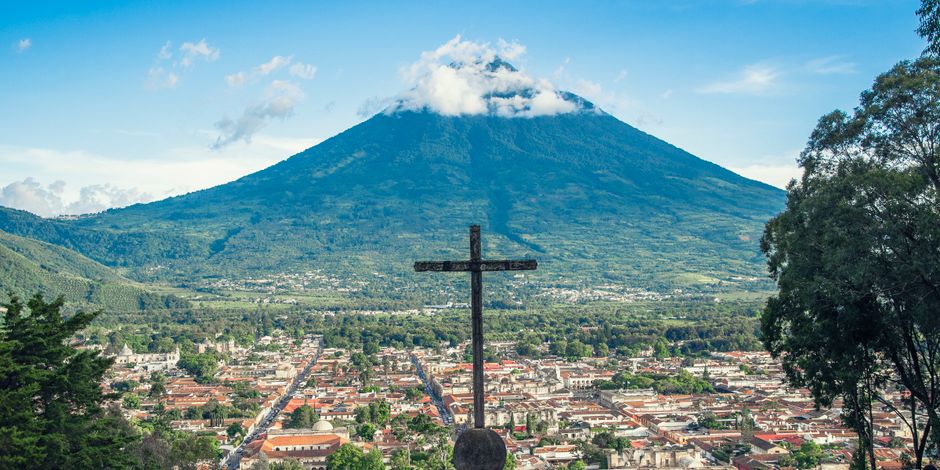
Antigua Guatemala is one of the most beautiful colonial cities in the Americas: a grid of cobbled streets lined with pastel houses, baroque church facades and the roofless ruins of convents, framed by three volcanoes, Agua, Acatenango and the smoking cone of Fuego. Founded in 1543 as the capital of the Spanish Kingdom of Guatemala, which stretched from Chiapas to Costa Rica, it was abandoned after the Santa Marta earthquakes of 1773, and the capital moved to today’s Guatemala City. What was left behind, earthquake-cracked churches and all, is now a UNESCO World Heritage Site and the travel hub of Guatemala, with excellent cafés and restaurants, Spanish schools, coffee farms on the slopes, colorful markets and the starting point for volcano hikes. At about 1,500 m (4,900 ft), it enjoys warm days and cool nights all year, and its Holy Week processions are among the most spectacular in the world.
Right now in Antigua Guatemala
- Wed16–25°C60–77°F10 mm rain
- Thu15–25°C59–77°F13 mm rain
- Fri16–21°C60–70°F23 mm rain
Top tours in Antigua Guatemala
See all tours for Antigua Guatemala →
From local operators, with prices and reviews; you check availability and book on Viator, our partner. We may earn a commission at no extra cost to you. How we earn money
Antigua at a glance
- Best for: colonial architecture and ruins, food and coffee, Spanish lessons, volcano hikes, markets and Holy Week.
- How long: two or three days for the city and a coffee farm; four or five with an Acatenango or Pacaya hike and a day trip to a market town.
- Best time: November to April, the dry season, for clear volcano views, according to INGUAT; Holy Week (March 21–28, 2027) is spectacular but very busy.
- Getting there: 45 minutes to an hour and a half by road from La Aurora International Airport in Guatemala City, according to INGUAT, by shuttle, taxi or hotel transfer.
- Before you go: entry rules, the CA-4 agreement and money are in our Guatemala travel guide.
Antigua’s layout: where things are
Antigua is small and laid out on a grid around the Parque Central, the main square, with the cathedral on its east side and the Palace of the Captains General on the south. Avenidas run north–south and calles east–west, and most sights, hotels and restaurants are within ten blocks of the square. The yellow Santa Catalina Arch spans 5a Avenida Norte a few blocks north, with the church of La Merced beyond it. The market and the main bus terminal are on the west edge of town, and the Cerro de la Cruz viewpoint is on the hill to the north. Around the city are villages such as San Juan del Obispo, Jocotenango, Ciudad Vieja and San Antonio Aguas Calientes, known for weaving.
Within that grid, each part of town has its own feel. The blocks north of the Parque Central, along 5a Avenida Norte toward the arch and La Merced, are the busiest, with cafés, galleries, rooftop bars and most of the boutique hotels. The east side, around Capuchinas, Santa Clara and the hotel in the former Santo Domingo monastery, is quieter and greener. The south and west, near San Francisco el Grande and the market and bus terminal, are more local, with cheaper guesthouses and street food. Beyond the old city, villages such as Jocotenango, San Felipe de Jesús and San Pedro las Huertas are a short tuk-tuk ride away, with their own churches, markets and lower prices.
Top things to see in Antigua
Most churches are free or ask for a small donation; ruins and museums charge modest entrance fees, often a few dozen quetzales, so carry small notes.
Parque Central and the cathedral
The tree-shaded main square, with its mermaid fountain, is the heart of the city. On its east side, the Cathedral of San José still holds services in a small rebuilt section, while the ruined nave behind it, open to the sky, shows the scale of the original. The arcaded Palace of the Captains General on the south side was the seat of Spanish power in Central America, and the Ayuntamiento (city hall) on the north side houses museums.
The Santa Catalina Arch and La Merced
The Arco de Santa Catalina, built in the 17th century so cloistered nuns could cross the street unseen, is Antigua’s most photographed landmark, especially with Agua volcano behind it in the early morning. A few blocks north, the church of La Merced has an ornate yellow-and-white stucco facade and a ruined cloister with a large fountain.
The convent and church ruins
Antigua’s earthquake ruins are its great sight. INGUAT highlights the convents of Santa Clara and San José el Viejo; others worth seeing include the vast Capuchinas convent with its circular cloister, San Francisco el Grande, the pilgrimage church of Santo Hermano Pedro, and the overgrown Recolección. Some ruins now sit inside hotels and cultural centers, such as the former Santo Domingo monastery.
Cerro de la Cruz
A path from the north end of town climbs to a cross on the hillside with the classic view over Antigua’s rooftops to Agua volcano; it takes about 20–30 minutes from the historic center, according to INGUAT. Go in the morning with others, as the view is clearest early.
Other things to do in Antigua
- Coffee farms: tour a finca on the volcano slopes to see how Antigua’s prized coffee is grown, picked and roasted.
- Spanish school: Antigua has dozens of schools offering one-to-one lessons by the week, often with a homestay.
- Markets: the main market by the bus terminal for food and daily life, and handicraft markets for textiles, jade and ceramics.
- Chocolate and cooking classes: learn to make cacao drinks or a Guatemalan pepián.
- Volcano hikes: Pacaya and, when allowed, Acatenango; see “Day trips” below and our hiking guide.
- Walking tours: guided walks explain the ruins, churches and history; see our city sightseeing guide.
Food and drink in Antigua
Antigua is the best place in Guatemala to try the country’s traditional cooking. The signature dish is pepián, a thick, smoky stew of chicken or beef in a sauce of toasted seeds, chilies and tomatoes, served with rice and tortillas. Look also for jocón (chicken in a green tomatillo and cilantro sauce), kak’ik, a spicy red turkey soup from the Verapaces, chiles rellenos, and chuchitos and tamales wrapped in corn husks or banana leaves. Snacks include rellenitos, mashed plantain filled with sweet black beans, and the colorful dulces típicos (traditional sweets) sold in shops around the square. Breakfast is eggs, black beans, fried plantain, cream and tortillas.
For the cheapest meals, the comedores in the main market serve set lunches of soup, a main and a drink; on Sundays, families sell tostadas, enchiladas and atol (warm corn drink) in front of La Merced and other churches. Antigua coffee, grown on the volcano slopes, is served everywhere, from simple cafés to specialty roasters. The town also has an excellent range of international restaurants, bakeries and rooftop bars with views of Fuego. Order a local Gallo or Moza beer, or try rum aged at altitude; nightlife is lively at weekends, but bars must close by 1 a.m. and some streets get loud. Restaurants often add a tip of about 10% to the bill, so check before tipping again.
Day trips and hikes from Antigua
Acatenango and Fuego
The overnight hike up Acatenango (3,976 m / 13,045 ft) to a camp facing Fuego, which erupts almost constantly, is Guatemala’s most famous adventure. It is a steep, cold climb of about five to six hours with a licensed guide. Access depends on Fuego: during the eruptive phase of August 3–4, 2026, CONRED stationed police at the trailhead to stop tourists from climbing, and on October 1, 2026, CONRED advised people not to stay on the high saddle near Fuego’s crater because of falling volcanic bombs. Check that the trail is open, book with an established company, and avoid tours that walk toward Fuego’s crater.
Pacaya
An easier half-day hike on an active volcano about 1.5 hours from Antigua, inside a national park with local guides. On September 1, 2026, CONRED reported only degassing at its crater. Stay on the guided route.
Market towns and villages
- Chichicastenango: the famous Thursday and Sunday market, about 2.5 hours away; shuttles run on market days.
- San Antonio Aguas Calientes and San Juan del Obispo: weaving and a colonial palace, close by.
- Ciudad Vieja and San Juan Comalapa: Ciudad Vieja, a few kilometers south-west, is near the site of the short-lived second capital destroyed by a mudslide from Agua in 1541; Comalapa, about an hour and a half north-west, is a Kaqchikel town known for its naïve painters and a long mural along the road to its cemetery.
- Guatemala City: the capital, about an hour away, has the country’s best museums of archaeology and Maya textiles; go with a guide or by shuttle and return to Antigua for the night.
- Lake Atitlán: about three hours by shuttle; see our Lake Atitlán travel guide.
Nearby destinations
- Lake Atitlán53 km
- Copán Ruinas173 km
- San Salvador192 km
Getting there and getting around
From the airport and Guatemala City
Antigua has no airport. From La Aurora International (GUA) in Guatemala City, the trip takes 45 minutes to an hour and a half depending on traffic, according to INGUAT. Shared shuttles and private transfers can be booked through hotels; INGUAT’s desk in the arrivals hall sells pre-paid taxi vouchers. Traffic into and out of Guatemala City is heavy at rush hours, so allow extra time for early flights.
Shuttles to other destinations
Tourist shuttles with hotel pick-up connect Antigua with Lake Atitlán (Panajachel and San Pedro), Chichicastenango on market days, Semuc Champey, Quetzaltenango, the Pacific beaches, and across the borders to Copán in Honduras and to El Salvador. For Tikal, most travelers fly from Guatemala City to Flores.
Getting around Antigua
Walk: the center is compact and flat. Sidewalks are narrow and the cobblestones uneven, so wear good shoes. Tuk-tuks and taxis wait near the Parque Central for longer trips and at night; agree on the fare first. Local buses leave from the terminal by the market for nearby villages.
When to go and how long to stay
Antigua has a spring-like highland climate. The dry season, from about November to April, brings sunny days and the clearest views of the volcanoes; December and January nights can be chilly, around 10 °C (50 °F). The rainy season, from about May to October, usually means clear mornings and heavy afternoon showers, with greener hills, lower prices and fewer visitors, according to INGUAT. Days are about 22–26 °C (72–79 °F) for most of the year.
| Season | What it’s like | Good for |
|---|---|---|
| November–February | Dry, sunny, cool to cold nights | Volcano hikes, clear views, Christmas |
| March–April | Dry and warmest; Holy Week crowds | Holy Week processions, rooftop views |
| May–August | Green season, afternoon showers | Spanish school, lower prices |
| September–October | Wettest months; some trails muddy | Quiet streets, coffee farms |
Holy Week is the high point of Antigua’s year. Processions carry huge floats through the streets over alfombras, carpets of dyed sawdust, flowers and fruit made by families overnight. In 2027 Palm Sunday falls on March 21 and Easter on March 28; book accommodation months ahead and expect higher prices. Lent processions take place on weekends from Ash Wednesday (February 10, 2027).
Antigua month by month
| Month | Weather | Crowds and prices | Why go |
|---|---|---|---|
| January | Dry, sunny days; cold nights near 10 °C (50 °F) | Busy early in the month | Clear volcano views, hikes |
| February | Dry and sunny | Lent processions at weekends from Ash Wednesday | Hikes, processions |
| March | Dry and warm | Very busy; Holy Week in 2027 is March 21–28 | Processions and alfombras |
| April | Dry and warmest; dusty | Busy early in the month | Rooftop views, hikes |
| May | Rainy season begins; afternoon showers | Quieter; lower prices | Spanish school, coffee farms |
| June | Clear mornings, afternoon rain | Quiet | Green hills, Spanish school |
| July | Afternoon rain, a drier spell some years (canícula) | Busier with summer visitors from abroad | Market trips, Spanish school |
| August | Afternoon rain | Moderate | Coffee farms, cooking classes |
| September | Wet; some trails muddy | Quiet; Independence Day on September 15 with torch runs | Local celebrations |
| October | Among the wettest months | Quiet | Quiet streets, museums |
| November | Dry season begins; clear skies | Moderate; November 1 giant kites at Sumpango and Santiago Sacatepéquez nearby | Kite festivals, clear views |
| December | Dry, sunny, cold nights | Busy at Christmas and New Year; December 7 “Burning of the Devil” | Festivities, hikes |
2 days in Antigua
Day one, the Parque Central, the cathedral ruins, the Santa Catalina Arch, La Merced and Capuchinas, with Cerro de la Cruz at sunset. Day two, a morning coffee-farm tour, the market and Santo Domingo, and an evening of rooftop bars with views of Fuego.
4 to 5 days in Antigua
Add a half day on Pacaya, the overnight Acatenango hike if it is open, a cooking or chocolate class, and a day trip to Chichicastenango’s market or the weaving villages.
Where to stay in Antigua and the hotel taxes
- Around the Parque Central: colonial hotels and guesthouses close to everything; can be noisy on weekends.
- North of the center, near La Merced and the arch: boutique hotels in restored houses, quieter streets.
- East and south edges: larger hotels with gardens, some in former convents.
- Villages around Antigua: quieter lodges and farm stays with volcano views, a short tuk-tuk ride away.
Hotel bills in Guatemala carry the 12% value-added tax and a 10% tourism tax, about 22% in total; check whether quoted rates include them. Prices rise sharply at Holy Week, Christmas and New Year.
What a day in Antigua costs
Antigua is more expensive than the rest of Guatemala but cheap by North American standards, and you can eat very well for little. Hotels and tours often quote in US dollars; markets, tuk-tuks and many restaurants charge in quetzales. These are our estimates for 2026, not official prices, converted at about Q7.6 to US$1, close to the Bank of Guatemala’s reference rate in early October 2026.
| Item | Quetzales (Q) | About (US$) |
|---|---|---|
| Set lunch at a market comedor | Q30–50 | US$4–7 |
| Pepián at a mid-range restaurant | Q70–120 | US$9–16 |
| Coffee at a café | Q20–35 | US$2.60–4.60 |
| Local beer at a bar | Q20–35 | US$2.60–4.60 |
| Tuk-tuk ride in town | Q15–30 | US$2–4 |
| Ruins or museum entrance | Q20–60 | US$2.60–8 |
| Hostel dorm bed | Q90–150 | US$12–20 |
| Mid-range double room | Q450–900 | US$60–120 |
| Overnight Acatenango hike with a guide | Q450–800 | US$60–105 |
| Shuttle to the airport | Q110–230 | US$15–30 |
A budget traveler can get by on about US$35 to US$50 (Q270–380) a day with a dorm bed, comedor lunches and a few entrance fees; a mid-range day with a boutique hotel, a tour and good restaurants is closer to US$120 to US$180 (Q920–1,380).
Practical tips for Antigua
- Money: ATMs are plentiful around the Parque Central; use machines inside banks. Many restaurants accept cards; markets and tuk-tuks want cash in quetzales.
- Water: don’t drink tap water; many hotels have refill stations.
- Photos: ask before photographing people, especially women and children in traditional dress.
- Safety: Antigua is one of Guatemala’s safer towns, with tourist police on patrol, but don’t walk alone late at night on empty streets, don’t carry much cash, and go to Cerro de la Cruz in daylight. For help, call PROATUR on 1500; police 110.
- Altitude and sun: at 1,500 m (4,900 ft) the sun is strong; use sunscreen and drink water.
What to pack for Antigua
Bring layers for warm days and cool nights, a fleece or light jacket, a light rain jacket from May to October, and comfortable walking shoes with good grip for cobblestones. For Acatenango add a warm jacket, hat, gloves and hiking boots; guides often rent gear. A daypack, sunscreen, a hat, a reusable water bottle and smart-casual clothes for restaurants complete the list. Plugs are the US type.
Antigua Guatemala travel FAQ
How do I get from Guatemala City airport to Antigua?
By shuttle, taxi or hotel transfer in about 45 minutes to an hour and a half, depending on traffic. INGUAT sells pre-paid taxi vouchers in the arrivals hall.
How many days do I need in Antigua?
Two or three days for the city, its ruins and a coffee farm; four or five to add a volcano hike and a market day trip.
Can I climb Acatenango from Antigua?
Usually yes, on an overnight guided hike, but access closes when Fuego’s activity increases, as it did in August 2026. Check with CONRED and your tour company before booking.
When is Holy Week in Antigua in 2027?
Palm Sunday is March 21 and Easter Sunday is March 28, 2027. Processions also take place on Lent weekends from February.
Is Antigua Guatemala a UNESCO World Heritage Site?
Yes. Its historic center was listed in 1979, according to INGUAT.
What is the weather like in Antigua?
Spring-like all year: days of about 22–26 °C (72–79 °F) and cool nights. November to April is dry; May to October brings afternoon rain.
Is Antigua safe?
It is one of the safer places in Guatemala for visitors, with tourist police. Take normal precautions, especially at night and on Cerro de la Cruz.
Is Antigua good for learning Spanish?
Yes. It has many schools offering intensive one-to-one lessons, often with homestays with local families.
What food should I try in Antigua?
Pepián, Guatemala’s smoky meat stew, plus jocón, kak’ik turkey soup, chuchitos, rellenitos and traditional sweets. The market comedores are the cheapest places to eat; Antigua coffee is served everywhere.
How much does a day in Antigua cost?
By our estimates, about US$35 to US$50 (Q270–380) on a budget and US$120 to US$180 mid-range. Hotels and tours often quote in dollars; markets and tuk-tuks want quetzales.
Plan your trip
Partner links: TravelerCenter may earn a commission if you book, at no extra cost to you.
🇪🇸 Useful Spanish phrases for Antigua Guatemala
All 38 Spanish phrases: restaurant, hotel, emergencies, romance (printable) →
Sources · last reviewed 4 October 2026
Researched and last reviewed on 4 October 2026. Antigua’s UNESCO listing, altitude, airport travel time, sights highlighted, Cerro de la Cruz walk and seasons: the Guatemalan Tourism Institute (INGUAT); Fuego’s August 2026 eruption and Acatenango closure, Pacaya’s degassing and the October 2026 warning about the saddle near Fuego: CONRED and INSIVUMEH; the airport taxi vouchers and PROATUR: the UK government. Antigua’s founding and earthquake history, the layout, individual churches and ruins, Holy Week dates, temperatures, hotel taxes, hiking times and distances to other towns come from secondary sources or general knowledge and are flagged for checking. Prices and rules change, so check before you go. For entry rules and money, see our Guatemala travel guide. The neighborhood notes, the food notes, Ciudad Vieja, Comalapa and Guatemala City as day trips, the festival dates in the month-by-month table and the daily costs come from general knowledge or our own estimates and are flagged for checking; quetzal amounts are converted at about Q7.6 to US$1, close to the Bank of Guatemala’s reference rate in early October 2026.
Data: Weather: MET Norway (CC BY 4.0) · Rates: ECB · Costs: World Bank ICP and price levels · Wikidata (CC0)