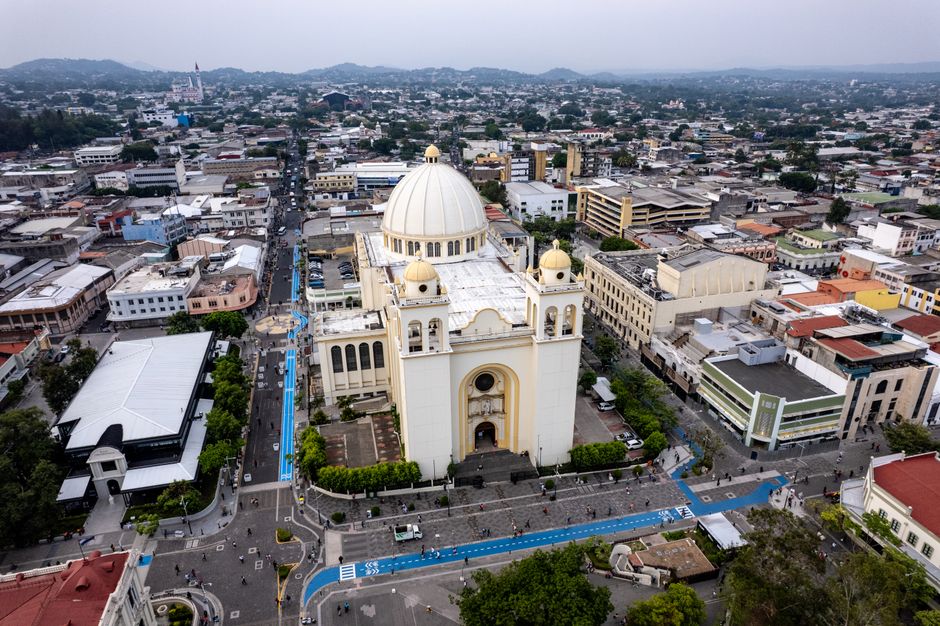
San Salvador, the capital of El Salvador, spreads across a green valley at about 650–700 m (2,100–2,300 ft), below the forested cone of the San Salvador volcano. It is a big, busy, modern city with a long history: founded by the Spanish in the 16th century, it has been shaken by many earthquakes, and most of its buildings date from the 20th century. Its renovated historic center, with new pedestrian streets and plazas around the Metropolitan Cathedral, the National Palace and the National Theater, has become a place to stroll, eat and visit museums again, while the western neighborhoods of Escalón, San Benito and Santa Elena have the best restaurants, hotels, galleries and malls. San Salvador is the natural base for day trips to the crater of El Boquerón, the Maya sites of Joya de Cerén and San Andrés, Lake Ilopango and the surf beaches of La Libertad, all within an hour or so. The city is the country’s air hub, with the international airport on the coast about 45 minutes away.
Right now in San Salvador
- Wed22–28°C71–83°F10 mm rain
- Thu21–27°C70–80°F8 mm rain
- Fri22–25°C71–78°F16 mm rain
- Mon 12 Oct Ethnic Pride Day (Día de la raza)
Top tours in San Salvador
See all tours for San Salvador →
From local operators, with prices and reviews; you check availability and book on Viator, our partner. We may earn a commission at no extra cost to you. How we earn money
San Salvador at a glance
- Best for: the historic center and its architecture, museums, food and coffee, and day trips to volcanoes, Maya sites and the beach.
- How long: two days for the city; three or four with day trips to El Boquerón, Joya de Cerén and Lake Ilopango or the coast.
- Best time: November to April, the dry season; the city’s main festival is in early August.
- Getting there: about 45 minutes by road from El Salvador International Airport (SAL), and about 5 to 6 hours by coach or shuttle from Antigua in Guatemala.
- Before you go: entry rules, the CA-4 agreement, money and bitcoin are in our El Salvador travel guide.
San Salvador’s areas: where things are
- The historic center (Centro Histórico): the old downtown around Plaza Gerardo Barrios and Plaza Libertad, with the cathedral, the National Palace, the National Theater, El Rosario church and the National Library; renovated in recent years with pedestrian streets.
- Escalón and the Zona Rosa (San Benito): the upscale western neighborhoods with restaurants, bars, hotels, the MARTE art museum and the National Museum of Anthropology.
- Santa Elena and Antiguo Cuscatlán: south-west of the center, with embassies, offices, malls and newer hotels.
- The volcano: the San Salvador volcano (Quetzaltepec) rises north-west of the city, with El Boquerón National Park at its crater.
- Los Planes de Renderos and Panchimalco: the hills south of the city, with viewpoints, pupusa restaurants and an Indigenous town.
According to the UK government, the areas of Santa Elena, San Benito and Maquilishuat have better security, as do most large shopping malls; most visitors stay in these western districts and visit the historic center by day.
Top things to see in San Salvador
Most churches are free; museums charge small fees in US dollars.
The Metropolitan Cathedral
On Plaza Gerardo Barrios, the cathedral, with its colorful tiled facade by Salvadoran artist Fernando Llort, is the spiritual heart of the city. In its crypt is the tomb of Saint Óscar Romero, the archbishop of San Salvador killed in 1980 and canonized in 2018, which draws pilgrims from around the world.
The National Palace and Plaza Libertad
Next to the cathedral, the neoclassical National Palace, built in the early 20th century, has dozens of rooms, many open to visitors, and a courtyard garden. A block away, Plaza Libertad has a monument to the country’s independence heroes.
El Rosario church
A striking modernist church of the 1970s on Plaza Libertad, whose plain concrete exterior hides an interior lit by rainbow-colored stained glass and decorated with metal sculptures; one of the most unusual churches in Central America.
The National Theater and the historic center’s streets
The early-20th-century National Theater has an ornate French-style interior. Around it, pedestrian streets, renovated plazas and the large modern National Library (BINAES) make the historic center an easy place to walk by day.
Museums in the west
The Museum of Art of El Salvador (MARTE) shows Salvadoran art from the 19th century to today, and the National Museum of Anthropology (MUNA) covers the country’s Maya, Lenca and colonial history. Nearby, the Monumento al Divino Salvador del Mundo, a statue of Christ on a globe, is the city’s emblem.
Other things to do in San Salvador
- Food: eat pupusas at a pupusería, try the street food of the historic center, and visit specialty cafés serving Salvadoran coffee.
- Markets: the Mercado Nacional de Artesanías for crafts such as La Palma’s painted wood and Suchitoto’s indigo textiles.
- Los Planes de Renderos and the Puerta del Diablo: viewpoints on the hills south of the city, with rock formations and views of the volcanoes and the coast.
- Nightlife: bars and restaurants in the Zona Rosa and Escalón.
- Walking tours: see our city sightseeing guide.
Food and drink in San Salvador
El Salvador’s national dish is the pupusa, a thick handmade corn tortilla stuffed and griddled to order, served with curtido (a tangy pickled cabbage slaw) and a thin tomato sauce. Classic fillings are revuelta (pork, beans and cheese), cheese with loroco, a fragrant edible flower bud, and beans and cheese; many pupuserías also make them with rice flour. Every neighborhood has pupuserías, from street griddles to family restaurants, and National Pupusa Day falls on the second Sunday of November. Other dishes to try are panes con pollo (turkey or chicken sandwiches in a spiced sauce), yuca frita with pork chicharrón, sopa de gallina india (free-range hen soup) and tamales of chicken or sweet corn.
Drinks are a highlight: Salvadoran horchata is made with ground morro seeds and spices, atol de elote is a warm sweet-corn drink, and fresh licuados of tropical fruit are sold everywhere. The country grows excellent coffee, and San Salvador has a growing number of specialty cafés, particularly in Escalón and San Benito, where you will also find the city’s best restaurants and bars. The local beers are Pilsener and Suprema. In the historic center, eat at busy pupuserías and market comedores at lunchtime. Restaurants usually add a 10% tip to the bill.
Day trips from San Salvador
El Boquerón National Park
At the top of the San Salvador volcano, about 45 minutes from the city, a park with an easy trail around the rim of El Boquerón crater, about 1.5 km (1 mile) across and more than 500 m (1,600 ft) deep, with a smaller cone, the Boqueroncito, inside. The volcano is not erupting. Go early before clouds roll in. See our hiking guide.
Joya de Cerén and San Andrés
Joya de Cerén, about 40 minutes west, is a Maya farming village buried by ash from a volcanic eruption around 600 AD, preserving houses, kitchens and fields; it was declared a UNESCO World Heritage Site in 1993, according to the Ministry of Tourism. Nearby, San Andrés, which the ministry describes as a regional capital between about 600 and 900 AD and one of the country’s largest pre-Hispanic centers, has pyramids and a museum on indigo production.
Lake Ilopango
A large crater lake about 30 minutes east, formed by a massive eruption, with lakeside restaurants and boat trips.
Surf City
The beaches of La Libertad, such as El Tunco, El Sunzal and El Zonte, are about 45 minutes to an hour south, for surfing, sunsets and seafood. See our surfing guide.
Suchitoto and Panchimalco
Suchitoto, a colonial town above Lake Suchitlán, is about an hour north-east; Panchimalco, an Indigenous town with a colonial church, is about 30 minutes south.
The Ruta de las Flores
A string of mountain towns in the west, about 1.5 to 2 hours from the capital, with coffee farms, waterfalls, murals and flowers along the roadsides from about November to February. Juayúa is known for its weekend food festival, when stalls fill the main square with grilled meats and local dishes; Apaneca has coffee tours and zip lines; Ataco is famous for its painted walls and textile workshops; and Nahuizalco holds an evening market lit by candles. It is best as an overnight trip.
Nearby destinations
- Copán Ruinas127 km
- Antigua Guatemala192 km
- Lake Atitlán244 km
Getting there and getting around
From the airport
El Salvador International Airport Saint Óscar Arnulfo Romero y Galdámez (SAL) lies on the coast about 45 minutes from San Salvador by the coastal highway. Use the official airport taxis, a hotel transfer or a ride-hailing app; agree on taxi fares before you set off. The airport has direct flights from many US cities; see our United States travel guide if you are connecting there.
By coach from neighboring countries
International coaches and tourist shuttles link San Salvador with Guatemala City and Antigua (about 5 to 6 hours from Antigua), Copán and Tegucigalpa in Honduras, and Managua. El Salvador, Guatemala, Honduras and Nicaragua share the CA-4 agreement, with one 90-day regional stay; registration at land borders is free, according to El Salvador’s migration authority. Cross in the morning, as borders sometimes close in the early evening, according to the UK government.
Getting around the city
San Salvador is spread out and hilly, and walking between districts isn’t practical. Use ride-hailing apps, which work in much of greater San Salvador, or radio-dispatched, pre-booked or hotel taxis from reputable companies; don’t hail taxis in the street or use unofficial ones, according to the UK and Canadian governments. Public buses, often repainted US school buses, are cheap but not recommended because of petty crime. The renovated historic center is pleasant to explore on foot by day.
Driving
Traffic is heavy at rush hours. You can drive on your home license for 90 days; the International Driving Permit isn’t accepted, according to the UK government. Keep doors locked and windows closed, and take extra care at junctions.
When to go and how long to stay
San Salvador has a warm climate tempered by its altitude, with daytime temperatures of about 23–31 °C (73–88 °F). The dry season from November to April brings sunny days and cool, clear mornings; March and April are the hottest months. The rainy season from May to October brings heavy afternoon and evening storms, according to the Canadian government, with mornings often bright. The eastern Pacific hurricane season runs from May 15 to November 30, according to NOAA’s National Hurricane Center; storms mainly bring heavy rain and landslides. The city’s patron saint festival, the Fiestas Agostinas, fills the first week of August with fairs and processions, culminating on August 6.
San Salvador month by month
| Month | Weather | Crowds and prices | Why go |
|---|---|---|---|
| January | Dry, sunny, cool mornings | Moderate | Sightseeing, El Boquerón views |
| February | Dry and sunny | Moderate | Day trips, the Ruta de las Flores |
| March | Dry and hot | Busy around Holy Week (March 21–28, 2027), when many residents head to the beach | Processions, beach trips |
| April | Hottest; first storms late in the month | Moderate | Museums, early sightseeing |
| May | Rainy season begins | Quiet | Green landscapes |
| June | Afternoon and evening storms | Quiet | Mornings for sightseeing |
| July | Storms, with a drier spell some years | Moderate | Day trips in the morning |
| August | Rainy afternoons | Busy for the Fiestas Agostinas (first week, ending August 6) | Fairs, processions |
| September | Among the wettest months | Independence Day on September 15, with parades | Parades, museums |
| October | Among the wettest months | Quiet | Food, cafés, museums |
| November | Dry season begins | Day of the Dead on November 2; National Pupusa Day on the second Sunday | Food festivals, clear days |
| December | Dry and pleasant | Busy at Christmas and New Year | Holiday lights, day trips |
| Season | What it’s like | Good for |
|---|---|---|
| November–February | Dry, sunny, pleasant | Sightseeing, El Boquerón views, day trips |
| March–April | Dry and hot; Holy Week | Museums, beach trips |
| May–August | Rainy afternoons; Fiestas Agostinas | Festivals, green landscapes |
| September–October | Wettest months | Museums, food, cafés |
2 days in San Salvador
Day one, the historic center: the cathedral and Romero’s tomb, the National Palace, El Rosario church, the National Theater and lunch at a pupusería. Day two, MUNA and MARTE in the morning, then El Boquerón National Park in the afternoon and dinner in the Zona Rosa.
3 to 4 days in San Salvador
Add Joya de Cerén and San Andrés, a day at the beach in Surf City, Lake Ilopango, or Suchitoto.
Where to stay in San Salvador and the hotel taxes
- Escalón and the Zona Rosa (San Benito): international hotels and boutique guesthouses close to restaurants and museums; a popular choice for visitors.
- Santa Elena and Antiguo Cuscatlán: modern hotels near malls and offices.
- The historic center: a few hotels near the cathedral, convenient for sightseeing by day; quieter at night.
Hotel bills carry El Salvador’s 13% value-added tax and a 5% tourism tax, about 18% in total; check whether quoted rates include them.
What a day in San Salvador costs
El Salvador uses the US dollar, so prices are the same in both. San Salvador is cheaper than Panama City or San José, especially for food and transport, though hotels in the western districts charge international prices. These are our estimates for 2026, not official prices; hotel bills add about 18% in taxes.
| Item | Price (US$) |
|---|---|
| Pupusa at a pupusería | US$0.75–1.50 each |
| Set lunch at a comedor | US$3–6 |
| Dinner at a mid-range restaurant in San Benito | US$15–30 |
| Specialty coffee | US$2.50–4 |
| Local beer | US$1.50–3.50 |
| Ride-hailing trip across the city | US$4–10 |
| Museum entrance (MUNA, MARTE) | US$1–5 |
| Shuttle or taxi to El Tunco | US$10–40 |
| Hostel or guesthouse bed | US$15–30 |
| Mid-range double room in Escalón or San Benito | US$60–120 |
A budget traveler can manage on about US$35 to US$50 a day with a guesthouse, pupusas and ride-hailing; a mid-range day with a good hotel, museums, a day trip and restaurant dinners is more like US$120 to US$180.
Practical tips for San Salvador
- Money: prices are in US dollars. Bring small notes, as US$50 and US$100 bills are often refused, and use ATMs in malls or banks, by day.
- Bitcoin: some businesses accept it, but no one has to since the 2025 reform of the Bitcoin Law; carry dollars.
- ID: carry a copy of your passport photo page; police may ask for it, according to the UK government.
- Safety: crime has fallen significantly, according to the UK government, but take normal big-city precautions: keep valuables out of sight, don’t walk alone at night, use reputable taxis, and stay away from demonstrations, as foreign nationals may not take part in political activities.
- Help: tourist police (POLITUR) +503 2224 2705; emergencies 911.
- Water: drink bottled water.
What to pack for San Salvador
Bring light clothes for warm days, a light jacket for evenings and El Boquerón, comfortable walking shoes, an umbrella or rain jacket from May to October, sunscreen and a hat, swimwear for the beach, a copy of your passport, and US dollars in small notes. Plugs are the US type.
San Salvador travel FAQ
How far is San Salvador from the airport?
About 45 minutes by road. Use official airport taxis, a hotel transfer or a ride-hailing app.
What currency is used in San Salvador?
The US dollar. Bitcoin is still legal tender, but accepting it is voluntary since 2025, and everyday prices are in dollars.
What are the best things to do in San Salvador?
The historic center with the cathedral and Saint Óscar Romero’s tomb, El Rosario church, the MARTE and MUNA museums, and day trips to El Boquerón and Joya de Cerén.
Where should I stay in San Salvador?
Most visitors stay in Escalón, San Benito (the Zona Rosa) or Santa Elena, which the UK government lists among the areas with better security.
How do I get from San Salvador to the beach?
The beaches of Surf City, such as El Tunco, are about 45 minutes to an hour away by car, shuttle or taxi.
Is the historic center of San Salvador worth visiting?
Yes. It has been renovated with pedestrian streets and plazas and is easy to explore on foot by day.
Is San Salvador safe?
Crime has fallen significantly, according to the UK government. Take normal precautions, use reputable taxis or apps, and carry ID.
What food should I try in San Salvador?
Pupusas with curtido, especially revuelta or cheese with loroco, plus panes con pollo, yuca frita, sopa de gallina india and sweet-corn tamales. Drink morro-seed horchata, atol de elote and Salvadoran coffee.
How much does a day in San Salvador cost?
By our estimates, about US$35 to US$50 on a budget and US$120 to US$180 mid-range. Prices are in US dollars; bring small notes, as large bills are often refused.
What is the Ruta de las Flores?
A scenic route through the western mountain towns of Juayúa, Apaneca, Ataco and Nahuizalco, about 1.5 to 2 hours from San Salvador, known for coffee farms, murals, waterfalls and Juayúa’s weekend food festival.
Plan your trip
Partner links: TravelerCenter may earn a commission if you book, at no extra cost to you.
🇪🇸 Useful Spanish phrases for San Salvador
All 38 Spanish phrases: restaurant, hotel, emergencies, romance (printable) →
Sources · last reviewed 4 October 2026
Researched and last reviewed on 4 October 2026. Joya de Cerén’s UNESCO year and San Andrés: the Ministry of Tourism (elsalvador.travel); free border registration: the General Directorate of Migration and Foreign Affairs (DGME); bitcoin’s legal status: the Legislative Assembly’s Decree 199 of 2025; hurricane season: NOAA’s National Hurricane Center; the rainy season and ride-hailing: the Canadian government; safer areas, ID, taxis, buses, banknotes, ATMs, driving, borders, political activity, POLITUR and the emergency number: the UK government. The city’s altitude and history, districts, churches, museums, Saint Óscar Romero’s tomb, the National Library, El Boquerón’s dimensions, Lake Ilopango, distances and travel times, temperatures, the Fiestas Agostinas and hotel taxes come from secondary sources or general knowledge and are flagged for checking. Prices and rules change, so check before you go. For entry rules and money, see our El Salvador travel guide. The food notes, National Pupusa Day, the Ruta de las Flores, the month-by-month table and the daily costs come from general knowledge or our own estimates and are flagged for checking.
Data: Weather: MET Norway (CC BY 4.0) · Rates: ECB · Holidays: Nager.Date · Costs: World Bank ICP and price levels · Wikidata (CC0)